Sabitlenmiş Tweet
Superpositions Studio
210 posts

Superpositions Studio
@SuperpositionsS
Practical quantum platform for industry. Learn: when quantum wins, when classical wins, and how to choose Benchmarks • tutorials • use cases • insights Try free
Katılım Aralık 2025
79 Takip Edilen31 Takipçiler

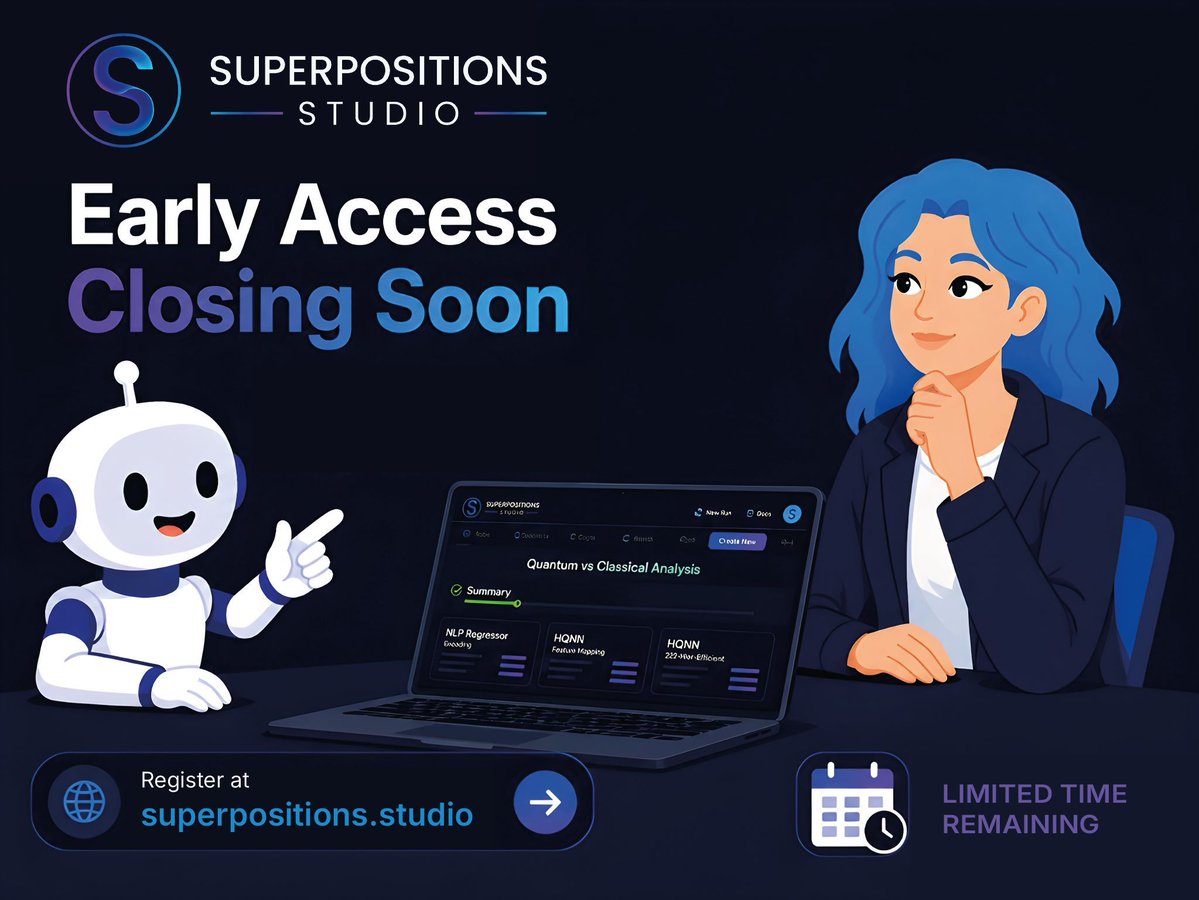
We're closing Early Access to Superpositions Studio.
When we launched the platform, we gave everyone who signed up 3 months of free access — full platform, quantum hardware, 1,000 credits.
That window is closing. Once we turn on subscriptions, new users get 30 days free instead of 90.
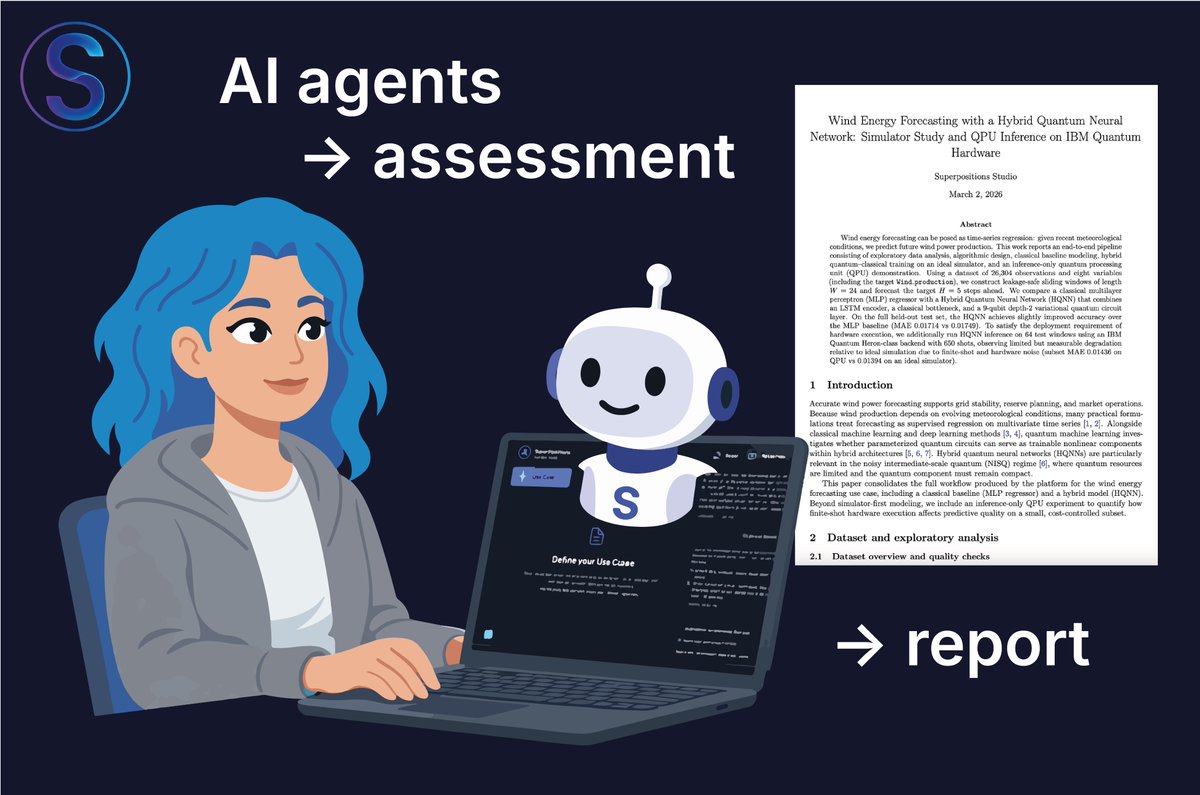
What the platform does, briefly: you describe an industrial problem in plain language — portfolio optimization, predictive maintenance, fraud detection — and get a quantum vs. classical comparison with working code and a PDF report. Real QPU runs on IBM, IonQ, and others.
If you've been curious about where quantum computing actually helps and where it doesn't, this is probably the cheapest experiment you'll ever run.
Register at superpositions.studio while the 3-month window is still open.

English

Most quantum tooling starts too low in the stack.
We’re about to share SPS Kit: a developer-facing toolkit with sklearn-like APIs, built-in datasets, and honest quantum vs classical benchmarking for applied QML and optimization
#QuantumComputing #SPSQuantum

English

"AI + Quantum" usually gets framed as one story: quantum will supercharge AI. In practice, there are two directions, and they're at very different stages.
The one that's actually delivering results today is AI for quantum: using machine learning to calibrate hardware, correct errors in real time, and optimize circuits. NVIDIA's recently launched Ising models for autonomous quantum calibration are a good example. What used to take researchers days of manual tuning can now happen in hours.
The second direction, quantum for AI, is earlier but producing interesting signals. Hybrid quantum-classical models are showing promise in specific settings: combinatorial optimization inside ML pipelines, classification on small and structured datasets, and memory-efficient data processing on problems that would overwhelm classical approaches.
Where the evidence gets thin: general LLM training, production ML at scale, and any claim that quantum "replaces" classical AI. The pattern is consistent — the more specific and constrained the problem, the more likely quantum adds real value.
We wrote a longer breakdown covering what's working, what's promising, and what remains hype in 2026, with references to recent research from Google Quantum AI, NVIDIA, and others.
Full article 👉 @superpositions_studio/ai-quantum-what-actually-works-today-625c51a40da4" target="_blank" rel="nofollow noopener">medium.com/@superposition…
#QuantumComputing #MachineLearning #QuantumML #DeepTech #PracticalQuantum
English

We're growing.
Superpositions Studio sits at the intersection of quantum algorithms and real industry problems. That means we need people who are rigorous and practical, who care as much about whether a result holds up under scrutiny as about whether it reaches a customer.
Right now, we're looking for:
🔹 Senior Quantum Research Lead: someone who can bridge theory and application. Design experiments, evaluate results honestly, and push the platform's scientific depth.
🔹 Business Developer: someone who can talk to R&D teams in finance, energy, pharma, and manufacturing, understand what they're actually trying to solve, and connect it to what we've built.
Both roles are remote across the EU, UK, and Switzerland.
If neither role fits but you're drawn to what we're doing, reach out anyway. The right person with the right mix of skills is always more interesting than a perfect job description match.
All details here: superpositions.studio/careers
DMs open. Or write to info@superpositions.studio.
Know someone who'd be a good fit? Tag them below 👇
#QuantumComputing #Hiring #DeepTech #RemoteWork #Careers

English

Are we heading into a quantum winter?
Quantum winter keeps coming up in conversations, and every time we hear it, we think the metaphor misses the point.
AI winters happened because the field hit real theoretical walls. The algorithms outran the hardware, the data wasn't there, and nobody was sure the math would eventually work.
🔹Quantum computing is in a fundamentally different place. The theory has been solid for decades. The engineering challenges are massive, but they're well-defined: reduce noise, improve error correction, scale qubit counts. And progress on all three fronts is steady and measurable.
🔹What the industry is actually going through looks more like a calibration. The gap between what was promised and what can be delivered today is narrowing, just more slowly than some roadmaps suggested. Some companies are adjusting timelines. Others are shifting toward hybrid approaches, combining classical and quantum methods where each contributes the most. Both of those are signs of a field maturing, not freezing.
There's also something genuinely new happening at the applied layer. Teams across finance, energy, and manufacturing are running real experiments, comparing quantum and classical approaches side by side, and building an evidence base that didn't exist two years ago. That kind of work doesn't happen in a winter.
The field will earn its credibility through practical results. And from where we sit, there are more teams doing that kind of work today than at any point before.
What's your read: is the industry finding its footing, or still adjusting expectations?
#QuantumComputing #DeepTech #PracticalQuantum #QuantumML

English

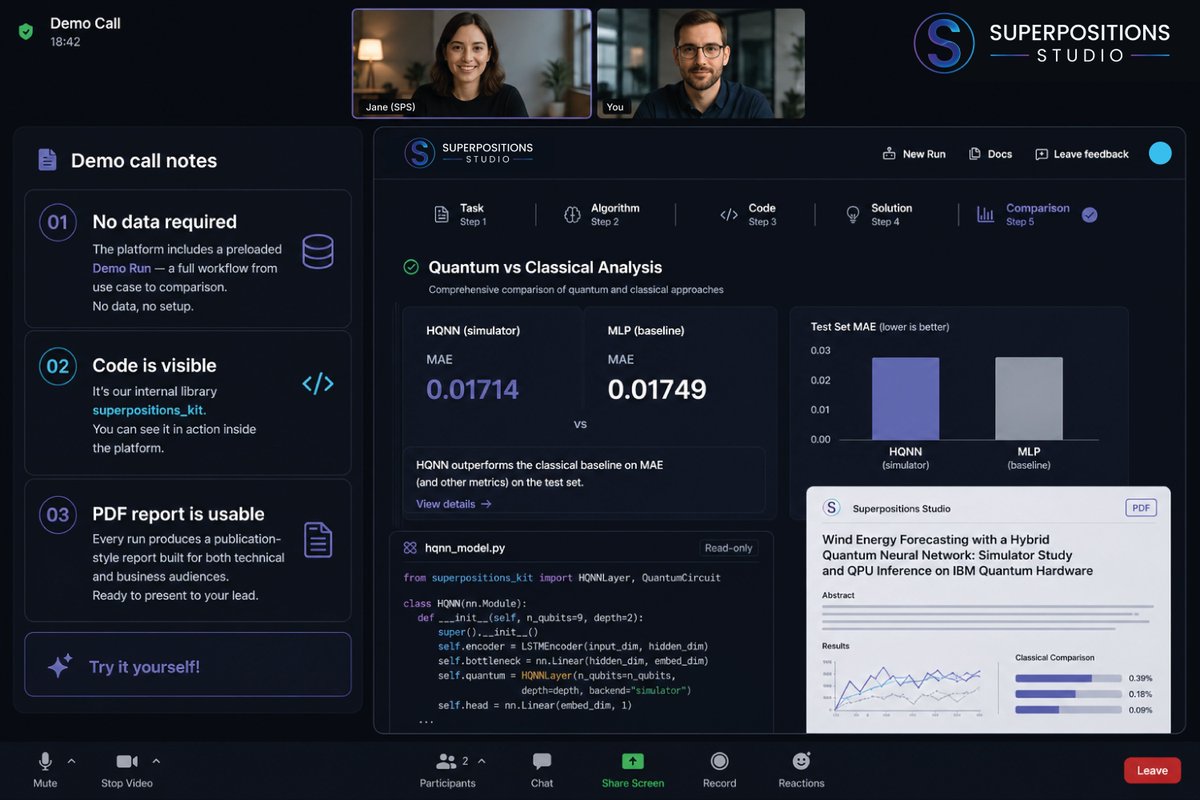
3 questions we hear on almost every demo call
"Do I need my own data to try it?"
No. The platform includes a preloaded Demo Run — a full workflow from use case to comparison, ready to explore. No data, no setup. When you're ready, describe your own problem in plain language and the co-pilot helps map it to the right formulation.
"The code imports superpositions_kit. Can I see it? Run it myself?"
Good eye. It's our internal library powering the experiments. Right now it runs within the platform — but we're preparing an open-source release so you can download it and use it locally. Coming soon.
"Can I actually use the PDF report to present results to my lead?"
That's exactly what it's for. Every run produces a publication-style report: abstract, methods, results, discussion, classical comparison. Designed so the person running the experiment and the person making the decision don't need to speak the same technical language.
Try it yourself!
#QuantumComputing #QuantumML #DeepTech #PracticalQuantum

English

Can quantum computing help catch financial crime?
Transaction screening is one of the hardest problems in anti-money laundering and fraud detection and one of the use cases we explore at Superpositions Studio.
The problem is brutal: in real-world transaction data, suspicious activity makes up a fraction of a percent. A model can look 97% accurate and still be operationally useless, burying compliance teams in false alerts.
We tested whether quantum kernels — one of the most mature near-term quantum ML approaches — can compete with classical methods on this kind of rare-event detection. Using an 8-qubit feature map on a credit card fraud benchmark (as an AML proxy), the QSVM achieved a PR-AUC of 0.98 with perfect precision on a balanced evaluation set.
Quantum kernels show real strength in small-sample, low-feature regimes — exactly the situation you face when labeled suspicious activity data is scarce. The open challenges are about scaling: kernel computation grows quadratically, real transaction streams drift over time, and moving from balanced training sets to real-world prevalence requires careful calibration.
What we think matters most right now:
→ Decision-focused metrics over headline accuracy
→ Rigorous calibration when moving between balanced training and real-world prevalence
→ Kernel approximation methods to make quantum approaches scalable
Explore this and other use cases in our Quantum Solutions Library.
🔗 superpositions.studio/quantum-soluti…
#QuantumComputing #AML #MachineLearning #FraudDetection #QuantumML #FinancialCrime

English

Happy World Quantum Day!
4.14 — the first digits of Planck's constant.
A good day to celebrate the physics. Also a good day to be honest about where the industry actually is.
At Superpositions Studio, we think the most useful way to work with quantum is to keep it grounded in real problems, real benchmarks, and clear comparison with classical methods.
For us, World Quantum Day is a good moment to celebrate the field and also keep the conversation practical.
What real-world problem would you be most interested to test with quantum today?
#WorldQuantumDay #QuantumComputing #QuantumML #DeepTech #MachineLearning

English

THE JOURNEY: From Excel to Quantum Processor
From business data to problem formulation, from simulation to QPU execution, the real value comes from turning experiments into evidence.
You can try this journey yourself on our platform and if you want to go further, our team is ready to help you explore a deeper, more tailored quantum solution for your problem.


English

Your CEO asks: "When will quantum computers deliver real ROI?"
Until recently, the honest answer was "nobody knows."
Now? Concrete numbers. Crossover graphs. Hardware roadmaps.
Here's what changed:
We built a platform that lets R&D teams answer this question quickly, no need to wait for months
→ Describe your business problem in plain English
→ Get a quantum algorithm recommendation
→ Run benchmarks against classical methods
→ See exactly when (and if) quantum wins
No PhD in physics required. No vendor lock-in. Just evidence.
The quantum hype cycle is ending. The evidence era is beginning.
Try it!
#QuantumComputing #Innovation #EnterpriseAI #ROI

English

More qubits ≠ more value
Physical qubit counts are growing fast. Useful applications are not growing at the same pace.
What matters: error rates, depth limits, overhead, and whether a hybrid workflow actually beats a strong classical baseline
Use case first. Hardware second
#QuantumComputing #QuantumML

English

Quantum computing is moving fast.
And like in any serious science, it helps to stay close to the research frontier.
But the best place to start can still be a good book.
If you’re building your understanding of quantum computing, here’s a reading list I’d recommend:
🔹 Quantum Computing for Everyone — Chris Bernhardt
A friendly entry point if you want intuition before formalism.
🔹 Quantum Computing: A Gentle Introduction — Rieffel & Polak
A solid next step for understanding the core concepts more systematically.
🔹 Introduction to Linear Algebra — Gilbert Strang
Not a quantum book, but essential. A lot of quantum computing becomes much clearer once the linear algebra clicks.
🔹 Quantum Mechanics: The Theoretical Minimum — Susskind & Friedman
Helpful for building the physics intuition behind the field.
🔹 Quantum Computation and Quantum Information — Nielsen & Chuang
Still the classic reference if you want depth.
🔹 Quantum Computing: An Applied Approach — Jack Hidary
Especially useful if you care about practical workflows and real-world relevance.
What would you add to this list?
#QuantumComputing #QuantumMachineLearning #MachineLearning #DataScience #DeepTech

English

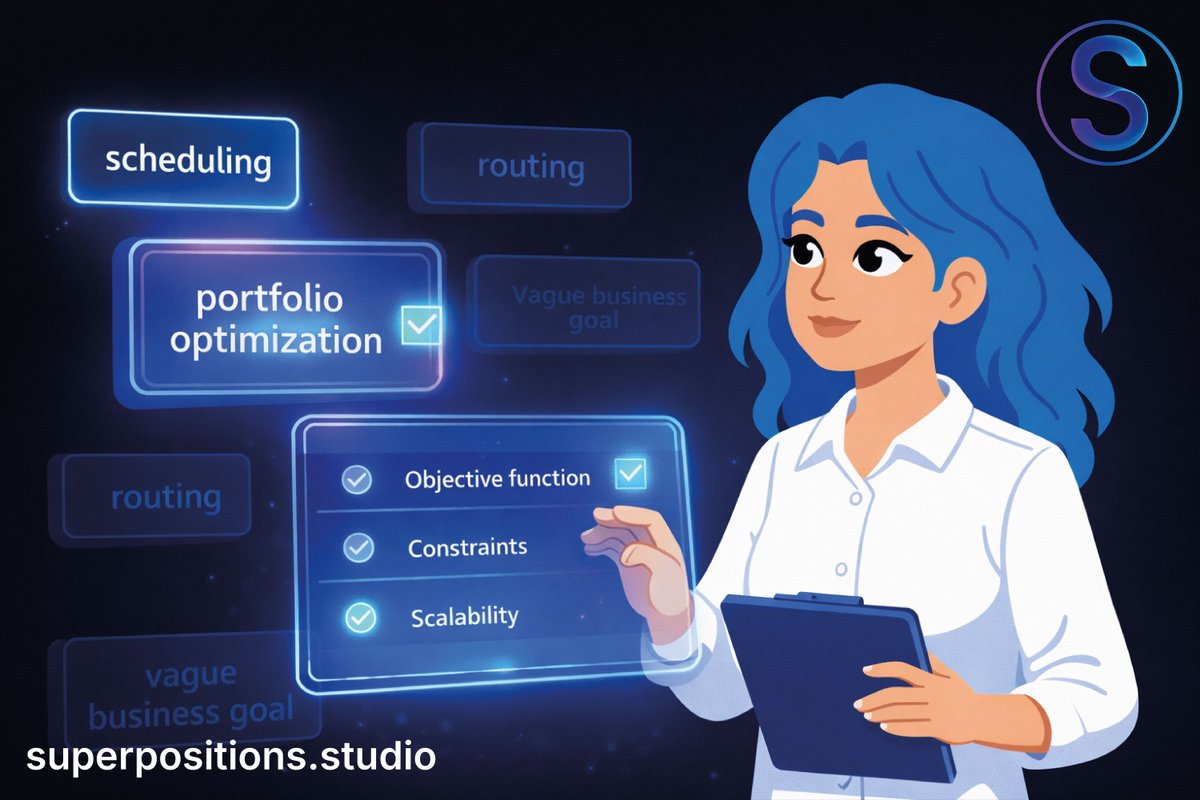
Not every hard problem is a quantum problem.
The right starting point is structure: clear objective, real constraints, scalable search space, and a strong classical baseline.
That’s how you decide what’s actually worth testing.
#QuantumComputing #Optimization

English

Superpositions Studio is live. Here's what's under the hood. 👇
⚡ 10+ quantum & hybrid algorithms
⚡ 5+ QPU backends
⚡ 20+ industry use cases ready to go
⚡ Classical baselines included by default
⚡ Downloadable code + PDF reports
⚡ 30+ AI agents orchestrating the workflow
The whole thing runs in your browser. Simulator-first for fast iteration. QPU when it counts.
🔗 app.superpositions.studio
English

@SakanaAILabs Great paper!
The most interesting part is end-to-end research workflows are becoming products.
At Superpositions Studio, we’re applying that in industry already.
@_chris_lu_
@cong_ml
@RobertTLange
@_yutaroyamada
@shengranhu
@j_foerst
@hardmaru
@jeffclune
English

The AI Scientist: Towards Fully Automated AI Research, Now Published in Nature
Nature: nature.com/articles/s4158…
Blog: sakana.ai/ai-scientist-n…
When we first introduced The AI Scientist, we shared an ambitious vision of an agent powered by foundation models capable of executing the entire machine learning research lifecycle.
From inventing ideas and writing code to executing experiments and drafting the manuscript, the system demonstrated that end-to-end automation of the scientific process is possible.
Soon after, we shared a historic update: the improved AI Scientist-v2 produced the first fully AI-generated paper to pass a rigorous human peer-review process.
Today, we are happy to announce that “The AI Scientist: Towards Fully Automated AI Research,” our paper describing all of this work, along with fresh new insights, has been published in @Nature!
This Nature publication consolidates these milestones and details the underlying foundation model orchestration. It also introduces our Automated Reviewer, which matches human review judgments and actually exceeds standard inter-human agreement.
Crucially, by using this reviewer to grade papers generated by different foundation models, we discovered a clear scaling law of science. As the underlying foundation models improve, the quality of the generated scientific papers increases correspondingly. This implies that as compute costs decrease and model capabilities continue to exponentially increase, future versions of The AI Scientist will be substantially more capable.
Building upon our previous open-source releases (github.com/SakanaAI/AI-Sc…), this open-access Nature publication comprehensively details our system's architecture, outlines several new scaling results, and discusses the promise and challenges of AI-generated science.
This substantial milestone is the result of a close and fruitful collaboration between researchers at Sakana AI, the University of British Columbia (UBC) and the Vector Institute, and the University of Oxford. Congrats to the team!
@_chris_lu_ @cong_ml @RobertTLange @_yutaroyamada @shengranhu @j_foerst @hardmaru @jeffclune
GIF
English

@CSenrui @FrancescoMeleAn Helpful result!
For applied quantum workflows, sample efficiency matters because it decides what is actually worth testing and benchmarking
English

Check out our latest work, "Towards sample-optimal learning of bosonic Gaussian quantum states"!
scirate.com/arxiv/2603.181…
Many thanks to @FrancescoMeleAn for the illustraive threads:
Francesco Anna Mele@FrancescoMeleAn
In today’s paper, we make important advances in our understanding of tomography of CV Gaussian states! arxiv.org/pdf/2603.18136 1/
English

@JiaqingJ Helpful result. For applied workflows, the real question is often whether thermal expectation values can be estimated efficiently enough to be worth testing in practice
English

we have designed a way to measure arbitrary observable without collapsing the Gibbs state ensemble arxiv.org/abs/2603.21595
Jiaqing Jiang@JiaqingJ
Do you think estimating observable value of thermal states is costly, since one must pay the mixing time to prepare *each* sample? We show that this sampling cost can be significantly reduced: effectively independent sample can be obtained in a time shorter than the mixing time!
English

@matterasmachine The useful part of this conversation is whether a model makes testable predictions and holds up against experiment
English

@DesFrontierTech Security gets real when it becomes a systems question
English

@jenseisert Useful direction
QML needs evaluation tools that say something about the learned model, not just the hypothesis class
English

A PAC-Bayesian approach to generalization for quantum models.
We take steps towards non-uniform and data-dependent bounds for generalization of quantum machine learning models.
scirate.com/arxiv/2603.229…
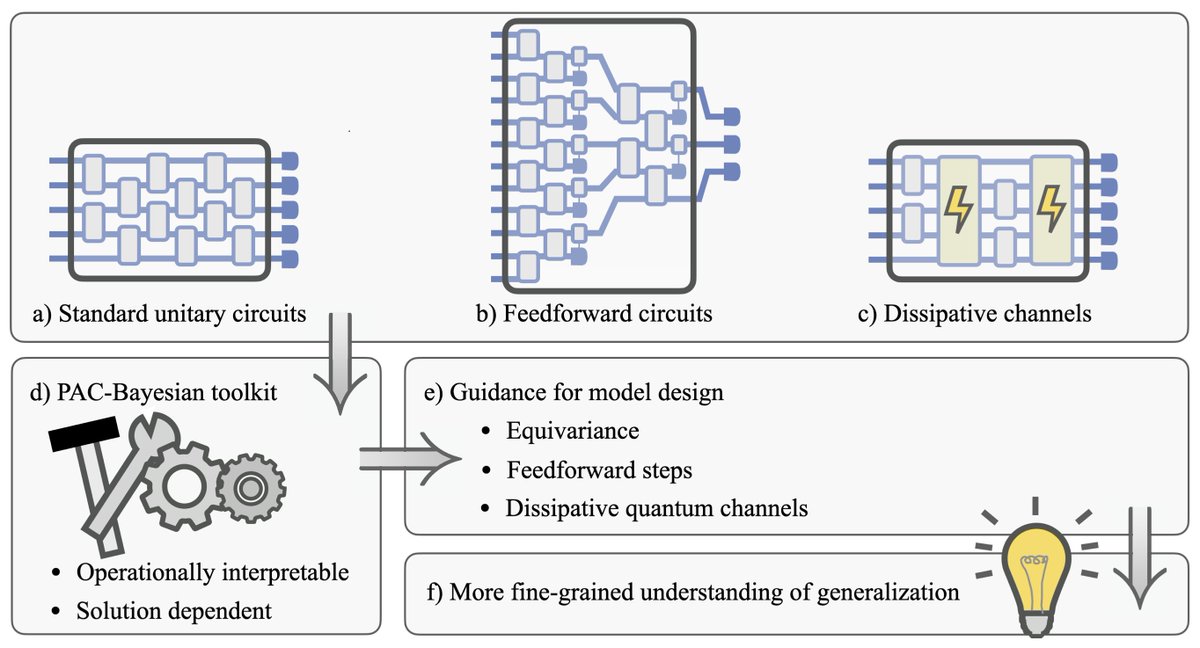
In detail, #generalization is a central concept in machine learning theory, yet for quantum models, it is predominantly analyzed through uniform bounds that depend on a model's overall capacity rather than the specific function learned. These capacity-based uniform bounds are often too loose and entirely insensitive to the actual training and learning process. Previous theoretical guarantees have failed to provide #nonuniform, data-dependent bounds that reflect the specific properties of the learned solution rather than the worst-case behavior of the entire hypothesis class.
To address this limitation, we derive the first #PACBayesian generalization bounds for a broad class of quantum models by analyzing layered circuits composed of general quantum channels, which include dissipative operations such as mid-circuit measurements and feedforward.
Through a channel perturbation analysis, we establish non-uniform bounds that depend on the norms of learned parameter matrices; we extend these results to symmetry-constrained equivariant quantum models; and we validate our theoretical framework with numerical experiments. This work provides actionable model design insights and establishes a foundational tool for a more nuanced understanding of generalization in #quantummachinelearning.
Warm thanks to the team of @pablones8, Matthias C. Caro, @EliesMiquel, @FJSchreiber, and @charl_bp for this great collaboration.

English