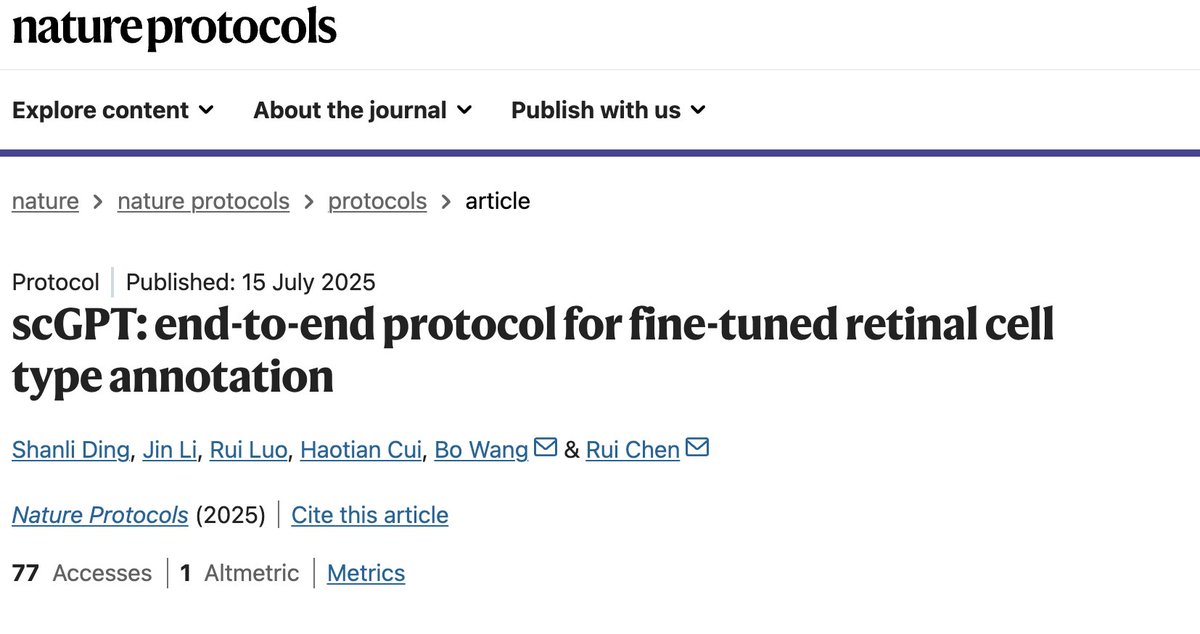
🚀 Excited to share our latest protocol in @NatureProtocols : "scGPT: End-to-end Protocol for Fine-tuned Retinal Cell Type Annotation"!
Single-cell RNA-seq is transforming biology, but annotating large-scale, high-resolution data is challenging. Our team introduces a powerful solution: fine-tuning scGPT, a generative pretrained transformer, specifically optimized for precise cell-type classification in complex datasets.
✨ Key Highlights:
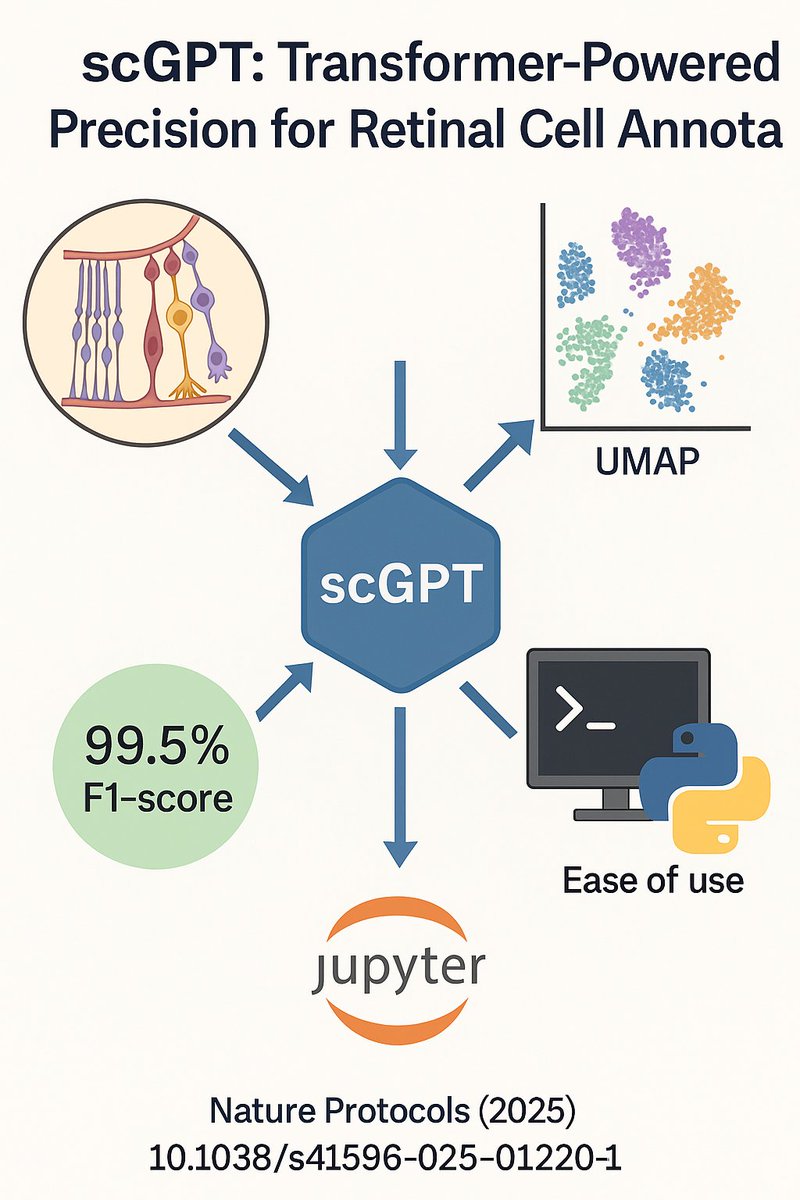
Achieved outstanding performance with 99.5% F1-score on retinal cell annotations.
Comprehensive, easy-to-follow guide covering data preprocessing, fine-tuning, and evaluation.
Streamlined workflow suitable for researchers with minimal programming background.
Includes open-source code, command-line tools, and Jupyter notebooks for quick setup and reproducibility.
🛠️ scGPT significantly simplifies annotation tasks compared to traditional methods (Seurat, scPred, scArches, Geneformer), especially for large datasets and rare cell populations.
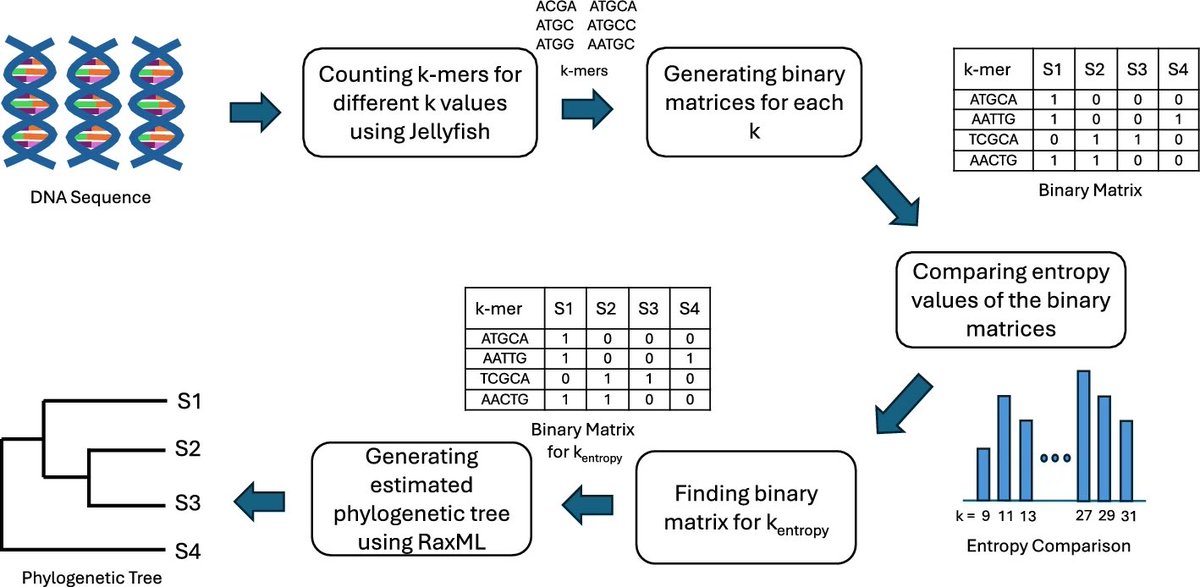
💻 Our protocol leverages transformer architectures, harnessing the power of attention mechanisms to capture intricate gene-expression patterns, offering unmatched scalability and precision.
🔗 Check out the full protocol here: doi.org/10.1038/s41596…
🙏 Huge thanks to our fantastic team: Shanli Ding, Jin Li, Rui Luo, Haotian Cui, Rui Chen, and all collaborators!
#scRNAseq#singlecell#FoundationModels#AI#Transformers#Bioinformatics#CellTypeAnnotation#OpenScience
UniCell: Towards a Unified Solution for Cell Annotation, Nomenclature Harmonization, Atlas Construction in Single-Cell Transcriptomics biorxiv.org/content/10.110…
🚀 New Chapter Alert! 🚀
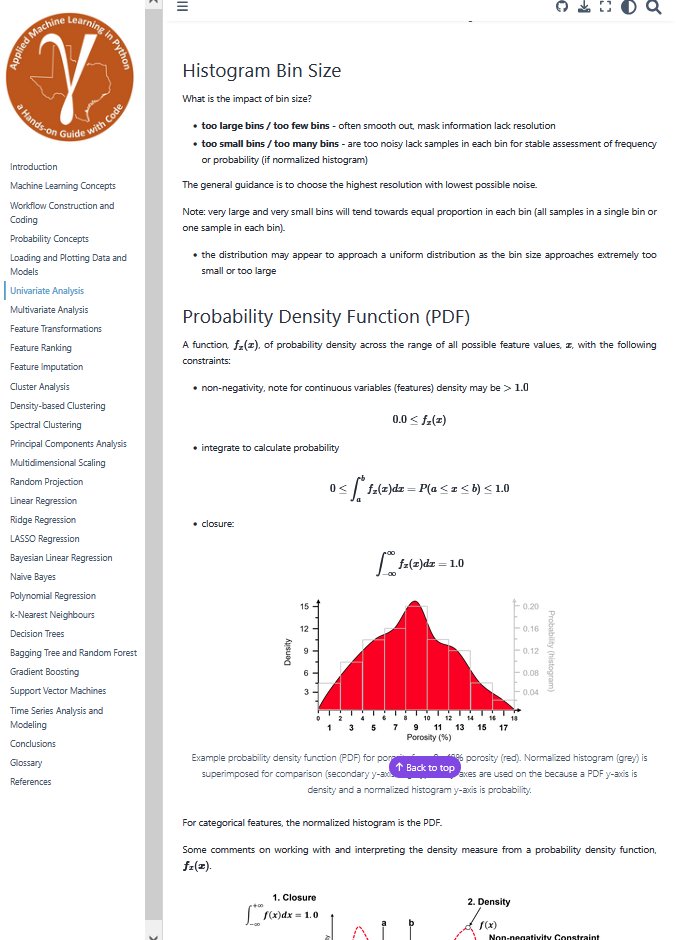
Excited to share the latest chapter of my free, online #MachineLearning e-book: Univariate Analysis! 📊
To truly master machine learning, it’s essential to have a solid grasp of the fundamentals of #statistics and #probability. I’m thrilled to help you on this journey!
Check out the chapter here: geostatsguy.github.io/MachineLearnin… ∀! 🔥
Let’s dive into the details and build a strong foundation together! 💡
Tomorrow, I'll be teaching ridge regression in my #MachineLearning course 📚✨. To explain regularization 🔒, I'll be using my interactive dashboard 💻 that lets students adjust the hyperparameters 🔧 and watch how the model parameters shrink toward zero 🔽❄️.
This will help them see how regularization works 💡, with the model ultimately estimating the average of the response feature 🧮 as the hyperparameter increases 📊🚀!
Check it out @ github.com/GeostatsGuy/Da… ∀.
P.S. - I asked ChatGPT to improve my first draft and to add an insane amount of emojis!
In #Microbiome
🚨Introducing LUPINE: an innovative network inference methodology suitable for analyzing longitudinal microbiome data🦠
📢Captures dynamic interactions, designed for small sample sizes, and validated across varied experimental designs
👉doi.org/n9q2
Interested in single cell genomics but need help getting started? Check out my lab's Single Cell Genomics Day on April 25. Talks will feature recent exciting computational and experimental advances and will be live-streamed at satijalab.org/scgd. Please RT/spread the word!
Do you know?
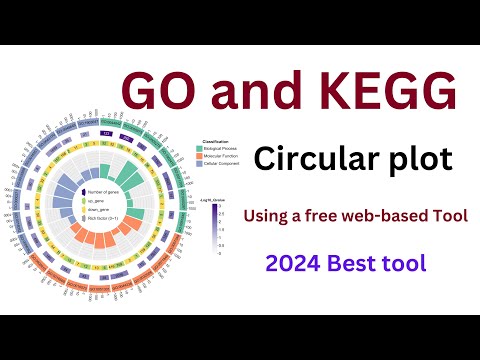
Graphs 📊 for gene 🧬 ontology and KEGG pathways (like given below) are now super easy to draw, without any learning of complex codes. Through web-based environment and for free 🆓
Tutorial: youtu.be/IW-woSE9YNk#Bioinformatics#kegg#trancriptomics
I’m thrilled to continue receiving such positive feedback from both students and professionals! 😊 In response to this, I’ve been constantly updating and enhancing my free online e-book,
Applied #MachineLearning in Python: A Hands-On Guide with Code. 📚💻
I’ve just made some exciting improvements, including the addition of a new chapter on random projection. 🔍✨ All chapters are linked to my YouTube lectures and available for download, allowing you to easily learn and apply #DataScience at your own pace. 🚀 Check it out here: geostatsguy.github.io/MachineLearnin….
Happy learning! 🎉📈
Very cool study showing that BBB becomes impaired during aging and Alzheimer's disease due to changes in specific proteins (Glycocalyx), and restoring some of those in mice improves brain function and reduces damage. @wysscoray@Nature
Paper:
nature.com/articles/s4158…