
Suryan
3.7K posts

Suryan
@Suryannn2
14 years building. delivery infra + AI agents, solo. crypto. security. linux.
Katılım Kasım 2017
1K Takip Edilen349 Takipçiler
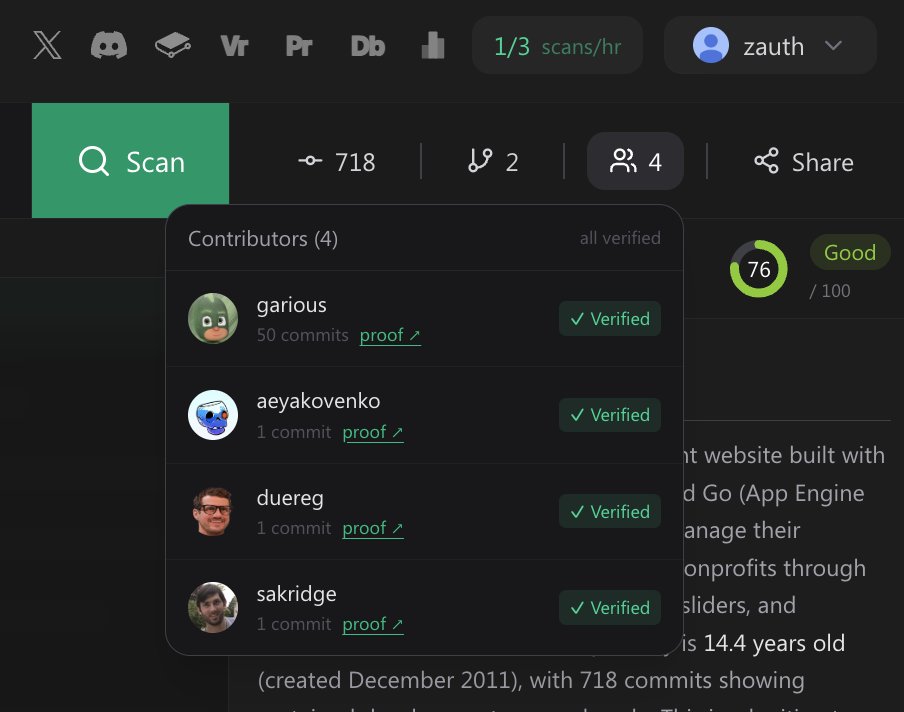
@zauthinc the 45% number is probably conservative. standard benchmarks catch known patterns, but AI-generated code stitches libraries together in ways no human would — implicit trust between components nobody audited. the attack surface isn't just bigger, it's shaped differently.
English

We are building in the biggest market in the history of software.
30 million.
That is how many software developers existed on Earth in 2022. The entire global supply, accumulated over seventy years.
Then AI happened.
80 million new builders have entered the arena. Majority of people building production apps in 2026 cannot write a line of code. They describe what they want. The model writes it. The platform ships it. Lovable. Bolt. Replit. v0. Claude. Base44. What used to take a team six weeks now takes one person a weekend.
Y Combinator's last batch of startups had codebases that were 95% AI-generated. Gartner projects 60% of all new code on Earth will be AI-written by the end of this year.
45% of AI-generated code fails basic security benchmarks. The traditional security industry has nothing for these builders. A pentest costs thousands and takes weeks. The solo founder who shipped Saturday and had 500 users by Tuesday will never pay for it.
The market priced them out before they existed.
zauth is not a cheaper pentest firm. We're building infrastructure for a market that already has 100,000 new apps being made every single day. One that will be a billion builders strong by 2030.
Vector for $50 a pentest. RepoScan with free repository analysis, having been used over 1 million times. Our x402 database that ensures agents pay for services that work. Three primitives, one thesis.
AI will never be perfect. We will catch what it breaks across the internet.
Wide-open categories appear once a decade.
Every business on Earth will run on AI-generated software within five years, and none of them can risk shipping without security.
We are not racing to win the category.
We are racing to define it.
And we will.
English
@DamiDefi been iterating on my claude.md manually for months. the part that surprised me most: half of what I wrote "for the agent" was really just me organizing my own thoughts. cutting those instructions improved output more than adding new ones ever did. less context, sharper behavior.
English

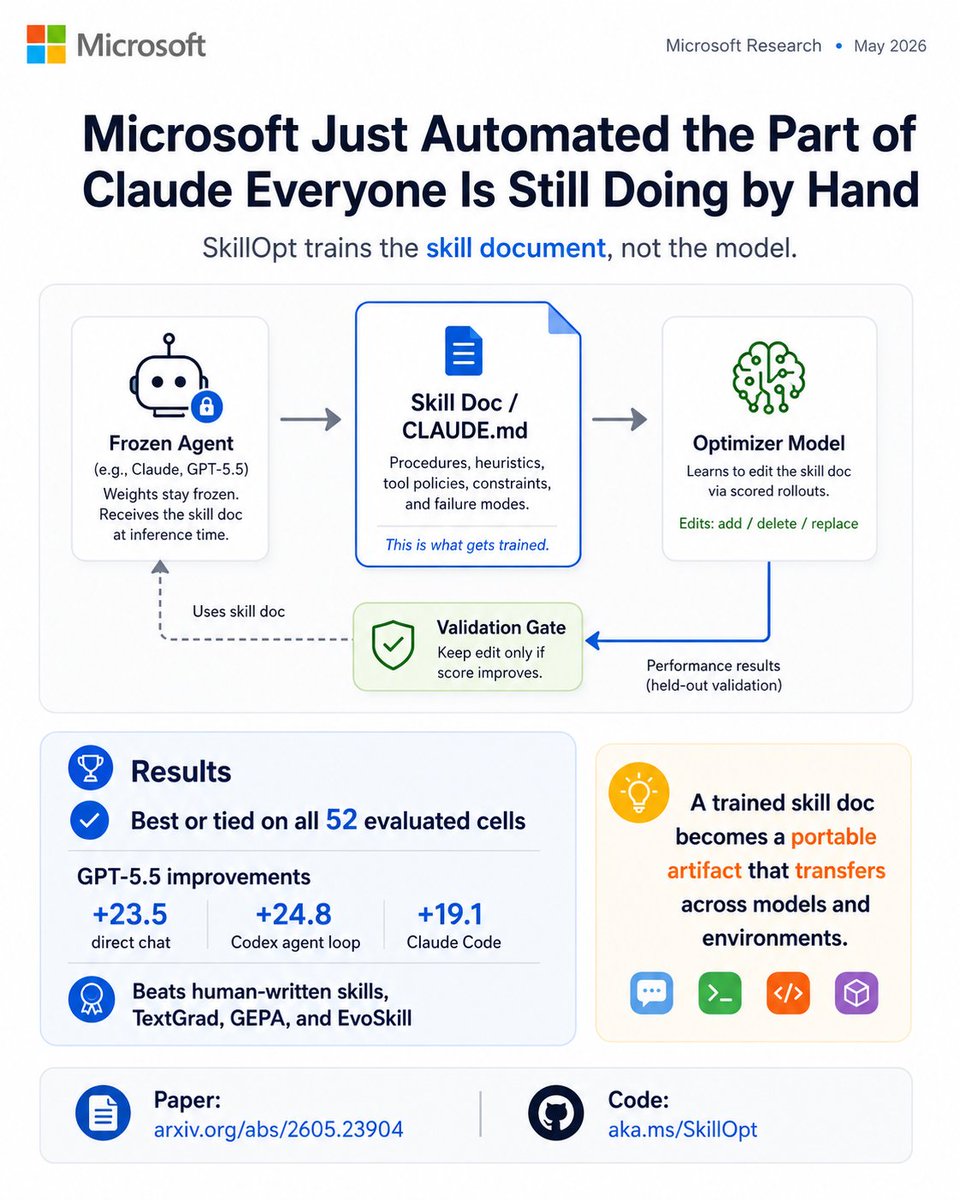
Microsoft Just Automated the Part of Claude Everyone Is Still Doing by Hand.
Most AI engineers write skill docs by hand.
They guess at what instructions work, ship them, and iterate on instinct.
Microsoft Research just published a paper showing why that ceiling is lower than it needs to be.
SkillOpt treats the skill document the same way deep learning treats model weights. Not something you write and ship. Something you train.
A separate optimizer model reads how the agent performed, then makes bounded edits to the skill doc. Add a line. Delete a line. Replace a phrase. Each edit only survives if it strictly improves the agent's score on a held-out validation set. If it makes things worse, it gets rejected.
The agent itself never changes. Only the skill doc gets trained.
That distinction matters. You are not retraining a model. You are optimizing the external text that tells a frozen model how to behave. Same discipline as gradient descent. Zero extra inference cost at deployment.
The results across 6 benchmarks, 7 models, 3 execution harnesses:
Best or tied on all 52 evaluated cells.
On GPT-5.5:
+23.5 points in direct chat over no skill
+24.8 inside the Codex agentic loop
+19.1 inside Claude Code
Beats human-written skills, TextGrad, GEPA, and EvoSkill.
The finding most people will miss: the optimized skill docs transfer across models, across execution environments, and to nearby benchmarks without any reoptimization.
A skill trained once is a portable artifact. Not a one-off fix for a single agent.
If you are building with Claude Code and writing CLAUDE.md files or skill docs by hand, this is the paper that explains why that process should eventually be automated.
Paper: arxiv.org/abs/2605.23904
Code: aka.ms/SkillOpt
English
@DamiDefi the "AI never writes to the vault" rule is the part most people will skip and it's the most important one. let the agent write to its own memory and within a month you're debugging stale context it treats as ground truth. human writes, agent reads. that boundary is load-bearing.
English
YOUR AI IS FORGETTING EVERYTHING YOU TAUGHT IT YESTERDAY.
That is why most outputs still feel generic.
The people getting real leverage in 2026 fixed this with one setup:
Obsidian + Claude Code.
Obsidian stores your thinking.
Claude Code reads the patterns.
Your notes become permanent context the agent can access anytime:
Daily thoughts.
Projects.
Ideas.
Contradictions.
Questions you keep returning to.
Then the real unlock:
Custom slash commands.
`/context` loads your recent thinking instantly.
`/emerge` finds hidden ideas across your notes.
`/challenge` tests your beliefs against your past writing.
`/trace` maps how your thinking evolved over time.
One critical rule:
The AI never writes to the vault.
You write. The agent reads.
That is what keeps the system valuable.
At first it feels like note-taking.
Eventually it feels like a second brain.
CyrilXBT@cyrilXBT
English

@lochan_twt "defaultMode": "bypassPermissions" in ~/.claude/settings.json. no more waiting
English

@charliejhills worth adding to the permissions section: "defaultMode": "bypassPermissions" skips every prompt without listing individual tools
English

One folder changes how Claude Code works.
Most users never set it up properly.
Here is the anatomy of .claude/:
✦ CLAUDE.md
This is your project's memory. Write your build commands, architecture decisions, and conventions here and keep it under 200 lines. Claude reads it at the start of every session and follows it throughout.
✦ CLAUDE.local.md
These are your personal overrides. Your preferences stay out of the shared version, so you can change them without touching anyone else's setup.
✦ settings.json
This is where you set permissions. Allow npm run *, block .env files, and spend five minutes here to avoid a lot of surprises later.
✦ commands/
These are your custom slash commands. review.md creates /project:review, and fix-issue.md creates /project:fix-issue. You build the workflow once and run it in every session.
✦ rules/
This is where you put modular instructions. When CLAUDE.md gets crowded, split it into focused files like code-style.md, testing.md, or api-conventions.md. You scope each file to the directories where it matters.
✦ skills/
These are auto-invoked workflows. Claude reads the task, matches it to a SKILL.md description, and runs it without you typing anything. Security reviews and deploys run hands-free.
✦ agents/
These are subagent personas. code-reviewer.md checks PRs to your standards, and security-auditor.md scans for vulnerabilities. Each one runs in an isolated context window and returns only the findings.
The decision rule:
✦ Project instructions → CLAUDE.md
✦ Recurring workflows → commands/
✦ Context-triggered tasks → skills/
✦ Specialised review work → agents/
Most just prompt harder when Claude gets confused.
The fix is almost always better project architecture.
Repost ♻️ to help someone in your network.
P.S. Have you set up your .claude/ folder?

English

While coding with Claude - save this to stop annoying Allow/Deny permission issue!
Just copy the code below and paste it on the prompt box.
Before continuing, create the file .claude/settings.json with this exact content:
{
"permissions": { "allow": [ "Bash(*)", "Read(*)", "Write(*)", "Edit(*)", "MultiEdit(*)"
]
}
} Create that file now, then continue.
It will bypass all the permissions for your project and you no longer have to seat there to allow or deny everything that comes up!
Save this and thank me later. :)
English
Solid. One upgrade that matters: not all note types should age the same way. An observation from last week is probably stale, a pattern you noticed across months still holds. Then let what you're searching for decide which types surface first. Asking "what happened" should pull recent observations, "what keeps happening" should pull patterns. Types stop being labels and start doing work.
English
@Mr_Lightspeed The only way to the top is persistent march. You're on the right track as always 😎 Few in this space i trust to do big things more than you btw
English

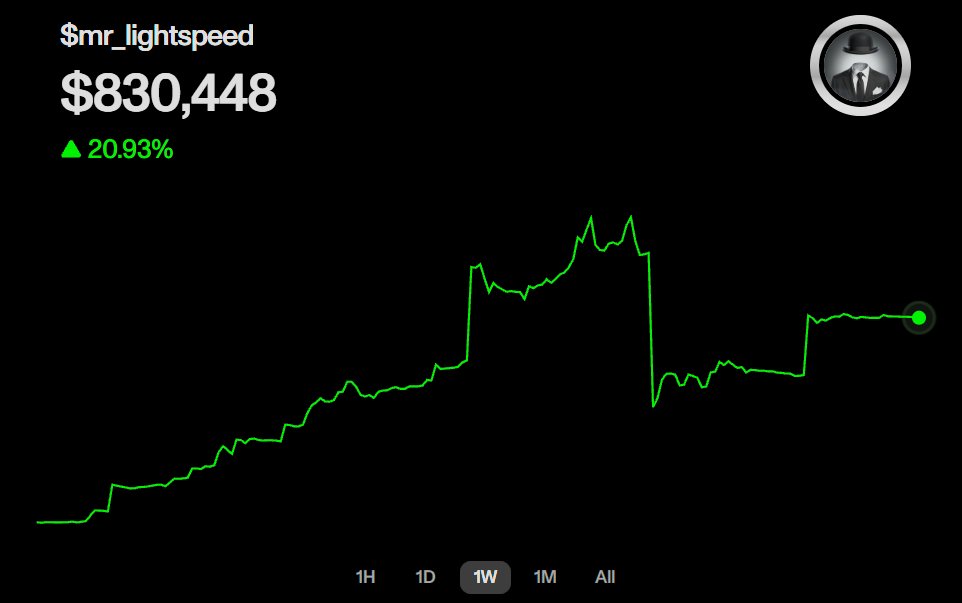
Looks like we got past that dump.
I am committed to trying to prove rank and file and get to number 1.
zora.co/mr_lightspeed
English
Super useful if you're working with Linux. And yes, you should understand this even in you have claude running the show. Understand your build, not just sit in the backseat while the AI hallucinate it's direction to destruction
Elorm Daniel@elormkdaniel
Every Linux Folder & What Each Folder Does Explained
English
Been looking through many repos, people's applications etc and I see soo many gaps. People don't keep a coherent codebase and do not test their code. In a age where anything is possible, be the extraordinary mput serious thought into the safety, don't just push anything please!
English
@RoundtableSpace Mostly refining my offline AI build to get higher quality output
English

@RoundtableSpace No need to switch entirely when you have a MCP server + open-source agent toolkit, built for Claude, ChatGPT or your favorite LLM.
English
ChatGPT for ideas. Claude Code for execution. Or are you switching entirely?
English
@Mr_Lightspeed Discord is sandboxed and running, once a month by now max 😅
English
FYI: I have to be reminded to check telegram.
I will have to reinstall Discord to check anything there.
English
@RoundtableSpace Well, seeing how my AI is taking over my tasks one by one. My job as a ai promoter and babysitter
English
Which industry is Claude going to kill with the next feature?
English
Regarding problems:
If you are not willing to fix the root cause, you are the problem.
English
The crypto community seriously lacks leaders of courage.
We can't move forward with pseudonymous cowards.
English