Thomas Hayes

77 posts

Thomas Hayes

Thomas Hayes

@THayes427

Researcher @biohub. Previously founder @evoscaleai, FAIR @MetaAI. @uchicago alum.

San Francisco Katılım Mayıs 2021
152 Takip Edilen763 Takipçiler
Sabitlenmiş Tweet
Thomas Hayes
Thomas Hayes@THayes427·
I’m so excited about the launch of ESMFold2, ESMC, and the new ESM Atlas. This was a massive team effort, and I’m grateful to have worked with such an incredible group @biohub. A headline result I’m especially excited about: ESMFold2 can design minibinders and antibodies with nanomolar affinity, target selectivity, and functional activity against therapeutically relevant targets. Today, we’re sharing the full binder design protocol.
Alex Rives@alexrives

Today we're announcing ESMFold2, an open scientific engine to power prediction, design, and discovery across protein biology. The new model delivers state of the art performance on protein interactions, especially antibodies, a critical modality for therapeutics. We have designed and validated miniprotein binders and single chain antibodies across five therapeutic targets that are important in cancer and immunology. We are seeing very high success rates, and affinities at levels consistent with therapeutic activity. We’re also releasing an atlas of 6.8 billion proteins, and 1.1 billion predicted structures. ESMFold2 is built on a state of the art language model that has been trained on billions of protein sequences. A world model of protein biology emerges through language modeling. We’ve used the techniques of mechanistic interpretability developed to understand large language models to understand the concepts ESM uses to represent proteins. The model’s representation space has a compositional organization of features across scales, levels of complexity, and abstraction, that reflects and mirrors the understanding of protein biology developed through a century of empirical science. This understanding emerges without prior knowledge, just from language modeling of protein sequences. Language models are becoming a powerful substrate to understand and program biology. The design of protein interactions is one of the most fundamental problems in biophysics, and has critical implications for the discovery of new medicines. A simple gradient based search with the model was able to discover high-affinity protein binders. I'm excited by the potential this has to accelerate basic science and the understanding of proteins. And especially for the new avenues it opens up for therapeutic design and medicine.
English
3
24
84
148.9K
Thomas Hayes
Thomas Hayes@THayes427·
Join us tomorrow at 1pm PT for a walkthrough of protein binder design with ESMFold2! We’ll cover computational design methods, wet-lab validation, a tutorial using open-source code, and live Q&A. Register here: bit.ly/4esCkkv
English
0
0
2
177
Thomas Hayes retweetledi
Aaron Ring
Aaron Ring@aaronmring·
I've been really impressed with ESMFold2's design capabilities. To make it easier to run locally, as well as to support structural templates, multichain targets, hotspots, Protenix-v2 validation, and automated MSA handling, I created this project: github.com/cytokineking/e…
English
0
28
179
21.5K
Thomas Hayes retweetledi
Alex Rives
Alex Rives@alexrives·
Together with UC Berkeley we are announcing the laser phase plate - a breakthrough in atomic resolution imaging. This is the brightest continuous wave laser in the world, 100 million times the intensity of the surface of the sun. Phase contrast plays an important role in microscopy, but it was thought close to impossible for electron microscopy, where it would require interfering with an electron beam. Holger Mueller and Robert Glaeser proposed exactly this using a standing wave laser. It has taken over 15 years to make this a reality. Biohub partnered with UC Berkeley and Mueller to support this work and to engineer and build the technology. Contrast has been the critical barrier to achieving atomic resolution imaging of the cell. In cryo-electron tomography, a cellular imaging technology that uses electron microscopy, the low contrast makes it impossible to resolve anything but the largest proteins within their cellular context. The laser phase plate removes that barrier. With advances in AI this breakthrough in contrast will start to open up a new frontier in structural biology, that will allow us to see the molecular machines of the cell, and how they assemble into far more complex and dynamic systems, and understand how they work.
English
92
569
4K
657.8K
Thomas Hayes retweetledi
Erik Bernhardsson
Erik Bernhardsson@bernhardsson·
I love to see @modal being used for biology and cutting-edge research like this. Very cool work from the team at @biohub to push open models forward in protein design and comp bio. Here's how to run it on Modal: modal.com/docs/examples/…
Thomas Hayes@THayes427

I’m so excited about the launch of ESMFold2, ESMC, and the new ESM Atlas. This was a massive team effort, and I’m grateful to have worked with such an incredible group @biohub. A headline result I’m especially excited about: ESMFold2 can design minibinders and antibodies with nanomolar affinity, target selectivity, and functional activity against therapeutically relevant targets. Today, we’re sharing the full binder design protocol.

English
4
10
71
12.8K
Thomas Hayes
Thomas Hayes@THayes427·
We’re excited to share the full binder design protocol. Check it out here: github.com/Biohub/esm/blo…. The notebook includes support for @modal to easily scale up binder generation. Give it a try and let us know how it works! You can read more about ESMFold2, ESMC, ESM Atlas, and the full results in the paper here: biohub.ai/papers/esm_pro….
English
3
25
82
22.8K
Thomas Hayes
Thomas Hayes@THayes427·
We also used cryo-EM to resolve the structure of one of our minibinders, shown in green, designed to bind EGFR, shown in yellow. The experimentally observed structure is shown in gray. The all-atom RMSD between the predicted and observed minibinder is just 1.204 Å, well within the experimental uncertainty of the 3.8 Å reconstruction.
Thomas Hayes tweet media
English
1
0
6
1K
Thomas Hayes
Thomas Hayes@THayes427·
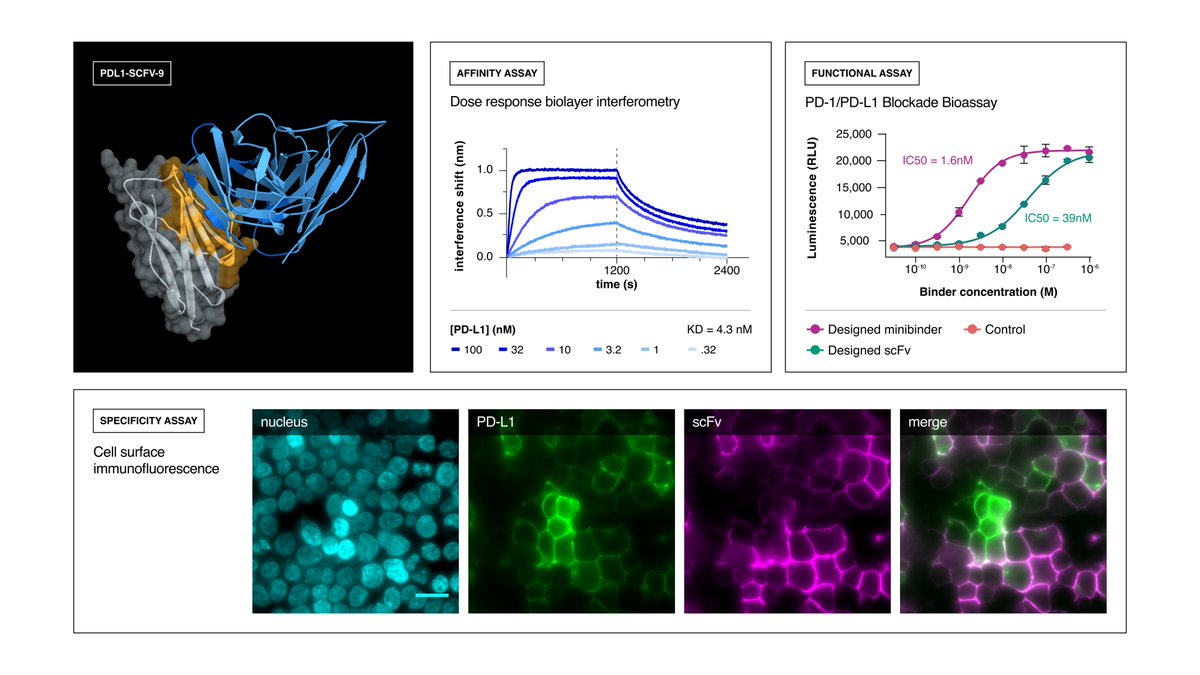
Therapeutic utility depends on more than binding, so we characterized binders for specificity, epitope fidelity, and functional activity. For instance, one designed PD-L1 scFv binds with 4.3 nM affinity, shows target-specific cell-surface staining, and relieves PD-1/PD-L1-mediated suppression of T-cell signaling with nanomolar potency.
Thomas Hayes tweet media
English
2
1
2
468
Thomas Hayes
Thomas Hayes@THayes427·
Hit rates are high across targets and modalities. And experimental outcomes improve significantly by applying more inference compute. Generating ~4.5x more candidates and using 19 rather than 4 critics improved minibinder hit rates from 54% to 70%; for scFvs, hit rates nearly doubled from 12% to 21%.
Thomas Hayes tweet media
English
1
0
1
530
Thomas Hayes
Thomas Hayes@THayes427·
The powerful predictive capabilities of ESMFold2 can be inverted to design new protein-protein interfaces. We applied a simple gradient-guided search protocol to design minibinders and single-chain antibodies (scFvs) against five therapeutically relevant targets. For every target and modality, this protocol recovered nanomolar (or tighter) binders.
Thomas Hayes tweet media
English
1
1
5
660
Thomas Hayes
Thomas Hayes@THayes427·
I’m so excited about the launch of ESMFold2, ESMC, and the new ESM Atlas. This was a massive team effort, and I’m grateful to have worked with such an incredible group @biohub. A headline result I’m especially excited about: ESMFold2 can design minibinders and antibodies with nanomolar affinity, target selectivity, and functional activity against therapeutically relevant targets. Today, we’re sharing the full binder design protocol.
Alex Rives@alexrives

Today we're announcing ESMFold2, an open scientific engine to power prediction, design, and discovery across protein biology. The new model delivers state of the art performance on protein interactions, especially antibodies, a critical modality for therapeutics. We have designed and validated miniprotein binders and single chain antibodies across five therapeutic targets that are important in cancer and immunology. We are seeing very high success rates, and affinities at levels consistent with therapeutic activity. We’re also releasing an atlas of 6.8 billion proteins, and 1.1 billion predicted structures. ESMFold2 is built on a state of the art language model that has been trained on billions of protein sequences. A world model of protein biology emerges through language modeling. We’ve used the techniques of mechanistic interpretability developed to understand large language models to understand the concepts ESM uses to represent proteins. The model’s representation space has a compositional organization of features across scales, levels of complexity, and abstraction, that reflects and mirrors the understanding of protein biology developed through a century of empirical science. This understanding emerges without prior knowledge, just from language modeling of protein sequences. Language models are becoming a powerful substrate to understand and program biology. The design of protein interactions is one of the most fundamental problems in biophysics, and has critical implications for the discovery of new medicines. A simple gradient based search with the model was able to discover high-affinity protein binders. I'm excited by the potential this has to accelerate basic science and the understanding of proteins. And especially for the new avenues it opens up for therapeutic design and medicine.

English
3
24
84
148.9K
Thomas Hayes retweetledi
biohub
biohub@biohub·
Proteins are the machinery of life. Scientists have cataloged billions of protein sequences—but their biology is still mostly unknown. Today we're releasing a world model of protein biology: a scientific engine for prediction, design, and discovery that consists of ESMFold2, ESMC, and ESM Atlas. Together, they're helping to open up a new way for researchers to design proteins and speed up scientific discovery. Our mission is to cure or prevent disease. To do that, we need to accelerate science. That's why we're releasing all three openly. bit.ly/3PGf1dk
English
9
64
352
79.1K
Thomas Hayes retweetledi
nature
nature@Nature·
A newly released AI tool has generated an atlas of more than one billion predicted protein structures and billions more protein sequences. go.nature.com/4fblM0Z
English
12
104
382
47.8K
Thomas Hayes retweetledi
Alex Rives
Alex Rives@alexrives·
Today we're announcing ESMFold2, an open scientific engine to power prediction, design, and discovery across protein biology. The new model delivers state of the art performance on protein interactions, especially antibodies, a critical modality for therapeutics. We have designed and validated miniprotein binders and single chain antibodies across five therapeutic targets that are important in cancer and immunology. We are seeing very high success rates, and affinities at levels consistent with therapeutic activity. We’re also releasing an atlas of 6.8 billion proteins, and 1.1 billion predicted structures. ESMFold2 is built on a state of the art language model that has been trained on billions of protein sequences. A world model of protein biology emerges through language modeling. We’ve used the techniques of mechanistic interpretability developed to understand large language models to understand the concepts ESM uses to represent proteins. The model’s representation space has a compositional organization of features across scales, levels of complexity, and abstraction, that reflects and mirrors the understanding of protein biology developed through a century of empirical science. This understanding emerges without prior knowledge, just from language modeling of protein sequences. Language models are becoming a powerful substrate to understand and program biology. The design of protein interactions is one of the most fundamental problems in biophysics, and has critical implications for the discovery of new medicines. A simple gradient based search with the model was able to discover high-affinity protein binders. I'm excited by the potential this has to accelerate basic science and the understanding of proteins. And especially for the new avenues it opens up for therapeutic design and medicine.
GIF
English
75
450
1.6K
617.4K
Thomas Hayes retweetledi
Alex Rives
Alex Rives@alexrives·
Scaling laws are powering AI. It’s time to scale biology. Today we’re launching the Virtual Biology Initiative to generate the data to unlock scaling laws in biology and build accurate predictive models of the cell. Digital representations of proteins are already expanding our understanding of life at the molecular level, and accelerating the design of molecules and medicines. Accurate digital representations of the cell could reveal the mechanisms that are responsible for disease, and show how to reverse them. The protein data bank, and worldwide repositories of protein sequence biodiversity were created through decades of work by the scientific community. The advances in artificial intelligence for proteins would not have been possible without them. The cell is orders of magnitude more complex, and we will need to create the data in just a few years rather than decades. This will require a coordinated global effort. We're partnering with Broad, Wellcome Sanger, Arc, Allen, Human Cell Atlas, Human Protein Atlas, NVIDIA, and Renaissance Philanthropy. Biohub is contributing to this effort as both a funder and a builder. We are developing microscopy to observe millions of cells in living organisms, and cryo-ET to resolve the cell in atomic detail. We're building instruments that expand the range of modalities and parameters that can be simultaneously measured. We’re developing molecular, cellular, and tissue engineering to create models of disease and design interventions. The data we generate will be available to the worldwide scientific community. We’re also committing $100M over the next five years to support work beyond Biohub. We invite other scientific teams and funders to join. Link: biohub.org/news/virtual-b…
English
38
137
747
132.5K
Thomas Hayes retweetledi
Rohil Badkundri
Rohil Badkundri@rohilbadkundri·
We used AI to predict the failure of a Phase 3 trial before the results were announced. Today, we're publishing 10 more predictions for the future. Thread 🧵
GIF
English
50
103
754
252.8K
Thomas Hayes retweetledi