RJ Honicky

117 posts

RJ Honicky banner
RJ Honicky

RJ Honicky

@honicky

BioTech - AI - Host of Latent Space AI for Science podcast

Mostly SF Bay Area Katılım Nisan 2009
223 Takip Edilen129 Takipçiler
RJ Honicky
RJ Honicky@honicky·
Noetik’s AI value proposition: “cohort selection” “When I do my drug’s clinical trials, who should participate?” Obviously, if you get that wrong, then your drug won’t “work,” even if it actually works! Ron Alfa explained to us how they do this using cheap imaging 1/
English
2
3
11
6.8K
Joseph Krause
Joseph Krause@josephfkrause·
Just did a fire episode with the team @latentspacepod 🔥 AI for Science is having a moment, excited for this one.
English
2
1
8
592
RJ Honicky retweetledi
Latent.Space
Latent.Space@latentspacepod·
🔬 Training Transformers to solve 95% failure rate of Cancer Trials the AI for Science pod is back with @RonAlfa, CEO of @NOETIK_ai, and Daniel Bear, VP Research at Noetik, explaining exactly how their team of top AI x Bio researchers and engineers (shoutout @owl_posting) will use AI to cure cancer, by focusing on key bottlenecks like patient selection, and training large cancer foundation models like TARIO-2, an autoregressive transformer trained on one of the largest sets of tumor spatial transcriptomics datasets in the world... which first required years of blind faith in collecting good data to even get going:
English
1
4
21
17.3K
RJ Honicky
RJ Honicky@honicky·
@kevinweil Glad we caught you before you left! Excited to see what's next for you :)
English
0
0
0
333
Kevin Weil 🇺🇸
Kevin Weil 🇺🇸@kevinweil·
Today is my last day at OpenAI, as OpenAI for Science is being decentralized into other research teams. It’s been a mind-expanding two years, from Chief Product Officer to joining the research team and starting OpenAI for Science. Accelerating science will be one of the most stunningly positive outcomes of our push to AGI, and I’m rooting for @sama @markchen90 @fidjissimo @gdb @merettm and the whole team!
English
283
145
4.3K
588.2K
RJ Honicky
RJ Honicky@honicky·
Heather Kulik from @KulikGroup makes an subtle point here about building models based on literature. Graphs and author interpretation can give different numbers. Heather's team built a model to predict the temperature at which a MOF breaks apart based on experiment reports, 1/n
English
3
0
0
41
RJ Honicky
RJ Honicky@honicky·
but found a big discrepancy between the plots in the reports and the interpretation. This is a good 60 seconds for anyone building scientific models based on literature. 2/n
English
0
0
0
12
RJ Honicky retweetledi
Latent.Space
Latent.Space@latentspacepod·
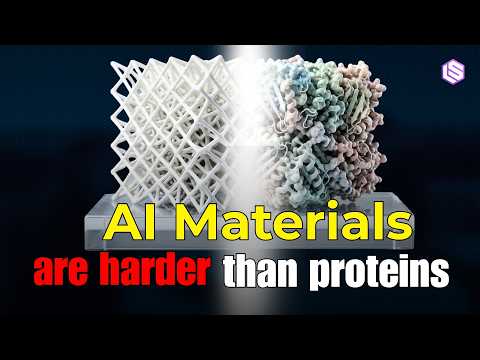
🔬Why There Is No "AlphaFold for Materials" latent.space/p/materials Materials Science is a force for good everywhere in our lives, from your clothes to the computers you use. We catch up on AI for Materials Discovery with Prof. Heather Kulik of @KulikGroup, one of the first materials scientists to realize that there was alpha in combining computational tools with data driven modeling... and we test out some predictions she makes on the pod with Opus 4.6 and GPT 5.4!
English
3
3
7
2.3K
RJ Honicky retweetledi
Anish Moonka
Anish Moonka@anishmoonka·
Your next cancer drug or gene therapy spends years stuck in a lab before it reaches a pharmacy shelf. Anthropic is testing a tool that goes after the bottleneck: the coding work biologists do before any human trial even starts. It’s called Operon. Four tasks show up on the loading screen and they tell you everything. “Design a CRISPR knockout screen” means turning off every gene in a cell, one at a time, across 20,000+ genes, to find which ones cause disease. Imagine flipping 20,000 light switches to figure out which one controls the kitchen. Planning that experiment alone takes a biologist months. “Analyze scRNA-seq data” means reading what each individual cell in a tissue sample is doing, instead of blending them all together into one average. The code to crunch that data takes weeks to write. “Rank enzyme variants with PLMs” means feeding an AI trained on 65 million protein sequences and asking: which version of this enzyme will actually work? It predicts the answer before anyone picks up a pipette. “Build a phylogenetic tree” means mapping how organisms or genes branched apart over evolution. How scientists trace where a virus strain came from. Every one of these jobs requires a PhD and serious programming chops. Operon wants to turn them into a conversation. The name itself is a nod. An operon is a cluster of genes that switch on together in biology. Nobody outside a biology department would pick that name. Operon sits inside Claude Desktop as its own mode, next to Chat, Code, and Cowork. It reads files straight off a researcher’s computer (biology datasets are way too big to upload). It has a planning mode and an auto mode, borrowed from Claude Code. Anthropic has been laying track here for months. Last October they launched Claude for Life Sciences with plug-ins for PubMed (35 million medical papers), Benchling (where scientists log experiments), and 10x Genomics. In January they added a drug compound database. Claude already beats human experts on a lab protocol comprehension test, 0.83 versus 0.79. And the real-world pharma results are hard to ignore. Novo Nordisk used Claude to chop clinical report writing from 15 weeks to under 10 minutes. A team of 50 writers shrank to 3. Their annual Claude bill costs less than one writer’s salary. Every day a drug hits the market sooner is worth roughly $15 million to them. The AI drug discovery market sits around $3 to 5 billion this year, growing 20 to 30% annually. Over 200 AI-discovered drug candidates are in clinical trials right now. But I want to be straight about what AI can’t touch: clinical trials still grind on for years. Regulatory review, manufacturing, all of that stays slow. AI trims the front of a decade-long pipeline. Anthropic hit $19 billion in annual run rate last month. $380 billion valuation. 80% of that revenue comes from businesses. Operon says a lot about where they think the next enterprise dollar is hiding. The lab.
TestingCatalog News 🗞@testingcatalog

BREAKING 🚨: Anthropic is working on a new Operon agent for Claude Desktop, built for scientific research in biology! Operon will have a "private environment" to work alongside you. Users will be able to create different sessions within Operon projects, manage generated artefacts, and work with Skills. Cowork but for scientists 👀
English
11
76
423
50.9K
RJ Honicky
RJ Honicky@honicky·
This material exploited quantum effects in a way that was very counter-intuitive to the people designing the material. Please check out this episode. Heather makes chemistry, physics, materials, and molecular design very approachable, and was really fun to talk with.
English
1
0
0
29
RJ Honicky
RJ Honicky@honicky·
AI in materials science is often accused of rediscovering known chemistry faster. Heather Kulik: Her team screened tens of thousands of materials with AI. The design it surfaced surprised the experimentalists, and they said they wouldn't have arrived at it themselves. 1/
English
2
0
0
33
RJ Honicky
RJ Honicky@honicky·
They made it in the lab and it was four times tougher, as predicted! It's hard to overstate how significant this is: Many teams get results in chemistry or biology or materials that turn out to be minor tweaks on existing practice. 2/
English
0
0
0
8
RJ Honicky
RJ Honicky@honicky·
It’s materials all the way down Drawing a line between the last two episodes @boltz_bio (protein design): search molecular interaction @cusp_ai (materials): search molecular space @wellingmax: underlying everything — biology included — is a material. Links in the comments
English
1
0
2
50
RJ Honicky
RJ Honicky@honicky·
@harrison_zhang This looks a lot like the Teichman preprint that dramatically downgraded their hypothesis: medrxiv.org/content/10.110… Would like to understand the difference between this new analysis and the Teichman manuscript
English
0
0
0
64
Harrison G. Zhang
Harrison G. Zhang@harrison_zhang·
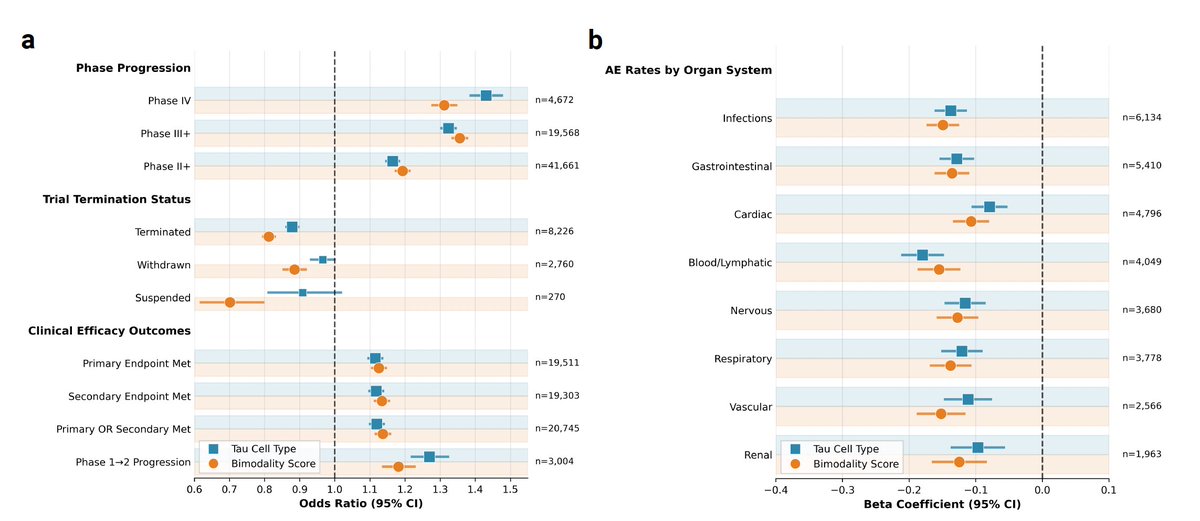
Result: large-scale analysis of 55,984 trials by agents showed drugs targeting cell-type-specific genes were 40% more likely to progress Phase I->II, 48% more likely to reach market (Phase IV), and showed 32% lower adverse event rates.
Harrison G. Zhang tweet media
English
3
0
6
794
Harrison G. Zhang
Harrison G. Zhang@harrison_zhang·
🚀🤖 Introducing the Virtual Biotech: a multi-agent AI research platform for therapeutic discovery & development This places a virtual CSO and its cross-functional R&D organization of AI scientists at a user’s fingertips. Preprint: biorxiv.org/content/10.648…
Harrison G. Zhang tweet media
English
22
49
281
86.8K
Latent.Space
Latent.Space@latentspacepod·
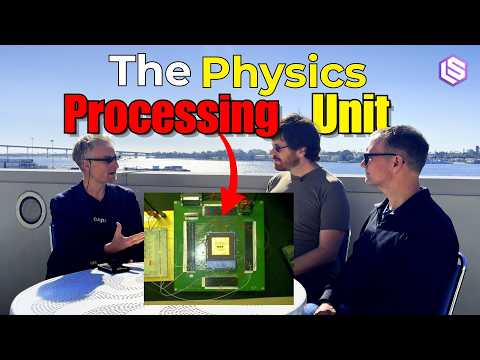
🔬 New Science pod with @cusp_ai! We are entering a new era where materials science and discovery is transitioning from slow, manual experimentation, to a high-speed search problem powered by generative AI and "physics processing units." @wellingmax argues that the foundation of all modern technology—from GPUs to climate solutions—is a materials problem, and that unifying the mathematics of stochastic thermodynamics with generative AI will unlock a new paradigm of automated scientific discovery.
English
4
6
45
20K
RJ Honicky
RJ Honicky@honicky·
Nature is the fastest computer. I love @wellingmax's take on this — instead of treating information theory and quantum complexity as a way to understand the universe, he flips it: it's a way to do science. By that logic, a lab experiment is just a really hard API call :-) 1/2
English
1
0
0
43