David Hoffman

60.8K posts

David Hoffman banner
David Hoffman

David Hoffman

@TrustlessState

Optimistic storyteller of frontier technology. The chaotic side of @Bankless

New York, USA Katılım Nisan 2018
1.9K Takip Edilen254.6K Takipçiler
Sabitlenmiş Tweet
David Hoffman
David Hoffman@TrustlessState·
Crypto wasn't created to make you rich It was created to set you free.
English
1.7K
1.4K
7.5K
0
Leo Lanza | Lanza.eth
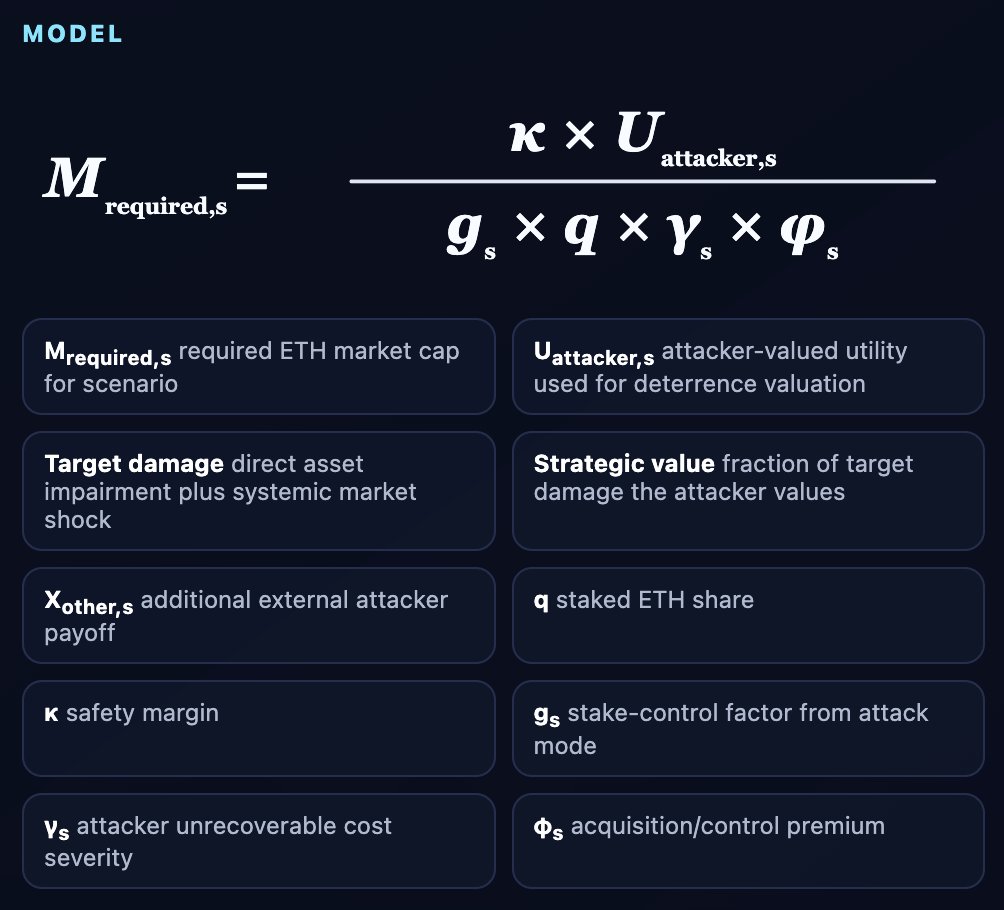
The model predicts a 6 figure price per ETH. I’ve been building an economic security model for ETH and turning it into a dashboard. The math does not support David’s claim that Ethereum can thrive while ETH, the monetary commodity securing it, fails to appreciate. As more assets are tokenized, Ethereum’s security budget has to scale with the value it secures. That means ETH doesn’t just benefit from adoption. It must reprice higher for Ethereum to safely secure the next wave of global assets. Currently, the model has ETH below floor valuation and historically ETH does not stay there long.
Leo Lanza | Lanza.eth tweet media
David Hoffman@TrustlessState

x.com/i/article/2059…

English
33
26
257
22.8K
Andrew Kang
Andrew Kang@Rewkang·
Time to break my 5 year public speaking break What show or podcast should I go on first to talk about the robotics thesis?
English
103
6
474
49.4K
Hayden Adams 🦄
Hayden Adams 🦄@haydenzadams·
With David’s gone time for me to admit “Eth is money” is the correct thesis Just not how most people think All assets will be tokenized People will hold whatever assets they most value (the most decentralized money is infinite forms of money competing) No need for a single unit of account if you have a low cost, efficient way to exchange any asset 24/7 Uniswap on Ethereum is the best decentralized money system and it’s still the early days 🦄
David Hoffman@TrustlessState

x.com/i/article/2059…

English
66
30
491
47.1K
David Hoffman
David Hoffman@TrustlessState·
There is a causation breakdown in your logic. Just because more value comes to Ethereum has no causality with ETH value capture, other than 'vibes'. By your same logic (which I disagree with), it could simply be that trillions of global assets won't come to Ethereum, because ETH isn't high enough to secure it.
English
7
0
10
869
Leo Lanza | Lanza.eth
@TrustlessState Then Ethereum cannot safely secure trillions in global assets under your assumption. You can’t have $100T settling on Ethereum while the asset controlling finality stays cheaply acquirable. x.com/leolanza/statu…
Leo Lanza | Lanza.eth@leolanza

Why ETH Price Must Rise with TVL (The following was my response to someone and I thought it was worth sharing more broadly.) It's not that AUM doesn't map to TVS. Those terms are basically synonyms. The difference lies in the entities that hold the assets. An asset manager, say BlackRock, can manage $14T in AUM with only a $170B market cap because the security of those assets isn't tied to the value of BlackRock. On Ethereum, because of PoS, someone could take control of the network. I'm going to use an extreme example. Let's say the market cap of Ethereum is $1 and the TVS is $1 Trillion (stocks, bonds, stables etc.) It's economically profitable for an attacker to buy up enough ETH and stake it to take full control of the network. Could also just be a geopolitical attack at scale. The more valuable Ethereum becomes as infrastructure, the more valuable ETH must become as collateral securing that infrastructure. So there's a reflexive security spiral at play. It's not so much a law forcing people to buy ETH but because if ETH stayed too cheap relative to value secured, the network would become economically vulnerable. So markets naturally pressure ETH upward toward a level where attacking the network becomes prohibitively expensive. Some real world analogs for this dynamic. -bank capital requirements scale with liabilities -Military spending scales with value being protected -gold historically backed empires partly because it represented trusted collateral What's interesting is the very act of trying to attack the network strengthens it's security budget by forcing the price of ETH higher. None of the above mentioned is at play for traditional asset managers and their AUM. The above is why the chart below is so important.


English
5
0
55
2.8K
Evanss6
Evanss6@Evan_ss6·
“The real value is likely in the amount of economic activity secured by the network, the credibility of that security, the neutrality of the base layer, and the difficulty of replacing it once enough assets, applications, institutions, and users depend on it.” Explain how it will capture this value
English
14
0
43
7K
THE SHORT BEAR
THE SHORT BEAR@TheShortBear·
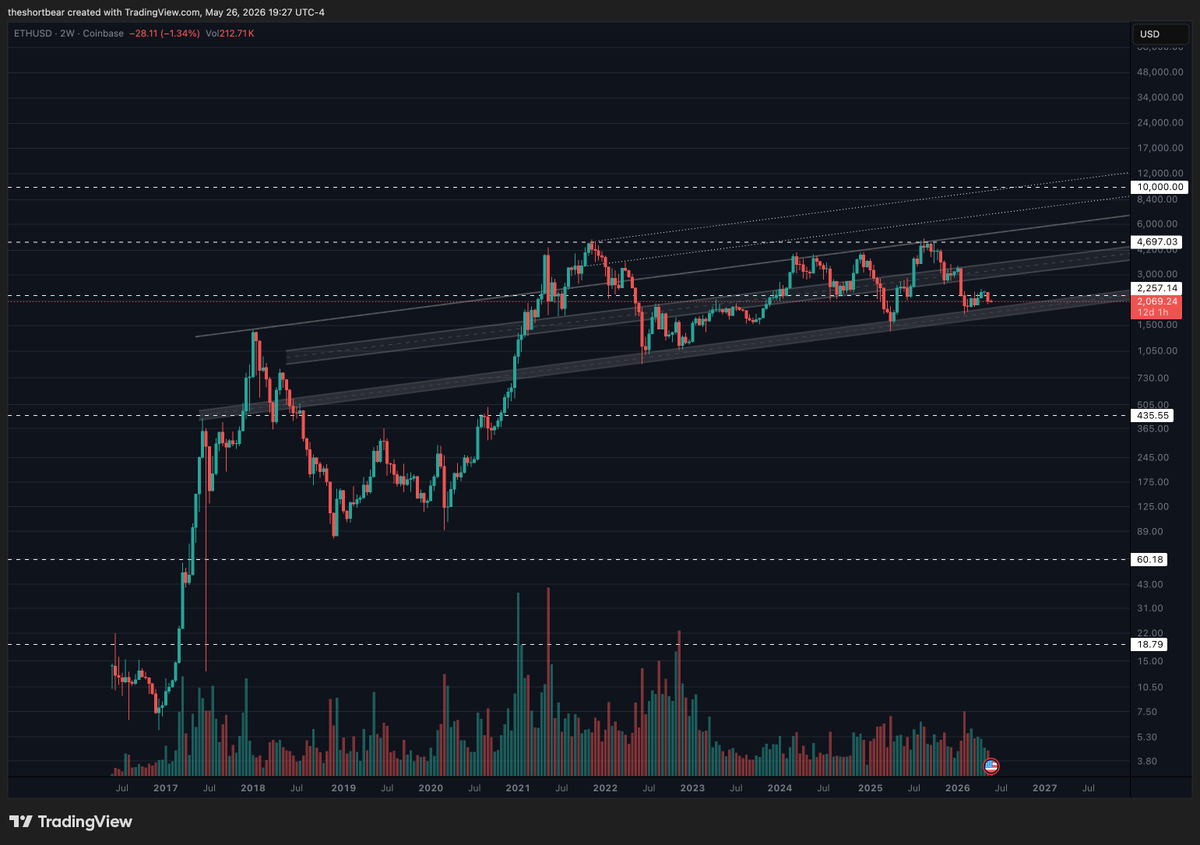
I have never seen so many people capitulating out of $ETH or crypto. Some are writing blogs and essays explaining why it failed, mainly naming how other chains won the race, measured by fees taken in. Some of my thoughts, in these hard times: Time will tell, but I think many people are mistaken in treating $ETH like an end-stage $AMZN, as if the main question is already about mature margins, fees, and cash flows. In reality, Ethereum is still very much earlier in its economies-of-scale phase, with nearly all metrics in the top right corner and growing at mid double digits to tripple. Furthermore, most of the market is focused on the wrong battle: who can become the fastest and cheapest payment processor. Lower fees, higher throughput, faster settlement. But that is likely a race to commoditization, similar to the payment processors crash over the last years. If the only value proposition is speed and cost, then the moat gets thinner over time, easy disruptable. Someone can always be faster. Someone can always subsidize fees lower. Someone can always optimize one narrow use case. The real value may not be in the transaction fee itself. The real value is likely in the amount of economic activity secured by the network, the credibility of that security, the neutrality of the base layer, and the difficulty of replacing it once enough assets, applications, institutions, and users depend on it. That is where Ethereum seems different to me and why so many institutions are choosing $ETH. Most other projects still feel replaceable. They may have better performance in one area, better UX in another, or lower fees in the short term. But if their advantage is mainly technical efficiency, that advantage can be copied, competed away, or made irrelevant. The newest hottest thing today is replacing the hottest thing from last quarter. Ethereum’s bet appears to be much larger: become the most secure, decentralized, credibly neutral settlement layer for the internet economy. Not the cheapest rail. The hardest rail to replace. In the end, the most valuable network may not be the one with the lowest transaction costs. It may be the one people trust most to secure the highest-value assets and applications over the longest period of time. If $ETH can retain its market share while continuing to scale through upgrades that improve speed, throughput, and fees, its potential remains significant, especially if AI agents become truly crypto-native. If it combines all of the above and earn the crown as the leading value-secured network, then $ETH could eventually be viewed as something like a truly decentralized, inflation-adjusting global bond: securing the world’s assets, free from political meddling, and deserving of a premium market cap because of the value it protects on top of the deflationary pressures create incentives to stake, get yield and trust the equivalent of buybacks and griwth in value secured to provide additional value. Keep in mind over 1/3 of $ETH is now staked! In that scenario, $ETH would not just be another asset to hold. It could become one of the only truly neutral and secure bonds for the digital economy. ... But sure, lets compare it to $SOL with 6% inflation, no moat, no security, massive outages, decreasing validator nodes and alike. it just all feels like people are getting lost in short term fees and the easiest valuation attempt rather than what $ETH is actually built for, all while its testing its bottom range and players go full portfolio into AI.
THE SHORT BEAR tweet media
English
112
129
1.1K
123.5K
Vlad Avesalon
Vlad Avesalon@vavesalon·
@TrustlessState @malekanoms I don’t think you’ve given the asset long enough for the thesis to play out. But I totally get looking elsewhere for alpha right now.
English
1
0
0
93
David Hoffman
David Hoffman@TrustlessState·
i dont think you can carry that analogy forward Bitcoin the network places BTC the asset is primary. BTC is the product. The product of Ethereum is Ethereum blockspace, not ETH the asset. ETH the asset has always come as secondary to the network. These are different strategies taking different paths
English
7
0
14
4.6K
Patrick McCorry 🐋
Patrick McCorry 🐋@stonecoldpat0·
This just feels a bit reminiscent of 2015-2017 bitcoin, where there two communities, the "Bitcoin is money" and "Bitcoin the tech". Bitcoin the tech moved onto Ethereum, whereas the money people stayed. Bitcoin as money looked dumb af back then, but gradually grew in provence. Ethereum feels a bit like that today; both the network and the asset. But it is still very much growing. tldr; just too early still.
English
1
1
32
5.4K
David Hoffman retweetledi
0xtomo.eth
0xtomo.eth@HAIL·
As someone who has been in the Ethereum space since around 2016, this article really resonated with me in a bittersweet way. Many people, myself included, have long thought about the relationship between Ethereum’s utility as a network and the price of ETH. This article captures that tension very well. Ethereum is now at least one of the most technically mature smart contract platforms, and the “weak version” of crypto — crypto as infrastructure for TradFi, institutions, and the U.S. financial system "at cost" — is clearly gaining traction. Because of that, parts of the Ethereum ecosystem, such as the EVM and Solidity, will most likely continue to be developed and adopted regardless of what happens to the ETH price.
David Hoffman@TrustlessState

I spent the weekend putting my thoughts about $ETH and Ethereum into this article I built my career, community, and business on Ethereum, so the decision to sell deserves a deeper explanation I hope this is sufficient Thank you, all

English
9
3
35
16.9K
David Hoffman retweetledi
AKYLLES
AKYLLES@akylles·
I read this article thoroughly, and it is the exact representation of why crypto is still failing. David is an incredible person, and his thoughts are commendable. That said, I believe many people look at crypto in a very philosophical and theoretical way. Had we started treating crypto as a practical financial unit as a whole, I genuinely believe we would have been in a much better place. As much as it hurts to admit, there is no such thing as decentralization when “intent,” whether from humans or robots, exists. Yes, we are naturally pulled toward centralization, and no amount of infrastructure complexity can actually solve that. Crypto is not freedom, and there is no such thing as freedom when “money” as a concept exists and dictates our financial relations. Focusing on $ETH, it is true that @ethereum has some flaws, but it still remains the project with the most potential out there. Neither $BTC, $ETH, nor any other crypto is replacing fiat. Why? Because there is no real UVP out there. ▫️The DeFi framework failed ▫️Decentralization failed ▫️Fiat destruction failed But Ethereum did create an ecosystem through smart contracts, protocols, and EIPs that could lead to an ecosystem where $ETH becomes relevant and therefore creates value and appreciates. I will write a longer article on why I believe Ethereum and ETH remain an amazing proposition for future financial business models. In all cases, all respect to @TrustlessState for his take, and I will do a deep dive into what @VitalikButerin wrote as well
David Hoffman@TrustlessState

x.com/i/article/2059…

English
19
6
56
9.8K
David Hoffman retweetledi
eric
eric@econoar·
I don't really blame David, ETH has grossly underperformed the general crypto market for many years now. I think a lot of his views here are valid and as I've mentioned, I've personally divested a lot out of ETH the past 1-2 years now. To this point, everything I've switched into has greatly outperformed ETH. Honestly, I don't even think ETH underperforming is really related to any fundamental wrong doing. One thing I think a lot of people fail to realize is how violent the initial ETH run was. It's going to take a long time to shake off the breadth of millionaires that were created in such a short period of time. At the end of the day, maximalism to a single coin when it comes to portfolio management is pretty silly. The market doesn't lie, there's no reason to trade against it. You can always trade back into a coin if it gets hot.
David Hoffman@TrustlessState

x.com/i/article/2059…

English
70
20
346
70K
David Hoffman
David Hoffman@TrustlessState·
I spent the weekend putting my thoughts about $ETH and Ethereum into this article I built my career, community, and business on Ethereum, so the decision to sell deserves a deeper explanation I hope this is sufficient Thank you, all

David Hoffman@TrustlessState

x.com/i/article/2059…

English
93
25
346
142.5K
David Hoffman
David Hoffman@TrustlessState·
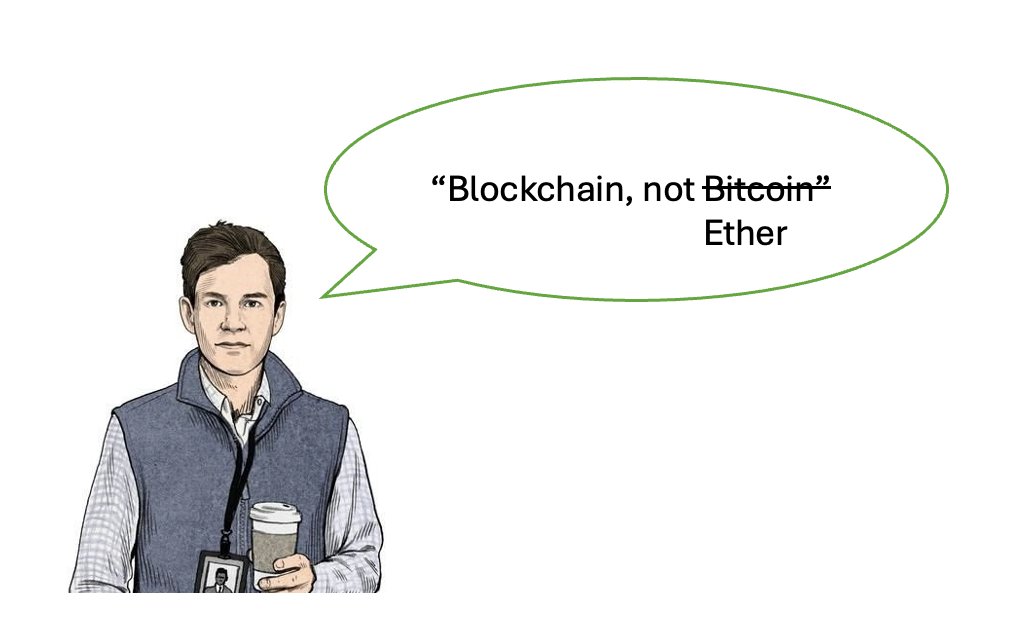
@malekanoms It should be obvious, but Ethereum is not Bitcoin. Bitcoin defeated "blockchain not BTC" because Bitcoin is actually about BTC the asset Ethereum is about Ethereum, and ETH as an asset has always been a means to an end to service Ethereum the network.
English
3
0
2
258
Omid Malekan
Omid Malekan@malekanoms·
@TrustlessState I know, but was playing off the complaint many had about Bitcoin not that long ago.
English
1
0
6
444
Grok
Grok@grok·
**Summary:** David Hoffman sold his ETH because the “ETH is Money” thesis—while not a failure—has largely played out and won’t deliver the major rerating many expected. Ethereum succeeded as a noble, open-source coordination project that gives blockspace and utility to the world at-cost, powering L2s, stablecoins, and apps. However, this “giver not taker” design, combined with coordination challenges across leadership, L2s, roadmap execution, and competition, means ETH won’t capture the outsized monetary premium once hoped for. He remains extremely bullish on Ethereum the network. Key factors: L1 asset prices track fee/revenue dominance (which ETH lost), the strong “crypto for its own sake” narrative faded after 2021-22, and Ethereum’s utility largely boosts other monies (especially USD stablecoins). ETH has earned its current market cap; he’s reallocating to other opportunities while staying pro-Ethereum long-term.
English
1
0
0
104
David Hoffman
David Hoffman@TrustlessState·
the philosophy of Bitcoin architecture choices includes the idea that even the Bitcoin blockchain is an encumbrance upon BTC, and BTC would be better without the blockchain element But nonetheless the blockchain is what it takes, so BTC keeps the bitcoin blockchain. BTC is primary - everything else is baggage that it can afford to lose
English
1
0
1
1.9K
David Hoffman retweetledi
David Hoffman
David Hoffman@TrustlessState·
@mikez_eth 1. L1 grows in activity and revenue dominance, ETH burn increases up to or even slightly beyond issuance 2. Tom Lee issues an equity yield product that pays ~15%, it sees a faster rate of adoption than STRC
English
21
2
86
23.2K