eric
1K posts

eric
@econoar
Crypto since 2012 | Author EIP-1559 | Recovering Tribalist | Interested in revolutionizing finance | HYPE + LIT and chill | Never financial advice

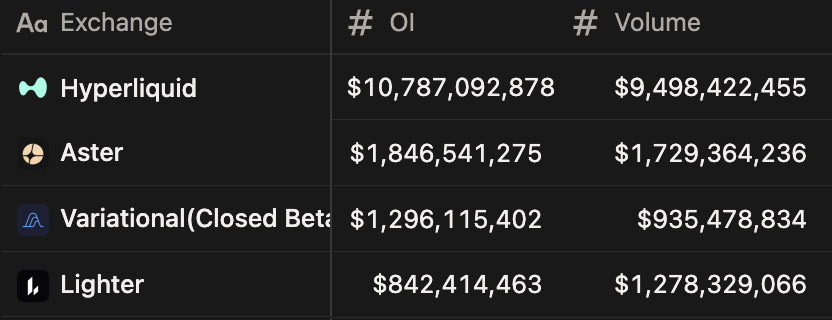
$LIT or $HYPE ? I'd BUY more $LIT here.. here's why: I think it could very well outperform $HYPE from here, and the reason is quite simple.. Lighter is already doing a meaningful share of Hyperliquid’s actual business, but $LIT is still valued at only a tiny fraction of $HYPE At the time of writing, $LIT is trading around $2.42 with a market cap of roughly $602M and an FDV of $2.4B. while $HYPE is trading around $65 with a market cap of roughly $14.5B and an FDV above $62B So based on circulating market cap, Hyperliquid is valued around 24x higher than Lighter. But when you compare the actual protocol numbers, the gap is not 24x everywhere. Over the last 30 days, Hyperliquid processed around $189B in perpetual trading volume while Lighter processed $37.6B. That means Lighter is already doing almost 20% of Hyperliquid’s volume while being valued at only around 4.1% of its market cap. Lighter’s current open interest is around $885M compared with $10.9B on Hyperliquid, meaning Lighter has around 8.1% of Hyperliquid’s open interest. It's TVL is around $525M compared with Hyperliquid’s $6B, meaning it has roughly 8.7% of Hyperliquid’s TVL So Lighter has around 20% of the volume, 8% of the open interest and 9% of the TVL, but only 4% of the market cap. That is the first major valuation gap I see. Even when looking at the entire perp DEX market, Lighter is no longer a small player.. The whole sector processed around $9B in volume over the last 24 hours and $527.7B over the last 30 days, with total open interest of around $17.8B Lighter contributed $621M of the latest daily volume, $7.48B over 7 days and $37.6B over 30 days.. That gives it roughly 6.9% of daily volume, 7.1% of monthly volume and around 5% of the sector’s open interest. Since launch, Lighter has already processed around $1.71T in cumulative perp volume. The product is also seeing actual onchain usage. Over the latest 24-hour period, DeFiLlama recorded around 9,040 active addresses, 428 new addresses and more than 963,000 transactions on Lighter. Its spot exchange is still much smaller than the perp business, but it has still processed around $230M in spot volume over the last 30 days and $11.1B cumulatively. So the main business remains perps, but they are slowly building a wider trading venue around it. Now, yeah the comparison becomes less attractive when we look at revenue. Lighter generated around $2.71M in fees and $2.11M in protocol revenue over the last 30 days. Hyperliquid generated around $60.3M in fees and $43.1M in revenue during the same period. So despite doing almost 20% of Hyperliquid’s volume, Lighter is currently generating only around 4.9% of its revenue. This tells us that Lighter’s volume is being monetised far less efficiently. If we annualise the latest 30-day revenue, Lighter is running at roughly $25.3M per year, while Hyperliquid is running at roughly $517M. That puts $LIT at around 24x annualised protocol revenue and $HYPE at around 28x. So based purely on current revenue, $LIT is not trading at some crazy discount to $HYPE. It is slightly cheaper, but not enough to build the entire thesis around that alone. The actual bet is that Lighter can monetise its existing volume much better from here. rn standard accounts pay zero maker and taker fees, but that free trading comes with 300ms taker latency and 200ms maker and cancellation latency. Premium accounts pay a 0.004% maker fee and a 0.028% taker fee, but they get faster execution. Staking $LIT then reduces both the fees and latency. At the highest listed tier of 500,000 LIT staked, the maker fee falls to 0.0028%, the taker fee falls to 0.0196% and taker latency improves to 140ms. The model is basically using zero fees to attract retail volume while charging more serious traders for speed and execution quality. And this is where I think the operating leverage could come from. Lighter does not necessarily need to grow volume from $38B to $100B immediately. Even if volume stays near current levels, revenue can grow much faster if a larger percentage of traders move towards premium accounts and staking-based fee tiers. But this is still something they need to prove. also yeah, I would not pretend Lighter is currently growing faster than Hyperliquid. It is not. but the protocol proved it could attract a huge amount of volume even after the airdrop.. its good to see how well lighter is doing overall now that the farmers are gone which isnt the case for many other projects who did airdrop and even the value accrual towards $LIT is real. Lighter uses trading-fee revenue to buy $LIT from the market through daily 24-hour TWAP purchases. Over the last 30 days, around $2.06M was recorded as token-holder revenue through buybacks. Over seven days, the figure was around $418,000, while cumulative token-holder revenue has reached approximately $22.4M. Lighter has also now burned 15,638,702 LIT that had been repurchased using exchange revenue through the end of Q2. That removed roughly 6.3% of the reported circulating supply. Going forward, the team says repurchased tokens will continue to be permanently burned, meaning the value loop is easy to understand: more trading activity leads to more fee revenue, which leads to more $LIT purchases and eventually less token supply. There is also real utility around staking. For every one LIT staked, users can deposit up to 10 USDC into Lighter’s LLP liquidity pool. Staking also gives access to fee discounts, better execution and lower latency. Around 125M LIT is currently staked, which is roughly half of the reported circulating supply. But there is an important catch here too. Lighter is targeting a staking yield of around 6%, which would distribute approximately 7.5M LIT per year at the current staking level. Those rewards will now come from the remaining ecosystem token allocation rather than entirely from recurring protocol revenue. Since staking launched in January, approximately 3.72M LIT has already been distributed, including around 170,000 LIT through its fee-credit programme. So the buybacks and burns reduce supply, but staking rewards release previously uncirculated ecosystem tokens and partially offset that reduction. The token structure is probably the biggest risk here. LIT has a maximum supply of 1B tokens, while only 250M, or 25%, is currently reported as circulating. The allocation is 25% for the original airdrop, another 25% for future ecosystem incentives and partnerships, 26% for the team and 24% for investors. So 50% was allocated to the ecosystem and 50% to the team and investors. Team and investor unlocks begin on December 29, 2026 after the one-year lockup. The team allocation will release around 237,286 LIT per day, while investors will receive around 219,000 LIT per day. Combined, that is approximately 456,286 LIT unlocking every day for three years. At the current price of around $2.42, that is roughly $1.1M of daily unlocks, 13.7M LIT per month and 166.5M LIT per year. To put that into perspective, the recent 15.6M-token burn is equal to only around 34 days of team and investor unlocks once vesting begins. So yes, the burn is meaningful today, but the protocol needs significantly higher revenue and buybacks before December if it wants to absorb a meaningful percentage of the future supply. This is easily the largest risk to the $LIT thesis atm Technology is where Lighter has a genuinely different angle. Lighter is an application-specific ZK rollup built on Ethereum, with order matching, liquidations and state transitions proven cryptographically and verified on Ethereum. The team says its infrastructure is designed to process tens of thousands of orders and cancellations per second with millisecond latency while keeping costs low enough to offer zero fees to retail traders. L2Beat currently reports around $932M in total value secured, which is different from DeFiLlama’s $525M TVL because both platforms measure different things. L2Beat also recorded approximately 45M operations over the latest day, averaging around 521 operations per second. Over the last year, Lighter paid around $217,000 in total Ethereum operating costs, equal to an average of roughly $0.000005 per L2 operation. That shows just how efficient the application-specific rollup design can be at scale. But again, there is no point hiding the other side. Lighter is still classified as a Stage 0 rollup. The operator remains centralised, emergency upgrades can skip the normal 21-day delay, the operator may be able to extract MEV through transaction ordering and users may need to wait 14 days before using the escape hatch if the sequencer fails or censors them. L2Beat also records a 4.5-hour downtime incident from October 2025, along with shorter proof and state-update interruptions more recently. So verifiable matching is an important advantage, but the protocol is not fully decentralised or free of operational risks today. Then there is the Robinhood partnership, which I think is the most interesting catalyst but is still too early to call a success. Eligible Robinhood Wallet users in selected jurisdictions can now trade Lighter perpetuals directly through the wallet. Lighter has committed $11M worth of LIT incentives to the Robinhood community, with users receiving double points when trading through Robinhood Wallet compared with Lighter’s own web application. The potential distribution is obviously huge, but the current numbers are still tiny. Robinhood Chain has contributed only around $12.1M of cumulative Lighter perp volume so far, including approximately $3.9M during the latest 24 hours. Compared with Lighter’s $37.6B monthly volume, Robinhood activity is still almost irrelevant today. So I see Robinhood as a real catalyst, not something that should already be fully priced into the thesis. Against the rest of the perp market, Lighter is also clearly ahead of most older protocols. Aster is currently slightly larger, with around $45.8B in 30-day volume and $1.89B in open interest. But Lighter’s $37.6B monthly volume is already nearly 14x GMX’s $2.7B, while its $885M open interest is almost 16x GMX’s $56M. Lighter also generated $2.11M in 30-day protocol revenue compared with approximately $631,000 for GMX. So even after the post-airdrop slowdown, Lighter has already established itself among the largest active perp venues rather than simply being another small competitor trying to chase Hyperliquid. That is why I think the setup is interesting. I am not saying Lighter is currently better than Hyperliquid. Hyperliquid still has around 5x more monthly volume, 12x more open interest, 11x more TVL and more than 20x the monthly protocol revenue. It has much deeper liquidity, better monetisation and a much larger ecosystem. But $HYPE is also valued around 24x higher based on circulating market cap. For $LIT to outperform, Lighter does not need to replace Hyperliquid. It only needs to hold around $35B to $40B in monthly volume, stop the decline in open interest, move more serious traders towards premium accounts, grow monthly protocol revenue from the current $2.1M towards $5M or more and continue burning the tokens it buys back. If Robinhood becomes a real distribution channel on top of that, the market may eventually start valuing Lighter closer to the business it has already built. But the bear case is just as clear. If volume continues falling, premium accounts fail to improve monetisation, monthly revenue drops below $1M, Robinhood activity remains insignificant and 166M team and investor tokens begin unlocking every year into weak demand, then the lower valuation is completely justified. In that situation, the buybacks would not be large enough to protect holders from dilution. So the numbers I am watching from here are simple: 30-day perp volume, open interest, revenue per dollar traded, premium-account adoption, monthly token buybacks, Robinhood volume and how much revenue Lighter is generating before the December unlocks begin. Right now, $LIT is valued at around 4% of $HYPE while Lighter is already doing around 20% of Hyperliquid’s volume, 8% of its open interest, 9% of its TVL and 5% of its revenue. That does not automatically make $LIT cheap. But it does mean Lighter does not need to flip Hyperliquid for the token to outperform. Even partially closing that gap could be enough. That is the actual thesis.


BREAKING: Korea Exchange briefly halted program selling as KOSPI crashed -5.3%. Samsung and SK Hynix, which together make up 50% of the index, fell -4.5% and -9%.

Thanks for having me on the podcast! It was a great conversation about a new category of integration: the first centralized exchange directly tapping into Hyperliquid's onchain infrastructure.

🤯 @vnovakovski thinks decentralized perps get CFTC approval too, not just centralized ones. He is now on the agency's Innovation Advisory Committee helping shape that path. 🎧

Trump Accounts are here, and they’re game-changing! 💰 Empowering families to build wealth for the next generation.

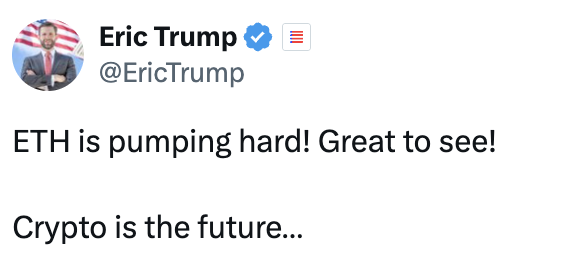
ETH is pumping hard! Great to see! Crypto is the future…

BREAKING: Iran's IRGC announces that it is officially closing the Strait of Hormuz "until further notice." The announcement came after Iran fired a warning shot at a vessel which it said was attempting to cross the Strait of Hormuz without authorization.