TTT

275 posts

TTT banner
TTT

TTT

@TTT_Shogun

@Shogun_AI_ Co-founder_CMO Your work context. Persistent across every AI. No restarts. No re-explaining. App. MCP. CLI.

Japan Katılım Ekim 2020
349 Takip Edilen158 Takipçiler
TTT
TTT@TTT_Shogun·
hello twitter, i’ve been building Shogun AI — a local-first “context OS” that gives your AI real memory — and i’m finally starting to share more in public. into ai-native product building, context engineering, and turning “tools” into actual teammates. if you’re building the next wave of ai software, let’s connect 🤝
English
0
2
6
67
Akash
Akash@Akasheth_·
Drop your project, app or website link below I'll check it out and give honest feedback
English
501
4
252
25.4K
TTT
TTT@TTT_Shogun·
@KaiXCreator I agree. In the end, what really matters is who builds what and when—and that’s something only a founder can do.
English
0
0
0
22
Kaito
Kaito@KaiXCreator·
Can you call yourself a founder if your entire product was built by Claude?
English
376
1
253
35.6K
TTT
TTT@TTT_Shogun·
Shogun Brand.
TTT tweet media
English
0
2
6
83
TTT
TTT@TTT_Shogun·
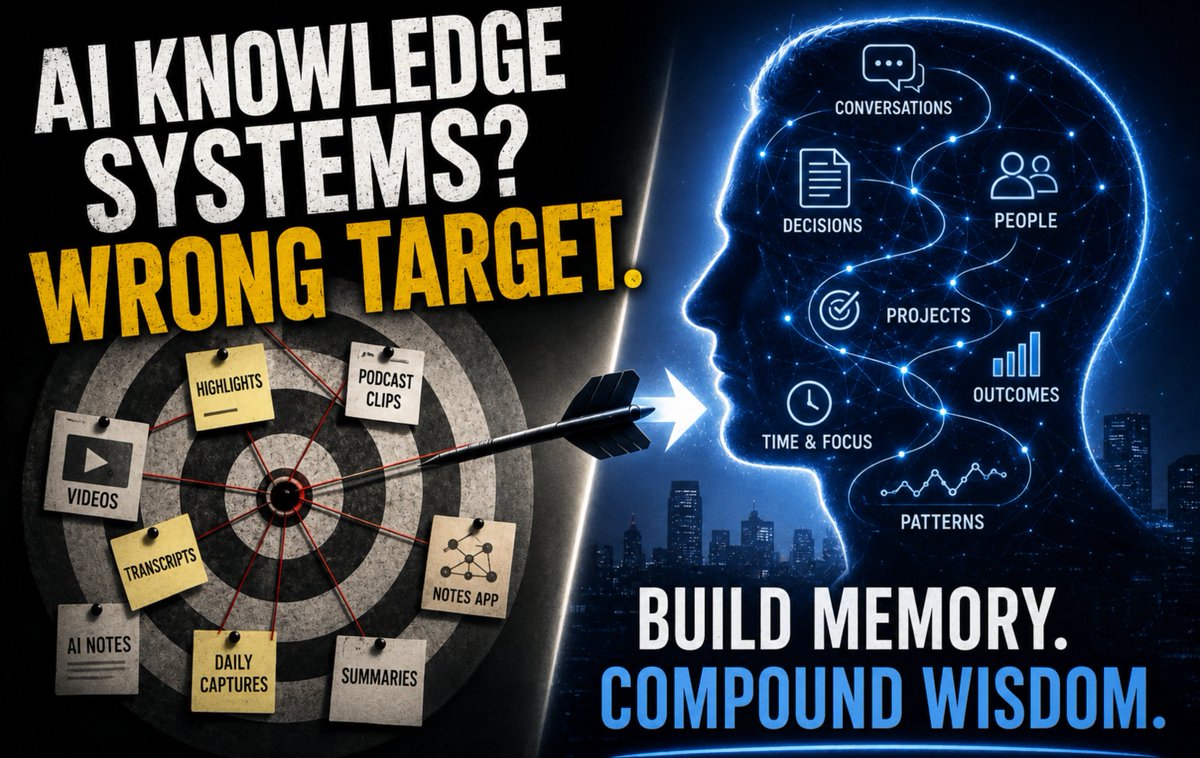
The Second Brain Illusion: Why Most “AI Knowledge Systems” Are Pointed at the Wrong Target Over the last couple of years, there’s been a particular kind of essay spreading across tech Twitter, LinkedIn, and Substack. The story is always similar: someone has finally built the “ultimate Second Brain” — a personal knowledge system that captures everything they read, watch, and think, pours it into a vault, and then sits an LLM on top as a tireless thinking partner. The stack is familiar. A read‑later app with highlighting. A podcast clipping tool. A transcription service for calls and voice notes. A chat bot for quick captures. Some automation glue. A Markdown or graph‑style note app as the “vault.” Then a frontier LLM on top, generating summaries, surfacing insights, answering questions about “your own thinking.” The promise is seductive: invest a weekend wiring this together and, six months later, you’ll wake up with a real partner in thought — an AI that knows you, never forgets, and compounds your ideas over years. I’ve read many of these guides. I’ve built versions of these systems. I’ve watched friends do the same and followed the underlying philosophy back to its early advocates. My conclusion is uncomfortable: almost all of these systems are optimized for the wrong problem. Six months later, most people are left with a beautifully organized archive of fragments — a museum of their thoughts — instead of the live, adaptive intelligence they imagined. This article is an attempt to describe why. Not to dismiss the ambition (the ambition is exactly right), but to name the structural traps in today’s approaches and sketch what a system that actually delivers on the promise would have to do differently. Why “Second Brains” Became Urgent For most of human history, the constraint on knowledge work was input. Books took weeks. Letters took days. Newspapers arrived once a day. The pace of new information was slow enough that you could, in principle, keep up. That world is over. A modern knowledge worker now consumes, in a single day, more information than a literate person two centuries ago saw in a year. Articles, threads, newsletters, Slack channels, docs, issues, DMs, videos, podcasts. The stream is continuous and parallel. The bottleneck is no longer input. It’s retention, synthesis, and recall. For years our only response was personal discipline: read faster, take better notes, build more careful folders. None of it scaled. Quietly, most of us accepted that the vast majority of what we see and think simply evaporates. Then, in late 2022, large language models crossed a qualitative threshold. Suddenly a different idea became plausible: What if you didn’t have to remember? What if your past — books you read, projects you shipped, late‑night notes — could be searched, summarized, and reasoned over by a system that never forgets? What if the static archive of your life could become a live, queryable substrate for present decisions? This is the real promise behind the “Second Brain” wave. It isn’t about being good at note‑taking. It’s about a deeper bet: that you can turn your past self into an active resource for your current self. That bet is correct. A future where your accumulated experience compounds, where today’s decisions are informed by patterns you noticed years ago, where the AI beside you knows you because it has watched you work — that is technically achievable and strategically important. The problem is not the destination. It’s the current map. What the Second Brain Movement Got Right Before the critique, it’s worth stating clearly what the original Second Brain philosophy nailed. Three core ideas still matter, and any successor system must preserve them. First: your “self” is larger than the present moment. You aren’t just who you are today. You are also every previous version of yourself, and the trail of choices, observations, and ideas they left behind. Most people have almost no access to that trail. It shows up as vague impressions and fuzzy memories, not as usable material. The Second Brain movement was right to call this a waste. Someone who can reach back into their own history and pull forward a half‑formed insight at the right moment operates with a fundamentally different kind of leverage. Second: ideas become powerful when they connect. A single observation is interesting. The same observation, lined up next to a dozen others from different domains and years, becomes a thesis. The Second Brain world correctly argued that the value lies in the network of connections, not in the isolated notes — and that no unaided human mind can hold enough of that network at once. Externalize storage, they said, and richer connections become possible. Third: the cost of forgetting is invisible but real. Every forgotten idea is a starting point you no longer have. Every missed pattern is a competitive edge you never develop. You rarely feel this directly, because lost ideas leave no trace. You don’t know what you used to know. Second Brain advocates did a service by naming this explicitly and arguing that systematic reduction of this loss is one of the highest‑leverage investments a knowledge worker can make. These three ideas are more true in 2026 than when they were first popularized. With LLMs plus the right personal memory architecture, we could in principle deliver on them. But the current systems rarely do — and the reasons are structural, not cosmetic. Five Structural Traps Most popular Second Brain recipes fall into several of the following traps. These aren’t minor bugs. They are consequences of the underlying design. Trap 1: Tool‑Wiring Hell A typical “AI knowledge stack” today involves half a dozen or more services: highlights, clips, transcripts, bots, automations, vaults, sync, chat interface, and a few utilities on the edges. On paper, you “set it up in a weekend.” In reality, you spend days choosing tools, signing up, paying, reading docs, connecting APIs, debugging webhooks, and fighting auth flows. By the time the pipeline works end‑to‑end, you’ve spent down the same energy you were supposed to use thinking with the system. Then the real problem starts: keeping it alive. Every dependency is a failure point. A provider changes an API. A free tier expires. A token dies silently. A note app updates its sync model. Each break steals an evening of your attention — always at the worst possible moment — just to get back to zero. Empirically, most DIY Second Brain stacks rot within a couple of months. A small minority survive, usually maintained by people who enjoy the maintenance itself. For everyone else, the system becomes a half‑working relic: some flows running, some broken, nobody quite sure which. Trap 2: The Five‑Percent Capture Ceiling This is the deepest trap, and the least discussed. Almost all current systems assume: “When something important happens, you will notice it, decide it’s worth saving, and take an action to capture it.” Practically, that means: While reading, you highlight key passages. While listening, you tap to clip. When you have an idea, you open a bot or note app. For important meetings, you remember to hit record. After a book or project, you sit down to write a summary. Each of these depends on a three‑step loop, in real time: You recognize that something matters. You decide it’s worth capturing. You perform a capture action. Now ask: what share of your actual meaningful cognition clears all three gates? For most people, it’s a tiny slice. Consider what never makes it in: The instant in a chat when you feel a proposal is wrong, before you can explain why. The half hour jumping between tabs, integrating five articles into a mental model you never write down. The debugging session where your sequence of attempts (and the intuitions behind them) is the whole story. The email you draft, delete, and decide not to send — and the reasons you held back. The design comparison where your gut chooses B over A for reasons you can’t verbalize yet. The micro‑expression in a meeting that tells you someone is silently resisting. The pattern of re‑opening the same doc or ticket three times in a week. The way your energy collapses every Tuesday afternoon. The code you wrote yesterday that already feels foreign this morning. All of this is you. It’s how your actual thinking, judgment, and behavior manifest. Nearly none of it flows through the “notice–decide–capture” pipeline. Meanwhile, the LLM sitting on top of your little archive confidently tells you what you care about and how you think. And its answers feel plausible — because they are true about the sliver of you that you chose to capture. But that sliver is biased. It’s weighted toward articulate, quotable, self‑flattering moments. The real substrate of your life — the messy, continuous stream of micro‑decisions and patterns — is mostly absent. You end up with a convincing portrait of your captured self, painted by an excellent storyteller. The danger is that you start mistaking that portrait for the whole person. Trap 3: The Frictionless Myth To fight Trap 2, most guides focus on “reducing capture friction.” One‑tap clips. One‑shake highlights. One‑sentence voice notes. The dream is that capture becomes so easy you barely feel it. The problem is that the real cost of capture is not the click. It’s the meta‑attention. The moment you read “with highlighting in mind,” a part of your brain is no longer reading. It is monitoring: “Is this important? Should I mark this? Did I already capture something like this?” That monitoring runs on the same limited attention you need for understanding. You can either lose yourself in the material and forget to highlight, or you can highlight diligently and absorb less. There is no magic mode where you fully read and fully capture at the same time. The same trade‑off applies to podcasts, meetings, and everyday work. You cannot be fully present and simultaneously run a constant “should I save this?” process in the background. “Frictionless” tools don’t remove this cost; they just hide it. The friction moves from your fingers to your attention. And because you don’t see the misses — the ideas and moments you never captured — you systematically overestimate how complete your archive is. A truly low‑friction system would not demand meta‑attention at all. It wouldn’t ask you to notice and decide in the moment. It would simply observe the work you’re already doing and structure it into something usable without interrupting you. That is a much harder design problem than making the save button prettier. Trap 4: Filing Cabinets Posing as Memory Most Second Brains today are, at bottom, storage systems. They save text into files, documents, or vectors, then ask a model to retrieve and summarize later. That’s not memory. That’s filing. Human memory has very particular properties that make it useful: It’s temporal: experiences are bound into eras (“when I was working on X”), not just timestamps. It’s contextual: memories come with attached people, goals, worries, open loops. It’s reinforced: things you revisit become more accessible; rarely used details fade. It’s abstracting: you continuously distill specific events into patterns and principles. A random Markdown file sitting in a vault has almost none of this. It’s frozen text plus a date and maybe some tags. When an LLM reads it, it’s always “cold” — stripped of the living context in which it mattered. That’s why many AI‑on‑notes systems feel strangely hollow. You get coherent answers that quote your documents, but it doesn’t feel like something that actually knows you. It feels like something that has merely read you. What we actually need is a genuine memory layer above raw storage: a structured representation of your work and life that tracks projects, decisions, outcomes, patterns, and their evolution over time. The AI should be querying that layer, not just re‑reading files from scratch. You can’t reliably bolt such a layer on after the fact. It has to be part of the design from day one. Trap 5: Compounding in the Wrong Direction Everyone in this space loves the language of compounding: six months to usefulness, a year to indispensability, three years to a moat. Compounding is real — but it only matters what you’re compounding. A typical system, after half a year, has accumulated: A few hundred highlights Some podcast or video clips Transcripts of select meetings A pile of AI‑generated summaries and weekly reviews This is something. But compare it to what could exist after the same six months if you captured the structure of your actual work: A linked record of key decisions and their context Detected patterns in your repeated mistakes The ground‑truth allocation of your time and attention Your observable energy and focus rhythms The trail from past decisions to real outcomes The evolution of your interests as revealed by behavior, not intention The texture of your collaborations and which ones produce traction Both are “compounding.” Both will generate impressive‑looking demos. Only one meaningfully improves your ability to choose and act in the future. One compounds your described self — the version of you that shows up in deliberate notes. The other compounds your lived self — the trace you actually leave in the world. Over three years, those trajectories diverge so far that they might as well be different species. The Root Cause: Who Feeds the System? All of these traps flow from one design decision: Most current Second Brains treat the user’s deliberate effort as the primary input source. If your core assumption is “the user will actively feed the system,” then everything else follows: You need lots of tools for lots of input types. You will always be limited to what the user remembers to capture. You must pretend capture can be “frictionless,” even though the real friction is cognitive. You will mostly store text fragments, because that’s what users can practically produce. You will compound artifacts of effort, not the structure of life and work. The way out is to flip the assumption. What if the user is not the input source, but simply the subject? What if the system observes their real activity — reading, writing, coding, meeting, deciding — and builds a structured memory from that, while demanding almost nothing in the moment? What if the primary “interaction” is just living your day? That is not a small optimization. It is a different category. Five Principles for What Comes Next If we take the critique seriously, any real successor to today’s Second Brains needs at least these five properties: Truly passive capture. The system records what you actually do — across apps and contexts — without you having to press a button or maintain constant vigilance. A real memory layer. Captured activity is organized into timelines, projects, decisions, and patterns, with reinforcement and abstraction built in. The AI talks to this layer, not a pile of documents. A single, integrated product. One installation, one surface. Capture, memory, and AI interaction shipped as one coherent system, not a DIY graph of SaaS tools. Local‑first and user‑owned. A decade‑scale memory of your life cannot be hostage to someone else’s cloud account. The default should be: lives on your machine, under your control. Memory tied to action. The goal isn’t to reminisce. It’s to move. The same context that explains past decisions should help draft the next email, prepare the next meeting, and nudge the next move on a stuck project. The Real Stakes This is not just about nicer note apps. In the next decade, the main gap between knowledge workers won’t be “who uses which model.” It will be: who can consistently hand an AI rich, precise, personal context — and who can’t. You cannot conjure that context on demand. When you open a chatbox and type a clever prompt, it’s already too late. Either you’ve been quietly building a structured record of your work and life for years, or you haven’t. The Second Brain movement sensed this before most people did. It pointed in the right direction but, in my view, stopped one layer too early. If you already invested in these systems, you’re ahead of the majority who have done nothing. But it’s worth asking, with some honesty, what exactly you’re accumulating — and whether that is the substrate you want compounding for the next five years. The first step is to stop mistaking a well‑organized archive for an actual memory. The second is to notice how much of your real thinking never makes it into any archive at all. The third is to design, or adopt, systems that start from that gap instead of ignoring it. Everything meaningful follows from there.
TTT tweet media
English
0
3
11
177
TTT
TTT@TTT_Shogun·
@saen_dev No doubt about it. I really learned a lot from this launch. I’ll start preparing for the next version’s launch. Thank you. If you have any thoughts or concerns about the context layer, I’d love to hear them.
English
0
0
3
22
Aaliya
Aaliya@aaliya_va·
@TTT_Shogun cool would love to support keep us in the loop
English
1
1
2
22