nabbo (bio/acc)

3.7K posts

nabbo (bio/acc) banner
nabbo (bio/acc)

nabbo (bio/acc)

@TensorTwerker

folding proteins @try_litefold

conserved motif Katılım Nisan 2025
757 Takip Edilen2.6K Takipçiler
Sabitlenmiş Tweet
nabbo (bio/acc)
nabbo (bio/acc)@TensorTwerker·
The future of biotech looks kinda grim if big labs with unlimited resources keep closing off their model weights like AlphaFold 3, and if LLMs keep cutting you off the moment you ask anything related to biology. AlphaFold 2 was open, and it changed everything. Everyone could build on it. ESM and OF3 still open source, thankfully, and really close to AF3 after years of work. And now general LLMS are getting so jumpy, they won't even answer basic biochem questions, just look at Fabel 5. Then there's GPT-Rosalind, OpenAI's model for biology and drug discovery, looks powerful but again locked behind trusted access and enterprise customers. So, unless you're a big pharma or have the right contacts, you are in the permanent underclass. We need much better bio safety guardrails, refusing to answer doesn't make it automatically safer.
English
5
10
123
8.8K
nabbo (bio/acc) retweetledi
Niko McCarty.
Niko McCarty.@NikoMcCarty·
About 6.2 billion basepairs of DNA are 'packed' into the nucleus of each human cell. Scaled by a factor of 500,000x, this is akin to packing a 1,000-kilometer-long string (roughly the distance from New York City to Detroit) into a small bedroom. How does all that DNA fit? Well, let’s do some back-of-the-envelope calculations: The human genome is 6.2 billion basepairs in length, and each basepair is separated by 0.34 nanometers along the helix. (A carbon-carbon single bond is about half that length.) Multiply these numbers together, and we see that the DNA inside of each cell stretches about 2.1 meters in length. This is not a scaled value! A human cell nucleus has a diameter of about 6 micrometers. So what fraction of that nucleus is 'occupied' by the DNA? First, we calculate the volume of the cell nucleus. Given a radius of 3 micrometers, and using the regular equation (V = 4/3*pi*r^3), we get a volume of 113 cubic micrometers. The DNA can be modeled as a cylinder. This cylinder is 2.1 meters long and about 2 nanometers in diameter. Again, using the equation for volume of a cylinder (V=π*r^2*h) we get 6.6 cubic micrometers. In short: The human genome occupies about 6% of the cell nucleus. This is not tightly packed at all. The main problem is that once you pack all of this 'string' into the nucleus, you have created a really difficult search problem for yourself. This string is coiled up tightly and, if you are an enzyme, then you might need to find a particular segment of the string located at, say, position 4,284,283,192. Good luck with that! And yet, cells have evolved highly effective search strategies to quickly retrieve information, which I think is one of the great innovations of evolution.
Niko McCarty. tweet media
English
10
51
254
14.3K
nabbo (bio/acc) retweetledi
Michael - Protein Thx and Biologics
Six months ago this was a dream. Now I have my own alphabetized 30 year old chemical stocks! Kidding aside this is a big moment and allows me to continue developing the technology, pipeline, and team. We will be releasing some data and updates soon. @FabricagenDOTai
Michael - Protein Thx and Biologics tweet media
English
2
1
20
1.3K
nabbo (bio/acc)
nabbo (bio/acc)@TensorTwerker·
the key to understand something is to raw dog the paper in one sitting, no agents, no coffee, just water and a notebook
English
0
1
17
563
GAMA Miguel Angel 🐦‍⬛🔑
HAALAND is even found in proteins 🤪 Interestingly, other proteins with the same fold (CATH: 1.20.140.10) also contain the same "HAALAND" motif.
GAMA Miguel Angel 🐦‍⬛🔑 tweet media
English
3
6
63
2.6K
nabbo (bio/acc)
nabbo (bio/acc)@TensorTwerker·
The Pareto tradeoff is absolutely real and you can apply it everywhere in real life
English
0
0
9
399
Kate Stafford
Kate Stafford@kastacholamine·
Setting up a new git repo and some config stuff wasn’t right. Claude offered to fill in my name, then suggested “Kevin Stafford”. Latent LLM sexism still alive and well!
English
1
1
15
1.1K
nabbo (bio/acc) retweetledi
Magnus Bauer
Magnus Bauer@kinasekid·
Can we program a kinase like a switch? Inspired by natural autoinhibitory complexes, we designed miniproteins against active- and inactive-like conformations of Focal Adhesion Kinase. Depending on the targeted state, the resulting binders either activated or inhibited the kinase.
English
8
42
205
15.4K
Jino Rohit
Jino Rohit@jino_rohit·
i had an amazing interview experience with nvidia, ill try and compile my thoughts when i get some time
Jino Rohit tweet media
English
60
8
1.1K
66.5K
Greg Preibisch, MD
Greg Preibisch, MD@GregPreibisch·
@TensorTwerker On the examples on the main page... You can see shadows on the structure. It seems to be fundamentally wrong...
English
1
0
2
209
nabbo (bio/acc)
nabbo (bio/acc)@TensorTwerker·
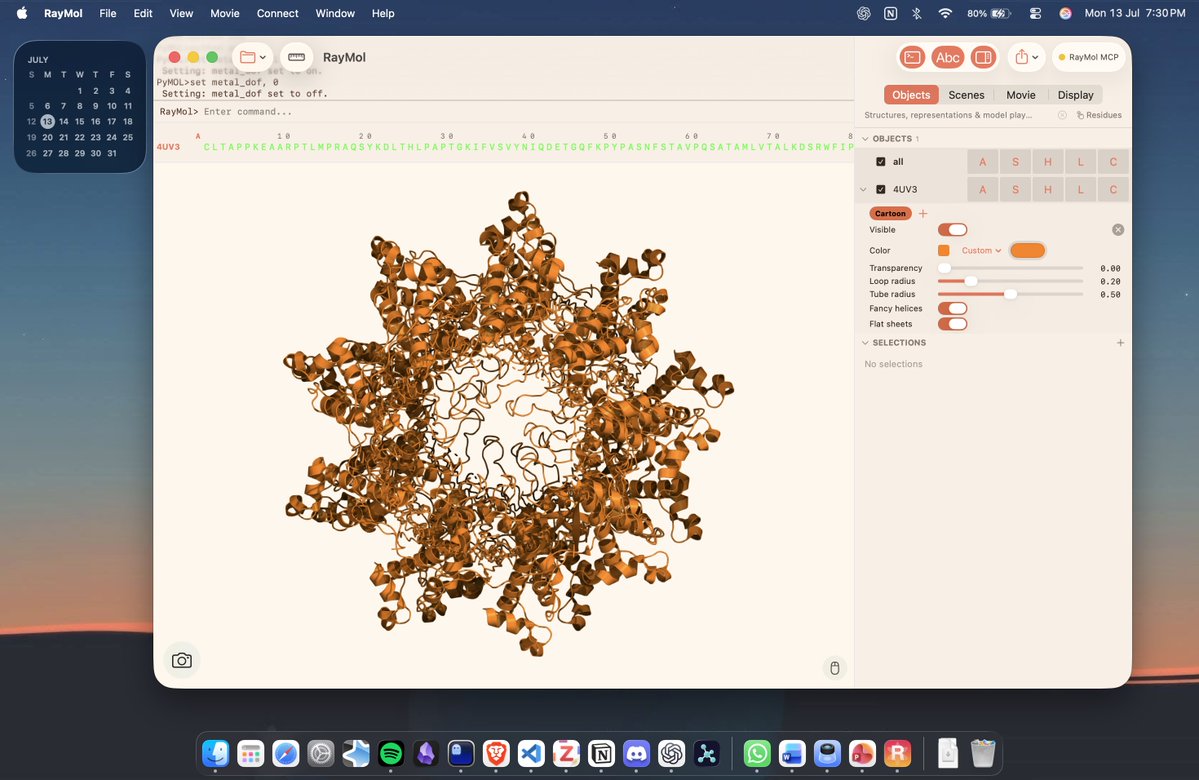
if you have apple silicon, i think raymol is a pretty cool project to check out. hundreds of such pymol projects exists, i found this one pretty cool and the other one rust implement pymol (i think? i forgot)
nabbo (bio/acc) tweet media
English
2
5
99
5K
nabbo (bio/acc) retweetledi
Martin Pacesa
Martin Pacesa@MartinPacesa·
The fold complexity scoring game has been updated with additional aspects of protein complexity according to suer feedback! All the scores have been recalculated and at least to me seem to correlate better with the apparent complexity of the fold! Happy voting!
Martin Pacesa tweet mediaMartin Pacesa tweet media
Martin Pacesa@MartinPacesa

We often talk about complex protein folds but what does that really mean? Turns out we don't have a good metric for it. So we made a game to make one! Head over to our website to vote on which fold you think is more complex and why! pacesalab.com/foldcomplexity…

English
2
6
42
6.1K
nabbo (bio/acc)
nabbo (bio/acc)@TensorTwerker·
already got my nose clogged up in this rainy day, i would kill to get some manchow soup
English
1
0
3
208