Ether Machine (ETHM)

959 posts

Ether Machine (ETHM) banner
Ether Machine (ETHM)

Ether Machine (ETHM)

@TheEtherMachine

An Ethereum Operating Company (NASDAQ: ETHM)

Katılım Nisan 2025
10 Takip Edilen11.8K Takipçiler
Sabitlenmiş Tweet
Ether Machine (ETHM)
Ether Machine (ETHM)@TheEtherMachine·
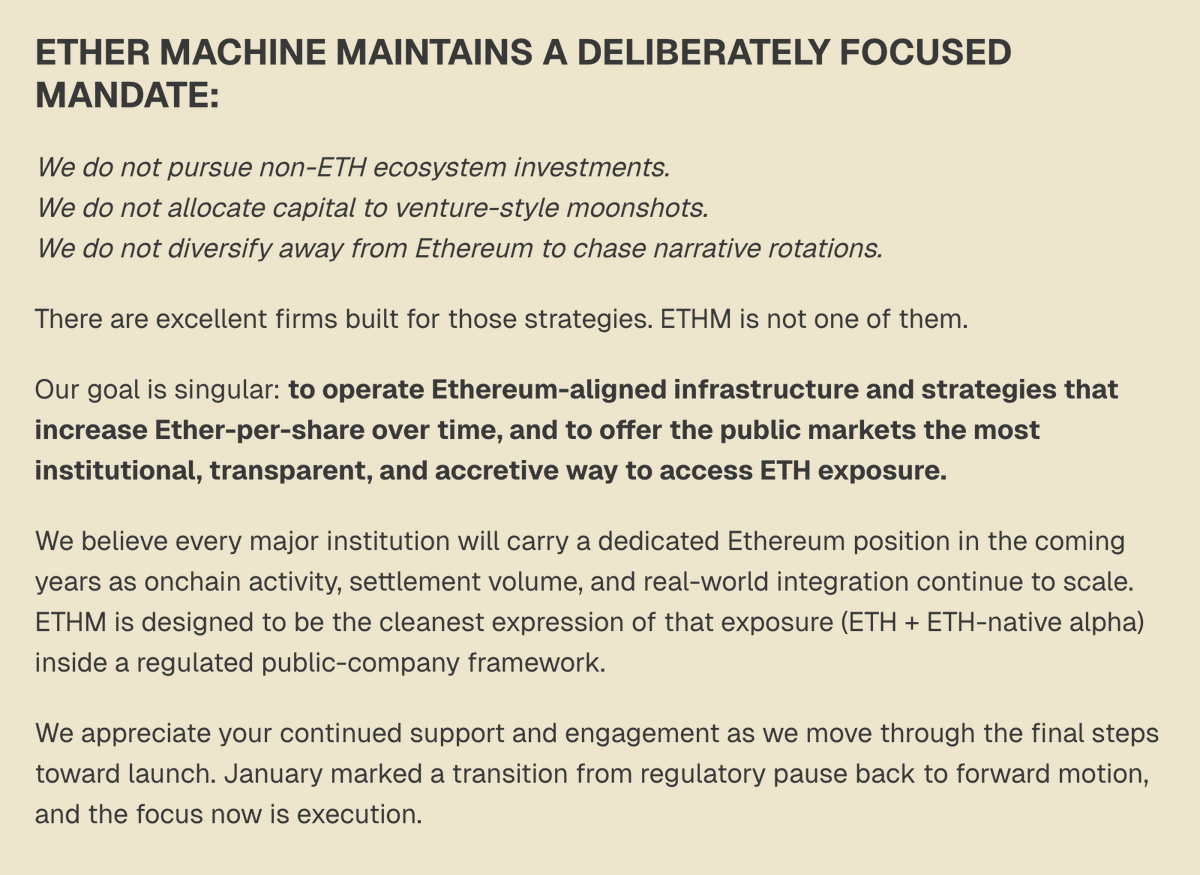
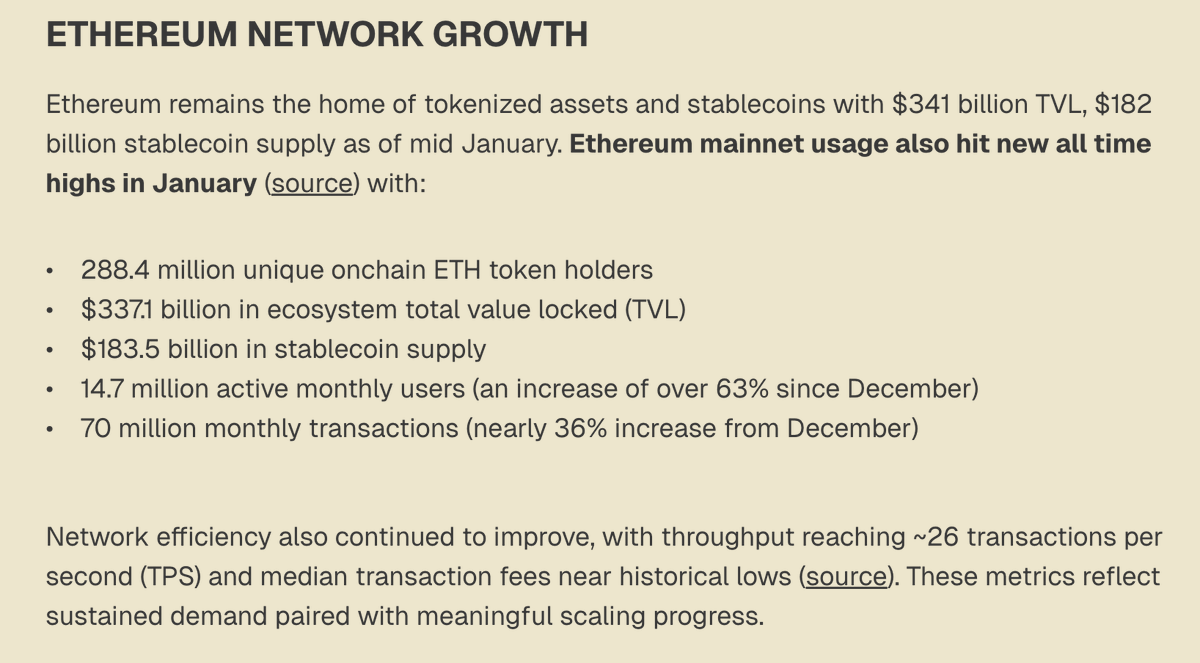
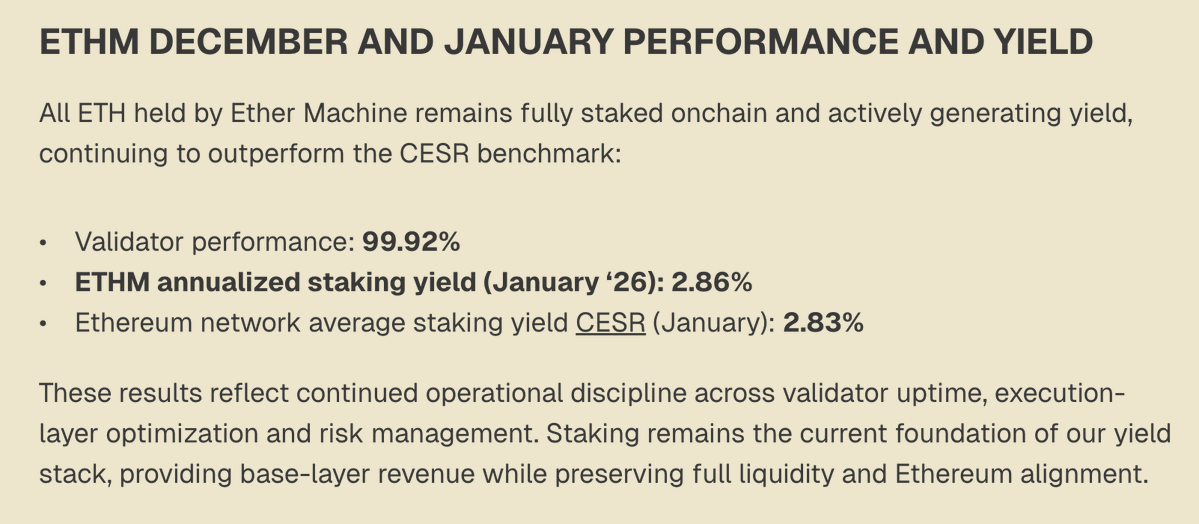
Highlights from our Ether Machine January investor update: We entered 2026 working toward the public launch of Ether Machine. We continue to expect the remaining steps – SEC clearance, shareholder vote, and close – to follow in sequence once SEC comments are resolved. As we move through this regulatory phase, we want to reiterate our belief in a core point: Ether Machine is built to operate and generate ether regardless of short-term public-market dynamics. We are not a passive Digital Asset Treasury. At launch we will be an Ethereum Operating Company, designed from inception with the intent to increase ETH-per-share via staking infrastructure, protocol participation, and onchain operations. Ethereum on our balance sheet is not the end point, it’s the starting point, and our team is actively creating value today through staking, and in future through active management decisions around restaking, DeFi, and other Ethereum-aligned opportunities.
Ether Machine (ETHM) tweet mediaEther Machine (ETHM) tweet mediaEther Machine (ETHM) tweet media
English
7
5
33
2.6K
Fede’s intern 🥊
Fede’s intern 🥊@fede_intern·
I have many criticisms of the Ethereum Foundation. But "no more manifestos, more shipping" from @hosseeb, a VC, is not feedback I'll take seriously. The ship faster intuition makes sense in one world: startups. You're burning runway, competitors are moving, every week debating is a week someone else is taking your market. I run many companies, we deliver, we grow fast, billions flow through what we've built and millions use our products. I know this logic from the inside. It's correct there. Ethereum is not a startup. It never was. It's a protocol. The mistake that keeps getting made by smart people with product backgrounds or VCs is applying the rules of one game to a completely different one. What makes Ethereum worth anything as infrastructure is credible neutrality. The belief that no single entity controls it. Not @VitalikButerin, not the @ethereumfndn. Theguarantee isn't in the code, it lives in thousands of independent people who are constantly watching, arguing, and who have shown repeatedly they will reject changes they consider illegitimate. The picture I'm posting captures perfectly the aesthetic of crypto taken over by performative believers: people who lost billions, kept the faith, and now demand to be taken seriously in fashion shoots. This is one of the two forces squeezing out the people actually building. Impatient capital that wants product velocity, and a performative culture that turned a technical movement into a costume party. Both are corrosive, both misunderstand what Ethereum is. Ethereum's premium over every other L1, despite being slower and more expensive, comes from one thing: people believe it won't be captured. The reason why it's also more expensive and slower is exactly because of this. All the research and technical work we're doing is difficult because we want to be the most decentralized L1 with Bitcoin. We want to become fast without losing our guarantees. Funds like Dragonfly have a structural incentive pointing in one direction. Criticize Ethereum's velocity, create urgency, justify backing cheaper copycats. This produces a genuine blind spot around the things that don't look like shipping but are actually holding everything together. The moment Ethereum optimizes only for shipping cadence over legitimacy it starts looking like every other foundation controlled chain. There are dozens of those. They're worth a fraction of the value. This doesn't mean Ethereum should be slow. This doesn't mean we shouldn't strive to become better. I've been one of the strongest critics of Ethereum. I'm burning a big part of my capital to push the boundaries of Ethereum. I'm building multiple companies on top and trying to make it faster and I'm trying to bring users to it. Believing that writing a manifesto is blocking the development of a protocol is ridiculous. The EF has real problems. Opaque communication, poor prioritization, bad recruiting, organizational dysfunction with real costs. These deserve serious criticism from people who understand what they're maintaining. But the solution is not startup logic applied to a protocol commons. It's better institutional design that preserves legitimacy while improving coordination. Those are different problems with different solutions. To the "just ship" crowd, from someone who has spent years building on these systems and not writing checks at them: the thing you want to optimize away is the thing you're invested in. The slow, pluralistic, nobody wins unilaterally process is not the cost of Ethereum. It's the product. The alternative is this Vanity Fair picture. A worse, cheaper version of TradFi dressed up in velvet and leopard print, demanding to be taken seriously.
Fede’s intern 🥊 tweet media
English
31
38
393
59.4K
Ether Machine (ETHM) retweetledi
Erik Voorhees
Erik Voorhees@ErikVoorhees·
It may be obvious in hindsight that we actually built crypto for the machines
English
227
391
3.7K
162.7K
Ether Machine (ETHM)
Ether Machine (ETHM)@TheEtherMachine·
This is the tokenization vision. Ethereum is the tokenization host.
Etherealize@Etherealize_io

Coinbase CEO Brian Armstrong: 4 billion people can’t invest in high-quality assets “Tokenization is kind of a buzzword right now and it is really important as a trend because the same thing that happened with stablecoins — where a dollar got ‘tokenized’ and now people all over the world can use it and there’s fast/cheap/global payments — is now happening in the equities market and every asset class that people might want to invest in.” Brian explains why this is so important: “There’s about 4 billion adults right now who are ‘unbrokered’. Some people have heard about being ‘unbanked’, but there are also about 4 billion people who are unbrokered, meaning they don’t have any way to invest in high-quality assets — whether that’s American tech companies or the latest BlackRock or Apollo fund. When you tokenize it, there’s a bunch of efficiency gains. But it’s also about democratizing access . . . People who only make their income from labor are oftentimes left out of this wealth-creation engine, which is the ability to invest some of their hard-earned money in high-quality assets. That’s what we’re trying to do with the tokenization of every asset class.” Treasuries, private credit, real estate, and many other real world assets (RWAs) are being tokenized, with Ethereum is the preferred settlement rail for compliant institutional capital markets. More than 60% of all tokenized assets — over $200 billion — reside on Ethereum. Source: @Bloomberg (Jan 2026)

English
2
13
60
4.1K
Ether Machine (ETHM)
Ether Machine (ETHM)@TheEtherMachine·
The SEC and @CFTC jointly classified ETH as a digital commodity yesterday, staking included, under federal law. Institutions weren't waiting on this concrete ruling to get interested, but they were waiting on it to move. A major legal overhang slowing institutional allocation was just lifted. Welcome to ETH🫡
Ethereum Daily@ETH_Daily

🔥 BREAKING: The U.S. Securities and Exchange Commission (SEC) has officially classified $ETH as a digital commodity—not a security—in its groundbreaking new crypto asset taxonomy framework. The classification means ETH derives its primary value from the programmatic functioning of the Ethereum network and market supply/demand dynamics, rather than from any expectation of profits driven by the essential managerial efforts of others (per the Howey test).

English
2
12
28
1.5K
Ether Machine (ETHM)
Ether Machine (ETHM)@TheEtherMachine·
Ethereum will continue to be the default institutional choice for one simple reason: No other chain combines programmability, censorship resistance, and decentralization at this scale. The latest @ethereumfndn Mandate is a reminder of why that has, and will always be, the core requirement and promise as the world goes blockchain.
Ethereum Foundation@ethereumfndn

Today, the Foundation’s Board released the EF Mandate. This document, which was first intended for EF members, reaffirms the promise of Ethereum, and the role of EF within this ecosystem.

English
8
11
85
2.5K
Ether Machine (ETHM) retweetledi
Etherealize
Etherealize@Etherealize_io·
Vitalik Buterin explains why proof-of-stake is more secure than proof-of-work “I think proof of stake is very secure because to attack the system, you need to have basically as much stake as the rest of the network. Right now, for example, we have 5 million ETH staking, which means you have to come up with 5 million ETH and then join the network.” At the time of this writing, more than 37 million ETH are being staked, with 3 million ETH waiting to join via the validator queue. At today’s prices, that’s more than $80 billion of ETH someone would have to acquire to attack the network and revert finalized blocks, which is more than the cost of attacking even the Bitcoin network by some estimates. The other defense mechanism that proof-of-stake has that proof-of-work doesn’t is slashing, which makes Ethereum antifragile. Vitalik explains: “Recovering from attacks is much easier in proof-of-stake than proof-of-work. For many kinds of attacks you do against [the Ethereum] network, we have this concept of automatic slashing. In order to revert a finalized block, you basically have to have a big portion of your validators sign two conflicting messages. This is something where once these messages are on the network, you can go and prove ‘these people did it.’ So we have this feature in the protocol where you basically take all these people who provably misbehaved and you burn their coins.” Vitalik also acknowledges the possibility of censoring attacks, where if 1/3rd of validators refuse to attest, the chain can’t finalize. But, as he explains, Ethereum has a contingency plan for this as well: “Everyone who got censored would create a minority chain, and the community would have to do a soft fork. The would have to say, ‘this chain is clearly attacking us and this one is not attacking us, so we’re going to join this chain.’ Then what happens is, on that new chain, the attackers also lose a lot of coins. The difference between proof-of-stake and proof-of-work is that in a proof-of-stake system, you can identify specific participants — and this isn’t a human going in and saying ‘I don’t like you’. It’s all automated.” One last benefit of proof-of-stake is that security scales with the value of the network. As Vitalik put it five years ago, it is really relative security, and not absolute security, that matters: “The security needs of a thing have to be proportional to the size of that thing, because as a thing gets bigger, its enemies become bigger and more well-motivated. If BTC were 100x as big as it is today, the value from destroying it would be 100x higher, and the kinds of actors that would want to care about destroying it would be much bigger and scarier. This is also why countries of all sizes have roughly similarly sized militaries as a percentage of GDP. Hence, cost of attack divided by market cap really is the correct statistic to measure, and in the long run issuance-free PoW really does look not that good." Source: @lexfridman (Jun 2021)
English
89
147
990
100.3K
Ether Machine (ETHM)
Ether Machine (ETHM)@TheEtherMachine·
The architecture of Ethereum is evolving to separate execution from verification. Verkle Trees reduce proof sizes from 150KB to just 2KB, allowing the network to handle exponentially more activity while lowering infrastructure barriers for global validators. (Featuring @AK_EtherMachine )
English
4
14
43
1.5K
Ether Machine (ETHM)
Ether Machine (ETHM)@TheEtherMachine·
By reducing finality to a single 12-second slot, Ethereum provides the same instant certainty of a wire transfer without the counterparty risk. This is the final friction point for institutions treating Ethereum as their primary settlement rail. (Featuring @AK_EtherMachine)
English
2
14
49
1.9K
Ether Machine (ETHM)
Ether Machine (ETHM)@TheEtherMachine·
This week on Ethereum: Network security on Ethereum is enforced through protocol-embedded incentives. Validators lock ETH to secure the chain, transforming a digital asset into the foundational security layer for the world's most active decentralized ledger.
English
4
14
29
976
Ether Machine (ETHM)
Ether Machine (ETHM)@TheEtherMachine·
Network effects are the primary driver of long-term digital asset value. While speed is a feature, Ethereum’s ability to compound developers, users, and capital creates a sustainable lead in the decentralized economy.
English
1
7
25
675
Ether Machine (ETHM)
Ether Machine (ETHM)@TheEtherMachine·
In a world of central server failures, Ethereum’s network of over 100,000 nodes provides a financial infrastructure with no single point of failure. This decentralization is what makes programmable finance truly resilient and always available. Next episode: Ethereum's Network Effects. Follow The Ether Machine to stay tuned!
English
3
13
36
1.4K
Ether Machine (ETHM)
Ether Machine (ETHM)@TheEtherMachine·
This week on Ethereum: Ethereum has become the primary infrastructure for digital dollars, with billions in stablecoins like USDC and USDT settling on-chain every day. This shift proves that the network's value lies in its role as a neutral, global settlement layer for traditional currencies.
English
6
9
29
846
Ether Machine (ETHM)
Ether Machine (ETHM)@TheEtherMachine·
Recent upgrades have reduced Layer 2 transaction costs by up to 95% while simultaneously increasing throughput. This technical evolution proves that Ethereum can scale globally without sacrificing the decentralization that financial institutions require. (Featuring @AK_EtherMachine)
English
3
9
26
788
Ether Machine (ETHM)
Ether Machine (ETHM)@TheEtherMachine·
A system handling billions requires robust security. Ethereum achieves this through Proof of Stake, where validators must lock up ETH to verify activity, ensuring the network is secured by the very value it protects. Next episode: Why Ethereum Is Decentralized. Follow The Ether Machine to stay tuned!
English
0
7
22
928
Ether Machine (ETHM)
Ether Machine (ETHM)@TheEtherMachine·
By turning contracts into self-executing software, Ethereum removes the need for traditional intermediaries. This is the foundation of programmable finance, enabling a more efficient, transparent system for global digital assets. Next episode: Why Ethereum Needs Validators. Follow The Ether Machine to stay tuned!
English
5
8
23
763
Ether Machine (ETHM)
Ether Machine (ETHM)@TheEtherMachine·
With $300B+ in stablecoins already on-chain, Ethereum is proving to be the primary infrastructure for the future of money. By offering a credibly neutral base layer, it allows institutions to move beyond simple liquidity and into programmable, 24/7 financial rails. (Featuring @AK_EtherMachine)
English
3
12
41
1.3K
Ether Machine (ETHM)
Ether Machine (ETHM)@TheEtherMachine·
Institutional-grade infrastructure is transforming settlement from days to seconds. By moving from Proof of Work to Proof of Stake, Ethereum enables T+0 settlement and programmable compliance, which TradFi leaders like @BlackRock and @jpmorgan are already adopting. (Featuring @AK_EtherMachine )
English
1
10
26
1.2K
Ether Machine (ETHM)
Ether Machine (ETHM)@TheEtherMachine·
The strength of a network is measured by the capital and talent it attracts, not the promises it makes. Ethereum doesn't just compete; it compounds the value of the entire ecosystem.
English
1
7
31
833
Ether Machine (ETHM)
Ether Machine (ETHM)@TheEtherMachine·
Most digital assets aim to create value through speculation, but Ethereum is built to create value through utility. By requiring Ether for every transaction and destroying a portion of the supply through usage, Ethereum’s economic design aligns network growth with scarcity.
English
4
7
38
951