Ryan Woodall

5.9K posts

Ryan Woodall banner
Ryan Woodall

Ryan Woodall

@TheFryanPan

Edmonds-Woodway WR Coach | Research Intern @The33rdTeamFB | Youth/Coach Development @CrownDownTrain

Seattle, WA Katılım Ağustos 2019
397 Takip Edilen611 Takipçiler
Sabitlenmiş Tweet
Ryan Woodall
Ryan Woodall@TheFryanPan·
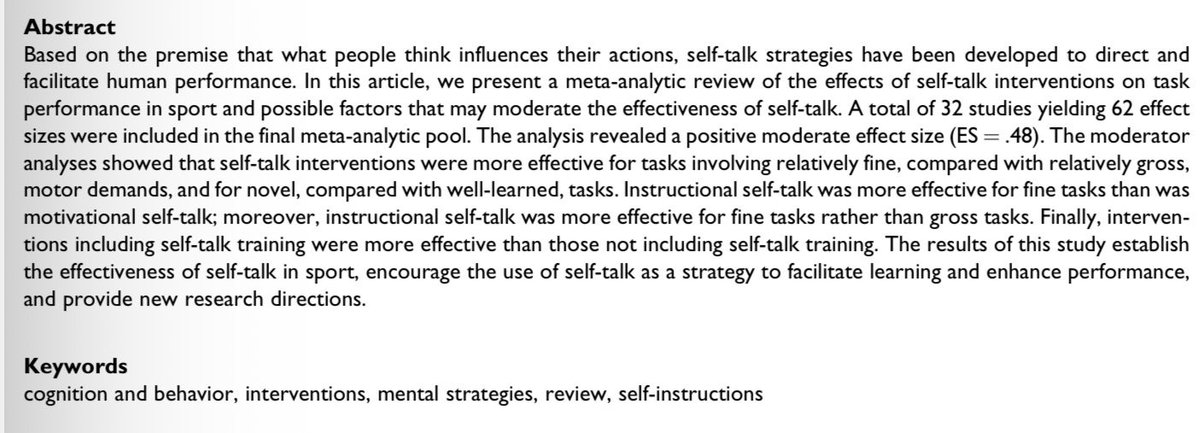
🧵Self-Talk and Sports Performance: A Meta-Analysis - Antonis Hatzigeorgiadis, Comoutos Nikos, Evangelos Galanis, Yannis Theodorakis researchgate.net/publication/22… The study analyzed 32 different studies (yielding 62 effect sizes) to mathematically prove what works and what doesn't when athletes talk to themselves. The overall finding was a positive, moderate effect size (ES = .48), confirming that self-talk reliably facilitates learning and enhances task performance in sports.  1. Fine vs. Gross Motor Demands The Science: Researchers divide sports movements into two categories. Fine motor skills require dexterity, hand-eye coordination, precision, and accuracy (like dart throwing or golf putting). Gross motor skills require physical conditioning, endurance, strength, and power (like long-distance running or a shot-put). The study found that self-talk interventions have a significantly larger effect on tasks requiring fine motor skills (ES = .67) compared to gross motor skills (ES = .26).  2. The Matching Hypothesis (Instructional vs. Motivational) The Science: The study tested the "matching hypothesis," which suggests that the type of self-talk must match the type of task.  • Instructional Self-Talk (Fine): Cues aimed at focusing attention or providing technical/strategic instructions (e.g., "eyes through hands," "high elbow").  • Motivational Self-Talk (Gross): Cues aimed at psyching up, maximizing effort, or building confidence (e.g., "let's go," "give it all").  The Football: Skill players (QB, WR, DB) rely on fine motor skills and hand-eye coordination. Their technique will benefit massively from self-talk. Linemen learning on strength and power (gross motor skills) will still benefit, but the impact is most noticeable when precision is required. If your Quarterback is struggling with his accuracy, yelling "I can do it!" (motivational) won't fix the mechanics. He needs an instructional cue to correct the fine motor skill. Save the motivational "let's go!" cues for the weight room or conditioning.
Ryan Woodall tweet media
English
1
0
0
278
Ryan Woodall retweetledi
Crown Down Training
Crown Down Training@CrownDownTrain·
Eye Tracker Training: Easy (11+ years) Help build your focus, cognitive processing, and vision. Via (Buffed/Youtube)
English
0
1
0
26
Ryan Woodall
Ryan Woodall@TheFryanPan·
@SoftlyAugust Because in the near future Seattle is paying top dollar for WR,CB, and DT. They don’t need a top RB to move the bottom line. Use that money to build depth.
English
0
0
14
5.3K
Ethan🫐
Ethan🫐@SoftlyAugust·
Why shouldn’t Seattle send 32 to Miami for Achane rn
English
130
33
3.7K
313.4K
Dontay Atkinson
Dontay Atkinson@DonAtkinsonNFL·
People: “The 49ers are a retirement home! They are falling behind the Rams and Seahawks who are both much younger!” Really? Number of players over 30 in the 2025/26 season: Rams - 11 49ers - 9 Seahawks - 7 Average player age: Rams: 26.38 years 49ers: 26.30 years Seahawks: 25.77 years The Rams and 49ers have both signed just 1 player 30+ years old here in 2026. The few new Seahawks signing are in their late 20s. The Rams are older than the 49ers. The Seahawks are younger on average by about 8 months. If you want to continue to use a false narrative to predict doom for the 49ers this year, just know that it’s very easy for others to crumble your argument by simply exposing it to sunlight.
English
95
75
742
90.6K
Ryan Woodall
Ryan Woodall@TheFryanPan·
@AdamSchefter Coverage Slot Corner. Gives Seattle more freedom to keep Spoon outside in Nickel/Dime. Curious to see how much Spoon’s role changes with only 2 outside corners in Seattle now
English
0
0
4
616
Adam Schefter
Adam Schefter@AdamSchefter·
Seahawks signed former Washington Commanders cornerback Noah Igbinoghene.
English
133
172
3.3K
417.8K
Steve Magness
Steve Magness@stevemagness·
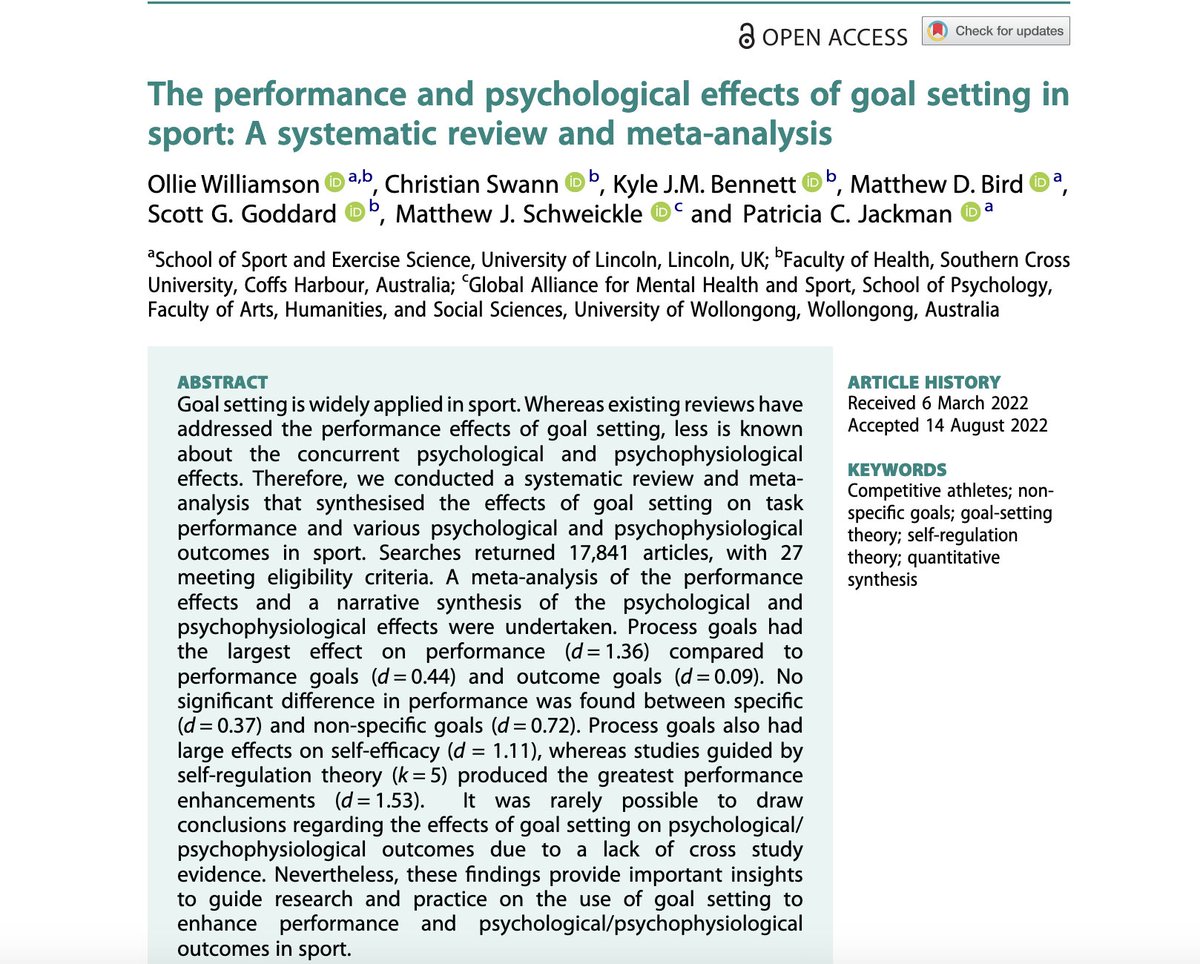
A new meta-analysis on the impact of goal setting on performance found: 1. Process goals had a large effect on performance 2. Performance goals had a moderate effect 3. Outcome goals had a negligible effect
Steve Magness tweet media
English
5
45
287
19.4K
Ryan Woodall
Ryan Woodall@TheFryanPan·
Neuroplasticity-Informed Learning Under Cognitive Load: A Systematic Review of Functional Imaging, Brain Stimulation, and Educational Technology Applications Evgenia Gkintoni, Andrew Sortwell, Stephanos P Vassilopoulos, Georgios Nikolaou researchgate.net/publication/39… 1. Finding the "Sweet Spot" on the Field Learning a physical skill follows the same inverted U-shaped curve as academic learning.  • Underload ("Coast" Zone): Doing the same walk-throughs or low-effort drills every day fails to trigger dopamine and BDNF (the brain's "growth fertilizer"). If players aren't mentally engaged, they aren't improving their neural "wiring".  • Overload ("Panic" Zone): Throwing too many new defensive installs or high-speed complex drills at once causes phase-coupling desynchronization. The brain shuts down to protect itself, and players revert to bad habits because their prefrontal cortex is "offline".  • The Sweet Spot: You want players at 40–60% of their mental capacity. They should have to think, but not so much that they can't move.  2. Managing the "Load" Strategy You can manually adjust practice to keep athletes in that high-growth zone.  Intrinsic Load (The Skill): • Concept: The inherent difficulty of the movement (e.g., a snap get off vs. a pulling-guard assignment).  • Strategy: Use "Part-Task Practice." Break a complex play into its smallest pieces (the footwork, then the hands, then the read). Only once they've "automated" the footwork (reducing the load on the prefrontal cortex) should you add the next layer.  Extraneous Load (The "Noise"): • Concept: Mental energy wasted on long-winded coaching explanations or confusing drill setups.  • Strategy: Use "Visual + Verbal" (Dual Coding). Don't just talk about a play; draw it on a whiteboard or show a quick film clip. This distributes the load across the occipital (visual) and temporal (auditory) regions, making it easier to process.  Germane Load (The "Real" Growth): • Concept: The mental effort spent actually understanding "why" a play works.  • Coaching Strategy: Instead of doing 20 reps of the same block, mix in 5 different blocks in random order. This "desirable difficulty" forces the brain to "re-load" the memory every time, creating much stronger structural synaptic modifications.  3. Prefrontal Cortex The dorsolateral prefrontal cortex (DLPFC) is the brain’s "Quarterback. "It manages resources and executive control.  • Managing Interference: High school athletes are often easily distracted. Training under moderate cognitive load (e.g., a QB making a throw while a coach calls out a number they have to repeat) strengthens the PFC’s ability to "gate" information and ignore the crowd or the pass rush.  Individual Differences: Some players have a naturally higher Working Memory Capacity.  • High-Capacity Players: Need "if/then" scenarios to stay in their sweet spot.  • Low-Capacity/Younger Players: Need one single focus point (e.g., "just watch his belt buckle") to prevent total network breakdown.  4. Practical Optimization Micro-Adaptations (Scaffolding)  If a player fails a rep 2x, stop and give a "scaffold" (slow the pace or give a single-word cue). This keeps them in the "sweet spot" and prevents a stress-induced shutdown.  Attentional Resets Switch drills or move locations every 10-15 mins. This aligns with the brain's natural attention cycles and keeps the prefrontal cortex engaged.  The 1-10 Huddle (Metacognition) After a complex segment, ask: "On a scale of 1-10, how much did you have to think during that?" This builds player self-awareness and helps you gauge their actual cognitive load.  Spaced Reinforcement Teach a new install on Monday, skip it Tuesday, then quiz them Wednesday. Gaps in practice align with neurobiological "consolidation periods" to create permanent memory.
Ryan Woodall tweet media
English
0
0
0
50
Ryan Woodall
Ryan Woodall@TheFryanPan·
Emanuel Wilson’s (Seahawks) ability to get out of the backfield excites me. K9 was loved for turning 0 or neg yards into a positive. Wilson is patient, with vision and has the elusiveness to find the cut or burst around the edge. Wilson YBeforeC: 0.91 YAfterC: 3.06 0/Neg Rush%: 11.2% Cook YBeforeC: 2.09 YAfterC: 3.16 0/Neg Rush%: 10.7% Henry YBeforeC: 1.6 YAfterC: 3.59 0/Neg Rush%: 15.3% Taylor YBeforeC: 1.39 YAfterC: 3.52 0/Neg Rush%: 15.2%
English
0
0
7
1.2K
Ryan Woodall
Ryan Woodall@TheFryanPan·
The Effect of Perceptual-Cognitive Skills in College Elite Athletes: An Analysis of Differences Across Competitive Levels Kuo-Cheng Wu,Su-I Liu, Hui-Chun Lin, Zi-Yi Cheng, Chih-Han Chang, Jo-Ning Chang, Hsia-Ling Tai researchgate.net/publication/39… Reflexes or a bigger "mental RAM"? 1. How do you measure a "Sport’s Brain"? Researchers studied 127 college athletes from sports like soccer, volleyball, and taekwondo. They split them into two main groups based on their competition history:  • Semi-Elite: These are your solid, high-level competitive players.  • Elite: These are the top-tier, "successful," and "world-class" athletes.  To see how their brains worked, they didn't just watch them play. They used two specific "brain games":  Reaction Time: How fast can you click a button when a light flashes? Corsi Block-Tapping: A computer flashes a sequence of blocks, and you have to remember the exact order. Think of this as testing your brain’s working memory or "RAM" of your mind.  2. Reflexes are just the "Entry Fee" You might think the Elite athletes would have lightning-fast reaction times compared to the Semi-Elites. But they didn’t. • In the "No Cue" reaction test, Semi-Elite athletes averaged 573 milliseconds, while Elite athletes averaged 581 milliseconds. Scientists found no significant difference in basic reaction speed between the groups.  Why? • By the time you reach college-level sports, everyone has fast reflexes. It’s a foundational skill you develop over years of practice. Having fast hands gets you on the team, but it doesn't necessarily make you the MVP.  3. The "X-Factor": Working Memory This is where the Elite athletes pulled ahead. They were significantly better at the Corsi Block-Tapping test.  • The Data: Elite athletes had a higher "Block Span" (remembering longer sequences) than the Semi-Elite group.  • The Lesson: Working memory is the ability to hold and use information "in the moment".  In-Game Application: • Semi-Elite Brain: Focused mostly on the ball and the immediate opponent.  • Elite Brain: Can hold the positions of multiple teammates, remember the coach's play, and ignore the screaming crowd all at once.  4. Summary If you want to move from "good" to "elite," don't just practice your sprints or your swing. You need to train your Executive Function (your brain's management system).  • Reflexes are your engine speed.   • Working Memory is your GPS and strategy computer.  • The Winner: The athlete who can stay focused and process the most "data" during the chaos of a game usually wins.
English
0
0
0
146
Ryan Woodall
Ryan Woodall@TheFryanPan·
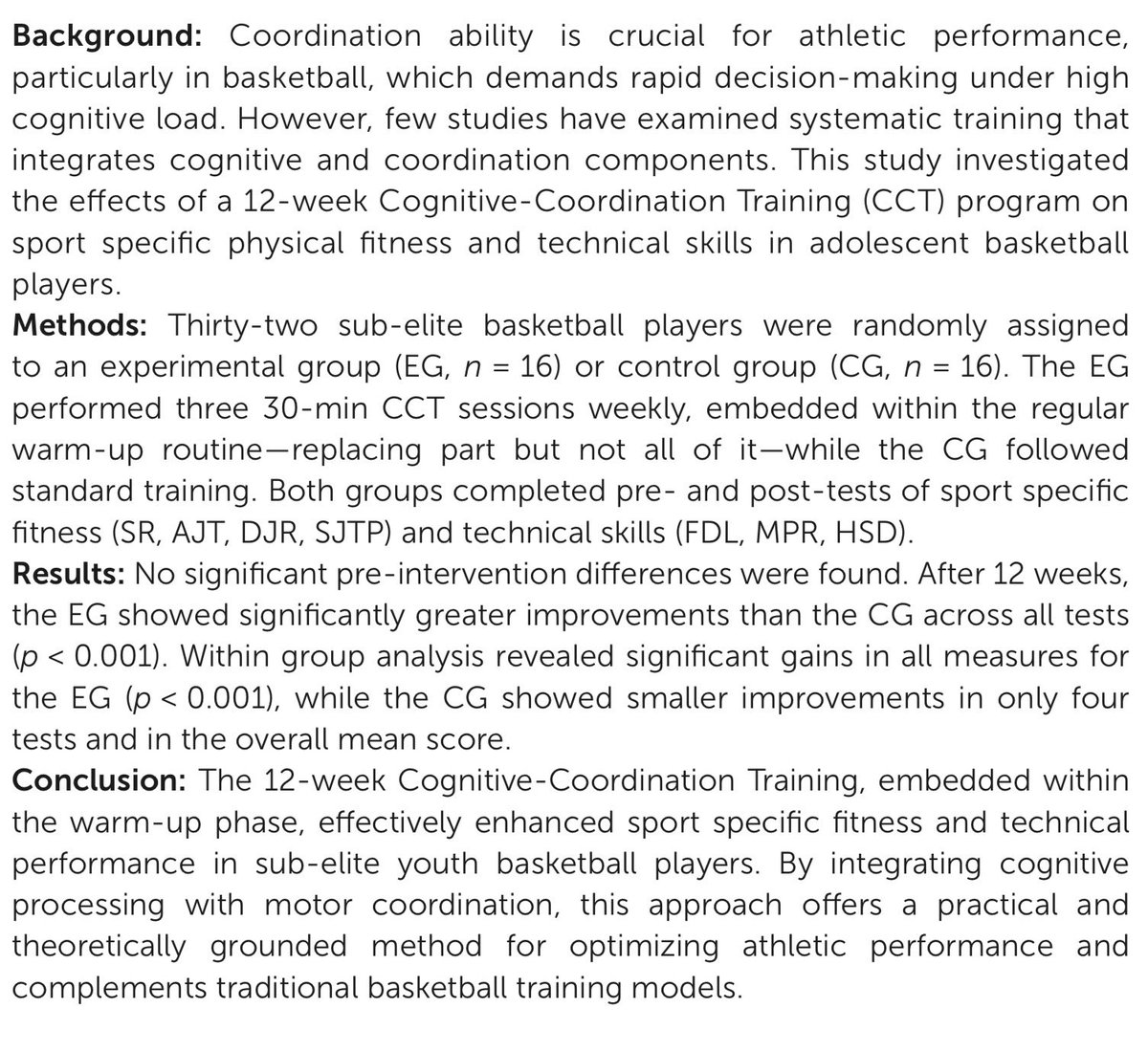
“Cognitive-coordination training: impact on sport-specific physical fitness and technical skill of adolescent basketball athletes.” Qiner Li, Quan Fu, Longhui L, Jingyi Wang frontiersin.org/journals/psych… Cognitive Coordination: the brain’s ability to process complex information while simultaneously executing high-level motor skills.  1. The Executive Functions: In sports, your brain isn't just reacting; it's managing "Executive Functions.” These are the high-level cognitive processes that dictate how you handle a game:  • Inhibitory Control: This is the "brakes" of the brain. It allows a player to stop a planned action. A quarterback holding onto the ball instead of throwing into a late closing window.  • Working Memory: This is your "live" scratchpad. It allows a basketball player to track the positions of nine other people on the court while dribbling under pressure.  • Cognitive Flexibility: This is the ability to pivot. It’s what helps an athlete instantly switch from an offensive mindset to a defensive one the moment a turnover occurs.  2. Neural Efficiency: The "Automated" Athlete The goal of cognitive training is to reach a state of Neural Efficiency.  Elite athletes use less brain power for technical skills because those movements are automated. If a volleyball player has to "think" about their footwork, they have no mental energy left to "read" the opponent's hitter. Training cognitive tasks with motor tasks forces the brain to automate the movement so the "higher mind" can focus on strategy.  3. Perception-Action Coupling Cognitive coordination training fuses seeing & doing through Perception Action Coupling.  Using light based cues or signals (SwitchedOn App) to trigger specific movements. In a game, an athlete never just "runs." They run because they saw a gap, missed shot, or see and hear the bat make contact. By training with unpredictable visual cues, you teach the brain to bypass the "hesitation gap" between seeing a play and making a move.  4. Progressive Cognitive Loading Just as you wouldn't ask an athlete to bench press 300 lbs on day one, you can't overload their brain immediately. You must use Progressive Loading:  • Simple Load: Fixed signals (Red = Jump). This builds basic "perception-motor" foundations.  • Moderate Load: Variable signals (Red = Jump, Blue = Slide). This forces the brain to "choose" under pressure.  • Advanced Load: Context-dependent rules (Only jump on the third red light). This trains high-level working memory and decision-making under fatigue.  Why this changes the game Athletes who train this way don't just get "faster,” they get "sharper." Research shows that this type of dual task training can reduce technical task completion by 1–3 seconds. In sports, a one-second advantage is an eternity. It’s the difference between a clean pass and a turnover.
Ryan Woodall tweet media
English
0
0
0
32
Ryan Woodall
Ryan Woodall@TheFryanPan·
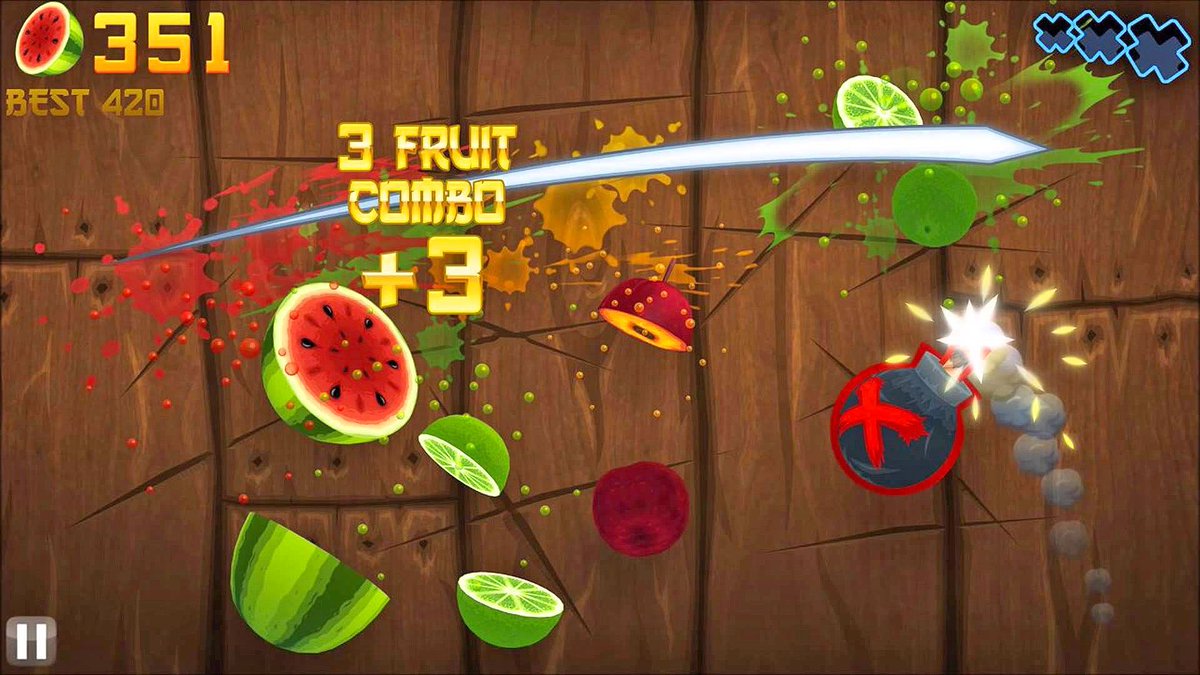
The Reality Check: Does playing Fruit Ninja mean you will become better at solving complex math problems or remembering names? Not necessarily, But it does keep the specific neural networks responsible for split-second decision-making, visual tracking, and impulse control active, lubricated, and sharp.
English
0
0
0
15
Ryan Woodall
Ryan Woodall@TheFryanPan·
4. Working Memory and Prioritization (Arcade Mode) • In Arcade mode, special bananas appear (Frenzy, Freeze, Double Points). • The Cognitive Workout: You have to hold the rules of these bananas in your working memory. When a Freeze banana appears alongside regular fruit and a bomb, your brain has to instantly rank them by value: Avoid bomb (highest priority) > Hit Freeze banana (second priority) > Hit regular fruit (lowest priority). You are doing complex triage in a fraction of a second. Real-World Application: High-stakes multitasking. This is the exact mental filtering process you use when cooking a complex meal (instantly grabbing a pot that is boiling over while monitoring a simmering sauce and chopping vegetables), or when fielding a ringing phone and an urgent question from a coworker without losing your train of thought.
English
1
0
1
35
Ryan Woodall
Ryan Woodall@TheFryanPan·
Fruit Ninja What feels like mindless fruit-slashing is actually a highly concentrated, rapid-fire neurological workout. In cognitive psychology, there is a standard assessment called the "Go/No-Go" task, used to measure a person's capacity for sustained attention and impulse control. Fruit Ninja is essentially a hyper-gamified, neon-colored version of this exact psychological test. 1. Inhibitory Control (Impulse Management) • The game conditions you to swipe at everything that flies up from the bottom of the screen. Your brain creates a "motor plan" to swipe the moment it sees movement. Then, a bomb is thrown into the mix. • The Cognitive Workout: You have to instantly hit the brakes on a physical action you have already initiated. This is called response inhibition. • Real-World Application: Inhibitory control is what stops you from saying something inappropriate when you are angry, or allows you to stop yourself from stepping into a crosswalk when a car suddenly runs a red light. It is a core component of self-control.
Ryan Woodall tweet mediaRyan Woodall tweet media
English
1
0
1
36