

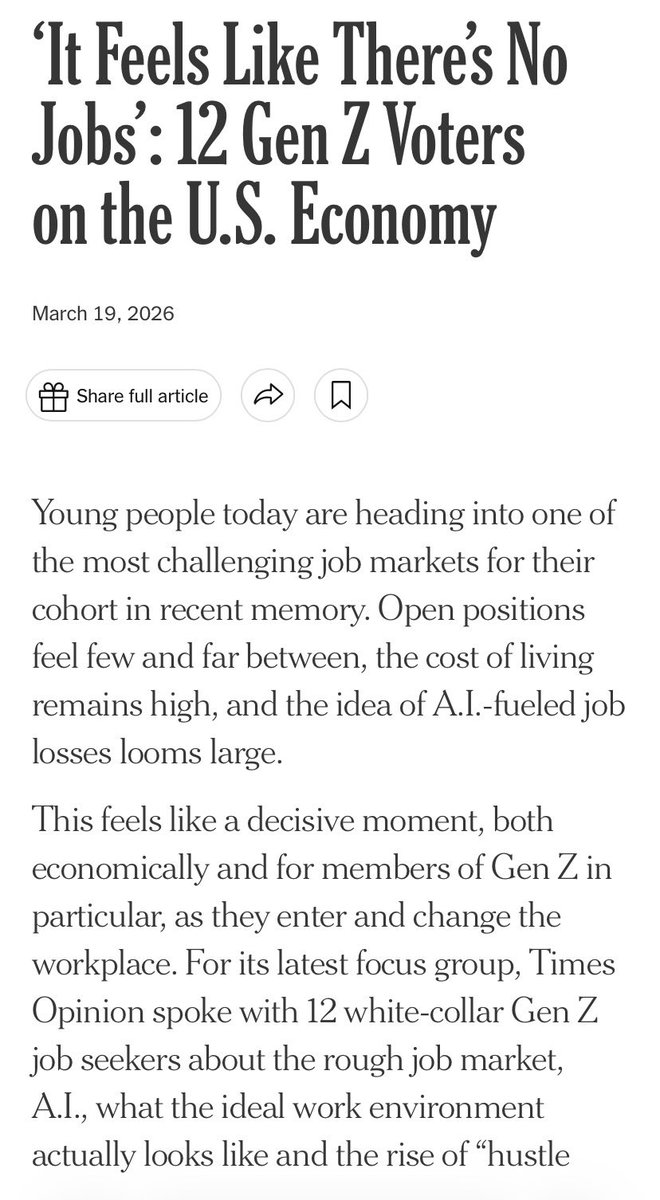
Gen-Z feeling the pain of job search, made worse by AI, per an excellent New York Times article:

English
The Human Front vs AI
831 posts

@TheHumanFront
Exposing AI’s societal harms, such as job losses, erosion of freedoms, and ideological lies. Human dignity is not for sale.

@DavidSKrueger I find it concerning to call people who disagree with you about a technology that doesn't even exist yet "traitors to humanity"
🚨The US housing market is built on one assumption. That the people making the payments will always have jobs. That assumption is now being tested by something we have never faced before. Artificial intelligence is walking into the office and not leaving. Anthropic's CEO warns that AI could wipe out half of all entry-level white-collar positions within five years. And unemployment could spike to 10–20%. These aren’t factory workers, these are the people holding mortgages. Amazon cut 14,000 corporate roles citing AI efficiency, Microsoft followed with 15,000, and Salesforce eliminated 4,000 support jobs. In 2025 alone, U.S. employers announced 1.2 million job cuts, a 58% surge from the year before. Over 54,000 of those explicitly named AI as the reason. Here is what nobody is talking about. The workers being replaced are what banks call "triple-A borrowers." They are the foundation of the mortgage system and there is $14 trillion in outstanding US mortgage debt. The housing market today is three times the size it was in 2008, carrying double the debt. A 15% sustained income drop among AI-exposed workers could push prime mortgage delinquencies from 0.9% to nearly 5%. That is enough to send shockwaves through the entire $9.4 trillion agency mortgage-backed securities market. So what does the government do? Exactly what it did after 2008, print money and trillions of it. But this time the debt load is so large that the interest payments alone could consume 100% of all federal tax revenue. The 2008 crisis was about bad loans made to bad borrowers. This one would be about good loans made to people whose entire income category stopped existing. Goldman Sachs projects 300 million jobs at risk globally. Forrester projects 10.4 million US jobs automated away by 2030. Stanford researchers already see a 13% drop in entry-level hiring for AI-exposed roles. The question is not whether AI takes these jobs. The evidence says it already started. The question is whether the financial system can absorb what comes next before the Jenga tower falls.
Jensen Huang just told every AI leader in the room to grow up. Stop scaring the public with science fiction. Start communicating like the weight of civilization is on your shoulders. Because it is. Huang: “AI is not a biological being. It is not alien. It is not conscious. It is computer software.” That single statement dismantles half the panic surrounding this industry. The mainstream conversation is dominated by people projecting human malice onto math. Alien consciousness onto code. Existential dread onto a software architecture we built, we trained, and we can read. Huang: “We say things like, ‘We don’t understand it at all.’ It is not true. We understand a lot of things about this technology.” When builders tell the public they don’t understand their own creation, the public hears threat. The state responds with control. That is already happening. Palihapitiya asked Huang what he would have told Anthropic during their regulatory clash with the Department of Defense. Huang didn’t attack the technology. He attacked the communication. Huang: “The desire to warn people about the capability of the technology is really terrific. We just have to make sure that we understand that the world has a spectrum, and that warning is good, scaring is less good because this technology is too important to us.” Warning shows risks, mitigation, why upside overwhelms downside. Scaring says we might be building something that destroys us and we can’t stop it. One builds trust. The other invites regulation written in panic. Huang: “To say things that are quite extreme, quite catastrophic, that there’s no evidence of it happening, could be more damaging than people think.” Projecting catastrophe without evidence is not caution. It is sabotage. When your technology is embedded in national defense, the financial system, and healthcare infrastructure, your words carry structural weight. If the architects act terrified of their own product, the response is predictable. Governments step in. They restrict. They seize control of something they don’t understand because the builders told them to be afraid. Huang: “There was a time when nobody listened to us, but now because technology is so important in the social fabric, such an important industry, so important to national security, our words do matter.” Most tech founders have not internalized this. You are no longer a startup founder disrupting an industry. You are running infrastructure that nations depend on. Your statements move policy. Your framing shapes legislation. Your tone determines whether governments treat you as partner or threat. Huang: “We have to be much more circumspect, we have to be more moderate, we have to be more balanced, we have to be far more thoughtful.” Huang did not ask for silence. He asked for precision. The leaders who cannot tell the difference will not be leading for long.


Jensen Huang: "If that $500,000 engineer did not consume at least $250,000 worth of tokens, I am going to be deeply alarmed. This is no different than a chip designer who says 'I'm just going to use paper and pencil. I don't think I'm going to need any CAD tools.'"
"Massive investment in AI contributed basically zero to US economic growth last year," per Goldman Sachs




Some incredible numbers being thrown around in this post re: Chinese humanoids, 80K units this year projected, almost triple 2025 volume, and the kicker: "the piece estimates each humanoid could replace 1.5-2 assembly-line jobs"
Meta's confirmed 15,000+ layoffs are just the cover story I'm hearing the real number is closer to 23,000 when you count contractors and "voluntary departures" Sources inside are saying they've been screen recording senior engineers' coding sessions for 8 months Every prompt. Every debugging session. Every architectural decision. All of it logged and fed into their internal training models One L7 told me he just realized the "productivity metrics dashboard" he helped build was actually profiling which engineers could be replaced first The knowledge extraction is complete now Meta's internal AI agents can replicate 73% of what their senior engineers do daily. The remaining 27% gets offshored to teams in Bangalore with access to the same prompt libraries Those 15,000 people? They've been training their replacements since last summer and calling it "AI enablement" The brutal math: $4.2B in annual salary costs eliminated. $800M in severance. Still a $3.4B savings that funds two more years of GPU clusters One insider said the transition plan shows 4,200 engineers by end of 2026. They had 23,400 eighteen months ago But sure, keep telling people this is about "efficiency" The efficiency is human disposal DMs open if you're still inside
Neil deGrasse Tyson ended tonight's debate with an impassioned plea for an international treaty to ban creating the sort of superintelligent AI that could kill us all.

