Douglas Fleming

4.3K posts

Douglas Fleming banner
Douglas Fleming

Douglas Fleming

@The_Dougger22

Affordable housing, golf, travel and gambling. Coach GR Storm Bball U16. Farm kid at heart. Isla and Leo grandpa! Disney guy!!

Lansing, MI Katılım Şubat 2012
1.5K Takip Edilen540 Takipçiler
Douglas Fleming retweetledi
BJ Saunders
BJ Saunders@WillBJSaunders1·
16u Storm UAA finishes up Session 2 in dramatic fashion with an @elihines3x game winner at the buzzer! 4-0 on the weekend and 7-1 overall putting us in 1st place. Together=TOUGH! #StormDifference 🌩️
BJ Saunders tweet media
English
2
12
26
2K
Douglas Fleming retweetledi
BJ Saunders
BJ Saunders@WillBJSaunders1·
16u Storm UAA continuing to play well and TOGETHER! 3-0 in Session 2 looking to finish the job tomorrow morning..
BJ Saunders tweet media
English
0
10
21
1.1K
Douglas Fleming retweetledi
Sarah Fields
Sarah Fields@SarahisCensored·
Activist: "Your cows are putting carbon into the atmosphere." Farmer: "Where did they get it?" Activist: "What?" Farmer: "The carbon. Where did the cow get it before it put it anywhere." Activist: "From... eating?" Farmer: "From eating grass. And where did the grass get it." Activist: "The soil?" Farmer: "The air. The grass pulled it out of the air last spring. The cow ate the grass. The cow breathed some of it back out. It went back into the air it came from." Activist: "But it's still going into the atmosphere." Farmer: "It's going back. There's a difference between a thing going somewhere and a thing going back. You've described a circle and you're frightened of it." Activist: "Then just don't have the cow." Farmer: "The grass still dies in autumn. It rots where it falls. The carbon goes back into the air either way, just without anyone getting fed in the middle." Activist: "It's not that simple." Farmer: "It's grass, cow, breath, grass. Or it's grass, rot, air, grass. Same circle, fewer dinners. If that's complicated for you I'd stay away from the water cycle. That one's got clouds in it."
English
136
1.2K
5.4K
112K
Douglas Fleming
Douglas Fleming@The_Dougger22·
The Pistons TOs are so lazy and completely unacceptable for professional players. James Harden push off (arm fully extended) is a foul at apparently every level but the NBA.
English
0
0
0
210
Douglas Fleming retweetledi
TJ Kelley
TJ Kelley@scoopIPS·
The only other time the Detroit Pistons lost an OT playoff game on the same day as the Tigers losing in extra innings was April 27, 1984. Isaiah Thomas scored 16 points in 90 seconds in the loss to the Knicks. The @tigers would go on to win the World Series in October, 1984.
English
0
2
3
697
Douglas Fleming retweetledi
BJ Saunders
BJ Saunders@WillBJSaunders1·
16u Storm UAA are Run n Slam PLATINUM DIVISION CHAMPIONS! Wins over Progeny UAA, The Family EYBL, and Meanstreets EYBL today capped off a 6-0 weekend. Statements were made this weekend…couldn’t be more proud of these boys. Together = TOUGH. #StormDifference 🌩️
BJ Saunders tweet media
English
2
18
62
6.9K
Douglas Fleming retweetledi
Brandon Ramsey
Brandon Ramsey@BRamseyKSR·
This Storm UAA 17u is really fun to watch. Kingston Thomas (East Lansing H.S. 2027) and Tayden Langdon (Brewster Academy 2027) have both shot it well and used their size on the perimeter to get to the rack and finish. Two very impressive guards.
English
1
9
8
3.7K
Grand Rapids Storm
Grand Rapids Storm@grstormbb·
Midwest Challenge always a top tier event. This year STORM will be well represented on Team Michigan squad! Time to rep the mitten. Let’s Go! 💪
Grand Rapids Storm tweet media
English
2
8
12
1.4K
Douglas Fleming
Douglas Fleming@The_Dougger22·
Brilliant
Brivael Le Pogam@brivael

Elon Musk avait dit un truc qui m'avait marqué sur l'allocation de ressources. En substance : passé un certain niveau de richesse, l'argent n'est plus de la consommation, c'est de l'allocation de capital. Cette phrase change tout. L'économie, dans le fond, c'est juste un problème d'allocation. Tu as des ressources finies et des usages infinis. Qui décide où va quoi ? Imagine une cour de récré. 100 enfants, des paquets de cartes Pokémon distribués au hasard. Tu laisses faire. Très vite, un ordre émerge. Les bons joueurs accumulent les cartes rares, les collectionneurs trient, les négociateurs trouvent des deals. Personne n'a planifié. Et pourtant chaque carte finit dans les mains de celui qui en tire le plus de valeur. Le système maximise le bonheur total de la cour. C'est ça, la main invisible. Maintenant fais entrer la maîtresse. Elle trouve ça injuste. Léo a 50 cartes, Tom en a 3. Elle confisque, redistribue, impose l'égalité. Trois effets immédiats. Les bons joueurs arrêtent de jouer, à quoi bon. Les mauvais n'ont plus de raison de progresser, ils auront leur part. Les échanges s'effondrent. La cour est égale, et morte. Elle a maximisé l'égalité, elle a détruit le bonheur. Le problème de la maîtresse, c'est qu'elle ne peut pas avoir l'information que la cour avait collectivement. C'est le problème du calcul économique de Mises, formulé en 1920. L'URSS a essayé de le résoudre pendant 70 ans avec le Gosplan. Résultat : pénuries, queues, effondrement. Pas parce que les Soviétiques étaient bêtes, parce que le problème est mathématiquement insoluble en mode centralisé. Quand Musk a 200 milliards, il ne les consomme pas, il les alloue. SpaceX, Starlink, Neuralink, xAI. Chaque dollar est un pari sur le futur. Et lui a un track record. PayPal, Tesla, SpaceX. Il a démontré qu'il sait identifier des problèmes immenses et y allouer des ressources avec un rendement spectaculaire. L'État aussi a un track record. Hôpitaux qui s'effondrent, éducation qui décline, dette qui explose, services publics qui se dégradent malgré des budgets en hausse constante. Le marché identifie les bons allocateurs, la politique identifie les bons communicants. Le profit n'est pas une finalité, c'est un signal. Il dit : tu as alloué des ressources rares vers un usage que les gens valorisent suffisamment pour payer. Plus le profit est gros, plus la création de valeur est grande. Quand Starlink est rentable, ça veut dire que des millions de gens dans des zones rurales ont enfin internet. Quand un ministère est en déficit, ça veut dire qu'il consomme plus qu'il ne produit. L'un crée, l'autre détruit, et on appelle ça redistribution. Dans nos sociétés il y a deux catégories d'acteurs. Les entrepreneurs et les bureaucrates. L'entrepreneur prend un risque personnel pour identifier un problème, mobiliser des ressources, créer une solution. S'il se trompe il perd. S'il a raison, ses clients gagnent, ses employés gagnent, ses fournisseurs gagnent, l'État collecte des impôts. Il est la cellule de base du progrès humain. Le bureaucrate ne prend aucun risque personnel. Son salaire est garanti. Au mieux il maintient une rente existante. Au pire il la détruit par excès de réglementation, mauvaise allocation forcée, incitations perverses qui découragent ceux qui produisent. Mais dans aucun cas il ne crée. Regarde les 50 dernières années. iPhone, internet civil, SpaceX, Tesla, Google, Amazon, Stripe, mRNA, ChatGPT. Toutes des inventions privées, portées par des entrepreneurs, financées par du capital risque. Pas un seul ministère n'a inventé quoi que ce soit qui ait changé ta vie au quotidien. La France est devenue le laboratoire mondial de la dérive bureaucratique. 57% du PIB en dépenses publiques, record absolu. Une administration tentaculaire, une fiscalité qui pénalise la création de richesse. Résultat : décrochage face aux États-Unis, à l'Allemagne, à la Suisse. Fuite des cerveaux. Désindustrialisation. Dette qui explose. Et le pire c'est que la mauvaise allocation s'auto-renforce. Plus l'État prélève, moins les entrepreneurs créent. Moins ils créent, moins il y a de base fiscale. Plus l'État s'endette et taxe. Boucle de rétroaction négative parfaite. La maîtresse pense qu'elle aide, et chaque année la cour produit moins. Dans nos sociétés, ce sont les entrepreneurs, toujours, qui font avancer la civilisation. Les bureaucrates au mieux maintiennent une rente, au pire la détruisent. Aucune société n'a jamais progressé en taxant ses créateurs pour subventionner ses gestionnaires. La question n'est jamais qui a combien. C'est qui alloue le mieux la prochaine unité de ressource pour maximiser le futur de l'humanité. La réponse depuis 200 ans n'a jamais changé. Ce ne sont pas les fonctionnaires.


English
0
0
0
39
Douglas Fleming retweetledi
Bank Hoops - Stephen Bell
Bank Hoops - Stephen Bell@BankHoops·
Since winning Mr. Basketball for Detroit King in 2022, Chansey Willis: 2022-23: SVSU 2023-24: Henry Ford 2024-25: WMU 2025-26: Minnesota 2026-27: Kent State
English
2
1
9
5.7K
Douglas Fleming retweetledi
BJ Saunders
BJ Saunders@WillBJSaunders1·
“All hype”…. 16u Storm UAA caps off 4-0 weekend in Rumble in the Rapids in dominate fashion. Together = REAL TOUGHNESS. Next up ➡️ Run n Slam (Ft Wayne, IN) #StormDifference 🌩️
BJ Saunders tweet media
English
0
12
21
2K
Sam Block
Sam Block@theblockspot·
LeBron is an Akron, Ohio legend. LeBron is a St. Vincent-St. Mary legend. LeBron is a Team USA legend. LeBron is a Cleveland Cavaliers legend. LeBron is a Miami Heat legend. LeBron is a Los Angeles Lakers legend. The debate is over. LeBron James is the greatest of all-time.
English
214
873
7.9K
113.8K
Douglas Fleming retweetledi
Handre
Handre@Handre·
Capital gains tax represents one of the most egregious examples of double taxation in the federal code, yet politicians treat it as if they're taxing "unearned" income for the first time. You earn $100,000, pay income tax on it, and save $70,000 after Uncle Sam takes his cut. You invest that already-taxed money in stocks, real estate, or bonds. Ten years later, you sell for $140,000. The government swoops in again, demanding capital gains tax on your $70,000 profit. They're taxing the same economic activity twice: your initial productive work that generated the savings, then the delayed consumption that made investment possible. Capital gains represent nothing more than the time value of money plus compensation for risk. When you save instead of consume immediately, you defer gratification to provide capital for productive investment. That $70,000 you invested didn't sit idle; it funded business expansion, job creation, and economic growth. The return you earned reflects both the productive use of that capital and inflation's erosion of purchasing power over time. The double taxation becomes even more perverse when you consider inflation. If your $70,000 investment becomes $140,000 over ten years, but inflation averaged 3% annually, your real purchasing power increased by roughly $18,000, not $70,000. Yet the IRS taxes the entire nominal gain, including the portion that merely kept pace with their own monetary debasement. Every dollar collected through capital gains tax is a dollar stolen twice; once from your labor, again from your thrift.
Handre tweet media
English
167
452
1.7K
53.5K
Douglas Fleming retweetledi
Handre
Handre@Handre·
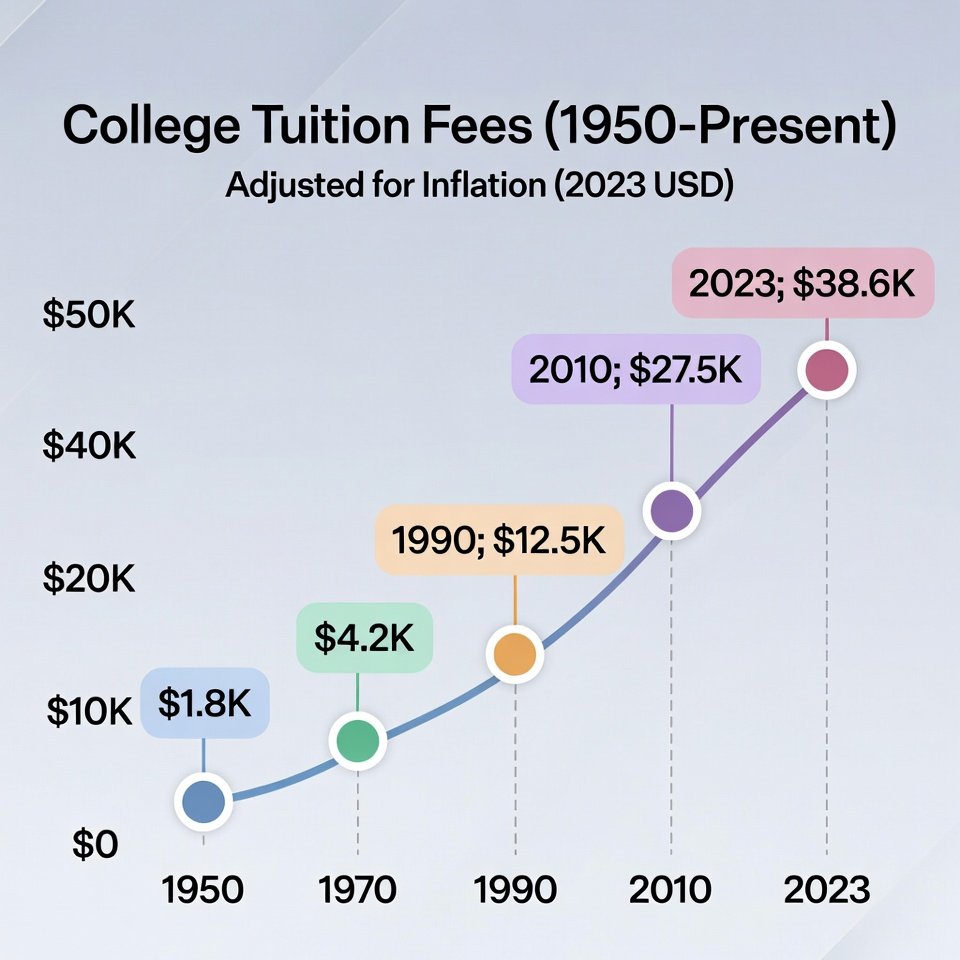
College tuition has exploded 1,200% since 1980 while wages rose just 213%. In 1963, a student could work a minimum-wage summer job and pay for a full year at the average public university. Today, that same job covers roughly one month of tuition. The culprit isn't corporate greed or underfunding. It's government intervention distorting every price signal in higher education. Federal student loans created artificial demand that universities exploited ruthlessly. When government guarantees endless credit to teenagers with zero income or assets, colleges face no market constraint on pricing. Why charge $3,000 per year when students can borrow $30,000? The money flows regardless of educational quality or job prospects. Universities responded predictably: they jacked up prices and hired armies of administrators to capture this guaranteed revenue stream. Easy credit always inflates asset prices, whether houses in 2005 or degrees today. Free market economists warned this would happen, just as they predicted the housing bubble. When you subsidize demand without increasing supply, prices skyrocket. Colleges simply absorbed every dollar of increased lending capacity into higher tuition, fancy dorms, and bloated bureaucracies. The 1950s model worked because students paid real prices with real money; either their own or their parents'. This created immediate feedback between cost and value. If Harvard charged too much, students went elsewhere. Today, that price mechanism is completely severed. Students don't feel the true cost until years later when loan payments hit, and by then universities already pocketed the cash. Every additional dollar of federal aid generates roughly 60 cents of tuition increases. The government created this monster, feeds it annually through increased lending limits, then acts shocked when colleges behave exactly like the rent-seeking cartels they've become.
Handre tweet media
English
175
634
1.6K
108.1K
Douglas Fleming retweetledi
John Stossel
John Stossel@JohnStossel·
Climate alarmists like Rep. Alexandria Ocasio-Cortez say, “The world is going to end in 12 years if we don’t address climate change.” Really? In order to get you ready for other scary “facts” you will hear on Earth Day, 3 scientists address some climate myths:
English
88
949
4.9K
163K