
Therapy First

6.4K posts

Therapy First banner
Therapy First

Therapy First

@TherapyFirstOrg

Raising the quality of care for youth gender dysphoria. Training and supporting clinicians to deliver developmentally sound mental health care.

Katılım Aralık 2021
928 Takip Edilen3.6K Takipçiler
Sabitlenmiş Tweet
Therapy First
Therapy First@TherapyFirstOrg·
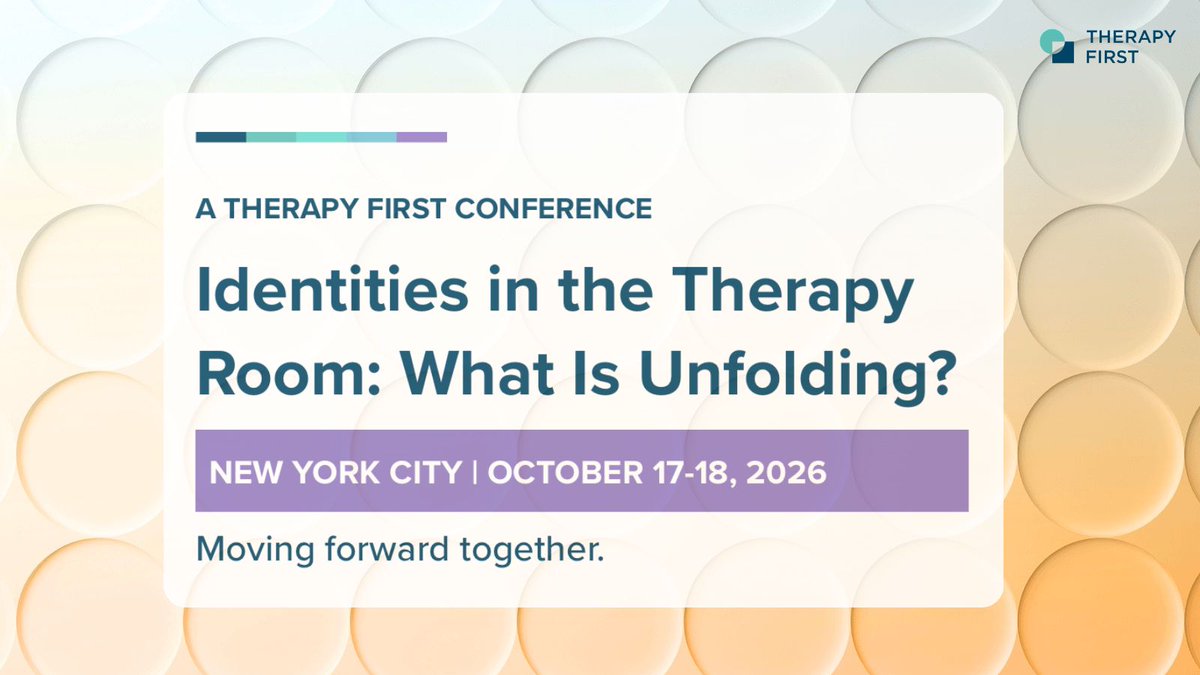
🗽✨We’re excited to announce that Therapy First will be hosting a professional conference in New York City this fall, on October 17-18. This event will bring together professionals from across the mental health sector and will be a unique opportunity to contribute to important conversations shaping the future of the field.
Therapy First tweet media
English
1
0
6
190
Therapy First
Therapy First@TherapyFirstOrg·
THERAPY FIRST means providing comprehensive mental health care as first-line for young people experiencing gender dysphoria, before medical interventions.  This involves clinicians developing a full psychological understanding of each young person by making thorough assessments. Clinicians conduct differential diagnoses of co-occurring conditions, and tailor therapeutic interventions to clients’ individual needs.  A therapy first approach to care also supports age-appropriate milestones. The therapy first approach is guided by principles of developmental psychology, the best available research, and established professional standards.
Therapy First tweet media
English
1
1
5
140
Therapy First
Therapy First@TherapyFirstOrg·
🛑 When questioning is treated as harmful, it forecloses enquiry, disagreements are pathologized, and potential coercion can be reframed as care.  We have a new video with highlights from our webinar with DR. ANNA HUTCHINSON - "Applying the Concept of Cultural Competence in Psychotherapy for Gender Distressed Youth".
English
2
3
17
1.1K
Therapy First
Therapy First@TherapyFirstOrg·
TOMORROW: Join us for our April webinar, "Stories of Transformation: Fairy Tales as a Clinical Lens on Embodiment, Gender and Psychological Change". tinyurl.com/TFMonthlyWebin…
Therapy First@TherapyFirstOrg

FAIRY TALES AND MYTHS  can function as symbolic scaffolds in psychotherapy, particularly in regard to embodiment, transformation, and gender. Join Dr. Libby Nugent (@becomingethical) THIS FRIDAY for our April webinar. Participants  will engage with recurring motifs through specific tales such as: • The Ugly Duckling (misrecognition and belonging) • The Handless Maiden (bodily wounding and reclamation), • The Frog Prince (disgust, contact, and metamorphosis) • The Emperor’s New Clothes (legitimacy, conformity, and group process). Drawing on psychodynamic, group analytic, and narrative approaches, the session will consider how motifs such as exile, metamorphosis, disguise, and recognition can illuminate the ways bodily experience becomes meaningful within psychological life. Participants will consider how symbolic thinking can support therapists in maintaining curiosity, tolerating ambiguity, and working thoughtfully with complex presentations involving gender and embodiment.

English
0
0
1
148
Therapy First
Therapy First@TherapyFirstOrg·
FAIRY TALES AND MYTHS  can function as symbolic scaffolds in psychotherapy, particularly in regard to embodiment, transformation, and gender. Join Dr. Libby Nugent (@becomingethical) THIS FRIDAY for our April webinar. Participants  will engage with recurring motifs through specific tales such as: • The Ugly Duckling (misrecognition and belonging) • The Handless Maiden (bodily wounding and reclamation), • The Frog Prince (disgust, contact, and metamorphosis) • The Emperor’s New Clothes (legitimacy, conformity, and group process). Drawing on psychodynamic, group analytic, and narrative approaches, the session will consider how motifs such as exile, metamorphosis, disguise, and recognition can illuminate the ways bodily experience becomes meaningful within psychological life. Participants will consider how symbolic thinking can support therapists in maintaining curiosity, tolerating ambiguity, and working thoughtfully with complex presentations involving gender and embodiment.
Therapy First tweet media
English
1
1
5
413
Therapy First retweetledi
Reem Alsalem UNSR Violence Against Women and Girls
Letter I wrote on behalf of Dr. Jill Spencer (@Jilliantweeting ), a senior psychiatrist at the Queensland Children’s Hospital, #Australia, concerning her reported suspension and the termination proceedings against her in connection with her public expression of professional pertaining to aspects of clinical approaches to children and adolescents experiencing gender-related distress is now public: spcommreports.ohchr.org/TMResultsBase/… No response was received to this letter
English
31
183
623
19.9K
Therapy First
Therapy First@TherapyFirstOrg·
🗽✨We’re excited to announce that Therapy First will be hosting a professional conference in New York City this fall, on October 17-18. This event will bring together professionals from across the mental health sector and will be a unique opportunity to contribute to important conversations shaping the future of the field.
Therapy First tweet media
English
1
0
6
190
Therapy First
Therapy First@TherapyFirstOrg·
FAIRY TALES AND MYTHS can act as symbolic scaffolds in psychotherapy, particularly in regard to embodiment, transformation, and gender. Learn more at our April webinar with Dr. Libby Nugent (@becomingethical) - all are welcome.
Therapy First tweet media
English
1
3
4
563
Therapy First retweetledi
The Spectator
The Spectator@spectator·
Finally, from Finland comes vital research into the prevalence of severe psychiatric disorders among ‘gender-referred adolescents’, focusing particularly on ‘outcomes related to medical gender reassignment’. This study is remarkably extensive; it covers everyone in Finland under the age of 23 who was referred for clinical support with gender dysphoria between 1996 and 2019. The findings absolutely shatter the myth of the child made suicidal through thwarted gender transition. The Finnish study shows that children who are distressed about their gender have significantly higher rates of psychological problems than in the general population, both before (46 per cent versus 15 per cent) and around two years after referral (62 per cent versus 15 per cent). ✍️ Joanna Williams Article | spectator.com/article/this-s…
The Spectator tweet media
English
48
330
1K
74.8K
Therapy First retweetledi
marcus evans
marcus evans@marcuse99903226·
Thanks Bernard this is a helpful summary. Many of the young people who present with these difficulties appear to have a fragile sense of self, threatened by the demands of transitioning from childhood to adulthood. The physiological, psychological, and social pressures of adolescence can intensify the use of defences aimed at controlling internal conflict and anxiety, leading to a search for certainty in belief as a defence against turmoil. These defences frequently rely on rigid splits between mind and body, and between good and bad versions of the self and others. The cost of such rigidity is developmental. Psychological development requires an atmosphere in which ambiguity can be tolerated, different elements of the self can be held in mind, and doubt can be thought about rather than eliminated. These defensive organisations are often associated with presentations such as eating disorders, depression, obsessive–compulsive symptoms, and schizoid states. As the study suggests, these presentations may reflect serious developmental difficulties. The gender issue, which is sometimes treated as entirely separate from these comorbid conditions, can instead be understood as part of the same overall presentation. A narrow preoccupation with gender may then distract attention from the core developmental problem. Under emotional stress, the individual’s capacity for symbolic and complex thinking can give way to rigid, concrete thought. The Finnish study suggests that a significant proportion of young people presenting with gender distress do so within a broader developmental and psychological context, rather than in isolation. Its long-term follow-up data are particularly valuable. This resonates with the clinical experience of myself and @sueevansprotect, based on seeing many young people and hearing from hundreds of parents since 2019. I first published a paper in the British Psychiatric Bulletin in 2020 that raised similar developmental concerns, titled Freedom to Think: The Need for Thorough Assessment and Treatment of Gender Dysphoric Children: cambridge.org/core/journals/… David Taylor wrote something comparable in his 2006 report on GIDS. Why has it taken so long for these developmental perspectives to be taken seriously? @genspect @Transgendertrd @CanSG_org @segm_ebm
English
10
59
202
6.1K
Therapy First retweetledi
SEGM
SEGM@segm_ebm·
Finland’s data are critical in the current debates on pediatric gender medicine. To our knowledge, Finland is the only country reporting full registry data, meaning outcomes are captured for all patients. By contrast, Dutch follow-up studies rely on later volunteers, with dropout rates near 50% which introduces a major risk of bias. /2 onlinelibrary.wiley.com/doi/10.1111/ap…
English
14
253
1.3K
57.3K
Therapy First retweetledi
marcus evans
marcus evans@marcuse99903226·
Grateful to the British Journal of Psychotherapy for the courage to support thoughtful clinical debate in a highly contested area. Beyond affirmation: Lessons from Tavistock A psychoanalytic critique of identity certainty and institutional defence. The paper explores how certainty can function defensively in individuals and clinicians. It argues that clinicians need institutions that support reflective work, rather than pushing short-term fixes or ideological certainty. onlinelibrary.wiley.com/doi/10.1111/bj… #psychoanalysis #mentalhealth #psychotherapy #GenderDysphoria #ClinicalDebate #ReflectivePractice @TheIoPA @rcpsych @psychoanalysis_ @BPApsychUK @BritPsyCouncil @RosieDuffield1 @ClaireCoutinho @segm_ebm @Transgendertrd
English
4
74
264
7.4K
Therapy First retweetledi
SEGM
SEGM@segm_ebm·
Although we have not yet analyzed the study in depth, its findings are deeply concerning. Among MtF adolescent patients, mental health problems rose from 10% before gender reassignment to 61% after; among FtM patients, from 22% before to 55% after. This is not reassuring.
SEGM@segm_ebm

📰A new Finnish study reports that youth gender transitions (under age 23) did not improve mental health symptoms. For some youth, medical gender reassignment may have had a negative impact. Link ⬇️ /1

English
63
640
1.7K
103.1K
Therapy First retweetledi
SEGM
SEGM@segm_ebm·
Gender-dysphoric youth deserve access to evidence-based care. At this point, further evidence reviews of the same deficient evidence base will not alter the underlying realities. Our attention now should turn toward aligning policy with existing evidence, and developing treatment approaches that support long-term health and wellbeing of gender-distressed youth. /9
English
3
11
81
1.9K
Therapy First retweetledi
SEGM
SEGM@segm_ebm·
After Utah passed a moratorium on medical youth gender transitions in 2023, activist groups lobbied for an evidence review to prove this practice is safe and effective. The result was the "Utah Review," which produced the desired answer by scrapping methodological standards. /1
SEGM tweet media
English
16
116
298
60.9K