Sabitlenmiş Tweet

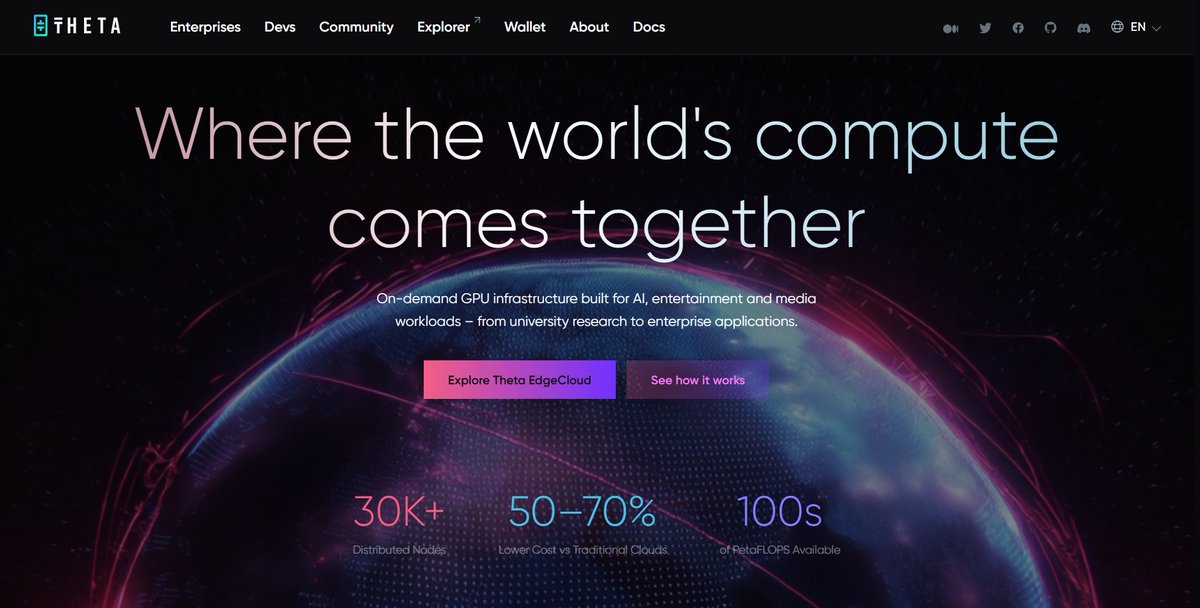
We just relaunched our homepage. New tagline, cleaner story. Here's the version we never quite told properly. 🧵
English
Theta Network
2.7K posts

@Theta_Network
Theta is the leading decentralized cloud for AI, media and entertainment ☁️. Where the world's compute comes together 🌍 https://t.co/tyqwF5KhAF
Excited to share that @Theta_Network’s joint research with Prof. Xiao @ZhenXiaoCornell’s team has two papers accepted to @TheWebConf 2026 (WWW’26)! 🎉 📄 Alzo: Auto-Tuning with Reinforcement Learning for DAG-based Blockchains: dl.acm.org/doi/10.1145/37… 📄 DARA: Few-shot Budget Allocation in Online Advertising via In-Context Decision Making with RL-Finetuned LLMs: dl.acm.org/doi/10.1145/37… The Web Conference (WWW) is a premier international forum on the future of the web, covering cutting-edge research in #AI, decentralized systems, Web3, and beyond. These two papers connect directly with our long-term vision for Theta EdgeCloud: building intelligent, decentralized infrastructure where AI models, compute resources, and blockchain networks can continuously optimize themselves. DARA explores how RL-finetuned LLMs can make better decisions under limited data. It introduces: -- Dual-phase LLM agents: a Few-shot Reasoner for initial planning and a Fine-grained Optimizer for feedback-driven refinement. -- GRPO-Adaptive: an RL fine-tuning strategy that improves reasoning and numerical precision. -- Real-world + synthetic evaluation for robust decision-making in dynamic environments. This direction is highly relevant to EdgeCloud as we build toward agentic AI workloads, model-serving optimization, and intelligent resource allocation across distributed GPU infrastructure. Alzo presents a hierarchical RL framework for automatically tuning DAG-based blockchains. It addresses the challenge that blockchain performance depends on many interdependent parameters across network, ledger, and node layers. Alzo introduces: -- Hierarchical RL: a Meta-Controller for strategic planning and domain-specific Controllers for fine-grained tuning. -- Safety-aware optimization with resource constraints and a shadow-control loop. -- Experiments showing higher throughput and lower latency than DQN, Bayesian optimization, and manual tuning. This aligns with Theta’s blockchain-powered EdgeCloud infrastructure: using AI to make decentralized networks more adaptive, efficient, and production-ready. As always, @Theta_Network remains committed to advancing the intersection of #AI, #Web3, and decentralized infrastructure. Stay tuned for more breakthroughs! 🌐