
Othmane

761 posts

Othmane banner
Othmane

Othmane

@ThisIsOthmane

AI @ Datadog | Hiring researchers & engineers - DMs open | Opinions my own

New York City Katılım Mart 2012
3.9K Takip Edilen450 Takipçiler
Sabitlenmiş Tweet
Othmane
Othmane@ThisIsOthmane·
The Datadog AI Research team will be at ICLR2026 in Rio later this month. We're sponsoring the SPOT workshop on reinforcement learning, and hosting Bits & Bites on April 27th, an evening of food, drinks, and conversation with our research team. We are hiring Research Scientists and Research Engineers in New York and Paris and would love to meet people working on RL, agents, and multi-modal foundation models. RSVP below 👇 (and stop by our booth)
Othmane tweet media
English
1
2
8
911
Othmane retweetledi
Sajid Mehmood
Sajid Mehmood@smehmood·
Phenomenal work from my former colleagues at @datadoghq Time series is an oft-overlooked modality for time series that will be critical to making AI great at managing all sorts of important control systems
Othmane@ThisIsOthmane

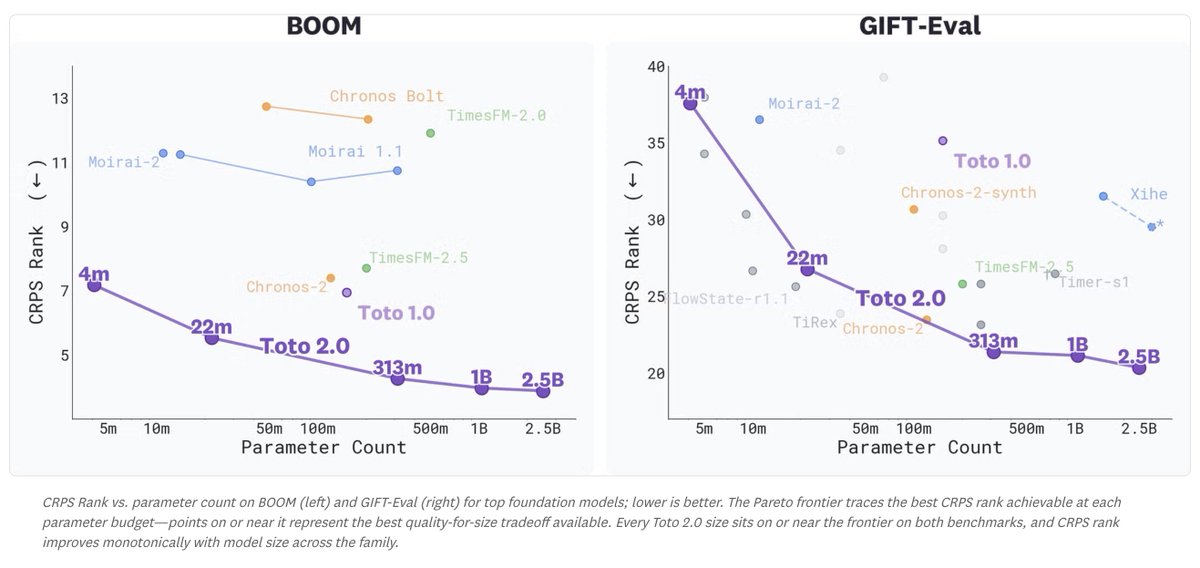
Scaling finally works for Time Series Foundation Models. Introducing Toto 2.0: open-weights TSFMs from 4M to 2.5B params, where every size beats the last from a single hyperparameter config. #1 on leading benchmarks: BOOM, GIFT-Eval, and TIME. Most TSFM families ship multiple sizes that all perform roughly the same. This one doesn't.

English
1
1
14
2K
Othmane retweetledi
Ameet Talwalkar
Ameet Talwalkar@atalwalkar·
Today we’re releasing Toto 2.0: a family of open-weights time series foundation models spanning 4M to 2.5B parameters. The question we set out to answer was simple (yet previously open): Do time series foundation models get reliably better as they scale? Our answer: yes! 🧵
Ameet Talwalkar tweet media
English
11
63
606
60.3K
Othmane
Othmane@ThisIsOthmane·
Next up: multimodal world models for observability. Today every signal lives in its own silo. Metrics go to anomaly detectors, logs to parsers, traces to latency analyzers. We want one model that learns the joint dynamics across metrics, logs, traces, topology, code changes, events, and alerts. Think GAIA-1 or Cosmos, but for production software systems instead of self-driving. A learned simulator you can use for predictive alerting, root-cause analysis, counterfactual "what if I roll this back" questions, and training SRE agents.
English
1
0
1
53
Othmane
Othmane@ThisIsOthmane·
Scaling finally works for Time Series Foundation Models. Introducing Toto 2.0: open-weights TSFMs from 4M to 2.5B params, where every size beats the last from a single hyperparameter config. #1 on leading benchmarks: BOOM, GIFT-Eval, and TIME. Most TSFM families ship multiple sizes that all perform roughly the same. This one doesn't.
Othmane tweet media
English
1
9
18
3.2K
Othmane
Othmane@ThisIsOthmane·
factored "minimal slides and spreadsheets" into my first job decision. 9 years later i'm spending sunday afternoon in google sheets. the universe has jokes. ok. enough. side project time. self-improving ai researcher agent. let's build some cool stuff.
English
0
0
3
115
Othmane
Othmane@ThisIsOthmane·
talent and execution are the biggest moat
English
0
0
1
59
Othmane
Othmane@ThisIsOthmane·
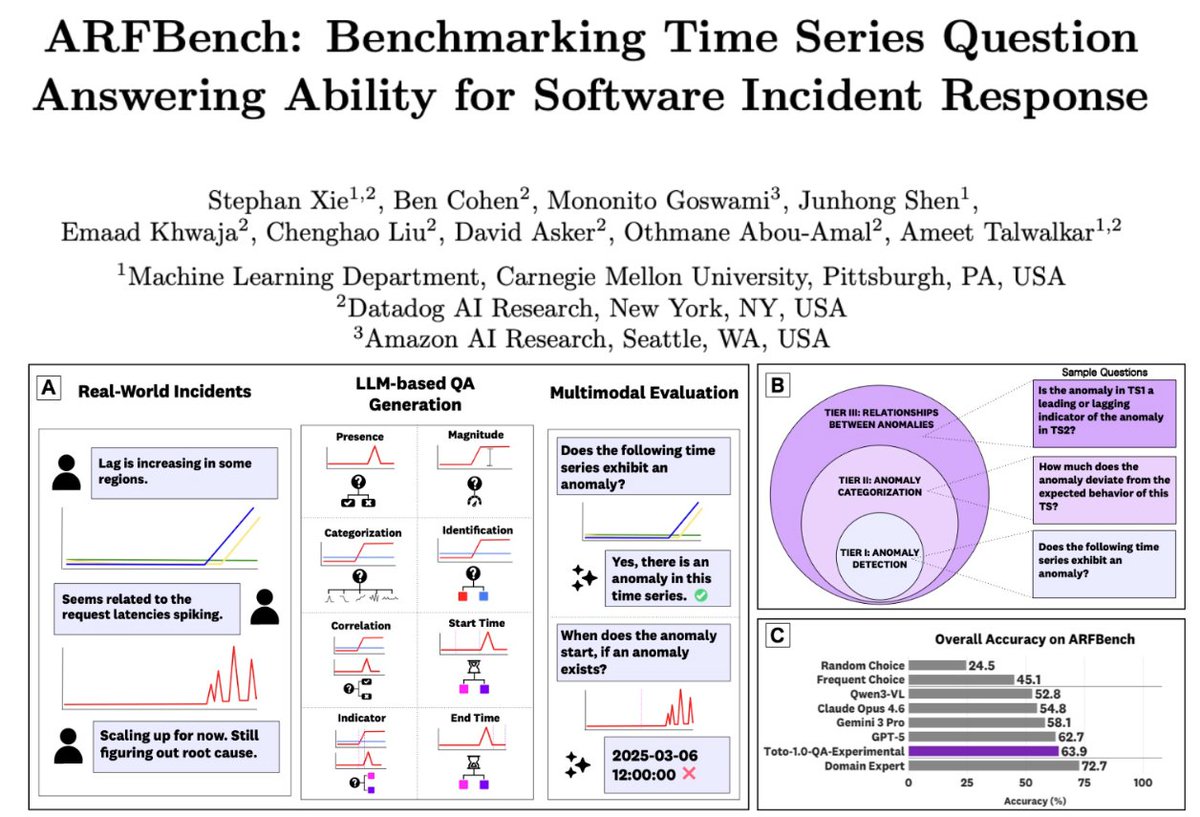
The best AI models can only answer 63% of basic questions about production outages. Your on-call engineers get 72%. But here's the twist: they fail on completely different questions. Combine them and you hit 87%. We built a benchmark to measure this, and a new model (Toto-1.0-QA-Experimental) that matches GPT-5 at a fraction of the cost. Great work from @stephofx and team! 🔗 👇
Othmane tweet media
English
1
1
5
476
Othmane retweetledi
Stephan Xie
Stephan Xie@stephofx·
How well do AI systems (LLMs, VLMs, time series FMs) answer questions about time series data📈? On ARFBench, the best models achieve ~63% accuracy on real incident data. But models and human experts fail in different areas: combining them achieves 87% accuracy. 🧵1/
Stephan Xie tweet media
English
1
16
41
3.6K
Othmane
Othmane@ThisIsOthmane·
I think part of what you're hitting is a comparison-class effect. The Western canon you're implicitly measuring against isn't actually that humane on inspection: Faulkner has incest and lynching, Gatsby ends in murder, Ulysses has Molly, Proust has Vinteuil and Charlus, Tolstoy puts Anna under a train, Dickens has dead children in workhouses. We tend to read familiar darkness as profundity and unfamiliar darkness as bleakness. Two specifics worth adding. Iran wasn't formally colonized, but it lived through the 1953 coup, the Pahlavis, the Revolution, and an eight-year war that killed close to a million people. Hedayat wrote The Blind Owl while reading Kafka and Poe, then killed himself in Paris, so the lineage there is partly European modernist. And Season of Migration is precisely the novel that refuses Conrad's frame; the scholarship and the trial are the setup, not the verdict Salih wants you to walk away with. Your award-bias hypothesis is partly right. The IPAF (the "Arabic Booker") does favor a certain register. But that's downstream of a bigger sampling issue: drawing conclusions about a civilization's outlook from prizewinning 20th-century novels is a method that would also tell you the English-speaking world is obsessed with adultery and shipwrecks. For counter-examples worth your time: Pezeshkzad's My Uncle Napoleon (one of the funniest novels of the century), Habibi's Pessoptimist, Khoury's Gate of the Sun (the Palestinian War and Peace), Ashour's Granada Trilogy, Alharthi's Celestial Bodies, Dowlatabadi's Missing Soluch, Hakim's Diary of a Country Prosecutor, Matar's The Return. One last thought. The deepest humanist tradition in this literary world isn't necessarily in the novel, which only arrived in Arabic and Persian around 1900. It's in the poetry: Hafez, Rumi, Saadi, al-Ma'arri, Ibn Arabi, the Mu'allaqat, Nizar Qabbani. Looking for the humane Arab canon while skipping a millennium of verse is a bit like looking for humane English literature and limiting yourself to post-2000 Booker shortlists. The tradition is there, just not where the sampling method points.
English
0
0
8
1.1K
Patrick Collison
Patrick Collison@patrickc·
Which are the most humane (empathetic, compassionate) Arab / Middle Eastern novels? Thought behind the question: I read a bunch of these novels last year -- my selection algorithm was to sample widely among the award-winning works from the region (Egypt, Sudan, Iran, Palestine, Jordan, among others) -- and, overall, I was very struck by the darkness and violence. (Abundant rape, murder, violence, and so forth.) In trying to figure out why the outlooks are so consistently bleak, I don’t think it’s only a matter of colonialism. For example, The Blind Owl is often ranked as the best novel to come out of Iran, which was never colonized as such, but nonetheless describes an obsessive madman who kills and dismembers his partner. In Season of Migration to the North, the colonizer -- Britain -- is described as being quite benevolent at least at the object level (granting a scholarship to the protagonist; treating him unreasonably justly during his murder trial). Men in the Sun is similarly grim while taking place in a post-colonial Arab world. Even books that are sometimes described as heartwarming (such as Mahfouz’s Cairo Trilogy) centrally feature rape and female oppression (that Amina is not permitted to leave the home is a core plot issue). One guess is that it is a function of award selection algorithms: gritty despair is seen as high-status and structurally celebrated. Another theory would be the period: there are lots of humane novels in the Western canon (Dickens, Tolstoy, Eliot…), but those are more likely to be from the nineteenth century, whereas the Arab / Middle Eastern novelistic canon didn’t emerge until the twentieth. I’m not sure this explains it, however. In Search of Lost Time, Great Gatsby, Ulysses, Midnight's Children are all critically-acclaimed 20th century novels, close to the top of almost any list, that one would not describe as macabre. It’s possible that I just read the wrong books and got unlucky. So: which authors from the region can best be compared to Faulkner, Eliot, Fitzgerald, or Rushdie? (And if they haven't won major awards, does that indicate that the awards have a negative bias?)
English
221
48
1.3K
683.2K