
Arie van Gemeren, CFA | The Timeless Investor

2.9K posts

Arie van Gemeren, CFA | The Timeless Investor banner
Arie van Gemeren, CFA | The Timeless Investor

Arie van Gemeren, CFA | The Timeless Investor

@TimelessArie

Ex-Goldman | $150M+ multifamily | Building the next empire through cycles, history & contrarian real estate

Portland, OR Katılım Ağustos 2023
323 Takip Edilen521 Takipçiler
Sabitlenmiş Tweet
Arie van Gemeren, CFA | The Timeless Investor
Everybody out here is saying Portland is dead. And we just acquired a 109-year-old apartment building in the core. Here's why. The Imperial Arms. Built 1917. 54 units. Cell tower on the roof. Classic brick building from the era when they built things to last — and it shows. Plus, prior ownership took great care of the property. New boiler. New roof. New windows. Upgraded electrical panels. The heavy CapEx is done. Our thesis right now is buy right and cash flow. And take advantage of a significant pricing dislocation in this property type. 1️⃣ We're going in at north of a 7% capitalization rate on the 'actual' T-12. 2️⃣ Purchase price per square foot is less than half of the replacement value. 3️⃣ 98% occupancy upon purchase. Cash flow day 1. Now — why Portland? Isn't everyone fleeing? That's exactly the narrative. And narratives like that are often where opportunity hides. Here's some data: Portland's new construction pipeline has collapsed. Permits are at multi-decade lows. The supply that crushed rents in 2022 and 2023 is not being replaced. Meanwhile, the city is 90,000 housing units short of meeting projected demand. We don't really buy narratives that you hear on X - we prefer math. This is a principle I keep coming back to: the best time to acquire real assets is when the headlines are the ugliest, and the competition has gone home. Every era of history repeats this lesson. Over and over. Washington bought land during the Revolutionary War. Smart operators bought San Francisco in the 1990s. Distressed assets in Detroit got picked up for pennies before the city came back. Fear clears the field. We like a clear field. Imperial Arms is vintage, supply-constrained, fully renovated, and cash flowing in a market that institutional capital has abandoned. That's the setup we look for. Patient capital. Operations first.
Arie van Gemeren, CFA | The Timeless Investor tweet media
English
7
0
6
1.5K
Arie van Gemeren, CFA | The Timeless Investor
The worst time to buy real estate always feels like now. In 2010 it felt like now. In 1992 it felt like now. In 1975 it felt like now. The people who bought anyway are the ones we study in history books.
English
0
0
0
29
Arie van Gemeren, CFA | The Timeless Investor
Spain extracted $1.5 trillion in today's dollars from the Americas in silver and gold. They used it to buy furniture from Italy, cloth from Flanders, wheat from Poland. By 1650 they were broke. The gold passed through. The industries never got built. A cautionary tale for any nation that confuses revenue with production.
English
0
0
2
28
Arie van Gemeren, CFA | The Timeless Investor
There's a scene in Landman where Tommy Norris (aka Billy Bob Thornton) drops a profound economic insight. He's an oil man. And he explains that high oil prices are actually bad for the oil industry. Why? The presumption is that when oil prices are high oil companies are racking profit. But it's bad because high oil prices are DEFLATIONARY. This question becomes really important right now, given what's happening in Iran. And I think a lot of people get the analysis backwards. Here's what's happening: Oil is a commodity. But it's ALSO a consumption tax. Every dollar that goes into your gas tank is a dollar that doesn't go to a restaurant, a renovation, a vacation, or a new appliance. Multiply that across 330 million Americans and you don't get inflation. What you get is cratering demand. In short, high prices means lower spending. And of course - we've seen this before. In July 2008, oil hit $147 a barrel — the highest price in history at that point. Six months later, the global economy was in freefall. The Fed's primary concern wasn't inflation. It was deflation. The oil spike didn't ignite a sustained price surge. It destroyed demand so fast that prices collapsed along with everything else. And guess what else? In early 2008, the Fed actually DELAYED cutting rates because they were terrified of headline inflation - caused by spiking oil prices. Woops? "But what about the 1970s?" Yes — the 1973 oil shock was genuinely inflationary. But the conditions were completely different: - Bretton Woods had just collapsed, untethering the dollar - The Fed was running loose monetary policy - US households carried very little debt - It was a supply shock hitting a 'growing' economy In 2026, households are leveraged. The Fed has no room to be accommodative. And an oil shock hits a consumer who is already stretched — not one with room to absorb it. High oil into a debt-heavy consumer doesn't stoke inflation. It suffocates growth. And here's the part even oil producers don't want to hear: High prices incentivize more drilling. More drilling increases supply. More supply eventually crashes the price. The producers who "win" from the initial spike often destroy their own margins 18–24 months later. My main man Tommy Norris knew this. Most analysts on TV don't seem to. So what does this mean for your portfolio? If the Iran war drives oil higher and that triggers demand collapse rather than sustained inflation, the asset that wins is not energy stocks or commodities. It'll likely be defensive strategies built around cash flow, low leverage and the ability to sustain through a protracted economic downturn. Fear is rational right now. But the mechanism matters. Understand the mechanism, and the portfolio implications become a lot clearer.
Arie van Gemeren, CFA | The Timeless Investor tweet media
English
0
0
0
30
Arie van Gemeren, CFA | The Timeless Investor retweetledi
Arie van Gemeren, CFA | The Timeless Investor
Julius Caesar began his career at 40. By that point, he'd been bankrupt, kidnapped by pirates (and laughed in their faces, promised them retribution, then returned and crucified the lot of them - true story), and politically sidelined. In short, the man endured a lot. More than most of us, I'd bet. Yet he NEVER quit compounding his skills, reputation, and network. Every single situation became an education. Another furnace to strengthen him.
Arie van Gemeren, CFA | The Timeless Investor tweet media
English
2
1
9
489
Adam Smith
Adam Smith@adamstatonsmith·
I took on 7 new listings worth 50ish million in this timeframe. This year could go from promising to shit real fast.
Adam Smith tweet media
English
9
0
27
4.1K
Arie van Gemeren, CFA | The Timeless Investor
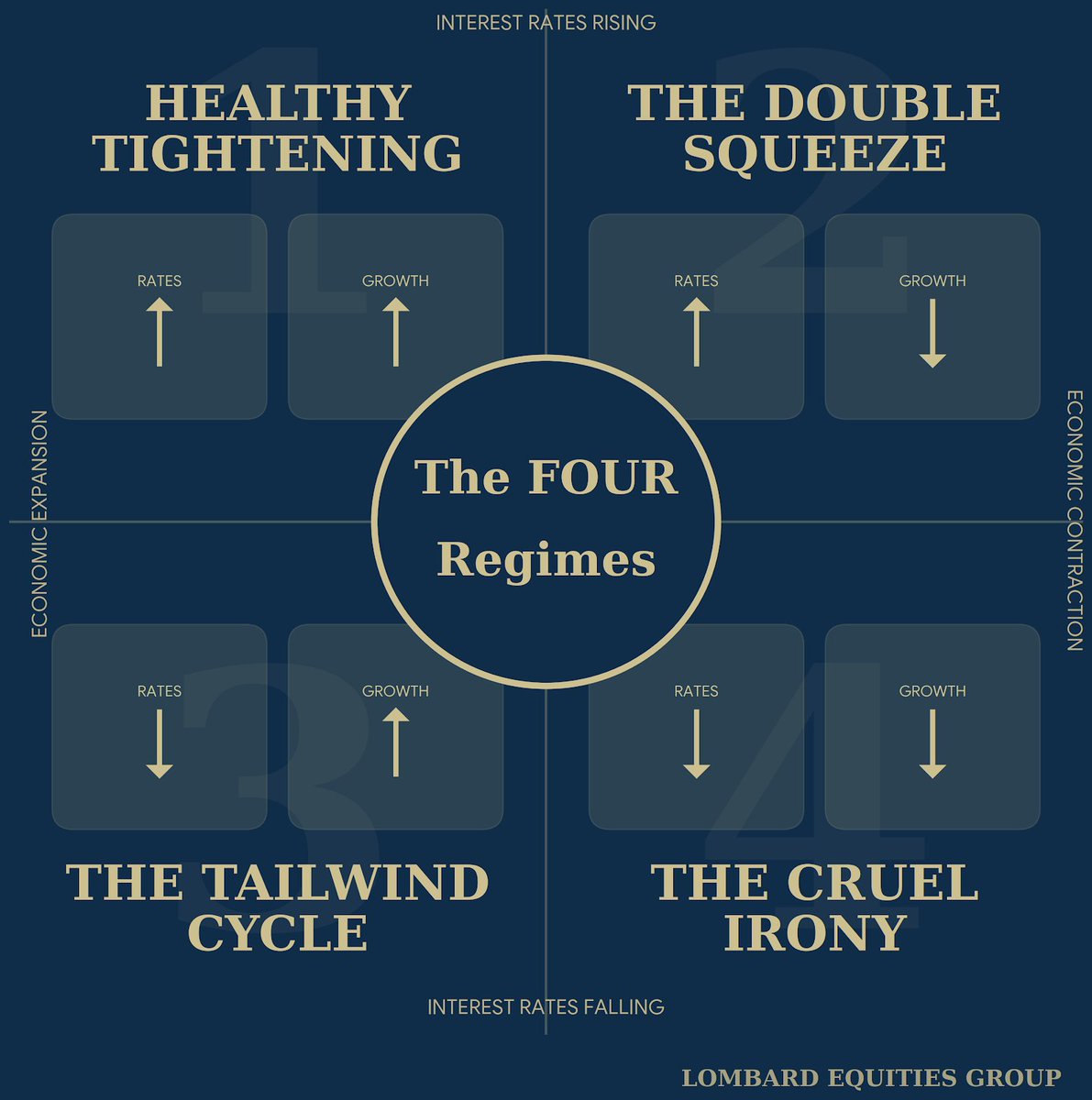
Interest rates are perhaps THE most important force in real estate investing. Everybody knows that, of course. But what if the direction of that movement wasn't the most critical factor — because rates move for all sorts of reasons. For example, rising rates are bad, right? We all know that. But consider: A rate that moves from 3% to 6% because the economy is ripping produces a completely different outcome than the same move because inflation is out of control and the Fed is overcorrecting. Same direction. Completely different regime. In my latest piece for The Timeless Investor, I lay out a framework for reading rate environments correctly: → The 4 distinct regimes — and how to identify which one you're in→ Why the 40-year tailwind that made everyone look smart from 1981-2021 is structurally over→ The 3 constants that build wealth across all rate environments→ Where we likely sit right now — and what that means for your next move Where do you all think we're at? More accommodating, modest growth and falling rates? Or something worse ... open.substack.com/pub/thetimeles…
Arie van Gemeren, CFA | The Timeless Investor tweet media
English
0
0
2
47
Arie van Gemeren, CFA | The Timeless Investor
Happy St Patrick's Day! May the luck of the Irish be with you. 🍀 Or was it really luck? I have an ancestor named Barnabus Valentine. He was shanghaied off the coast of Ireland. Seized. Pressed into sea service on someone else's ship, going somewhere he didn't choose. He escaped. Made it to the colonies. And then fought in the Revolutionary War. I don't know much else about him. I don't know if he had money or land or any reason to believe things would work out. He probably didn't. He just kept moving. His descendants fought in the Civil War (for the Union) at Gettysburg. I think about my own (and many others' in this great nation) Irish ancestors at this time of year. Not the parades, or the leprechaun "pee" we put in toilets so my children laugh, nor the fun. I think more often about the "No Irish Need Apply", or the people fleeing the Potato Famine and being immediately pressed into the army and sent to the frontlines. The canal digging and rail laying. Arriving with nothing into cities that would eventually bear their names on courthouses and city halls. The Irish were one of the most despised immigrant classes in American history. They were hated for being different. For being Catholic. And they persevered. And today, this entire nation celebrates Saint Patrick's Day. If that isn't an epic tale of overcoming odds and building something great, I don't know what is. My great-great-great-great-grandfather Barnabus Valentine got shanghaied from his farm and ended up on the right side of a revolution. And his descendants are still around today, all over this nation. If that isn't a lesson for everybody, I don't know what is. PS Painting is of the Irish Brigade during The American Civil War. The Irish Brigade produced 11 Medal of Honor recipients. At the Battle of Antietam, they lost over 60% of their men in one charge. Father William Corby gave absolution and general benedictions to the regiment before the Battle of Gettysburg, and his statue stands today at Notre Dame.
Arie van Gemeren, CFA | The Timeless Investor tweet media
English
0
0
2
52
Pangram Labs
Pangram Labs@pangramlabs·
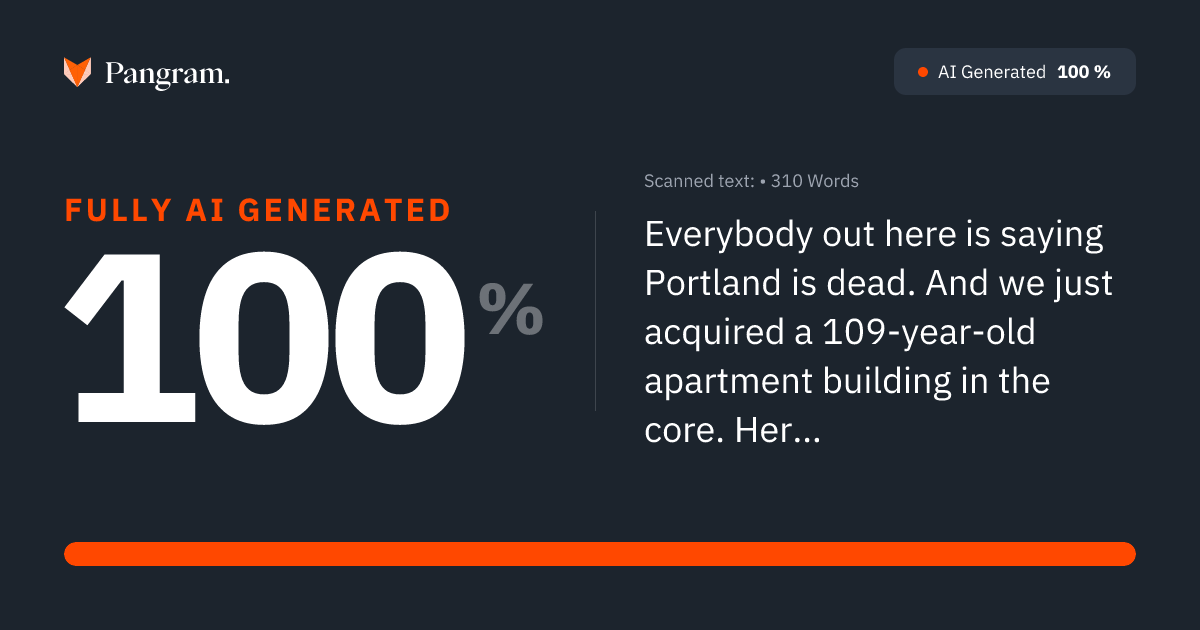
@insearch0fvalue @TimelessArie We are confident that this document is fully AI-generated pangram.com/history/fc78ab…
Pangram Labs tweet media
Arie van Gemeren, CFA | The Timeless Investor@TimelessArie

Everybody out here is saying Portland is dead. And we just acquired a 109-year-old apartment building in the core. Here's why. The Imperial Arms. Built 1917. 54 units. Cell tower on the roof. Classic brick building from the era when they built things to last — and it shows. Plus, prior ownership took great care of the property. New boiler. New roof. New windows. Upgraded electrical panels. The heavy CapEx is done. Our thesis right now is buy right and cash flow. And take advantage of a significant pricing dislocation in this property type. 1️⃣ We're going in at north of a 7% capitalization rate on the 'actual' T-12. 2️⃣ Purchase price per square foot is less than half of the replacement value. 3️⃣ 98% occupancy upon purchase. Cash flow day 1. Now — why Portland? Isn't everyone fleeing? That's exactly the narrative. And narratives like that are often where opportunity hides. Here's some data: Portland's new construction pipeline has collapsed. Permits are at multi-decade lows. The supply that crushed rents in 2022 and 2023 is not being replaced. Meanwhile, the city is 90,000 housing units short of meeting projected demand. We don't really buy narratives that you hear on X - we prefer math. This is a principle I keep coming back to: the best time to acquire real assets is when the headlines are the ugliest, and the competition has gone home. Every era of history repeats this lesson. Over and over. Washington bought land during the Revolutionary War. Smart operators bought San Francisco in the 1990s. Distressed assets in Detroit got picked up for pennies before the city came back. Fear clears the field. We like a clear field. Imperial Arms is vintage, supply-constrained, fully renovated, and cash flowing in a market that institutional capital has abandoned. That's the setup we look for. Patient capital. Operations first.

English

1
0
2
42
Arie van Gemeren, CFA | The Timeless Investor
Everybody out here is saying Portland is dead. And we just acquired a 109-year-old apartment building in the core. Here's why. The Imperial Arms. Built 1917. 54 units. Cell tower on the roof. Classic brick building from the era when they built things to last — and it shows. Plus, prior ownership took great care of the property. New boiler. New roof. New windows. Upgraded electrical panels. The heavy CapEx is done. Our thesis right now is buy right and cash flow. And take advantage of a significant pricing dislocation in this property type. 1️⃣ We're going in at north of a 7% capitalization rate on the 'actual' T-12. 2️⃣ Purchase price per square foot is less than half of the replacement value. 3️⃣ 98% occupancy upon purchase. Cash flow day 1. Now — why Portland? Isn't everyone fleeing? That's exactly the narrative. And narratives like that are often where opportunity hides. Here's some data: Portland's new construction pipeline has collapsed. Permits are at multi-decade lows. The supply that crushed rents in 2022 and 2023 is not being replaced. Meanwhile, the city is 90,000 housing units short of meeting projected demand. We don't really buy narratives that you hear on X - we prefer math. This is a principle I keep coming back to: the best time to acquire real assets is when the headlines are the ugliest, and the competition has gone home. Every era of history repeats this lesson. Over and over. Washington bought land during the Revolutionary War. Smart operators bought San Francisco in the 1990s. Distressed assets in Detroit got picked up for pennies before the city came back. Fear clears the field. We like a clear field. Imperial Arms is vintage, supply-constrained, fully renovated, and cash flowing in a market that institutional capital has abandoned. That's the setup we look for. Patient capital. Operations first.
Arie van Gemeren, CFA | The Timeless Investor tweet media
English
7
0
6
1.5K
Arie van Gemeren, CFA | The Timeless Investor
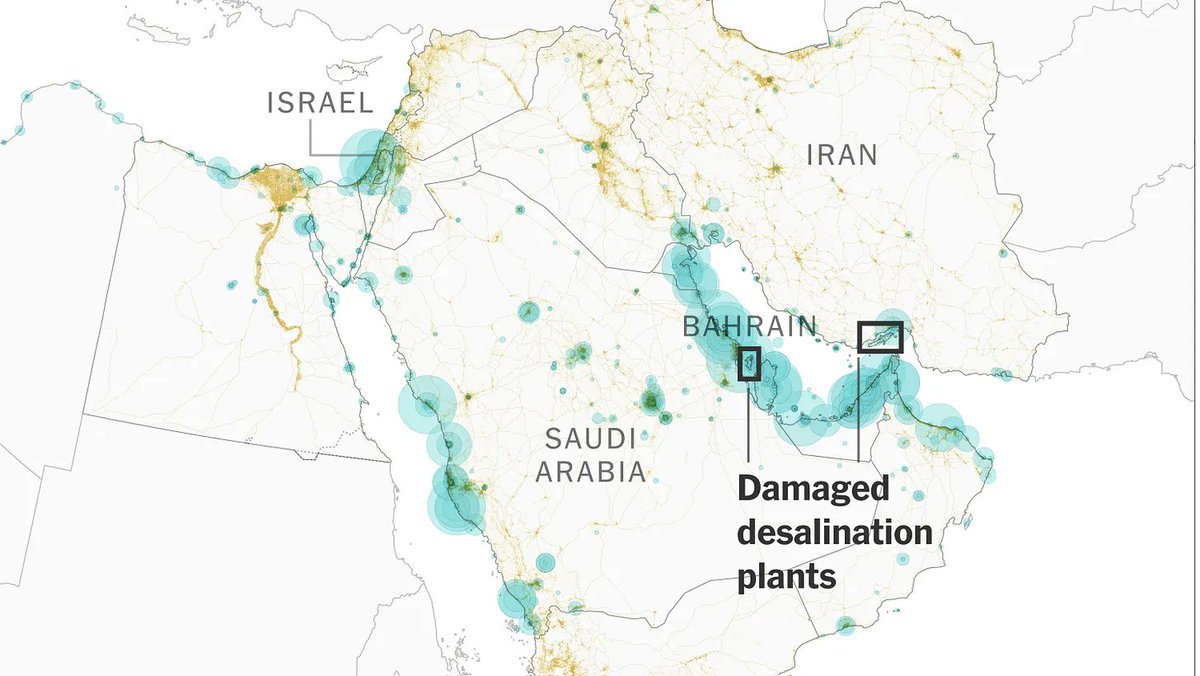
Is Dubai dying? Serious question. I was on a call with a client and friend this week who mentioned he had "intended" to move his family to Dubai, and wasn't interested anymore. Social media is full of "death of Dubai" images. Aside from the real human cost here, it's an interesting real estate story. Because Dubai was 100% engineered, from the ground up, to be a hub. It doesn't have "natural" advantages. It's literally man-made, in every conceivable way. And many regimes, in many places, have tried to create their own Dubais. And failed. But Dubai worked. It was engineered for demand. No taxes. Emirates built from the ground up to provide access globally. Strong rule of law. So much more. But trust and reputation, as we know, are easily lost. And it's "very" hard to bring them back. Now, add on the terrifying reliance on desalination plants across the Gulf States. A leaked 2008 diplomatic cable warned that Riyadh could need to be evacuated within a week if a single desalination plant were destroyed. Iran knows this. Dubai is at risk here, too. Also in The Timeless Five today, the future of the petrodollar, why the War in Iran is causing serious issues for the Yen Carry Trade (which ought to seriously frighten any US investors out there), and much more. Full article below 👇 open.substack.com/pub/thetimeles…
Arie van Gemeren, CFA | The Timeless Investor tweet media
English
0
0
2
159
Arie van Gemeren, CFA | The Timeless Investor retweetledi
Arie van Gemeren, CFA | The Timeless Investor
A hill I'm making my stand on: manage your own investment properties. We reclaimed control of multiple buildings from an underperforming 3rd-party manager (now self-managing in-house), and the results have been incredible. Here's one anecdote. We threw a resident appreciation pizza party. My team went. I went. We met a lot of people. First comment: This is amazing. Did you know that in the last 2 years I've lived here, I have NEVER seen anyone from the property management company in person? (this tracks, btw, as it was also hard for me to get ahold of them) Second comment: oh, you're the owner? You're brave to come here. Followed by an excellent and candid conversation on why rents had gone up, why we were charging for utilities, and what we could do for building security. People were REALLY happy to have the discussion. I solicited feedback on what we could do with a public area in the property. So on so forth. Manage your stuff yourself. Or hire a manager who actually cares.
English
5
1
14
638
Arie van Gemeren, CFA | The Timeless Investor
I've got a bad feeling on the Iran war. No easy exits. No offramps. No easy wins here. One thing people forget or do not realize. The leadership of the IRGC and Iran are mostly veterans of or they bear the cultural memory of the Iran-Iraq War. And if you understand the suffering Iranians bore during that war, then you understand why bombing campaigns are in no way shape or form going to force them to give up.
English
0
0
1
81
Arie van Gemeren, CFA | The Timeless Investor
If you want to understand where the global economy is headed, you simply 'have' to understand the Petrodollar. Once you see the petrodollar, you can understand the pattern of US Foreign Policy over the last 50 years. At the end of the day, my friends, it really "is" all about oil. A lot of content has been produced over the last few years about the "end" of the petrodollar system. Saudi Arabia didn't renew its 50-year compact with the US, joined BRICs, and has been looking at settling oil in other currencies. Which, if you understand the "system", would be really bad (for the United States). It helps explain our intervention in Venezuela. And yes - in Iran. The US has offered to "insure" tankers going through the Strait of Hormuz. TBD if it happens. But "this" is why the US took the mantle from the UK after WW2 - we have the naval power, and the wealth, to actually back our currency with hard power. Also, clearly, maintaining the system is the most important thing for the United States. But if the system ends, what comes next? I wrote a long-form piece on our Substack exploring the future of the petrodollar system, what might replace it, and critically - what investors should do with the information. Particularly all my fellow hard-asset investors. This is, without hyperbole, the issue of our times. We've been living in the beneficience of a global system that unwillingly supports and aids US financial hegemony. And the foundations for what comes next are already being laid. Full article in the comments. 👇 PS Fantastic graphic I came upon explaining the system relatively simply. This is the way it has been. I think it might still be the way it continues to be. But something will "eventually" replace oil. thetimelessinvestor.substack.com/p/after-the-pe…
Arie van Gemeren, CFA | The Timeless Investor tweet media
English
0
0
0
57
Joe (pasta) Pasquale
Joe (pasta) Pasquale@PastamanV_Mises·
An excellent missive from @TimelessArie “Prince Du Conti sent 3 wagons to the bank of France Demanding gold/silver for his paper shares of the Mississippi Company”- he knew the bubble was over Warren Buffet liquidated most of his positions in 2025 Prince Du Conti Buffet!
Joe (pasta) Pasquale tweet media
English
1
0
3
74
Mitch McMullen
Mitch McMullen@weddingowner·
@TimelessArie A run when you’re feeling gunky, unmotivated, sad, stressed, whatever it may be, is like medicine
English
1
0
1
29
Arie van Gemeren, CFA | The Timeless Investor
While the world loudly burns up, something positive is happening in the Pacific Northwest. Rents are rising, transactions are picking up, and the bid-ask gap is finally closing. Seattle is one of the only major US markets to NOT experience rent loss over the last few years. We've been asking for (and receiving) 3 - 5% rent increases on renewals, and residents have been accepting them. Our Seattle PM told me they have other buildings where "every" resident received 9.5% rent increases and they ALL signed the renewal. It seems the supply wall is at last hitting these markets. And it couldn't come at a better time. While the news is exploding with stories of failing markets nationwide, the Pacific Northwest is quietly building strength. And I do mean quietly. I still get a lot of pushback for investing in these markets. It's woke. It's wack. It's a bad place to invest. And that's great. Because contrarian bets only work if they're actually contrarian. I prefer little to no competition in our target markets for as long as possible. Here's some data points to sit with: → New construction starts in Portland down 68% YoY → Seattle new starts down 60% → Forced transactions starting to surface from overleveraged sellers → Rents compressing in the Sunbelt — NOT here (have real live evidence of this across our entire portfolio) The window is open. Most people are looking the wrong direction. Link below for accredited investors interested in exploring this thesis further. lombardequities.portal.agorareal.com/#/invest-with-…
Arie van Gemeren, CFA | The Timeless Investor tweet media
English
0
0
3
92