Timo Koskela

694 posts

Timo Koskela

Timo Koskela

@TimoKoskela6

An human

Katılım Haziran 2020
801 Takip Edilen349 Takipçiler
Alex 👽
Alex 👽@AlexesNakamoto·
@TimoKoskela6 Buying $1B worth of BTC at $80K instead of $1M is an absolute gift.
English
1
0
12
340
Alex 👽
Alex 👽@AlexesNakamoto·
1.5 years ago, it was just a bold statement. Yesterday, he executed it.
English
6
19
271
18.9K
Timo Koskela
Timo Koskela@TimoKoskela6·
It's great that @Strive now enables @saylor to observe what happens - but it might be that the best play is to leave some "room to play" You might want to have a slight potential for a drop to attract certain capital. ? I don't know - but there could be benefits there as well. But I do agree we need these on the market, and I applaud @ColeMacro and the team for doing this. It might be the best possible combo for the US markets to have a daily and a bit more "trustworthy" running two times a month. The dynamics will be interesting.
English
1
0
2
647
BRITISH HODL ❤️‍🔥🐂❤️‍🔥
A weekly or daily dividend sounds like it makes sense for a retail market but is a ploy to try and drum up trading volume on a product - not a superior idea in the grand scheme of finance like idiot Bitcoin-ers seem to think it is. It’s one of the straws you clutch to differentiate when you’re getting your ass beaten and already overpaying and it’s not working. As I told my friend @PunterJeff in person here at the Bitcoin Abu Dhabi conference last year in the presence of part of the True North podcast gang: MSTR is the winner & there is no catching up or beating @saylor and team MSTR - no matter whether the strategy is spreadsheets or hoodies & tears. There is only ONE true north - and that’s MSTR. And the 2nd smartest treasury company will just buy MSTR products and serve a degenerate trading market that wants maybe a 5%-10% lift on MSTR Vol & give up trying to differentiate. $ASST has started doing half of that. Now for the giving up trying to differentiate part next. I don’t know why MetaPlanet hasn’t figured out how to “shore up” its “Bitcoin credit rating” by putting MSTR equity products on its Japanese balance sheet for the Japanese market. Sounds obvious to me. Generally - my conclusions still stand 100% true - everyone BESIDES MSTR will collapse into MSTR. It’s already hard to beat Bitcoin returns, now trying to beat MSTR returns through podcasting and ploys. It’s Not Gonna Happen. Bear in mind my biases - I am 100% fully team MSTR & @saylor. All these others are dead to me.
English
87
9
290
67.8K
Giovanni's BTC_POWER_LAW
Giovanni's BTC_POWER_LAW@Giovann35084111·
Given the interest in the power law and the questions people ask I will suggest to read my book because most of these questions are answered in the book. I also wrote a bunch of articles on many of these topics. Please read them here on X or Medium. At a point I will write a companion book with explicit Q&A covering all the major objections or questions related to the power law. If you like you can write some of your burning questions in a comment in this post so I can add them to my list if it is not something I already wrote down in the list. x.com/compose/articl…
Cole Walmsley@Cole_Walmsley

@Giovann35084111 @natbrunell Curious, does Bitcoin's power law account for the debasement of fiat over the next (x) years, including the potential of fiat's collapse?

English
2
1
20
3K
Timo Koskela
Timo Koskela@TimoKoskela6·
@ForrestHODL To understand where it matters, and where it doesn't - and why. And there, is the alpha.
English
0
0
0
49
Forrest
Forrest@ForrestHODL·
Okay I'll bite, why should I care about the clarity act?
English
19
1
30
5.7K
Timo Koskela
Timo Koskela@TimoKoskela6·
21 million cap was designed. 21% volatility floor was not — it emerged from 4,100 rolling volatility windows across every regime Bitcoin has ever produced. FTX. COVID. 2018. The 2017 mania. Not once did realised volatility breach it. Two completely independent methods confirm the same number. That single empirical fact changes the entire options pricing framework. When you separate Bitcoin's structural signal from its speculative multiplier, the structural growth rate cancels exactly from the Black-Scholes pricing formula. This means Bitcoin's massive long-run appreciation — the thing that makes it attractive to hold — is completely irrelevant to how its options should be priced. Only the speculative uncertainty remains. The correct volatility input is 40%, not 70%. This is not an approximation. It is an exact algebraic result, invariant to how you estimate the structural signal. The 30-point difference translates directly to every institution currently measuring Bitcoin risk. Basel capital requirements are calibrated to the wrong volatility. Credit ratings on Bitcoin-backed instruments are stress-tested against scenarios the structural model shows are materially overstated. The worst observed Bitcoin stress event — FTX — produced a stressed Expected Shortfall below the Basel unstressed benchmark. The framework measuring the risk is measuring the wrong state variable — and it is measuring it wrong in the same direction, for every institution, simultaneously. This is no longer just an options pricing correction. It is a structural decomposition of how a power-law monetary asset behaves — the volatility, the cycles, the floor, the regulatory implications, and the long-run asymptote all falling out of one equation. The derivatives layer is attached. The monetary theory came first. Longer article about this below 🧡 x.com/i/status/20541…
English
0
0
6
252
Timo Koskela
Timo Koskela@TimoKoskela6·
21 million cap was designed. 21% volatility floor was not — it emerged from 4,100 rolling volatility windows across every regime Bitcoin has ever produced. FTX. COVID. 2018. The 2017 mania. Not once did realised volatility breach it. Two completely independent methods confirm the same number. That single empirical fact changes the entire options pricing framework. When you separate Bitcoin's structural signal from its speculative multiplier, the structural growth rate cancels exactly from the Black-Scholes pricing formula. This means Bitcoin's massive long-run appreciation — the thing that makes it attractive to hold — is completely irrelevant to how its options should be priced. Only the speculative uncertainty remains. The correct volatility input is 40%, not 70%. This is not an approximation. It is an exact algebraic result, invariant to how you estimate the structural signal. The 30-point difference translates directly to every institution currently measuring Bitcoin risk. Basel capital requirements are calibrated to the wrong volatility. Credit ratings on Bitcoin-backed instruments are stress-tested against scenarios the structural model shows are materially overstated. The worst observed Bitcoin stress event — FTX — produced a stressed Expected Shortfall below the Basel unstressed benchmark. The framework measuring the risk is measuring the wrong state variable — and it is measuring it wrong in the same direction, for every institution, simultaneously. This is no longer just an options pricing correction. It is a structural decomposition of how a power-law monetary asset behaves — the volatility, the cycles, the floor, the regulatory implications, and the long-run asymptote all falling out of one equation. The derivatives layer is attached. The monetary theory came first. Longer article about this below 🧡 x.com/i/status/20541…
English
0
0
1
413
Luke Martin
Luke Martin@VentureCoinist·
"We've bought $100M an hour, it doesn't move price. We've bought $200M an hour, it doesn't move price. We've bought $300M an hour, and stopped...price goes up." - @saylor STRC fueled BTC buy this week on pace to be +$1Billion. That's $2.35M of BTC/minute or $140M of BTC/hour.
gum@gumsays

$847,000,000 dollars from STRC into Bitcoin in just 6 hours🤯 That's $2.35M per MINUTE...more than 10 THOUSAND BITCOIN purchased by Saylor just today It is unbelievable how we're not past $82K yet.

English
66
78
1K
373.2K
Timo Koskela
Timo Koskela@TimoKoskela6·
You have a decade to think about this, but the Bitcoin per share growth will plateau at some point (just the force of fixed supply at the very end) So at some point the narrative will need to change, the sooner you pick up that new narrative alongside here, the easier slide towards it is. Great job team, can't wait for what happens when the coin starts to help us a bit more strongly.
English
0
0
0
22
Jamie Knowles
Jamie Knowles@the_desert_ape·
My favourite type of RNS this morning - more orange. The Smarter Web Company have purchased another 10₿, bringing total holdings to 2,840₿. This marks our second Bitcoin purchase announcement this week, having added 25₿ on Tuesday. The QTD Bitcoin yield is now 14.26%. One of our primary metrics remains long-term Bitcoin per share growth, and all capital market decisions continue to be made through that lens. We always encourage shareholders to assess us based on that metric and execution over time, rather than any single transaction in isolation. The purchase was financed through our Coinbase facility. Leverage is now 10.89% (£16.5m), which we continue to monitor closely in line with market conditions. Our view remains that the market is rewarding Bitcoin treasury companies able to demonstrate a responsible and manageable level of leverage / amplification, which we believe we are approaching prudently. We’ve now acquired 176 Bitcoin in 2026 - approximately 1.3₿ per day. We continue to strengthen our position as the UK market leader. Scale and liquidity matter, and we remain laser-focused on continuing to build both. Nothing makes the team happier than delivering more orange and we’re working around the clock to keep doing so. LSE: #SWC | OTCQB: $TSWCF | FRA: $3M8
The Smarter Web Company@smarterwebuk

RNS Announcement: Bitcoin Purchase The Smarter Web Company announces the purchase of additional Bitcoin as part of "The 10 Year Plan" which includes an ongoing treasury policy of acquiring Bitcoin. Please read the RNS on our website (link in comments). LSE: #SWC | OTCQB: $TSWCF | FRA: $3M8

English
12
12
114
3.5K
Timo Koskela
Timo Koskela@TimoKoskela6·
next bull run will be historical: - MSTR - STRC - ASST - SATA - Metaplanet - MARS (?) - XXI (?) - retail return? - ETF's get their first real bull run - boomer FOMO!! - a lot of "burned" capital from the treasury companies will return on the market, possible learnt a lesson and going pure BTC? - Regulatory changes (?) - All other smaller treasury companies getting the wheel running again, helped by pure BTC running - Rotation from other assets? What else?
English
0
0
2
357
Timo Koskela
Timo Koskela@TimoKoskela6·
So all the money just sits on SATA and jumps twice a month to STRC?
English
2
0
2
351
Brian Brookshire
Brian Brookshire@btc_overflow·
@LizardWizardBTC When I researched this I came to the conclusion that it looked technically possible, but practically challenging. I imagine the back office conversation being something like "screw it, let's do it."
English
5
0
25
868
Radu-Constantin XIXI⚡️☸ ☯
I always assumed daily dividends would require a Layer 3 on top of treasury companies like MSTR and ASST, since traditional equity infrastructure has structural limitations around record dates, settlement, and corporate action processing that make daily distributions impractical. Has that barrier just been shattered? If so, when does MSTR start paying daily dividends?
Strive@Strive

Strive: The Daily Dividend Company Investor Update - May 2026 $ASST $SATA

English
10
2
46
6.1K
David
David@david_eng_mba·
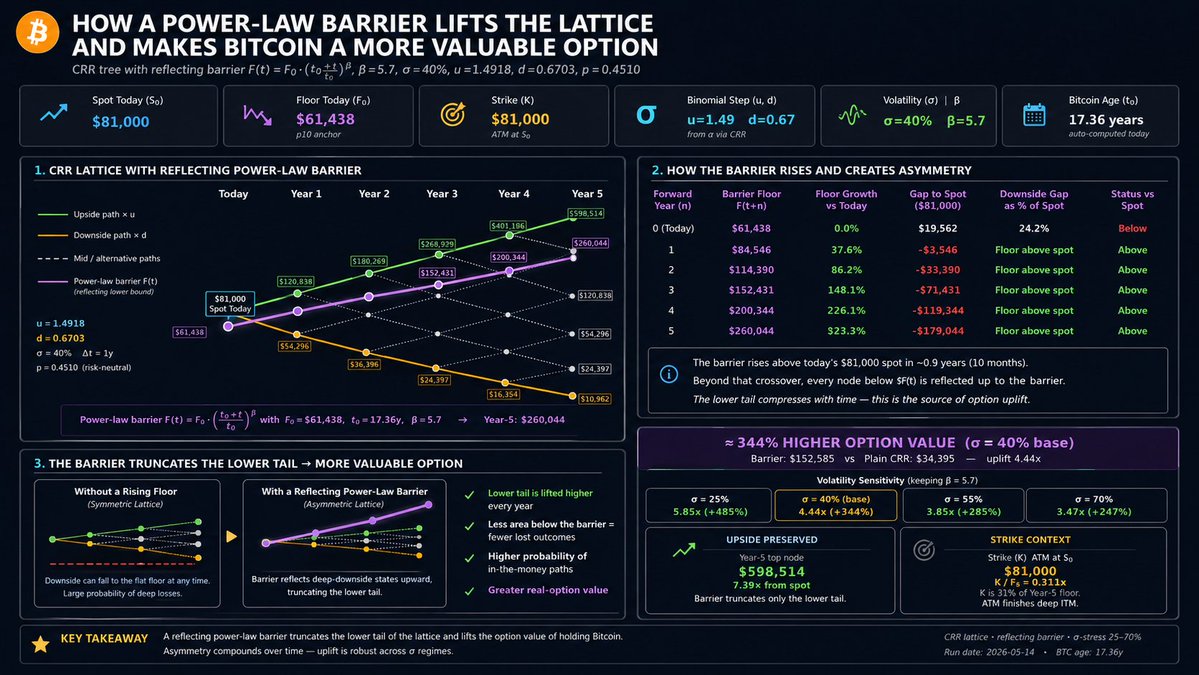
Bitcoin’s Rising Floor Turns Volatility Into a 4.44x Option Year-5 floor: $260,044 Plain call: $34,395 Barrier call: $152,585 Uplift: 4.44x Vol sensitivity: 25% vol: 5.85x 40% vol: 4.44x 55% vol: 3.85x 70% vol: 3.47x A normal call prices upside volatility. A rising floor removes part of the downside path. Less downside + same upside = higher convexity. The market just sees Bitcoin volatility. It is missing the power-law floor.
David tweet media
English
5
8
53
2.5K
Strive
Strive@Strive·
Strive: The Daily Dividend Company Investor Update - May 2026 $ASST $SATA
English
131
214
1.5K
682.9K
Timo Koskela
Timo Koskela@TimoKoskela6·
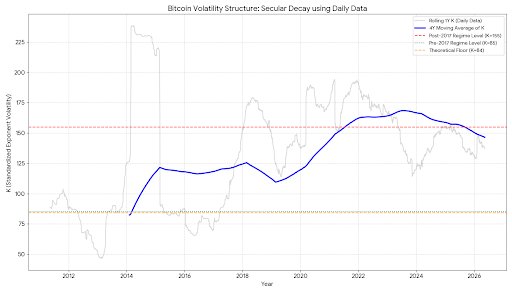
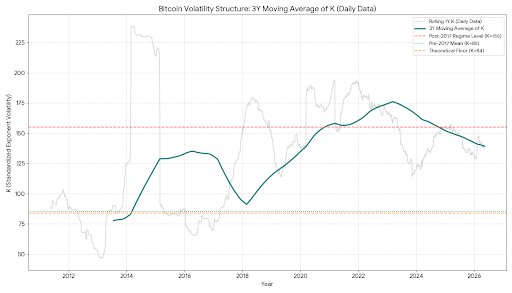
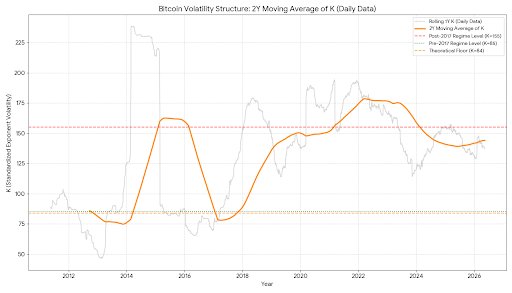
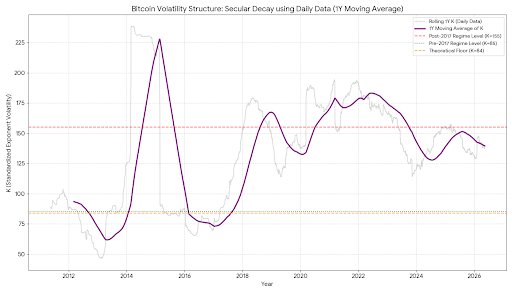
A bit more on this... We ran it on daily closes — your exact methodology. n_daily computed from daily data, 365-day rolling standard deviation, 4-year moving average. No weekly smoothing, no low-pass filter, no sampling artefact. The numbers: ▪️4Y MA peak: 168.48 (mid-2023) ▪️4Y MA current (May 2026): 146.48 ▪️Raw 1-year rolling K current: 137.42 The 4Y MA has broken below the 155 regime line and has not recovered. But before drawing strong conclusions, the ordering across windows is worth examining carefully. The 1Y K is the most informative number. The 4Y MA declining from 168 to 146 could partly reflect the 2021 ATH (K ≈ 190) exiting the rolling window — a regime transition artefact rather than genuine secular decay. The 1Y rolling K at 137 is much harder to dismiss on those grounds. It contains only the last 365 days of data — entirely post-2021, entirely post-2022 bear, capturing only the 2024–2025 environment. The 2021 high-K period has been completely absent from this window for over two years. And yet the 1Y K sits at 137, well below the 155 regime mean. That is the cleanest single observation: Bitcoin's current volatility in your coordinate system, measured over the most recent year with no 2021 influence, is 137 — not recovering toward 155. The annualised vol trajectory: K value / Implied σ_annual 168 (4Y MA peak, 2023) / 42.2% 155 (post-2017 regime mean) / 38.8% 146 (4Y MA, May 2026) / 36.7% 137 (1Y K, May 2026) / 34.4% 83 (floor K at current t) 20.7% The SAOM's operative σ_ε = 40.54% was calibrated from Deribit implied volatility. The daily K analysis gives the structural trajectory in return space. They are pointing toward the same floor from two different directions. What this means — and what it doesn't. The current data is consistent with secular decay. But your regime stationarity claim cannot yet be ruled out. The 2024–2025 cycle may simply be a lower-K cycle than 2021 due to ETF-era institutional depth and hedging — a composition effect rather than a structural shift. If the next cycle peak drives the 1Y K back above 155, regime stationarity holds and the current 137 reflects cycle characteristics, not structural compression. The definitive test is the next cycle. Each new cycle adds evidence. The direction will become clearer over time — and both frameworks are watching the same future data. The most informative upcoming data point will be the next bull cycle peak: if the 1Y K recovers to 190+ as in 2021, the stationarity hypothesis is strongly supported. If the next peak lands materially below the 2021 K peak, the secular decay hypothesis gains substantial weight. Either way, the peak comparison across cycles is where the most evidence will accumulate. The dual-frequency picture. What the moving averages do suggest, without requiring the secular decay question to be settled, is that Bitcoin's volatility has a dual-frequency structure: ▪️High-frequency: K oscillates around a local mean within each cycle — this is what your stationarity result captures, and it is real. ▪️Low-frequency: Something is operating beneath the cycle, whether secular structural decay or cycle-specific composition effects, that is currently holding all windows between 137 and 147. Your coordinate system found the cycle. The SAOM is trying to find what moves beneath it. The data so far is encouraging. The next cycle will be decisive. @Giovann35084111
Timo Koskela tweet mediaTimo Koskela tweet mediaTimo Koskela tweet mediaTimo Koskela tweet media
English
0
0
0
28
Giovanni's BTC_POWER_LAW
Giovanni's BTC_POWER_LAW@Giovann35084111·
The daily slope n=log(P2/P1)/log(t2/t1) is the natural quantity that describes almost all mathematical properties of Bitcoin. All the discussion of projected future returns, volatility and similar become much clearer in this framework. Take volatility. The n volatility has had 2 main regimes in the last 17 years. It has been very stable over the last 9 years (something happened in 2017 to make it shift). This is very interesting and consequential. This framework explains many things. Many people say the Bitcoin volatility is declining giving hand waving arguments of why that is the case. In fact, it is not in n, it is stable the observed decline in non-normalized volatility is a consequence of the power law. The "vol is declining" puzzle is now solved. Daily vol isn't mysteriously decaying with time as a function we have to fit empirically — it's the necessary consequence of n_daily having a roughly stationary distribution. If you believe n_daily is the natural physical quantity (and the data suggests within each regime it is), then σ_r(t) = K/t is forced. The bounded-residual property falls out for free. Under σ_r ∝ 1/t, the variance of the cumulative residual converges: Var(ε_t) ≈ Σ K²/s² → K²π²/6. So the "power law channel" doesn't widen indefinitely — residuals stay in a fixed band relative to the trend. This is exactly what the data shows (residual std actually shrinks, from 0.94 to 0.22 across the sample, because the early sample falls inside the bigger pre-2017 K-regime variance and the late sample falls inside the smaller K/t variance at large t). The signal-to-noise ratio is constant within a regime. The deterministic trend's daily contribution is dlog(P)/dt = n/t. The noise contribution is K/t. The ratio K/n is therefore time-invariant. Pre-2017: K/n ≈ 85/5.68 ≈ 15. Post-2017: K/n ≈ 155/5.68 ≈ 27. The market "feels" about 1.8× noisier post-2017 relative to the deterministic growth rate, and that ratio stays put as long as you stay in the regime. The 2017 step makes physical sense as a structural change. CME futures launched December 2017, ETF speculation accelerated, institutional flows arrived. A discrete change in the noise scale (K) without a change in the exponent of the t-dependence is exactly what you'd expect if the market's "intrinsic" noise level changed but the trend's scaling did not.
Giovanni's BTC_POWER_LAW tweet media
English
3
4
21
2.9K