Timothy Terrell

2.2K posts

Timothy Terrell banner
Timothy Terrell

Timothy Terrell

@timothyterrell

Economics professor. Senior Fellow @mises. Retweets not always endorsements. I sometimes post material with which I disagree. https://t.co/ADTR79yhLb

South Carolina Katılım Ağustos 2008
1K Takip Edilen2.1K Takipçiler
Timothy Terrell retweetledi
Jay Van Bavel, PhD
Jay Van Bavel, PhD@jayvanbavel·
I don't think people fully realize how badly AI has damaged higher education. This is not an easy problem to fix. There are two major issues that foster cheating with AI: 1) Friction: It used to be hard to cheat. You had to find another student to copy. Now you just drop a short prompt (or the PDF of your assignment) into a chatbot and you get a complete response. This problem is not going away, it will only get worse as AI answers get harder and harder to detect 2) Social norms: Too many students are using this technology. As more and more students use AI to cut corners, it becomes easier and easier for other students to rationalize it. At some point, you reach a tipping point where cheating (rather than following the rules) feels normative. Unless you can fix both of these issues, cheating will get worse. Much worse. The problem is that the lack of friction creates worse social norms, which then makes it easier for others to justify cheating. Even students who don't want to cheat will eventually feel that it's necessary to keep up with other students. Like many professors I know, Princeton is trying to do something to protect the integrity of their educational experience. If they don't, employers will quickly figure it out and the value of a Princeton degree will eventually approximate the value of a degree from a diploma mill. I have had to change my exams and class assignments to reflect this new reality.
Jay Van Bavel, PhD tweet media
English
48
72
281
42.9K
Timothy Terrell
Timothy Terrell@timothyterrell·
🧵5/5 Too many rich-country environmentalists view paying to hunt wildlife as an unmitigated evil, even worthy of death for hunters. But without the hunting market, some species are seen by locals only as deadly and destructive pests, with little reason to tolerate their presence. dailymail.com/news/article-1…
English
1
0
5
279
Timothy Terrell
Timothy Terrell@timothyterrell·
🧵4/5 Elephants don't just kill safari hunters like Ernie Dosio. "No community in Europe or North America would tolerate the presence of such menacing megafauna," wrote Ed Stoddard for the Daily Maverick, a South African newspaper. "But poor rural Africans, often viewed from afar as extras on the set of a Tarzan movie, are seen as natural cohabitants with such wildlife." Foreign environmentalists and governments make decisions that impose terrible costs on much poorer locals. Rather than this "conservation imperialism," often funded by taxes and naive donors, hunting fees can help locals and wildlife. Safari hunters who will pay to hunt elephants and other wildlife give locals a reason to manage rather than eliminate them. This need not threaten a species--for example, hunters can selectively target males and aging animals that can no longer reproduce but still compete for resources. dailymaverick.co.za/article/2024-0…
English
1
0
5
284
Timothy Terrell
Timothy Terrell@timothyterrell·
Elephants trampled to death a 75 y.o. American as he hunted antelope in Africa (link in🧵5/5). The macabre glee from anti-hunters is more than evil malevolence. It's ignorance of wildlife management, and maybe some "conservation imperialism." Native Africans kill and drive off elephants. Because they're dangerous. And when rich-country environmentalists blunder into what they don't understand, they can make things worse. In 2022, conservationists helped Malawi's gov't move 263 elephants from one national park to another to boost the elephant population there. Within 24 hours of release, several had crossed into Zambia and trampled two farmers to death. 🧵1/5
Timothy Terrell tweet media
English
3
3
35
3.1K
Timothy Terrell
Timothy Terrell@timothyterrell·
The restrictions were lifted in 2025, but the capital equipment necessary to produce incandescents had been mostly scrapped by that time. Along with the possibility of a reimposed regulation later, this meant that going back to making cheaper incandescents was impractical.
English
0
0
1
108
Timothy Terrell
Timothy Terrell@timothyterrell·
GE and Philips, major light bulb manufacturers, worked hard to get gov'ts to ban incandescent light bulbs. Why? CFLs and LEDs offered higher profit margins, but customers weren't persuaded by energy savings. So GE enrolled government, spending $47 million in 2007 on lobbying for a ban plus carbon regulations and other energy policies that would tilt the playing field in GE's favor.
GIF
English
1
1
6
1.3K
Timothy Terrell
Timothy Terrell@timothyterrell·
@newstart_2024 GE, a major light bulb manufacturer, spent $47 million in 2007 lobbying for a ban on incandescents. Philips started in 2006 trying to get govt bans. Why? Competition in incandescents was high, & profit margins for the CFLs and LEDs were higher. More “bootleggers & Baptists.”
English
0
0
18
1.5K
Camus
Camus@newstart_2024·
Dave Asprey just made me want to rip out every light bulb in my house. He revealed that the US basically made traditional incandescent bulbs illegal to sell last year (with fines up to $440 per bulb for companies that break the rule), forcing everyone toward harsh, bright white LEDs and fluorescent lights that quietly mess with your brain, cause brain fog, and accelerate aging. Studio lighting in particular is brutal. Asprey wears special glasses on set that block the toxic part of blue light, and he swears the difference in how his brain feels at the end of the day is massive. His simple fix? Ditch the harsh blue light. Use warm 2700K bulbs, add dimmer switches, and get as close as possible to the old incandescent glow your body actually likes. He stocked up on thousands of incandescent bulbs right before they became illegal to sell. (Note: While selling incandescent bulbs is now banned in the US and similar phase-outs have happened in the EU, Canada, and other countries, owning and using the ones you already have is still perfectly legal.) Have you switched to warmer lighting at home yet, or are you still living under harsh cool-white LEDs? Noticed any difference in energy or mental clarity?
English
157
460
2.2K
443.4K
Timothy Terrell retweetledi
University of Austin (UATX)
University of Austin (UATX)@uaustinorg·
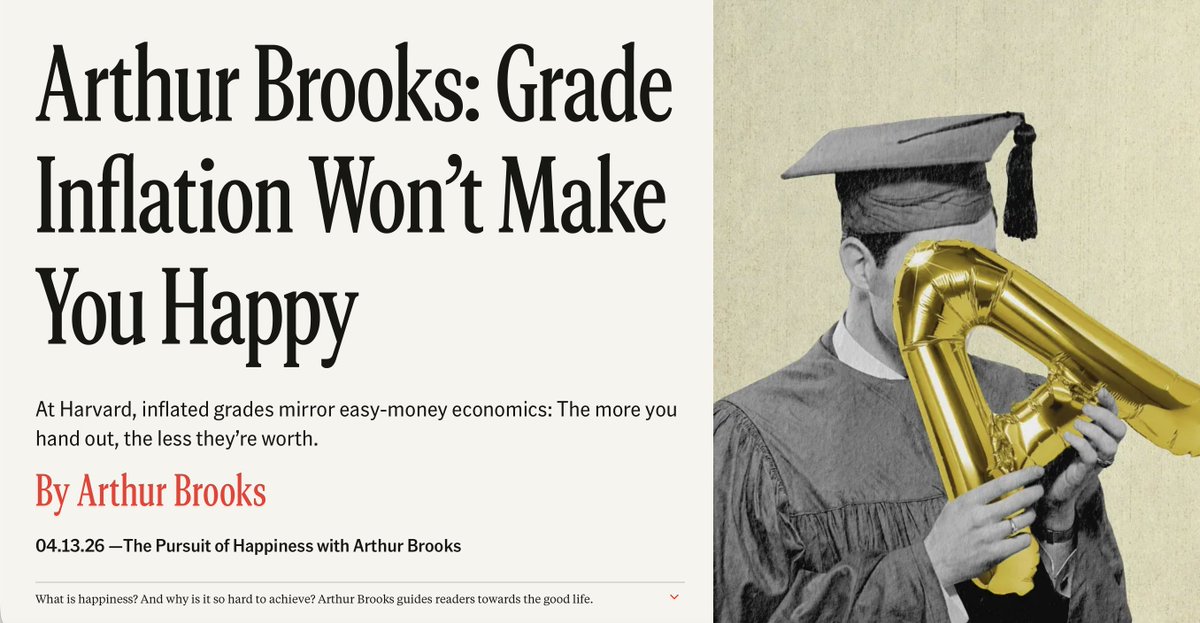
Grade inflation is "a tax on the highest-performing students, who work hardest and perform best but cannot differentiate themselves from less outstanding students with their marks. The signal to employers and graduate schools about which students do the best academic work is also distorted—which once again penalizes the best students. This seems unfair and non-meritocratic, not just inefficient." — @arthurbrooks, Harvard professor and UATX advisor
University of Austin (UATX) tweet media
English
6
10
68
24.7K
Timothy Terrell retweetledi
Handre
Handre@Handre·
The Yuan dynasty handed us history's most perfect case study in monetary destruction when Kublai Khan's government abandoned silver-backed currency for pure fiat paper money in 1260. The Mongols initially maintained the existing Chinese monetary system—silver ingots and copper coins with real metallic value. Smart move for conquerors who understood they needed economic stability. But power corrupts absolutely, and unlimited money printing corrupts faster than anything else in human history. By 1260, the temptation became irresistible. Why collect taxes from reluctant subjects when you can simply print wealth into existence? The Yuan issued their first paper chao notes backed by nothing but imperial decree and the threat of execution for anyone refusing to accept them. Marco Polo marveled at this "alchemy" in his travels, calling it ingenious that the Khan could create money from mulberry bark. What Polo witnessed wasn't genius—it was the inevitable pattern of government monetary manipulation that Austrian economists recognize instantly. Predictably, the printing presses ran hot. The government funded massive public works, military campaigns, and bureaucratic expansion with fresh paper. Prices exploded across the empire. By 1350, hyperinflation had destroyed the currency entirely. Peasants abandoned the worthless chao and returned to barter systems. The economic chaos contributed directly to the dynasty's collapse in 1368—lasting barely a century largely because they destroyed their own monetary system. Every central banker today follows the exact same playbook as Kublai Khan, just with digital entries instead of mulberry bark. The technology changes, but the economic laws remain ruthlessly constant.
Handre tweet media
English
19
167
481
22.7K
Timothy Terrell
Timothy Terrell@timothyterrell·
Want to see what the Duke Energy electric power sources are for the last few days, and how they've changed hour by hour? Go to gridstatus.io/eia/DUK
English
0
0
0
74
Timothy Terrell
Timothy Terrell@timothyterrell·
My thanks to my retired Wofford colleague Richard Wallace for arranging the Bad Creek tour for us. Allan Boggs of @DukeEnergy, who has been with Bad Creek from the beginning (over 35 years ago), was an excellent guide.
Timothy Terrell tweet media
English
1
0
2
95
Timothy Terrell
Timothy Terrell@timothyterrell·
Most Duke Energy customers aren't familiar with the Bad Creek Reservoir, a quiet facility northwest of Lake Jocassee in SC. But it has a powerful impact on the electric grid. I took a tour last week. Here's what I found out.
Timothy Terrell tweet media
English
1
2
7
386