Tinkerdust #FBPPR# retweetledi
Tinkerdust #FBPPR#
1.7K posts

Tinkerdust #FBPPR# retweetledi

So I asked Grok, if I gave it £47Bn instead of giving it to Mauritius, what could we get to help rebuild Britain
200 new/upgraded hospitals
50,000 Nurses
20,000 Doctors
1000 new/upgraded schools
50,000 Teachers
500 new/upgraded police stations
20,000 police
200 New ambulance stations
2000 Ambulances
10,000 paramedics
English

An honest talk today. If you don’t like honest talks, you can scroll further. 😁😉
What I’ve learned recently is that I’m going through a phase called the dark night of the soul, and it’s intense. I feel sad all the time for literally no reason, and I face many trials and triggers, yet I still feel extremely powerful deep within. I’m amazed at how fast I learn new things from my own experience. People’s advice is literally useless to me in this phase, often making things worse. Surprisingly, only what comes from within truly helps me, I’m my own advisor, which is crazy (not counting @MetalTriple @n2232n @Baker13Rex , thank you boys for your help, support, and understanding, your advice is the only one that actually helps me). Hardly anything from the outside can help. I need to figure things out alone, in my heart, and only that gives me the growth I need.
The most beautiful moments are when I truly figure something out, when the pain fades a little, and I feel divine love. It’s something words cannot capture. It’s as if the Universe is telling me I’m doing great and It’s proud of me. These moments keep me alive, and the growth I’m experiencing becomes visible and immense.
Another fascinating aspect of this phase is the sense of rebirth. Everything I see and touch feels new. Each time I touch a tree, grass, or water, it feels like the first time, it feels deeper, as if this were a new life. It's as if finally, when I'm out of the egregoric constructs, and claimed my sovereignty as a soul, I feel I'm truly alive.
I’m much more sensitive right now. I’m trying to stay calm and positive, but sometimes emotions get too strong, so I apologize if I’ve ever hurt you. That was never intentional.
I believe this phase is for my body, it’s going through some kind of transformation. Sometimes I laugh about it, saying I’m gaining superpowers. We’ll see what happens in the near future.
That’s all my honest talk for today. What I meant by this is simply: please be patient with me, because I’m going through something difficult right now. You know I love you all so much, and I would never intentionally hurt or trigger you. If I get too emotional, please don’t take it personally.
Thank you all for your support. I truly love you.
NOTE: Please, don’t write much under this post. An emoji is enough. A hug will help. That’s all I need right now. Advice doesn’t help me; I need to figure things out on my own, but I always value your presence. 🤍
English
Tinkerdust #FBPPR# retweetledi

@priscillaharvey1/note/c-133662492?r=ok0dc&utm_medium=ios&utm_source=notes-share-action" target="_blank" rel="nofollow noopener">substack.com/@priscillaharv…
ZXX
Tinkerdust #FBPPR# retweetledi

* The Economics of benefits *
This is the transcript of my video this morning, which challenges the whole idea most people have about the benefit of benefits.
------
If you ask the average politician about benefits, they will in some way or other imply that we are pouring money into a black hole and we've got to cut them, because that's the only way in which the government can balance its books, and apparently the government balancing its books is vital for economic growth.
All of that is complete and utter nonsense. The actual reality is that making benefit payments in the UK is one of the best ways that we have available to us to stimulate growth in this country. If Labour only understood that, they would never have got themselves into the mess they did around personal independence payments. They would never have had to fall out with their own party. They would never have looked like the fools that they now do. But they were totally confused by neoliberal myths. So let's talk about the economics of benefits.
Let's be clear. The benefits that are paid by the UK government do, almost entirely, go to poorer households, those who are in the bottom half of the income distribution overall.
Yes, some of them do go to people who have reasonable incomes because they are in situations where they need those benefits to be paid to them. For example, people who do have personal independence payments, who can work, but who nonetheless need to be assisted with the extra costs that their disability creates.
Nonetheless, though, however it is looked at, the vast majority of the benefit payments in the UK go to people on lower incomes. And if there's one thing that we know about people in the UK who are on lower incomes, it is that they have very few savings. Only 9% of UK wealth is owned by people in the bottom half of the income distribution. And as a consequence, what we know is that the vast majority of the money that they get month in, month out is spent by them and virtually straight away.
But that doesn't mean to say that the money that we pay them in benefits is wasted. Far from it, in fact, because the reality is that the moment the people who receive these benefits get them, they begin to spend them and they become someone else's income. The benefits that a person receives immediately begin to support somebody's job, somebody's business, or somebody's services. And understanding this is absolutely vital, because if we understand that benefit payments immediately become the income of people who are working inside the economy, what we can see is that benefit payments don't just support those who need them, but they support our businesses as well.
And what is more, they also support tax receipts because the moment that a person spends the money they receive by way of benefits, they'll do so with a business that will probably pay VAT as a consequence. It'll also pay corporation tax. And that business will then pay its staff, who will, as a result, pay income tax and national insurance. So the benefit payment gives rise to an almost immediate, significant tax flow back to the government. The money isn't lost. It's fueling government revenue.
But this isn't a process that happens once, because of course, once the staff who are paid by the business who receives the income that the benefit recipient had, have their net pay at the end of the month, they'll go out and start spending it, because they, most likely, will still be in that group of people in the UK who save very little. So they too will now be boosting the UK economy as a consequence, in effect, of the benefit payments which were paid to the person who paid it to the business that employed them, that then provided them with the opportunity to spend, and so the cycle goes on.
We do, in fact, create a virtuous cycle, which economists call the multiplier effect because this money goes round and round and round and round; okay, always in ever smaller amounts, because tax is paid on each and every cycle, but nonetheless, first of all, there's a boost, and a continuing boost to real incomes as a consequence of the benefits payment made to the first recipient, but secondly, tax is paid on every occasion when the money goes around in this cycle. And as a consequence, it could, if the cycle kept running, actually return to the government, all that it's spent by way of the benefits payment.
Benefit payments aren't, therefore, money poured into a black hole. They're just a way of actually generating economic growth for vastly more people than the recipient in the first instance, and also a way of guaranteeing that the government will, as a consequence of that growth, which is created as a result of the benefits payment, get as much back in tax as they probably spent.
Except, and here I have to add a caveat, except if the person who receives the money, which was originally generated as a consequence of the benefit payment to the first recipient who went on and spent it, if the person who receives that income then saves it. The person who saves the money they get as a result of the cycle that I've just described breaks the chain. They stop money going back into the economy. They stop the cycle from working. They stop there being new income for somebody else because they've kept the money for themselves. They've turned this live money, which is creating good things in the economy into dead money, which is precisely what savings are, they're money put aside and it's dead thereafter.
Now, neoliberals don't describe things this way. They say that we should, if we want to grow the economy, let the wealthy get as wealthy as possible, and then their money will slowly trickle down into the economy and that this will, as a result, make everybody richer. There's absolutely no evidence to support this absurd claim, because if you are rich and you get some more income, which is what the neoliberals say we should ensure that the rich do get, you save it. And when you save your money, nothing trickles down. All you do is just turn it into yet more dead money.
And that's what neoliberalism is all about. It's about capital accumulation for a few at cost to the many.
But if we start injecting money instead into the economy with those who are amongst the poorest benefit recipients, what we can guarantee is that we get the maximum payback on that money because it will circulate many more times before the wealthy get their hands on it, put it aside, and break the cycle of growth, which it gives rise to.
Far from wealth trickling down, the truth is that wealth in our economy floods upwards, and it is the accumulation of wealth by the wealthiest that actually prevents the reality that growth could be much larger than it is in the UK if only they didn't put money aside.
Now, what does that mean? We need to stop the wealthy from hoarding is the actual truth of the matter. Far from money being wasted on making payments to those in receipt of benefits, as most of the wealthy would claim, where money is wasted in the UK economy is by letting the wealthy have it, who then don't want to use it.
And that should be glaringly obvious. Leaving money with somebody who doesn't want to use it can never create new wealth because nobody's got it to spend. So as a consequence, what we need to do is, and let's be blunt about this, tax the wealthy more, redistribute to those on lower incomes, and as a consequence, that dead money, which the wealthy had, which we've now put back into circulation as a consequence of taxing them so that we can then manage the consequences of giving those on benefits more money to spend, that process will fuel growth.
Giving money to the wealthy won't.
Giving money to the poorest in our communities will.
Benefits are the way to make our economy stronger.
They're not about charity.
They're not about feeding black holes. They are literally about how our economy is kept running.
And it's the greed and ignorance of neoliberalism that has fueled the imaginations of politicians who actually believe all the nonsense that it has to say that is holding us back.
We can beat the problem of low growth and a stagnant economy, but we can only do it by taxing the wealthy more and by providing more income to those who do not have enough because they will spend it, and that will fuel our economy, and employment, and growth, and investment.
And what is more, and let's be clear about this, the government would even balance its books because the money would circulate for longer before it ended up in somebody's savings account, and as a result, government revenues as the proportion of GDP were rise, not because we increased tax rates, but simply because the money was allowed to circulate for longer.
The economics of benefit payments are the reverse of what we are normally told, but that's always true in macroeconomics, because macroeconomics normally runs the other way round from microeconomics, which is the economics of the household. And far too many of our politicians believe that the economics of the household are what should be applied to the management of the state.
They're not. If we only understood that if we feed money into the bottom of our economy, we get the maximum growth rate, but if we feed it into the top, we get the lowest possible growth rate, then we would have a better economy, a better society, and better off people. Why don't politicians want that? I wish I knew.
English
Tinkerdust #FBPPR# retweetledi

There’s a persistent myth that our government is somehow at the mercy of the financial markets and that it has to dance to their tune. This is most definitely doing the rounds this week, mainly as a result of Labour's mismanagement of its own party, and Rachel Reeves' subsequent very public tears.
It’s a myth I have been challenging for years, so let me summarise why.
1. The government creates the money
The UK government is the monopoly issuer of the pound. It spends all of that money into existence. Every pound of government spending creates a matching financial asset for someone else. It is only afterwards that the government issues bonds, not because it needs the money, but to provide a safe place for savers to deposit their funds when banks cannot provide this service.
This point is critical. The government does not need the markets to ‘fund’ its spending. It is simply swapping one form of money (reserves) for another (gilts). Bizarrely, it pays interest to those to whom it provides this service.
2. Gilts are a choice, not a necessity
The sale of government bonds, gilts in the UK, is presented as if the government is dependent on the markets to keep spending. This is nonsense. The government issues gilts largely because:
It wants to drain reserves from the banking system to help the Bank of England hit its (currently too high) interest rate target.
It wants to give pension funds and insurance companies a safe deposit facility to underpin their promises to those who use their services.
It believes it must maintain an outdated and now unnecessary City-based financial architecture.
None of this means it needs the markets to spend. If no one bought gilts, the government could continue to spend. In fact, as quantitative easing and now quantitative tightening prove, there is no relationship between bond issues and Bank of England market interventions and the capacity of the government to spend: the evidence is all there for anyone to see.
3. The central bank is always the buyer of last resort
When financial markets are in turmoil, as happened in the mini-budget fiasco under Liz Truss, the Bank of England steps in. Its role is to stabilise prices and yields. This is not optional. It is a fundamental part of having a sovereign currency and a central bank that acts as the lender of last resort. This means the financial markets are, in fact, dependent on the government and its central bank. Not the other way around.
4. Interest rates are a policy choice
People say, “but the markets set interest rates, and so they can discipline the government.” Again, this misunderstands monetary operations. The Bank of England sets the base rate. It can cap or control longer-term rates by buying or selling bonds as it chooses. The so-called market rates are policy-contingent. When push comes to shove, the central bank can always enforce the interest rate it wants.
5. What markets really influence is ideology
So why the obsession with ‘market confidence’? The reality is, politicians and economists often invoke markets to justify austerity. It is easier to say “the markets demand it” than to admit their own ideological choice, which would otherwise be unpalatable to the electorate. Financial markets do, in that case, play a political role, but they do not hold the government hostage. They operate within the monetary framework that the government and its central bank set. We could just as easily choose to run the economy with other priorities, but it does not suit neoliberal politicians to do so. That is because they view politics as the City does, at cost to us all.
Summary
I keep returning to this issue because it is so fundamental: the UK government is a currency creator, not a currency user. It is not like a household. It does not need to beg or borrow from the markets to spend. Financial markets are accommodated by the government, not the other way around.
Understanding this changes everything. It means that economic policy decisions — on public services, investment, climate action, and inequality — are political choices, not technical constraints imposed by bond traders. That is why misinformation on this issue matters so much, and the fact that it is so widespread shows just how strong are the forces that wish to deny that democratic choices can still be made in the UK.
English
Tinkerdust #FBPPR# retweetledi

Palliative care? Underfunded.
Disability support? Gutted.
Mental health services? In crisis.
Assisted dying? Fast-tracked.
What does that tell you?
#AssistUsToLive #KillTheBill #AssistedSuicide #AssistedDyingBill #NotDeadYet
English
Tinkerdust #FBPPR# retweetledi

There is only one way for Parliament to be redeemed after this week of blood lust votes against the most vulnerable in society...The people must rise...a new parliament must be formed...one devoid of professional politicians, WEF Flunkies, Globalists, and workers of Evil...such as we have now...!! The whole system must be broken and remade...especially the civil service vice with its demonic globalist indoctrinations...!! It's time for the power to rest in the people...and end the political class for good...!!
@PhilHs10 @calvinrobinson @RevdBrettMurphy @revwickland @realrikkidoolan @LozzaFox @TRobinsonNewEra @DANNYUNFILTERED @btbsoco
English
Tinkerdust #FBPPR# retweetledi

EPIC: Peter Hitchens demolishes Net Zero on BBC Question Time, to the utter dismay of both panellists and audience members.
"We didn't just close down our coal fired power stations, we blew them up, we were so certain we were right to do so. At the same time, China is building the equivalent of two new coal fired power stations a week. India has a vast expansion programme of coal fired power stations."
"The contribution which this country is making to these outcomes is not merely minimal, it's non-existent. Everything that we do is completely blotted out by what much larger countries are doing to maintain their own power."
"If you want to live in a country where nobody can afford to heat their house... if you want lots of people to lose their jobs because there's no energy, if you want to be cold all the time... then carry on believing that the demand to go for Net Zero is intelligent and thoughtful."
English

@mcco62712 @toobaffled Please tell us what we can do to help ourselves x
English

@toobaffled You can detox from these vaccines , they are weakened over time. It's very hard to eliminate them from your system, but it can be done.
English

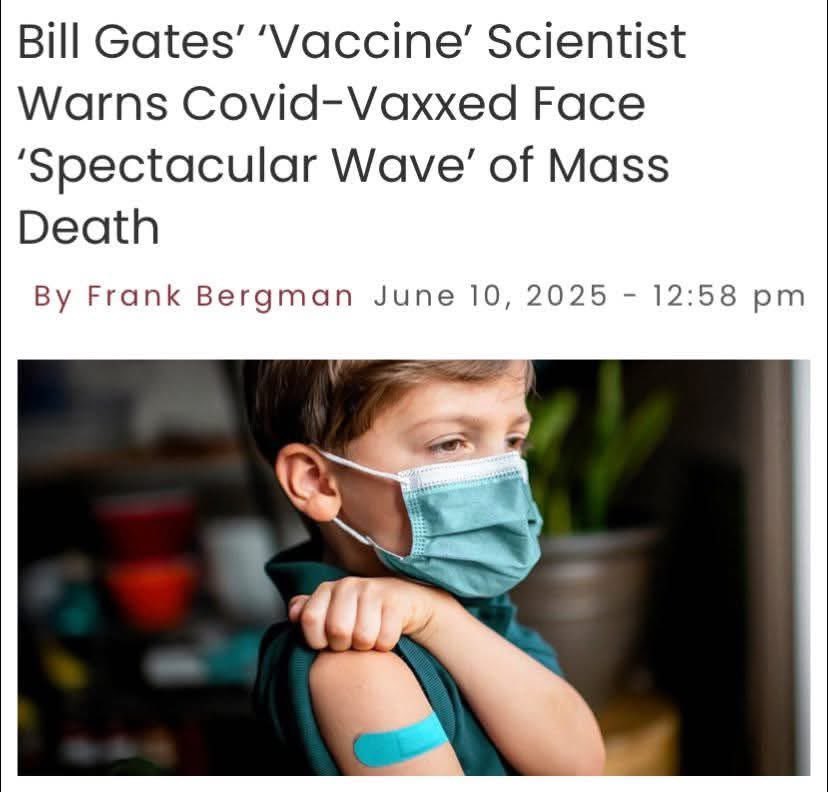
One of the world’s leading vaccinologists is warning the public that Covid mRNA “vaccines” were the trigger for a looming global mass depopulation event.
Dr. Geert Vanden Bossche, a former Gates Foundation “vaccine” scientist, warns that the human race is facing a deadly “spectacular wave of hyperacute systemic disease” that will wipe out billions of people who received mRNA injections.
Bossche reveals that Covid mRNA shots were designed with a “delay” that triggers an “evolutionary mechanism.”
He warns that the coming devastation caused by Covid injections will be “unprecedented in the history of clinical virology and underappreciated by our public health authorities.”
Bossche is sounding the alarm over a looming collapse of immunity among those who received the Covid mRNA injections.

English