
Tom Nelson

333.7K posts

Tom Nelson banner
Tom Nelson

Tom Nelson

@TomANelson

Co-founder of Gorilla Science (@WatchGorillaSci). "Climate: The Movie" producer. CO2 is vital plant food, but it is *not* the climate control knob.

Katılım Aralık 2008
1.7K Takip Edilen70.3K Takipçiler
Sabitlenmiş Tweet
Tom Nelson
Tom Nelson@TomANelson·
Just how interested are U.S. voters in parting with their hard-earned money for climate scam purposes? Well, as of a couple of months ago, "Cost of Living" was their #1 issue, with "climate change" listed way down as issue #35 of 39. @ClimateDefiance
David Shor@davidshor

Excited to be on Odd Lots to talk about the politics of AI. AI today is less important than it will ever be. Over the past year, AI rose in issue importance faster than any issue we track — it's now more important to voters than climate change, child care, and abortion.

English
0
2
13
1.7K
Dave Collum
Dave Collum@DavidBCollum·
.@TomANelson I was in a seminar on new technology for capturing CO2 to prevent climate change. I calculated how many tons of CO2 was occluded by planting a single white pine sapling and asked, "Will any technology beat that?" They retorted, "The tree will die eventually", at which point I said, "Plant another."
English
50
47
462
16.7K
Tom Nelson
Tom Nelson@TomANelson·
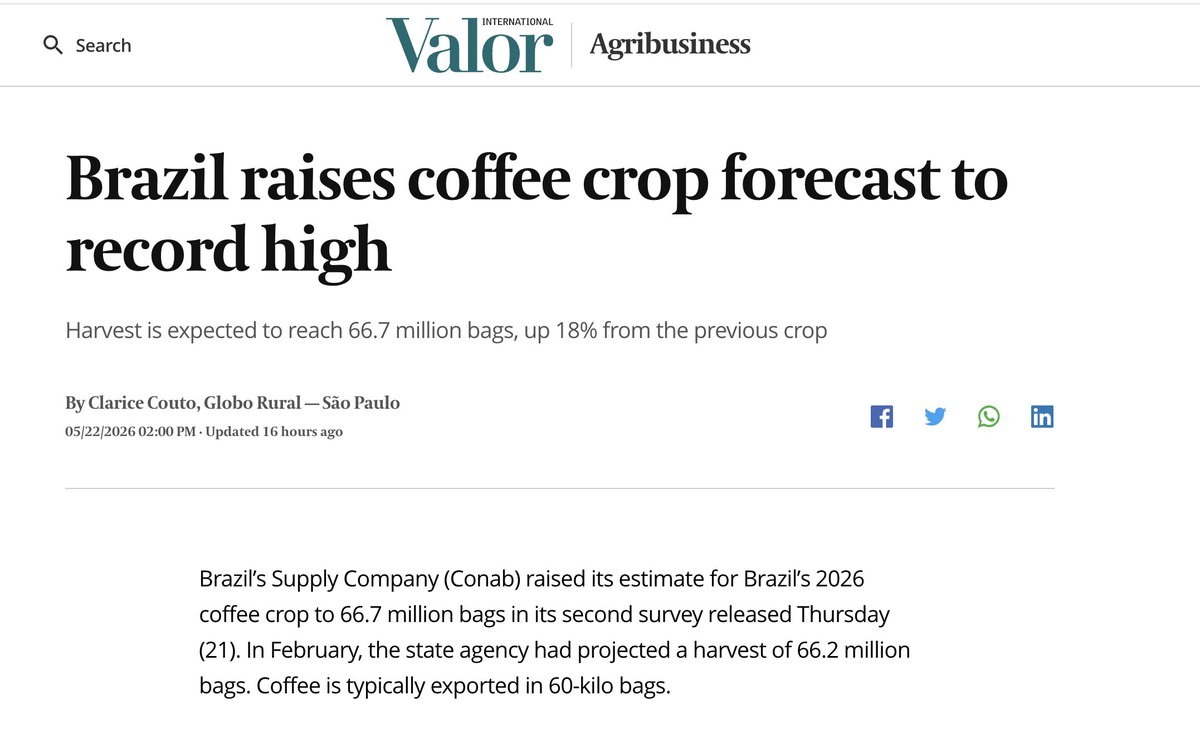
CO2-induced coffee shortage update
Tom Nelson tweet media
English
7
21
95
3.8K
Tom Nelson
Tom Nelson@TomANelson·
@TomSteyer Trying to prevent bad weather by funneling money to climate scammers is off-the-charts stupid.
English
1
8
85
529
Tom Steyer
Tom Steyer@TomSteyer·
By transitioning to green energy and holding Big Oil accountable, I'll bring down costs and protect our planet.
English
348
124
954
19.2K
Al Gore
Al Gore@algore·
Twenty years ago today, An Inconvenient Truth made its debut in movie theaters across the U.S. I’ll be honest: I was skeptical that my slideshow about the climate crisis could become a successful movie. But thanks to our immensely talented director, Davis Guggenheim, Jeff Skoll, who made the ultimate decision to make the movie, and the incredible team behind the film — Laurie David, Lawrence Bender, Scott Z. Burns, Lesley Chilcott, Ricky Strauss, Diane Weyermann, and so many others, the film was a huge success, and opened the eyes of millions around the world to the threat posed by the climate crisis. While I wasn’t sure that there’d be widespread public interest in a science-based slideshow, I have never doubted humanity’s ability to solve this crisis. We know we must act, and Mother Nature is making that clearer and clearer every day. We’re already feeling the rapidly worsening impacts of a warming planet. Those impacts are evidence that our cause is even more urgent than it was 20 years ago. And as a result, the global movement for climate action has grown into the largest morally-based movement in the history of the world. We also know now that we can act. Indeed, in the past 20 years, we’ve made tremendous progress: The world came together in 2015 to forge the historic Paris Agreement, which despite the recent U.S. withdrawal, continues to drive global action and ambition. Incredibly, last year, renewables made up 86% of all the new electric power installed around the world. In the U.S., renewables were 92% of all new power capacity! Electric vehicles are now 25% of all new car sales worldwide and the sales of gasoline-powered vehicles have been declining since they peaked in 2017. Unfortunately, however, the crisis is still getting worse faster than we are deploying the solutions — solutions that are now way cheaper than the dirty and dangerous fossil fuels still spewing heat-trapping pollution into the sky as if it is an open sewer. So, while this is a natural occasion to reflect on the 20 years since the movie came out, I’m focused much more intensely on what we need to do now in order to shape what our world will look like in the next 20 years. I’m still presenting my updated slideshow all over the world, training grassroots climate leaders and working with partners in 194 countries and territories who are creating change in their communities, in their workplaces and schools, and in their nation’s policies. From what I’m seeing and hearing, I have no doubt that we will win this struggle. But it is still not clear that we will win it in time to avoid catastrophic damage and the dangerous negative tipping points that the climate scientists have long been warning us we must prevent. Will we muster the moral courage and political will to solve this crisis? Well, if you ever doubt our ability to do so, just remember that political will is itself a renewable resource. It’s up to all of us to renew it. Photos: Still from An Inconvenient Truth, 2006. Climate Reality Project training in Nashville, TN, 2026.
Al Gore tweet mediaAl Gore tweet media
English
491
592
1.9K
101.6K
Tom Nelson
Tom Nelson@TomANelson·
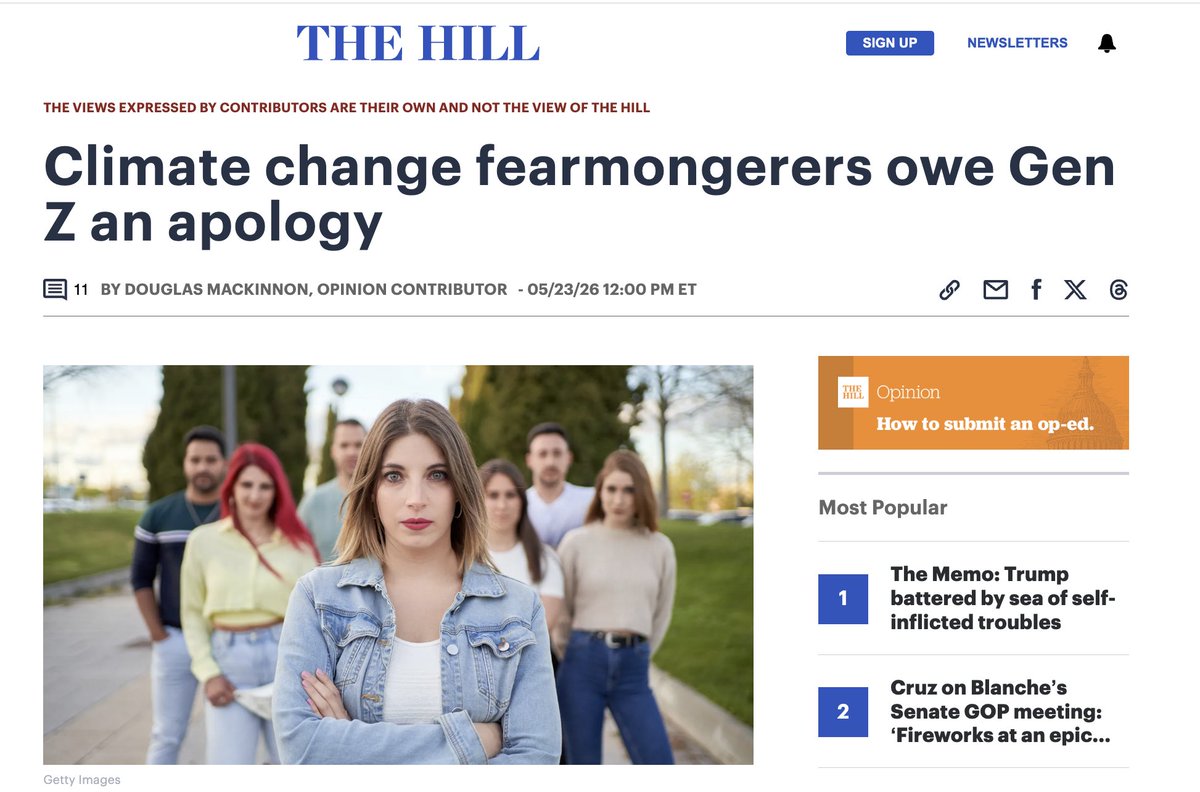
Now even The Hill is reporting on the climate scam implosion
Tom Nelson tweet media
English
2
15
60
4.9K
Tom Nelson
Tom Nelson@TomANelson·
@ClintonSTurczak Sounds good! If you can recommend a knowledgeable person to talk about this, please let DM me.
English
1
0
0
10
Clinton S Turczak
Clinton S Turczak@ClintonSTurczak·
@TomANelson Any chances of getting a pod on the effects of the South Atlantic Anomaly and how a magnetic dipole declination effects biology? Not exactly climate, but...
English
1
0
0
17
Tom Nelson
Tom Nelson@TomANelson·
CO2-induced climate change will disrupt the childhoods of exactly zero children ever, but people selling the climate scam to kids *are* disrupting childhoods.
Tom Nelson tweet media
English
2
9
32
616
NanaSox
NanaSox@argylesox28·
@TomANelson This podcast is fabulous!! I love, love Thomas’s comparison of history to weather.
English
1
1
2
27
Tom Nelson
Tom Nelson@TomANelson·
Tom Nelson Podcast #392: Thomas Kurz: “Why There Is No Climate Crisis” is now published. Thomas Kurz discusses his upcoming book, Why There Is No Climate Crisis (Kindle in May, print in June), and argues modest warming is largely natural, claiming the IPCC obscures evidence of past climate variability. He explains paleoclimate proxies (oxygen isotopes, carbon-14, beryllium-10) and links climate shifts to Milankovitch cycles, solar cycles, galactic cosmic rays influencing clouds, and ocean oscillations (AMO/PDO). Using temperature reconstructions, glacier, treeline, sea-level, historical freeze, agriculture, insect, and civilization records, he says warm periods brought prosperity while cold periods drove drought, famine, disease, and upheaval. He concludes about half of post-1850 warming is natural, warming is generally beneficial, and future cooling is likely. 00:00 Guest And Book Intro 00:24 Why He Dug In 01:46 Focus On Climate Cycles 03:44 Paleoclimate Proxies 04:57 Isotopes And Temperature 06:48 Cosmic Rays And Solar 07:56 Milky Way Climate Cycle 12:17 Milankovitch Ice Ages 14:28 CO2 Follows Temperature 17:10 Holocene Cooling Trend 19:29 Schwabe Solar Cycles 21:42 Millennial Solar Cycles 23:14 Temperature Reconstructions 25:04 Glaciers Treelines Seas 28:44 Historical Freeze Evidence 32:27 Farming And Wildlife Clues 37:06 Warm Vs Cold Impacts 41:28 Storm Evidence In Proxies 44:44 Civilizations And Climate 45:48 Holocene Optimum Prosperity 47:42 2200 BC Collapse Event 48:18 Minoan Warm Period Boom 50:47 Greek Dark Ages Breakdown 52:53 Roman Warm Period Growth 54:23 Late Antique Cooling Plagues 56:50 Medieval Warm Period Golden Age 59:11 Little Ice Age Hardship 01:06:46 Witch Hunts Climate Blame 01:09:16 Modern Warming Attribution Debate 01:12:17 Ocean Oscillations AMO PDO 01:15:44 No Climate Crisis Wrap Up
English
11
140
286
22.2K