Sabitlenmiş Tweet
Nick Groeneveld
11.6K posts

Nick Groeneveld
@ToolboxOfDesign
Product designer and developer for growing SaaS companies. Better onboarding, branding, and design systems for companies scaling from $10k to $100k+ MRR.
The Netherlands Katılım Mayıs 2012
271 Takip Edilen2.8K Takipçiler

@Shpigford You have a blocky font so the mark needs to follow that
English

@danmall There’s a whole subreddit for those posts too. If you make it there, it feels like getting a medal
English

Adding “LinkedIn Lunatic” to my LinkedIn.
LinkedIn Lunatics@LinkedInLunat1c
The best standing desk is an infinity pool in the rainforest (but it's not a vacation)
English

@galluzzo_julian @shipstudio_app You should. It’ll be good for SEO and leads
English

@ToolboxOfDesign @shipstudio_app Thank you so much!! Wanna add some more pages and probably a blog too :D
English

well, for probably the first time in my career, I have a personal site which I am truly happy with 😁
It's a work in progress, as is everything in life, but this is what about 8 total hours inside of @shipstudio_app got me.
No Figma, just went with the vibes. Very fun process.
English

@danmall It was kind towards you with a subtle stab towards social media algoritms as a whole!
English

@galluzzo_julian I’ve only ever worked with nice people from Canada. So not the worst place to be!
English

@ToolboxOfDesign moving (back) to Canada very very soon :D
I'm a Canadian citizen only, Serbia won't give me citizenship, and because of Italy's stupid government, they won't give me citizenship either
so... back to the only place that gives us rights 😂
English

@mrtylerwhite and I share what work outside of Figma looks like for us in the latest episode of Design Table Podcast.
Take a look here - youtube.com/watch?v=19j9zz…

YouTube
English

Designers want ‘UX’ to have a seat at the table. Yet, all we do is fight about what tool is best.
Canvas vs. code, Webflow vs. Framer. Figma vs. whatever. If we as a profession want to be taken more seriously, we have to zoom out and discuss the bigger picture.
Real UX talk about how it works and where it needs to change in today’s AI wave, for example. But also;
- How to think through edge cases in our work (if you want to keep with tools, but better);
- figure out to what degree designers should touch code (if at all);
- and what else we can do to stand out when each tool does more or less the same thing.
If you want to stand out as a designer, talk about what you have to offer outside of the tools you use. No more ‘Figma is [clickbait-y thing]’.

English

@Shpigford Style it like it is hand written and/or paper documents
English

i'm hitting a wall on the keptwell.org marketing site.
i hate the stock photography feel but kinda stumped on what else to try overall.
English

@Shpigford You know you’re going to build a better tool yourself!
English

I gotta say, after 7 years of using Webflow and hundreds of videos, I have no Webflow swag 😅
Made a cool lil video on @sanity_io and their team sent me this. Thanks guys!! Great quality too.

English

@mrtylerwhite and I discuss the above and more in this week’s Design Table Podcast episode. Super useful for people who feel stuck or insecure in their portfolio building journey.
Take a look here: youtube.com/watch?v=Cua5FY…

YouTube
English

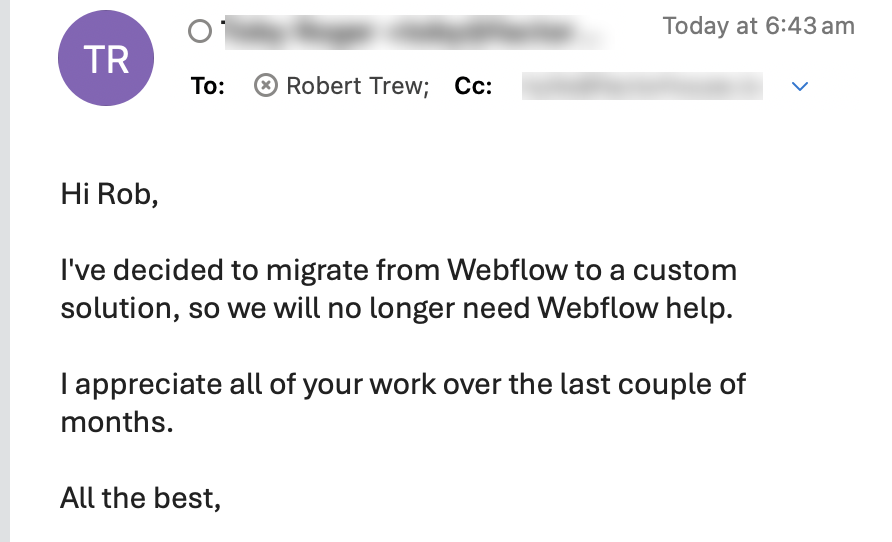
The tools you use to build a product design portfolio don’t matter as much as some make you believe.
We designers fight way too much about what the ‘best’ portfolio tool is. We talk about Framer vs. Webflow, Codex vs. Claude, and no-code vs. code. Discusions like these are almost always a waste of time.
I’ve had conversations with designers who were insecure about their WordPress or Squarespace portfolio. They always mention social media discussions as the main reason for their insecurity.
“Shouldn’t I use Framer? Or Claude? I’ve read that it is better to use those tools…”
This literally happened on a coaching call just last week.
Here are two better questions to ask yourself.
First up; can you design the portfolio you have in mind using the tools you already know?
Answering ‘yes’ here means it is perfectly fine to keep using the same tools. It doesn’t matter if it is WordPress, Framer, or something else. Just go and build that portfolio.
Next; do you want to sell design projects using a specific (no code) tool?
For example, I’m a Webflow certified partner and maintain Webflow websites for multiple clients. Because of that, it makes sense for me to have a portfolio website built on Webflow. It is my ‘first project’ and a great showcase for potential clients.
But that doesn’t mean one’s better than the other. Choosing the ‘right’ tool here is just a good business practice. You could do the same for WordPress or Framer templates.

English

@galluzzo_julian Webflow’s CMS view is very useful for my clients. They can easily add or update content without having to go through me or a terminal/canvas/code editor
For personal projects where it is just me, I’m using traditional dev tools and CC
English

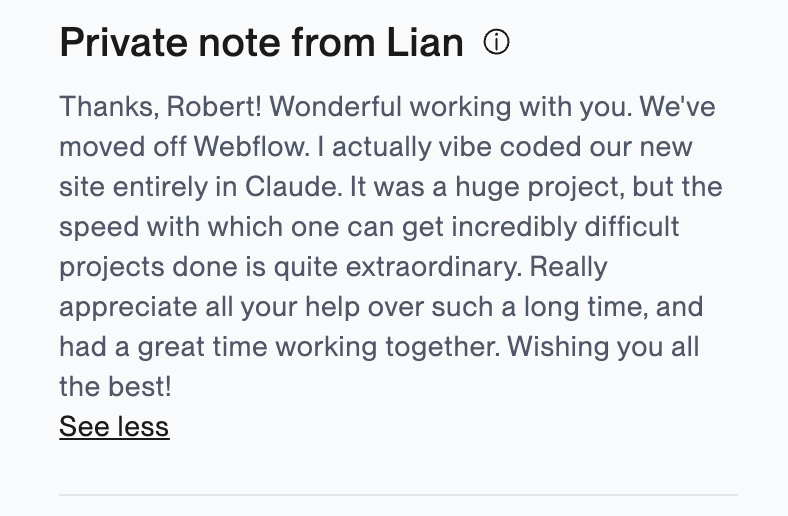
i would like to start a discussion
let me be clear - i am not making any statements, I am just asking a question and would love to hear thoughts from all sides.
what is the point of using tools like Webflow or Framer right now?
what do they give you which you wouldn't get from using traditional dev tools + building with AI?
English

@ToolboxOfDesign It does and it usually works. But it has been super buggy lately. It often frequently refuses to do things and tells me they are stupid basically. I suspect they ask telling it to be lazy to save resources.
English