Dan Mall

27.4K posts

Dan Mall banner
Dan Mall

Dan Mall

@danmall

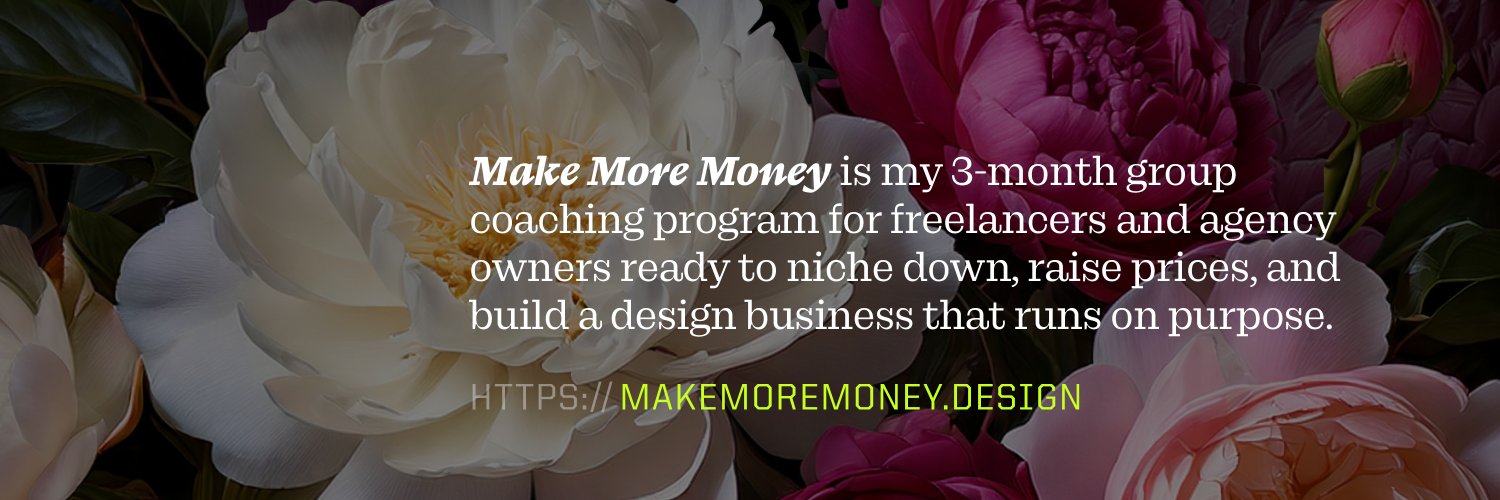
I help $100K+ design agency owners make $1M and get their flowers in 33 steps. DM “MAKEMOREMONEY” for the map.

Get 33 steps to a $1M agency → Katılım Şubat 2007
5.4K Takip Edilen47.4K Takipçiler
Sabitlenmiş Tweet
Dan Mall
Dan Mall@danmall·
I’m so proud of my Make More Money students that have been stacking wins in such a short amount of time. Some of last week’s highlights in our Slack #wins channel: 🚀 One member landed their biggest client since May ($30K in one deal). 💡 Another walked away from a $4K repeat client to protect their energy, and felt better than ever after. 🤝 Someone hired and paid their first team members and realized their business is now creating opportunities for others. 💰 Another secured $10K for a single project… a milestone they once thought was impossible. Different numbers. Different stories. But the same pattern: When you commit to growth, your wins multiply. What’s the biggest win you’re chasing right now?
Dan Mall tweet mediaDan Mall tweet mediaDan Mall tweet mediaDan Mall tweet media
English
2
0
30
8.3K
Dan Mall
Dan Mall@danmall·
“We don’t adopt your rituals. You adopt ours.” That was the rule at my agency for every client engagement. Most agencies pitch “we become part of your team” like it’s a feature. It’s not. The moment you join their Slack, adopt their tools, follow their meeting cadence, and work inside their systems, you’ve signaled them you’re a vendor. You work for them. You follow their rules. You’re embedded in their world now, and you will assimilate whether you mean to or not. Their bad habits become your bad habits. Their slow approval process becomes your slow approval process. You came in sharp and different—that’s why they hired you—and within two weeks you’re just another set of avatars in their Monday standup. At my agency, we did the opposite. When a client hired us, they got embedded on our team. Our systems. Our communication tools. Our review cadence. Our rituals. Why? Because if they could do this well on their own, they wouldn’t have hired us. They came to us because their way wasn’t working. So why would we go work their way? We shipped more in the first week than most clients’ internal teams shipped in three months. And when they saw that pace, the dynamic flipped. They stopped asking for weekly status meetings. They started deferring to our process because they saw what happened when they let us run. If a client wouldn’t change any of their habits to work with you, you’re replaceable. If a client restructures how they communicate, review work, and make decisions just because that's how you do things, you're undeniable. Do you have a way of working that’s distinct enough that a client would be better off it they adopted it? Not a process page on your website. An actual set of rituals and standards that you would never compromise on. If not, build the rituals. Make them opinionated. Then stop embedding with your clients and start embedding your clients with you.
English
0
2
15
905
Dan Mall
Dan Mall@danmall·
Three months ago, a Make More Money student’s pipeline was referrals and luck. Last week, they sent me this message. They’re a solo developer specializing in Webflow. They did around $250K in revenue last year, but the model was brittle. Every project came from referrals or agency subcontracting. No system. No funnel. Their marketing strategy was, in their words, “throwing spaghetti at the wall.” Their ICP was too broad. They’d take any project from anyone who used Webflow or wanted to. Startups, agencies, enterprise… didn’t matter. If the the inquiry said “Webflow,” they’d quote it. The first thing we did was narrow. We identified a gap nobody was filling. We refined the value proposition until it was easy to describe in a sentence. My student built a prospect list targeting VPs and marketing directors at companies that fit a very specific scenario. They went from sending 6 outreach messages a week to 20. We mapped the funnel. They stopped treating pipeline like something you turn on when you need it and started treating it like something that runs every day regardless. Last week, they landed a $90K project. That was double the largest project they’ve ever signed—and it was a smaller scope that most of their previous projects. CEO bought in. Stakeholders bought in. Nobody negotiated. Their exact words: “The pricing sheet on it breaks my brain. The client feels good about the price, I’m paying my team exceptionally well, and I’m taking in an amazing amount of owner comp + profit.” That’s the sentence that tells you it’s working. Not “I won the project.” Everybody wins projects. The real test is whether the client feels good, the team gets paid well, and the owner takes home real money. All three. At the same time. Nothing changed about their skills. Nothing changed about their talent. We just changed the conversation they were having before the price ever came up. *** I built a 33-step roadmap that shows agency owners exactly which positioning moves to make at each stage of growth. DM me MAP and I'll send it to you.
Dan Mall tweet media
English
1
0
8
734
Dan Mall
Dan Mall@danmall·
I have a new office this week. The view is ok. (I shot this photo yesterday.) My daughters are in the pool. My wife is reading on the deck. And in about three hours, I’ll be teaching my weekly coaching class for agency owners from this rental house while they go explore. I didn’t cancel the class. I didn’t reschedule it. I didn’t ask someone to cover for me. I just teach it from here. And I want to be clear: this isn’t “begrudgingly sneaking in a few hours of work while I’m supposed to be on vacation.” We're actually not on vacation. I’m working. My wife is finishing a paper for school. My kids are studying for upcoming tests. It’s a regular week for us. We just figured we might as well do it in one of the most beautiful places in the world. And honestly? I’d be sad if I had to skip today’s class. Helping agency owners grow is one of my favorite things to do. I genuinely look forward to Wednesdays. The fact that I get paid to do a thing I enjoy from a place like this with my family ten feet away isn’t a compromise. That’s the whole point. When I teach agency owners to make more money, I’m not talking about more revenue for the sake of it. I’m talking about living a rich life full of worthy goals, things that make you happy to do the hard work of running an agency. It’s not about the number. It’s the experiences that number can bring you and the people you want to share it with. My number gets me a Wednesday where I can spend 90 minutes sharing tips and tricks with agency owners and then my family and I can walk 5 minutes down the road to snorkel at the reef. If your business can’t survive you being somewhere beautiful for a few days, it’s not a scheduling problem. It’s a design problem.
Dan Mall tweet media
English
1
1
4
779
Dan Mall
Dan Mall@danmall·
The single biggest mistake agency owners make for their pipeline: They stop marketing when they get busy. My favorite restaurant in the world is Royal Sushi Omakase in Philadelphia. (If you ask me, it’s the best restaurant in the world.) It has only 8 seats. They only do 2 seatings per night. There are over 1,200 people on the waiting list. Chef Jesse still posts to Instagram every day. He still promotes the restaurant even though it would take months to get through the current waitlist. Every night, they cross 16 people off the list. Every night, double or triple that amount get added to the waitlist. The waitlist is growing, not shrinking. That‘s the point. Rolex does the same thing. You can't walk into a store and buy one. There's a waiting list. And yet they still run ads everywhere. Not to make sales. To make the line longer. Most agency owners do the opposite. They land two clients, breathe a sigh of relief, let off the gas on outreach, stop posting, stop pitching. Then when the projects end, the line is gone. And now they’re desperate again. That’s the feast-famine cycle, and it’s a marketing problem, not a sales problem. The fix: you never stop filling the line. When you’re busy, you market. When you’re slow, you market. The waitlist is the asset.
Dan Mall tweet media
English
0
0
8
859
Dan Mall
Dan Mall@danmall·
Your favorite portfolio piece might be killing your pipeline. You did a tattoo design for a friend. A flyer for someone’s event. A landing page in an industry you’ll never work in again. The work was good. You’re proud of it. And now you’re wondering: should I put this on my website? No. Your portfolio isn’t a scrapbook of things you’re proud of. It’s a sales tool for the next client you want to attract. Every piece that doesn’t fit your positioning is actively working against the pieces that do. Here’s the test: if you showed your portfolio to your dream client right now, would every single project make them think, “This is exactly who I need?” Or would it make them hesitate? “Everything” is the most expensive word in agency positioning. Because the moment a prospect thinks you do everything, they compare you to everyone. Your competitive set just went from 3 agencies to 3,000. The work that’s hardest to hide is the work that’s great but doesn’t fit. Bad work is easy to cut. Nobody struggles to delete a project they’re embarrassed by. But that beautifully executed project in an industry you’re never going back to? That’s the one that kills your positioning slowly, one portfolio piece at a time. Your portfolio is a bouncer, not a host. Its job isn’t to let everything in. Its job is to keep the wrong things out so the right clients see exactly what they need to see and nothing else. If it doesn’t attract the next client you want, it doesn’t go on the website. No matter how good it is.
English
2
1
15
1.8K
Dan Mall
Dan Mall@danmall·
Great run today with a solid team. Made a few bad choices but overall happy with how I played.
Dan Mall tweet media
English
1
0
2
588
Princewill
Princewill@Princewill_SSH·
@danmall Brother you can't close high-ticket sales in dms🤦‍♂️
English
1
0
0
17
Dan Mall
Dan Mall@danmall·
I’m hiring. Right now I spend a lot of time selling for my Make More Money program. I’m pretty good at it, but it’s not where I do my best work. My best work is teaching, coaching, and sharing what I know with agency owners who are ready to grow. So I’m looking for someone to own sales entirely. Fielding responses, qualifying inbound leads, building outreach lists, starting conversations, and seeing them through to enrollment. We sell entirely through DMs and email. I don’t do any sales calls or have fancy funnels. We sell by having conversations with agency owners who are stuck and looking for help. I’d love to connect with someone who: → Has closed high-ticket offers through DM or chat-based conversations → Is self-directed and doesn’t need hand-holding to hit sales targets → Can run a high volume of conversations without acting like a robot → Sells the way people actually talk: warm, direct, no corporate filler → Can follow a playbook and know when to go off-script → Asks more questions than they make statements → Is based in the U.S. I’ll pay you a monthly base with a commission for every new student you enroll. If that’s you or someone you know, here’s how you apply: Send me a DM and sell me on why you’re the right person. Our conversation is your audition.
English
2
1
6
1.8K
Nick Groeneveld
Nick Groeneveld@ToolboxOfDesign·
@danmall I would have raised my hand, but after mostly designing for healthcare, government, and high-tech, we’re probably not a good match!
English
1
0
0
34
Dan Mall
Dan Mall@danmall·
If you’re an agency owner still doing creative direction, project management, and client calls, you’re the ceiling for your business. As Michael Gerber says in The E-Myth Revisited, “If your business depends on you, you don’t own a business. You have a job. And it’s the worst job in the world because you’re working for a lunatic.” The CEO of a growing agency does exactly and only three things: 1️⃣ Numbers. Know your revenue, profit margin, pipeline, and cash position at all times. If you can’t tell me your profit percentage right now, you're not doing this job. 2️⃣ People. Hire, develop, and retain the team. Build their skills. Have hard conversations when needed. This is your highest-leverage activity. 3️⃣ Culture. Define how work gets done. Protect the standards. Create an environment where good people want to stay. Everything else is production work. Creative direction? Train someone. Project management? Playbook it. Client calls? Bring your team in. The agency only scales past you when you stop being the bottleneck. *** I built a 33-step roadmap that maps out exactly when to start making these shifts in your agency. DM me “MAP” and I'll send it to you.
English
6
3
26
2.3K
Dan Mall
Dan Mall@danmall·
You wrote an SOP (Standard Operating Procedure) for something you’ve never done. That’s not a system. That’s a guess. You haven’t onboarded a single client yet, but you have a 12-step onboarding document. You haven’t hired anyone, but you’ve got a hiring playbook in Notion. You haven’t delivered your offer three times, but you've already mapped out the entire workflow. That’s not building systems. That’s procrastinating by organizing. You can’t systematize something you haven’t repeated. After only one time, you don't know what’s essential and what was specific to that situation. After two times, you start seeing patterns. After three, you know what scales. The order matters: 1️⃣ Do it yourself, messily. 2️⃣ Do it yourself, noting what worked. 3️⃣ Do it yourself, with a rough process in mind. NOW write the playbook. Then hand it off. The playbook should represent your best current understanding, not your first attempt. And definitely not your ideal version that you’ve never tried. Everyone fantasizes about the fancy organizational manual. But if you hand off a process you’ve never even done yourself, you’re not delegating. You’re asking someone else to figure it out for you and calling it a system. Minimum three reps before you document. No exceptions.
English
1
3
10
1.1K
Dan Mall
Dan Mall@danmall·
McDonald’s doesn’t need world-class chefs at every restaurant. That’s the whole point. My second job ever when I was 14 was working at McDonald’s. At 14, the best meal I could make on my own was a bowl of cereal or some toast, and that was pushing it. But, at 14, I could make a perfect Big Mac. Not because I was some sort of burger savant, but because McDonald’s made it easy. McDonald’s hires teenagers and gives them a playbook. And every Big Mac tastes the same. In fact, McDonald’s has scaled their Big Mac playbook so successfully that people of a certain age who have never even worked at McDonald’s also know how to make it. If that’s you, say it with me: “Two all-beef patties, special sauce, lettuce, cheese, pickles, onions, and a sesame seed bun.” (If you don’t know what I’m talking about, McDonald’s had TV commercials using that playbook as a catchy jingle. Look it up on YouTube.) Building a sustainable agency isn’t about finding a team of unicorns who can always figure out what to do. That works, but it’s time-consuming, expensive, and fragile. Building a sustainable agency is about building a system where the least experienced person is still empowered to deliver your highest-quality work. Most agency owners ask, “Where do I find great designers?” Instead, ask, “How do I build a process where someone with 60% of my skill delivers 90% of my quality?” That’s a documentation problem, not a talent problem. And document problems are much more easily—and affordably—solved than talent problems. Three things make this work: 1️⃣ Clear standards. Definitions of what “done” looks like, with examples. 2️⃣ Measurable outcomes. Actual criteria over ambiguous “culture fit.” 3️⃣ Consequences and rewards. Accountability that runs without you. Build the playbooks. Then let your people cook.
English
1
1
16
2.3K
Dan Mall
Dan Mall@danmall·
One of my students made $74K last year and burned out. This year, he’ll clear that by the end of Q1. How? He‘s not working harder. He’s directing three projects right now where he’s not doing the work. He came to me a few months ago and said, “I’ve signed two contracts and I’m signing two more. I need to manage the work. What are the steps?” Most agency owners ask, “How do I do all this work?” He asked, “How do I organize this so I don‘t drown?” So we worked on it. He identified designers he could contract. He hired and trained an executive assistant on his processes, tools, his custom GPTs with the goal of building a partnership where she could anticipate what he’d do. Then he said something that stuck with me: “My confidence in my ability to make money is growing. I just need to keep my momentum.” That’s the shift. He stopped measuring his value by how much work he personally produced and started measuring it by how much work he could orchestrate. $74K with burnout last year. Now on pace for that by the end of the month, all without doing the design work himself. Same person. Different operating system. *** I built a 33-step roadmap that shows you exactly when to start hiring and what to delegate first. Message me “MAP” and I’ll send it to you.
Dan Mall tweet media
English
7
0
11
1.5K
Dan Mall
Dan Mall@danmall·
You built your agency on being the best designer in the room. But the thing that got you here is the thing that’s keeping you stuck. Now, somewhere between $200K and $500K, the thing you built your identity around—being the person who does the work—is the exact thing holding you back. This is the question every agency owner hits at this stage: “If I stop doing the work, who am I?” Take heart, friend. “Designer” is a role. It’s not your identity. Identity is the stuff that persists even when your role changes. You’re still kind, smart, thoughtful, funny, and however you’ve seen yourself since you were a kid, even though your role changed from “student” to “designer” to “creative director” to “CEO.” The founder working on building an internal company culture is using the same creativity. The leader who develops people is using the same attention to detail. You’re not losing yourself by stepping out of production. You’re applying the same time-honed skills to higher-leverage work. But nobody warns you about this part. It’s one of the loneliest transitions in agency ownership.
English
2
1
11
1.6K
Dan Mall
Dan Mall@danmall·
Totally agree. It’s very easy to make money online this way because it’s always been easy to make money offline this way since the dawn of time. (See shamanism, Hippias, Gehazi, etc.) It’s also not the only way to make money online.
derek guy@dieworkwear

my impression is that it's very easy to make money online so long as you're willing to be a boastful, ego-centric bullshitter and sell sham products to a growing fan base. you can easily be a millionaire this way. and perversely, this wealth only earns you more credibility

English
0
0
3
1.2K
Ridd 🤿
Ridd 🤿@ridd_design·
I'm at a crossroads with @joindiveclub and would love your advice... Video is gaining popularity very quickly. And for a design show the ceiling does feel higher. However I don't want to alienate audio-only listeners (honestly I might fit in this category) Some options on my mind: - go all in on video and screensharing - only release on Spotify/Apple when not screenshare heavy so if you see it in your app you know it's audio friendly - go back to prioritizing episodes with less screensharing - something else?
English
66
1
48
8.9K