Mike Wordsmith

9K posts

Mike Wordsmith banner
Mike Wordsmith

Mike Wordsmith

@TorahMike

“And if it is evil in your eyes to serve the LORD, choose this day whom you will serve” (Joshua 24:15)

United States Katılım Kasım 2010
1.4K Takip Edilen1.4K Takipçiler
Mike Wordsmith
Mike Wordsmith@TorahMike·
One fun, but, destabilizing fact. Not a single NT author ever self-identified themselves as Christian. They acknowledge the term, welcomed it. But if any of them were to be transplanted into a modern Church, they would likely be swiftly removed as “non-Christian.” I imagine a lot of denominational enthusiasts are adamant that when Jesus returns, he will reveal that he is of their denomination - aha! We win. Except… Jesus is Jewish. A rabbi, even.
English
0
0
0
25
Mike Wordsmith
Mike Wordsmith@TorahMike·
Perfectly reasonable and cause for deeper realignment that most will be willing to consider. “When the Son of Man comes (Returns), will he find faith on earth?” (Luke 18:8) “Stand by the roads, and look, and ask for the ancient paths, where the good way is; and walk in it, and find rest for your souls.” (Jeremiah 6:16)
English
1
1
3
236
Joel Berry
Joel Berry@JoelWBerry·
I’m not too dogmatic about which Christian denomination is correct because I think we’re probably all doing it wrong in different ways. It’s a miracle of grace that Jesus accepts any of us at all.
English
189
234
3.3K
49.7K
Mike Wordsmith
Mike Wordsmith@TorahMike·
I’ve engaged this conversation in good faith the entire time, offering historic, linguistic, and contextual exegesis of the texts (Col 2:16-17 in its full chapter context, 1 Cor 5:7-8’s command to “celebrate the festival,” and Zechariah 14’s literal kingdom observance). In return, the responses have been: - “Ah, so you deny Scripture” - “Now you’re twisting the Scriptures” - and finally a sarcastic mimicry of my own “I’d kindly suggest” opener to label me a “Judaizer” who should stop. That isn’t exegesis — it’s personal attacks & rhetorical shutdown. The Scriptures themselves invite us to test everything and hold fast to what is good (1 Thess 5:21). I suspect we will not see eye to eye. I only communicate the difference between our approaches to illustrate for onlookers which of us is demonstrating a Halacha of truth and goodness.
English
1
0
0
14
Mike Wordsmith
Mike Wordsmith@TorahMike·
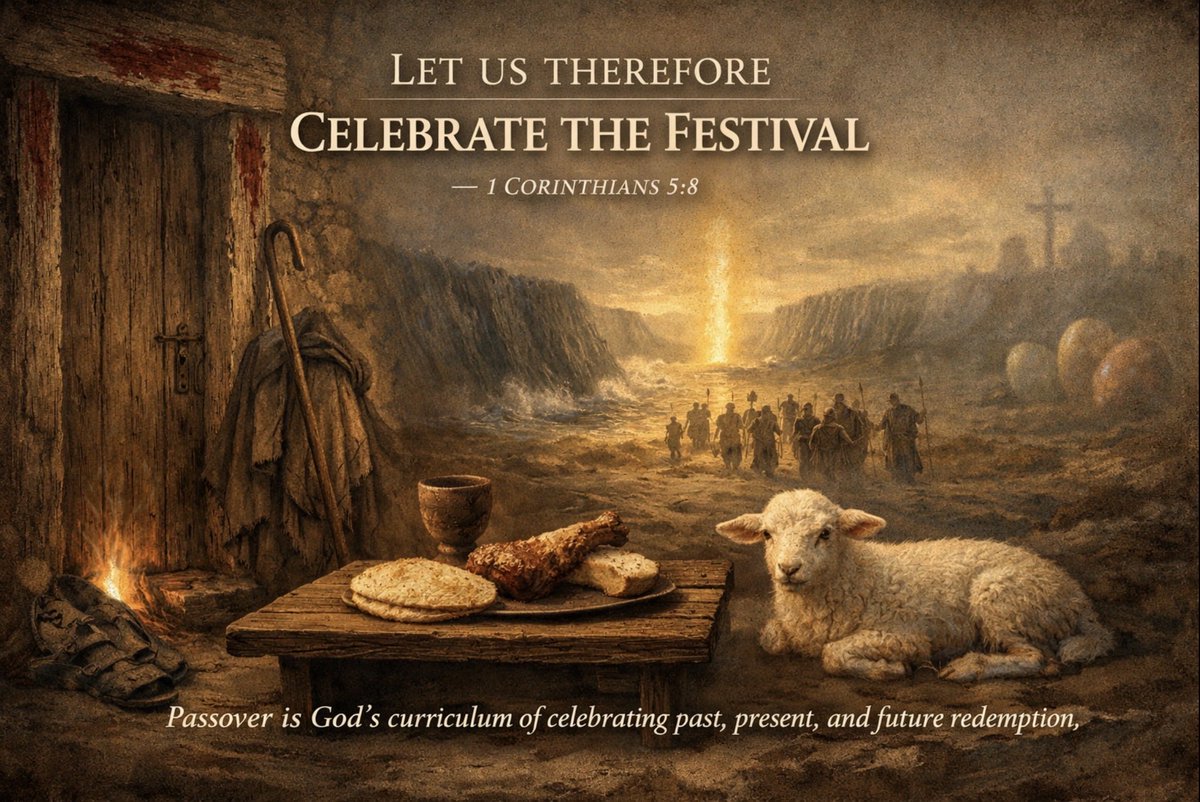
One of my biggest “beefs” with Easter is this: It celebrates the death and resurrection of Jesus (a very good thing), yet it completely severs the rich biblical symbolism of the Exodus from Egypt. At the personal level, the Exodus is an allegory of our own salvation. At the national level, it’s prophetic — pointing to a second, greater Exodus still to come. Passover is God’s own curriculum. It teaches us about: - the Messianic sacrifice, - personal salvific deliverance, - and the future prophetic national deliverance. Man-made “Easter” tips its hat to the biblical holiday, but quietly drops the last two. God’s way is better.
Mike Wordsmith tweet media
English
14
5
27
1.1K
Mike Wordsmith
Mike Wordsmith@TorahMike·
Yes, but to his point, the early Church fathers (Catholic) specifically disconnected Easter from the Passover: From the Letter of the Emperor Constantine to all those not present at the Council. “We ought not, therefore, to have anything in common with the Jews (Passover on 14th of Nissan), for the Saviour has shown us another way; our worship follows a more legitimate and more convenient course (the order of the days of the week); and consequently, in unanimously adopting this mode, we desire, dearest brethren, to separate ourselves from the detestable company of the Jews, for it is truly shameful for us to hear them boast that without their direction we could not keep this feast. “Besides, consider well, that in such an important matter, and on a subject of such great solemnity, there ought not to be any division.  Our Saviour has left us only one festal day of our redemption, that is to say, of his holy passion, and he desired [to establish] only one Catholic Church.” “I hope, will agree upon this point.  As, on the one hand, it is our duty not to have anything in common (Passover) with the murderers of our Lord”
English
3
0
3
420
Mike Wordsmith
Mike Wordsmith@TorahMike·
I'd kindly suggest that the common reading of Colossians 2:16-17 may actually invert Paul's intended meaning. If the Sabbaths, New Moons, and festivals aren't "according to human precepts" (which Scripture clearly shows they are not—see Leviticus 23), then the passage reads positively: “Let no one judge you for keeping the appointed times (mo’edim), for they are shadows of things to come — the substance belongs to Messiah.” The whole of Colossians 2 sets the stage consistently. Paul isn’t warning against Jews keeping God’s appointed times. He’s cautioning believers against being taken captive by “philosophy and empty deceit, according to human tradition, according to the elemental spirits of the world, and not according to Christ” (Colossians 2:8). This likely refers to Greco-Roman Platonic or ascetic influences that treated physical observances as inferior (or even harmful) compared to purely spiritual “mental ascension.” For those thinkers, literally observing the mo’edim would be seen as a regression. But biblically commanded Mo’edim are demonstrably not “empty deceit” or “human tradition.” Paul drives this home right after verse 17: “If with Christ you died to the elemental spirits of the world, why, as if you were still alive in the world, do you submit to regulations— ‘Do not handle, Do not taste, Do not touch’ (referring to things that all perish as they are used)—according to human precepts and teachings?” (Colossians 2:20-22)
English
2
0
0
40
Captain Santa - Pastor ex Nihilo
Now you're twisting the Scriptures. The shadow is not the substance. You want it the other way around. Colossians 2:16-17 [16] Therefore no one is to act as your judge in regard to food or drink or in respect to a festival or a new moon or a Sabbath day— [17] things which are a mere shadow of what is to come; but the substance belongs to Christ.
English
1
0
0
47
Mike Wordsmith
Mike Wordsmith@TorahMike·
Appreciate the Palm Sunday link — those fulfillments are spot-on and a beautiful picture of Jesus as the Passover Lamb on 10 Nisan! They’re correct… but incomplete. They look back at prophecies already fulfilled (a very good thing). What gets left out when we subtract Passover / First Fruits from God’s curriculum is the forward layer: the prophecies yet to come that rely directly on Exodus imagery for a second, greater deliverance. Jer 16:14-15, Isa 11:11-16, Ezek 20:33-38, and even Rev 15:3 (the song of Moses and the Lamb) all depend on that full Passover typology. God’s curriculum still has future chapters. Passover keeps the whole story in view.
English
1
0
0
24
Mike Wordsmith
Mike Wordsmith@TorahMike·
Your logic on the analogy is off. If the biblical holidays are a shadow of Christ (Col 2:17), then refusing to keep them puts you outside the very shadow whose substance is Christ. No, I don’t deny Scripture—Scripture plainly says the biblical holidays will still be kept by gentiles when Jesus returns and rules (Zechariah 14:16-19). If you believe His return and kingdom are literal, you can’t spiritualize away the edicts of that kingdom. The holy days are among them.
English
1
0
0
20
Captain Santa - Pastor ex Nihilo
Ah, so you deny Scripture. Ok. Paul is talking about the unrepentant sin being practiced by those in the Corinthian church and tolerated by the other members - instructing them to clean out the leaven (sin). Later he just says to kick the guy out until he repents. Christ is the true Passover, no further need to look forward to what was coming, He came. So Paul saying we are free to celebrate the feast - he is speaking of the celebration of freedom of life in Christ. Christians don't celebrate the shadows. We celebrate the risen Lord.
English
1
0
0
39
Mike Wordsmith
Mike Wordsmith@TorahMike·
@PauleyMo67 @johngacinski Absolutely not. If anything, the Easter ham is the antitype of Passover. Not Jesus. “Therefore let us celebrate the festival” - you missed that part. You are against celebrating the festival.
English
1
0
0
23
Captain Santa - Pastor ex Nihilo
Don't you? 1 Corinthians 5:6-8 Your boasting is not good. Do you not know that a little leaven leavens the whole lump of dough? Clean out the old leaven so that you may be a new lump, just as you are in fact unleavened. For Christ our Passover also has been sacrificed. Therefore let us celebrate the feast, not with old leaven, nor with the leaven of malice and wickedness, but with the unleavened bread of sincerity and truth.
English
1
0
0
36
John Gacinski
John Gacinski@johngacinski·
Passover is the shadow. Jesus is the fulfillment. Passover is the type. Jesus is the antitype. Of course we're free to celebrate the festivals as we see fit but this idea that Passover is for today really misses the point that Jesus is the FULFILLMENT of all the OT types and shadows. Why live in the shadows?
English
1
0
1
52
Mike Wordsmith
Mike Wordsmith@TorahMike·
@WWUTTcom You’re right Easter wasn’t a pagan holiday. But claiming zero customs have any pre-Christian elements is the mirror image of the error you mock: they overclaim everything pagan, you under-claim everything. Same overrunning of evidence, just flipped. @MichaelWordsmith/easters-hares-and-eggs-pagan-relics-in-the-christian-spring-feast-b55eb11a38a9" target="_blank" rel="nofollow noopener">medium.com/@MichaelWordsm
English
1
0
0
165
WWUTT?
WWUTT?@WWUTTcom·
Easter is not a pagan holiday. It’s never been a pagan holiday. It doesn’t originate with a pagan holiday. The people who are convinced that it is don’t want to hear it. The evidence will not convince them. They’re 100% certain of Easter’s pagan origins.
English
55
13
167
5.7K
Mike Wordsmith
Mike Wordsmith@TorahMike·
@5Solas2 Bacon fact: pigs flesh is so physiologically similar to human flesh that it can be used for organ/skin transplants, cross species.
English
0
0
4
31
Mike Wordsmith
Mike Wordsmith@TorahMike·
What did you think of Jeremiah’s definition of the new covenant, immediately prior? “For this is the (New) covenant that I will make with the house of Israel after those days, declares the LORD: I will put my Torah within them, and I will write it on their hearts. And I will be their God, and they shall be my people.” (Jeremiah 31:33)
English
1
0
4
69
The Bible In Context
The Bible In Context@BibleInContext1·
Thus says the Lord, “If the heavens above can be measured And the foundations of the earth searched out below, Then I will also cast off all the offspring of Israel For all that they have done,” declares the Lord.  (Jeremiah 31:37)
English
5
6
49
1.5K
Mike Wordsmith
Mike Wordsmith@TorahMike·
Matthew, Mark, Luke, John, and Paul never taught a separate “Eucharist”—symbolic or otherwise—that replaces the biblical Passover. They showed Jesus giving the Passover and the Passover meal (Seder) its foreshadowed meaning: He is the true Passover Lamb. The idea of the Lord’s Supper as a brand-new standalone Christian ritual developed later. Passover itself remains the biblically commanded holy day that still points forward to the greater exodus and full redemption at the Messiah’s return.
English
0
0
1
82
The Bible In Context
The Bible In Context@BibleInContext1·
Not exactly a Mic drop for ya bud…. Luke, Matthew, Mark, John and Paul taught a symbolic Eucharist! They in no way taught the pagan aristotelian philosophy of the transubstantiation eucharist! Those men are really, the only Christian authors who’s opinion matters since they are the only ones inspired by God! But you also have Clement of Alexandria, & Tertullian. Now tell the truth about how the Jewishness of our faith was diminished after Rome demolished Jerusalem twice, and the emphasis of Bible interpretation became overrun by Greek modes of interpretation of scripture that overly spiritualized and allegorized the Bible! The early church writers are not our instruction in the faith. It’s the inspired written word of God that does that.
Dr Taylor Marshall™️@TaylorRMarshall

Try to name ONE Christian author in the first 3 centuries who said the Eucharist is “just a symbol.”

English
150
16
272
41.1K
Mike Wordsmith
Mike Wordsmith@TorahMike·
I would say belief in Messiah was always a requirement for redemption. Ever since Genesis: She will crush your head, and you will bruise her heel. Or Abraham “God will provide a lamb…” and so forth. The NT illustrates that Jesus was slain before the foundation of the world (God stands outside of time).
English
2
0
0
22
Luana Fabri
Luana Fabri@LuanaGoriss·
@TorahMike I don’t know why Jesus is required for redemption. We were/are already redeemed. Belief in a messiah was never a requirement for redemption, and certainly not through the death of a human.
English
2
0
0
28
Mike Wordsmith
Mike Wordsmith@TorahMike·
Is there symbolism in the Passover meal? Absolutely—past, present, and future. Agreed, the Passover lamb was not a sin sacrifice (chatat). Those were mainly for unintentional sins and often dealt with ritual clean/unclean status. (Not every form of uncleanness was a moral “sin,” so the categories don’t line up perfectly.) The Passover sacrifice is about redemption—which is superior to atonement. That’s the deeper Messianic picture of deliverance (From Egypt / the world / worldliness)
English
1
0
0
51
Luana Fabri
Luana Fabri@LuanaGoriss·
@TorahMike Is there symbolism? To begin with, the Passover lamb was not a sin offering. It was purely a memorial meal.
English
1
0
2
105
Mike Wordsmith
Mike Wordsmith@TorahMike·
Spring festivals all had major prophetic fulfillment at the first coming of Christ. The fall festivals are prophetic of when Jesus returns for the full harvest, and have had no major prophetic fulfillment - yet. Modern doctrine requires most to interpret this scripture below in the negative, but, for many reasons, it must be interpreted in the positive. The festivals are a prophetic shadow of things to come: “Therefore let no one pass judgment on you in questions of food and drink, or with regard to (KEEPING) a festival or a new moon or a Sabbath. These are a shadow of the things to come, but the substance belongs to Christ.” (Colossians 2:16-17)
English
1
1
3
57
Mike Wordsmith
Mike Wordsmith@TorahMike·
@nicetrytoucan I love hearing that. For those that may bash on you for celebrating God’s holidays, keep in mind that scripture indicates when Jesus returns, the whole world will be keeping the festivals. So if they don’t like it now - they’ll need to change their tune before Jesus returns.
Mike Wordsmith tweet media
English
1
1
3
87
Mike Wordsmith
Mike Wordsmith@TorahMike·
@wordsofthislife Then why call the resurrection day “Easter”? Seems like your logic forbids it. Earliest and best evidence suggests the name “Easter” is that of an Anglo-Saxon goddess. @MichaelWordsmith/easters-hares-and-eggs-pagan-relics-in-the-christian-spring-feast-b55eb11a38a9" target="_blank" rel="nofollow noopener">medium.com/@MichaelWordsm
English
0
0
0
80
Brian Reynolds
Brian Reynolds@wordsofthislife·
I would never get in a spaceship called Artemis. A Pagan goddess that “fell from heaven” — nope
English
7
2
12
756
Mike Wordsmith
Mike Wordsmith@TorahMike·
As a bystander that personally views Christmas as a largely pagan construct, I always find it so ironic to see the attack of “paganism!” flippantly thrown around by those who uphold and defend Christmas. Not every Christian theology has to treat Christmas on Dec 25 as “pagan.” But your particular stream—the one that is quick to label non-scriptural elements “pagan” and slide them straight into hell—has a real consistency problem. The date Dec 25 rests entirely on the Calculation Theory: a non-scriptural, traditional construct developed inside a Hellenistic world where philosophy, religion, calendar, and sacred-time symbolism were deeply intertwined (not separated like today). As the article below shows, even though the rationale stands on a Christian “reason-of-record” (“internal derivation”), it does not prove historical independence from that pagan-influenced cultural matrix: medium.com/christmas-dece…
English
0
0
2
126