
Trashatarian retweetledi
Trashatarian
4.9K posts
Trashatarian
@Trashatarian
My mortgage identifies as a student loan. I also love all food...from junk food to fine dining...
Katılım Nisan 2009
157 Takip Edilen59 Takipçiler

@LPNational These are some of the worst libertarians. Are you trying to get us to leave the party?
English

Live from the Libertarian National Convention! Jo Jorgensen, Chase Oliver, Lars Mapstead and Ammon Bundy square off!
Join the chat!
Free ⭐️ Are You Smarter Than a Politician?@SmarterGameShow
Jo Jorgensen, Chase Oliver, Lars Mapstead, Ammon Bundy on Are You Smarter Than A Politician? x.com/i/broadcasts/1…
English
Check out that community note. Ouch. 🤣
The Wall Street Journal@WSJ
From @WSJFreeEx via @WSJOpinion: After losing a primary election Tuesday night, Rep. Thomas Massie peddled the oldest antisemitic trope in the book: that conniving Jews hold secret power, writes @matthennessey on.wsj.com/4fygtbZ
English
Trashatarian retweetledi
Based on @C__Herridge's reporting & our CIA whistleblower's testimony, the CIA appears to be ILLEGALLY SPYING on @DNIGabbard's team, INTERFERING w/ investigations on the COVID coverup, the JFK, MLK, & RFK assassinations, UAPs, etc.
We've got to get to the bottom of what they're hiding.
Catherine Herridge@C__Herridge
English
Trashatarian retweetledi

CBS News said there was no evidence of fraud.
The NYT said the Somali community was being targeted
CNN said there was "little evidence."
Tim Walz said it was “white supremacy” to expose fraud
Today: $90M busted and 15 charged.
IT WAS ALL FRAUD AND THEY KNEW.
English
Trashatarian retweetledi

I lost my election on the six month anniversary of the Epstein Files Transparency Act becoming law.
Those buggers don’t waste any time.

English
Trashatarian retweetledi
There’s a quiet all out war for the future of our country. Let us not misdirect our precious resources.
I do not believe I lost due to fraudulent votes, mail-in ballots, hacking, or mistabulated results. I respect those who want to make sure, but I won’t be requesting a recount.
English
Trashatarian retweetledi
No one should have to beg the government to exercise a constitutionally protected right anywhere in the country.
Thank you @AustinScottGA08 for cosponsoring HR 645, the National Constitutional Carry Act.
English
Trashatarian retweetledi

Today the U.S. national debt surpassed $39 Trillion, inflation is rising, gas is over $4.50, and we are in another foreign war.
Nothing changed.
Literally nothing.
English
Trashatarian retweetledi
The U.S. should NOT use propaganda on our citizens, but that prohibition was lifted in 2013!
Thank you @RepDavidRouzer for cosponsoring HR 5704 to repeal the 2013 Smith-Mundt Modernization Act.
English
@JoForLiberty @RepThomasMassie I would like to believe you, but Chase Oliver was a joke. And you were awful on COVID and leaned woke with your anti-racist garbage.
It's not that hard: keep government out of our lives and out of our wallets.
I'm a registered libertarian as a protest, nothing more.
English

If you backed @RepThomasMassie because he challenged war, defended liberty, respected constitutional limits, and refused to bow to political strongmen, you are not politically homeless.
You are just closer to libertarianism than the Republican Party ever wanted you to realize.
English
@BlondeMAGAinNJ @JoForLiberty @LPNational @RepThomasMassie You seriously use that as your excuse not to support the best congressman we have? Clearly you DGAF about the actual issues and what Massie stands for.
English


English
@ComicDaveSmith It's not like we're celebrating our 250th anniversary of freedom or anything like that. I'm saddened that even KY isn't fighting for any morals, truth, or liberty.
English
“Sometimes when you win, you really lose.
And sometimes when you lose, you really win”
-Rosie Perez, philosopher.
English
Trashatarian retweetledi

Spencer Pratt: I’m gonna remove the homeless druggies from in front of your kids’ elementary school, let you rebuild your homes, and arrest criminals
Karen Bass: Taxpayer funded teeth for meth heads
Nithya Raman: I’m gonna ban BBQs
How is this even a choice
English
Trashatarian retweetledi
Trashatarian retweetledi

Massie defended Trump through two impeachments and demanded answers from Garland on FBI assets present on January 6. Where is Trump's loyalty to Massie? Why do the cultists expect it to be a one-way street?
Disclose.tv@disclosetv
JUST IN - Trump calls Thomas Massie "a disloyal, ungracious, and sanctimonious FOOL," and "the Worst 'Republican' Congressman in the History of our Party!"
English
Trashatarian retweetledi

Just in the week leading up to the election, AIPAC has purchased over $1.5 million of anti-Massie advertising and Miriam Adelson’s superPAC has purchased $1 million of anti-Massie advertising.
Can you keep my pro-Massie ads on TV by donating to massiemoneybomb.com ?
English
Trashatarian retweetledi
When the establishment spends $2.5 million to take out one congressman, you know he's doing something right. Stand with @MassieforKY and join the Massie Money Bomb.
Thomas Massie for Congress@MassieforKY
Just in the week leading up to the election, AIPAC has purchased over $1.5 million of anti-Massie advertising and Miriam Adelson’s superPAC has purchased $1 million of anti-Massie advertising. Can you keep my pro-Massie ads on TV by donating to massiemoneybomb.com ?
English
Trashatarian retweetledi
Trashatarian retweetledi
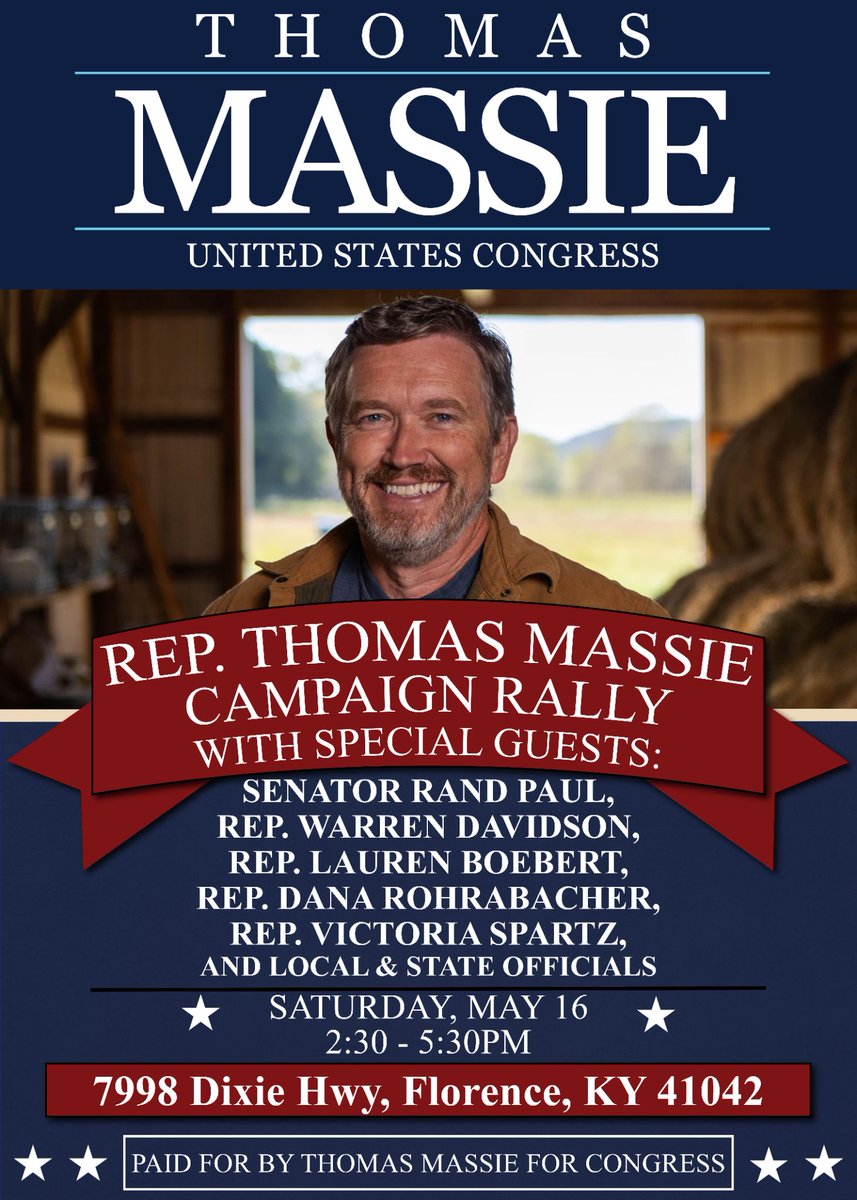
Join me Saturday, 5/16, from 2:30 PM–5:30 PM in Florence for a rally with @RandPaul, @LaurenBoebert, @WarrenDavidson, @Victoria_Spartz, @DanaRohrabacher and local Kentucky leaders!
Bring your friends and family!
English