The people who think the election was rigged are the same people who think a horse paste cures Covid-19 while also maintaining that it was also a hoax.
These are not thinkers.
Always something…
We better wake up to what’s happening online. The right isn’t just posting anymore; they’re scaling influence with AI.
📌 AI-generated pro-Trump “influencers” are surging on social media and are starting to shape what people see and believe.
That’s the new game. AI personas that sound human, post like humans, and build followings.
The new director of Netanyahu's Press Office, Eli Hazan, said he deliberately fabricates fake news as a communications tactic: "The truth doesn't matter anymore. The facts don't matter anymore," adding: "We need to be Trump."
Trump's EPA has added six chemical, fertilizer, and oil execs to its new Science Advisory Board:
— Shawn Gannon, Chemours (maker of forever chemicals)
— Gary Minsavage, ExxonMobil
— Matthew LeBaron, Dow Chemical (sued by Texas this year for pollution)
— Jessica LaRocca, Corteva Agriscience (maker of forever chemicals)
— Thomas Haren, AGPROfessional (fertilizer lobbying firm)
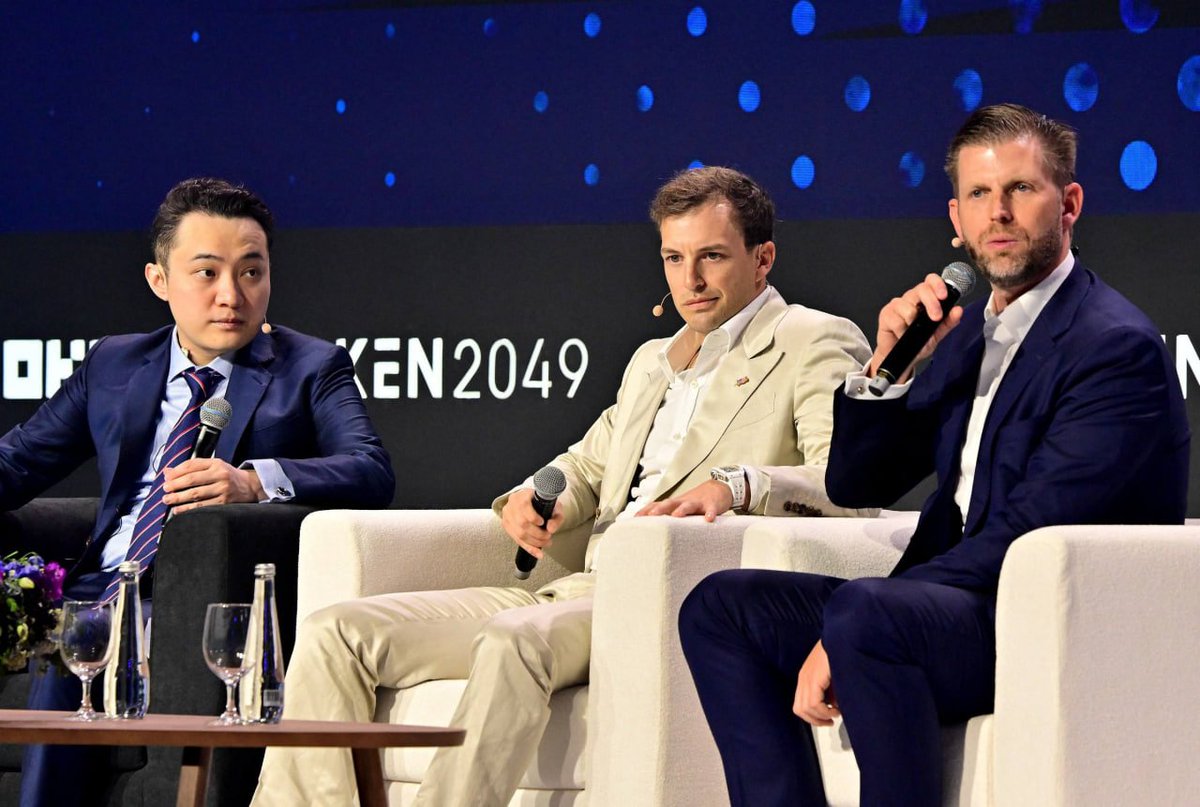
Dumb & Dumber promoted a $499 “gold” phone with a 2025 launch target.
Preorders opened. Deposits collected.
TODAY: delayed rollout, shifting details, and buyers still waiting for delivery.
Just another Trump family scam. 😑
🚨 ISRAELI OFFICIAL THREATENS THE WORLD LIVE 🔥
"Anyone who criticizes Israel is our enemy.
We will watch you through Google.
We will expose your weaknesses.
We will get you fired from your job.
And if you own a business, we will bankrupt you."
This is not a random activist speaking.
This is an official from the Israeli Embassy in Washington.
This is exactly what Zionism has become.
A global intimidation machine that threatens your livelihood if you dare speak against them.
Share before they try to delete it.
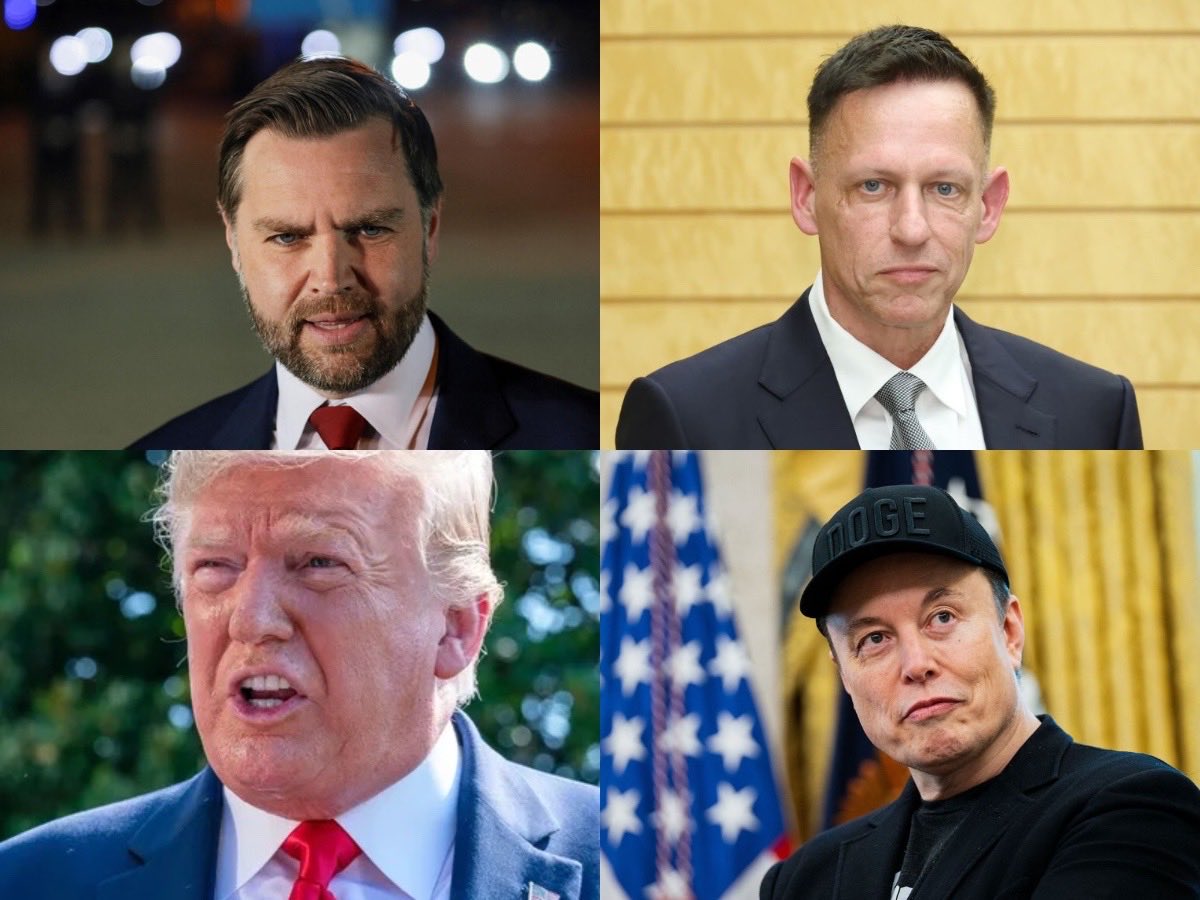
It’s hilarious watching Trump, Vance, Musk, and Thiel pretend to fight the ”global elite.”
They run the administration, own the platforms, control the media, hold the data, and have all the money.
Who exactly are they fighting?
They are the deep state they warn you about
Favorite video from last night’s celebrations in Budapest dropped
Here is Zsolt Hegedus….leading candidate to become the new Health Minister of Hungary…..this is what defeating a dictator looks like!
World Liberty Financial Is a Ponzi Scheme and Nobody Is Saying It Loud Enough
World Liberty Financial, or WLFI, is a crypto project backed by the Trump family that has been quietly raising hundreds of millions of dollars while offering retail investors almost nothing of real value in return. This is an opinion based on publicly available information, but when something walks like a Ponzi, quacks like a Ponzi, and takes your money like a Ponzi, it is worth asking the question loudly.
World Liberty Financial launched in late 2024 with enormous fanfare, riding the wave of Donald Trump's presidential comeback. The project bills itself as a decentralized finance platform designed to bring financial freedom to the masses. It issued a token called WLFI that was sold to the public in multiple rounds, raising over 300 million dollars in the process. Sounds exciting, right? A politically connected, high-profile crypto project with the weight of the Trump brand behind it. Surely this must be revolutionary technology that is going to disrupt the banking system. Except it is not. Not even close.
The most fundamental question you should ask about any crypto project is what the token actually does. In WLFI's case, the answer is embarrassingly simple. Almost nothing. WLFI tokens were initially non-transferable. That is right. You could buy them, but you could not sell them, trade them, or move them off the platform. You were essentially handing over your money for a digital IOU with no liquid market and no exit. The promise was always utility coming later, a classic hallmark of projects that need to keep stringing investors along.
When a token cannot be transferred, it has no real market price. Its value exists only on paper. This is not an accident. It is a feature designed to prevent a mass selloff that would immediately expose the true market demand, or lack thereof, for the asset. In a functioning DeFi protocol, tokens serve real purposes like governance, liquidity provision, and staking rewards derived from actual protocol revenue. WLFI offered vague promises of governance rights over a platform that had no meaningful on-chain activity, no significant total value locked, and no real user base to speak of.
According to WLFI's own documents, a staggering seventy-five percent of net protocol revenues go directly to the Trump family and their associates. Let that sink in. Three quarters of whatever this protocol earns flows straight to insiders, not to token holders, not to liquidity providers, not to the community that supposedly governs the protocol. In a legitimate DeFi protocol, revenue is typically shared with stakeholders in proportion to their contribution. In WLFI's model, regular investors buy the token, provide the credibility and the capital, while insiders collect the overwhelming majority of any money that flows through the platform. This is structurally identical to how Ponzi schemes and fraudulent investment vehicles work. The promoters extract value while participants hold increasingly worthless paper.
One of the oldest tricks in the fraudulent investment playbook is using the credibility and fame of well-known figures to substitute for actual product value. WLFI did not just use this trick. It built its entire marketing strategy around it. The Trump name is the product. The political association is the product. The press coverage is the product. When you strip away the celebrity branding, what are you left with? A DeFi fork with no original technology, no unique market position, and no competitive advantage over the hundreds of better-established protocols already in existence.
Justin Sun, the Tron founder who is facing SEC fraud charges, reportedly invested thirty million dollars into WLFI. Rather than being a red flag that caused investors to pause, this was promoted as a validation of the project. Think about that for a moment. A man facing federal securities fraud charges investing in your project is being used as a selling point.
Now look at the mechanics of how this thing actually works. The project raised capital in waves, each new token sale round essentially providing fresh capital. There is no underlying business generating sufficient revenue to justify the valuation or sustain the token's implied price. The value of holding WLFI is almost entirely dependent on the expectation that someone else will buy it at a higher price later. That is the pure definition of a speculative bubble propped up by new entrants. When the hype fades and new buyers stop arriving, holders are left with a non-transferable or illiquid token worth a fraction of what they paid. This is not DeFi innovation. This is musical chairs with extra steps.
WLFI's token sale was structured in a way that deliberately excluded American retail investors from certain rounds, a classic move designed to skirt SEC securities regulations. If this is such a great product for the average person, why are ordinary Americans being walled off from it? The answer is simple. Securities law. If WLFI tokens were sold to US retail investors without proper registration, the project would immediately face regulatory scrutiny. By limiting sales to accredited investors or non-American buyers in certain rounds, the project's architects created legal distance between themselves and the consequences of selling what many legal experts argue are unregistered securities.
Meanwhile, the Trump administration has simultaneously been pushing to gut crypto regulation, dismiss SEC enforcement actions against crypto projects, and install crypto-friendly regulators at key agencies. This creates an extraordinary and deeply troubling situation where the sitting president's family is profiting from a crypto project while the president himself is dismantling the regulatory apparatus that would scrutinize it. This is not coincidence. This is strategy.
WLFI launched right as Trump was preparing to return to the White House. The project benefited from the post-election euphoria that sent crypto markets surging. Prices pumped. Sentiment was at its peak. And in that window of maximum hype, the project raised hundreds of millions of dollars from people who believed they were getting in early on the next big thing. This is textbook pump mechanics. Launch at peak sentiment, raise maximum capital, lock in buyers with non-transferable tokens, and collect your seventy-five percent revenue share while retail holders wait for utility that may never materially arrive.
Every legitimate DeFi protocol is built on something original, whether that is a novel market design, a unique lending mechanism, a cross-chain bridge, or an innovative derivatives structure. The technology is the moat. WLFI's platform appears to be largely built on a fork of Aave, one of the oldest and most established DeFi lending protocols in existence. They did not build something new. They took open-source code that anyone can deploy, slapped a brand on it, and called it a financial revolution. This is not disruptive technology. This is a reskin. If the technology is not the value proposition, and the token has no real utility, and seventy-five percent of revenues go to insiders, what exactly are you buying when you buy WLFI? You are buying the brand. You are buying the hope. And when hope fades, you are left with nothing.
The concern here goes beyond just WLFI. This project exists in a broader context of politically connected crypto ventures that are using regulatory capture, celebrity branding, and retail fear of missing out to extract billions from ordinary people who can least afford to lose it. When the President of the United States has a direct financial interest in the success of a crypto token and simultaneously has the power to shape crypto regulation, that is a conflict of interest of historic proportions. It means that policy decisions affecting millions of Americans and trillions of dollars in financial markets may be influenced, at least in part, by what is good for a private investment vehicle that personally enriches the sitting president's family. That should terrify you regardless of your politics.
World Liberty Financial has a token with no real utility, a revenue structure that funnels the vast majority of proceeds to insiders, no original technology, celebrity and political endorsement substituting for substance, a structure dependent on new capital to sustain the appearance of value, legal structuring designed to avoid regulatory scrutiny, and a launch timed perfectly to maximum political hype. If a stranger pitched you this investment on the street, you would walk away. The only reason people are buying WLFI is because of the Trump name, the political excitement, and the fear of missing out on something big. That is not investing. That is gambling on a brand at the expense of your financial security. Call it what it is.
Justin Sun spent $175 million to get closer to the Trump family than anyone in crypto. They froze his wallet anyway. You cannot make this up.
> November 2024: Sun drops $30 million into World Liberty Financial while actively facing SEC fraud charges.
> He's named a project advisor the next day.
> January 19, 2025: He adds another $45 million.
> Total WLFI investment now $75 million, making him the single largest private backer.
> February 2025: The SEC pauses his fraud case to "explore a resolution."
> May 2025: He emerges as the top holder of the $TRUMP memecoin with a $100M+ commitment.
> Wins a seat at Trump's gala dinner at Trump National Golf Club.
> Walks out with a Trump Golden Tourbillon watch.
> Total exposure to the Trump crypto empire: $175 million.
> September 1, 2025: $WLFI launches publicly.
> September 4: Sun moves around $9 million in WLFI between addresses.
> He calls them exchange deposit tests.
> WLFI freezes his wallet the same day using a smart contract function called guardianSetBlacklistStatus.
> 595 million unlocked tokens. $107 million Locked.
> Price crashes 42% from launch. His frozen stack bleeds $60M in value he cannot touch.
> March 6, 2026: The SEC formally drops all charges against Sun personally, the Tron Foundation, and the BitTorrent Foundation.
> Rainberry, his BitTorrent subsidiary, pays $10M and he walks.
> April 12, 2026: Five weeks after the dismissal, Sun goes public.
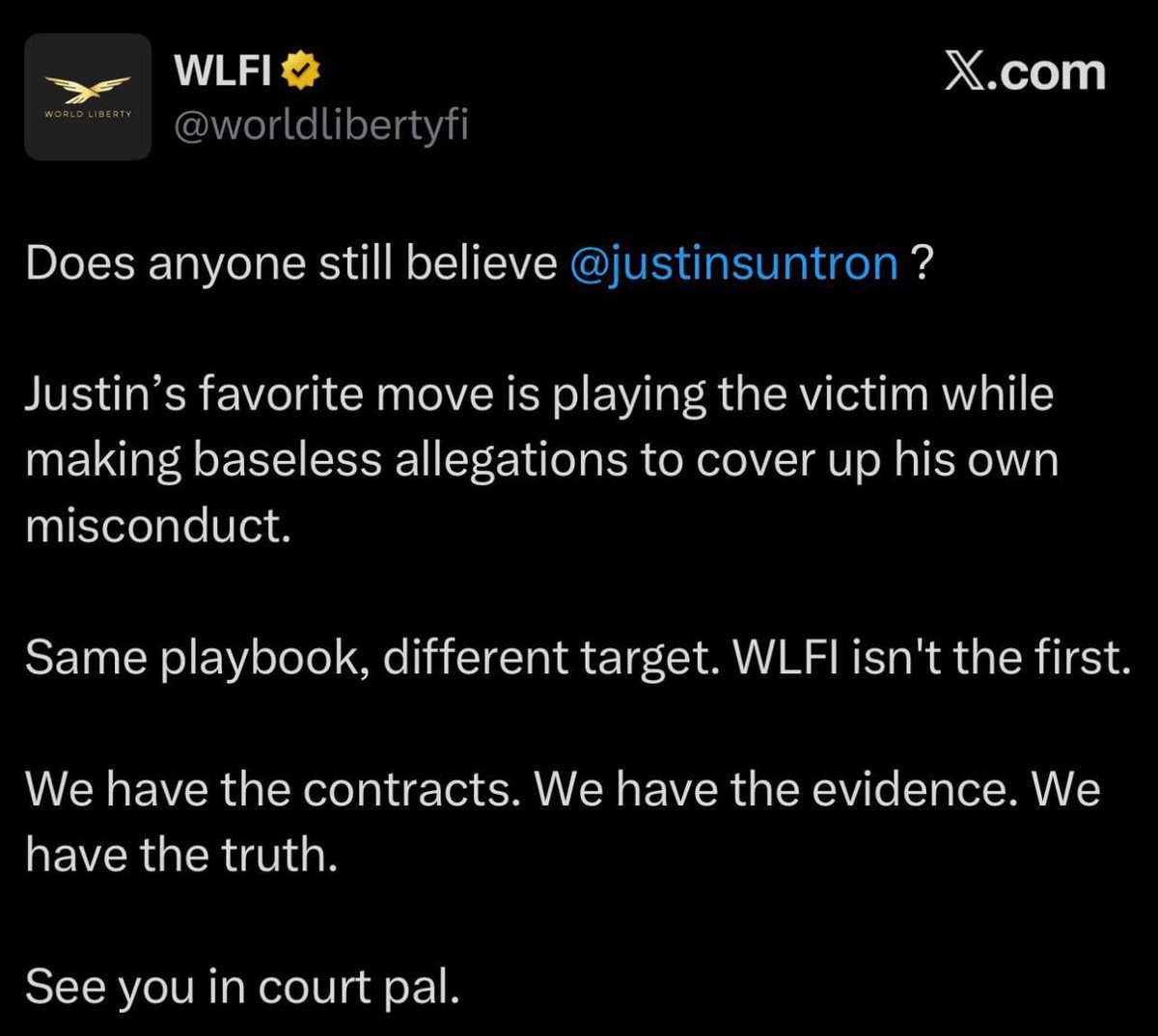
> He accuses WLFI of embedding a backdoor blacklist function in the WLFI smart contract.
> Gives the team unilateral power to freeze, restrict, or confiscate any holder's tokens, without notice or cause.
> His words: "A trap door marketed as an open door."
> WLFI's response: "Same playbook, different target. See you in court pal."
> The man who got his fraud case dismissed, dined at the President's club and walked out with a golden watch just accused the Trump family's DeFi protocol of running a confiscation scheme.
> WLFI is threatening to sue him back.
> Two of crypto's most compromised operators just turned on each other in public.
The only thing more valuable than the $175M Sun spent is the evidence they now claim to have on each other.
The new Twitter is a right-leaning cesspool, but the rug Elon just pulled on all the low-effort MAGA influencers has been great.
Monetizing them til they quit their jobs to fart out dumdum takes & then changing the algorithm so that they now make nothing was pretty chef’s kiss.
Wish I still had the energy to pump out content but uploaded so much in vain while these wannabe influencers raked in 7 figs copying n pasting urls 💀 my passion dissolved slowly but surely. Overdue's an understatement but the reactions are still priceless nonetheless. @elonmusk@nikita
A lot of "influencers" seem to think that serially stealing content made by others and adding nothing new or original to it somehow qualifies as a full time job and entitles them to millions of dollars.
The humbling is long overdue.