Senzu

3.4K posts

Senzu banner
Senzu

Senzu

@TwoSenzuBeans

Cultivating healing properties w/ knowledging :: Kinesiology / Nutritional science :: Natural Athlete 🏋️

New York, USA Katılım Ekim 2019
221 Takip Edilen1K Takipçiler
Senzu
Senzu@TwoSenzuBeans·
@jasonwilliamsmd @DrPatrick This is huge 🙌 Saudi is the first country to approve Anktiva for metastatic NSCLC with checkpoint inhibitors. Patients who failed prior therapy now have a real option.
English
1
1
8
5.1K
Senzu retweetledi
Jason R. Williams, MD, DABR
Jason R. Williams, MD, DABR@jasonwilliamsmd·
Chemotherapy kills cancer cells. It also kills the immune cells that kill cancer cells. Most of oncology has accepted that trade-off. @DrPatrick never did. He built Anktiva, an IL-15 agonist that activates and expands your NK cells and T cells without triggering the suppressive cells that protect tumors. Saudi Arabia just approved it for lung cancer. First country in the world to do so. I've been using IL-15 intratumorally in combination with other immunotherapy agents for years. What Dr. Soon-Shiong is doing at the systemic level, we're doing at the tumor level. The future of cancer treatment isn't about finding better poisons. It's about unlocking what's already inside you.
All day Astronomy@forallcurious

🚨: Japanese scientist Patrick Soon-Shiong has designed a treatment that activates body's natural killer cells that fight against cancer cells. Its approved in the U.S. and now Saudi Arabia has also approved it for its public.
English
69
1.9K
9.1K
466.3K
Senzu
Senzu@TwoSenzuBeans·
Your skeleton rewrites itself every 7-10 years. Wolff's Law states that bone remodels along the lines of mechanical stress placed upon it. Load a bone repeatedly in one direction and osteoclasts remove material where it's not needed while osteoblasts deposit it where stress concentrates. This is why tennis players have 30-40% greater bone density in their dominant arm compared to their non-dominant arm. Same genetics. Same nutrition. Same hormones. Different loading history. Your bones are a physical record of how you've moved your entire life.
English
3
1
60
4.1K
Senzu
Senzu@TwoSenzuBeans·
Check out @jasonwilliamsmd has been talking about this exact connection. The gut microbiome is the beating heart of the immune system, and when it's disrupted, the downstream effects don't stop at digestion. Leaky gut triggers systemic inflammation through TLR4 signaling, which sets up the very environment that favors cancer development and immune suppression. He's pointed out that the rise in early-onset colorectal, breast, and pancreatic cancers in young adults tracks directly with generational shifts in the microbiome starting in the 1970s. More C-sections, less breastfeeding, over-prescribed antibiotics, processed food, and now microplastics. If the gut is the interface between environment and immune function for cancer, it almost certainly is for neurodegeneration too.
English
0
0
2
712
Michael Okun
Michael Okun@MichaelOkun·
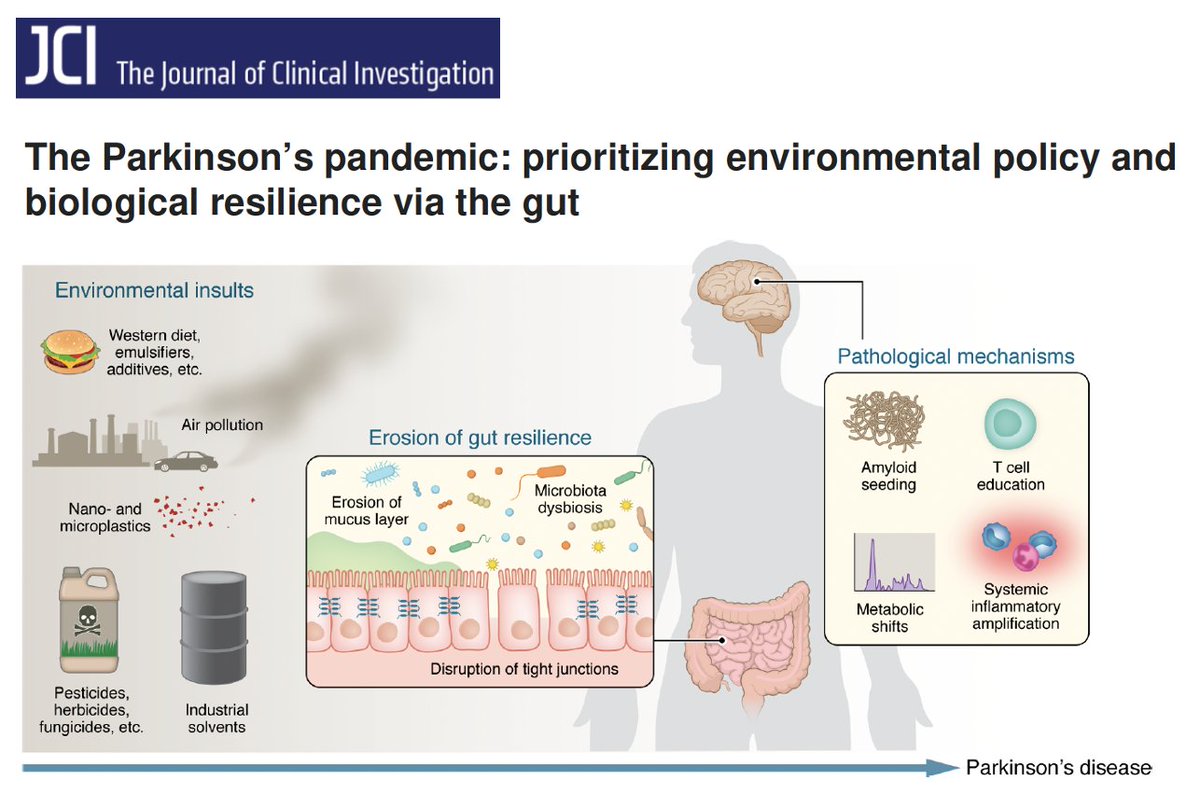
Where do environmental exposures and biological vulnerability collide? Your gut of course. This is why as we face down the Parkinson’s pandemic, environmental policy may shape the future of brain health. Gut microbiome means the community of bacteria and microorganisms living in the digestive tract that influence immunity, metabolism and even brain health. Bianca Palushaj and Robin Voigt describe in a new paper in the Journal of Clinical Investigation how environmental exposures and the gut microbiome may together shape the rising global burden of Parkinson’s disease. Key Points: -Parkinson’s disease incidence has more than doubled in many industrialized regions and is projected to rise more than 50 percent globally by 2040, suggesting environmental pressures may be contributing beyond aging and genetics. -The gut serves as a major interface between the body and environmental chemicals including pesticides, solvents, microplastics and food additives which may reshape gut microbes and weaken intestinal barrier defenses. -Disruptions in the gut microbiome may promote inflammation, immune activation and amyloid related processes that eventually lower the threshold for alpha synuclein misfolding and neurodegeneration. My take: This paper reminds us that Parkinson’s disease is not just in the brain. Could the gut be where environmental exposures and biological vulnerability collide? If that is true, then prevention strategies must move upstream and include environmental policy, nutrition and gut health. Here are 5 points that resonated w/ me: 1- Parkinson’s disease may represent a convergence of environmental exposures and biological vulnerability rather than a purely genetic disorder. 2- The gut is uniquely positioned as one of the largest interfaces between the environment and the nervous system and it may influence whether disease begins. 3- Environmental chemicals such as pesticides, solvents and air pollution may reshape the microbiome and reduce biological resilience. 4- Strengthening gut resilience through diet, microbiome targeted therapies and barrier protection may become part of future treatment strategies. 5- Environmental policy may ultimately be one of the most powerful tools for slowing the global rise of Parkinson’s disease. jci.org/articles/view/… @ParkinsonDotOrg #parkinson
Michael Okun tweet media
English
3
14
56
2.7K
Senzu
Senzu@TwoSenzuBeans·
Winter sport athletes breathe massive volumes of cold dry air during training and competition. Over years, this causes airway epithelial damage and remodeling. The cells lining the bronchial passages physically change structure in response to chronic cold air exposure. This is why exercise-induced bronchoconstriction rates are significantly higher in winter sport athletes than in summer sport athletes. The lungs adapt, but not in a good way. The tissue becomes hyperresponsive to environmental triggers. Your respiratory system wasn't designed for sustained high-output breathing at subzero temperatures. Winter athletes are pushing a system beyond its evolutionary design parameters every single session.
English
4
0
46
3.6K
Senzu
Senzu@TwoSenzuBeans·
Reverse running is trending hard right now and there's actual science behind it. Running backward shifts load from the anterior chain to the posterior chain. Your quads absorb force differently, your hamstrings engage earlier in the gait cycle, and the ground reaction forces through your knees drop significantly because you can't overstride. Some researchers claim backward running provides up to 8x the cardiovascular benefit of forward running at the same speed. That sounds aggressive but the metabolic cost is genuinely higher because the movement pattern is inefficient. Inefficiency equals greater energy demand. If you have knee pain from forward running, backward running might let you keep training while the joint recovers. Your body doesn't know "forward" is the only option.
English
3
1
50
3K
Senzu
Senzu@TwoSenzuBeans·
Over 42% of Winter Olympic athletes report respiratory illness during competition. Cold dry air at altitude irritates airways and compromises mucosal immunity. The intense training loads leading into Games suppress immune function through elevated cortisol and reduced immunoglobulin A. But here's the kinesiology connection. Respiratory illness affects balance. When your vestibular system is compromised from congestion, your proprioceptive accuracy drops. In sports where millimeters and milliseconds determine outcomes, a stuffy head isn't just uncomfortable. It's a fall risk multiplier. An athlete with a cold on a halfpipe is a fundamentally different biomechanical system than a healthy one.
English
2
0
55
5.1K
Senzu
Senzu@TwoSenzuBeans·
@jasonwilliamsmd From what I’m seeing, intratumoral delivery with cryo or oncolytic combos triggers the effect more often than IV alone 👀
English
0
0
3
3.2K
Senzu retweetledi
Jason R. Williams, MD, DABR
Jason R. Williams, MD, DABR@jasonwilliamsmd·
Most of these immune-related adverse events are a delivery problem. When checkpoint inhibitors are given intravenously, they activate the immune system everywhere. Not just at the tumor. That's why you see pneumonitis, colitis, thyroiditis, hepatitis. You're removing the brakes systemically across every organ. When we inject the same drugs directly into the tumor, the immune response starts locally, learns to recognize that specific cancer, and generates a systemic response through the abscopal effect. You target distant tumors without triggering the immune system where no cancer exists. Same drugs. Dramatically different risk profile. Here's the part that doesn't get discussed enough: what happens to cancer patients who already have an autoimmune disease? Rheumatoid arthritis. Lupus. Hashimoto's. Crohn's. These patients are often told they can't receive immunotherapy at all because systemic checkpoint inhibitors could cause a dangerous flare of their existing condition. That's a real problem, because some of these same autoimmune diseases actually increase cancer risk. RA is associated with increased lymphoma. IBD with colorectal cancer. So the very patients who may need immunotherapy the most are being denied it because of the delivery method. Intratumoral immunotherapy changes that equation. By focusing the immune activation at the tumor, we can offer these patients a path to treatment that systemic delivery cannot safely provide. One more thing. When adverse events do occur, the standard response is steroids. That concerns me. Steroids suppress the very immune response you just spent time and money activating. We use tocilizumab first when possible, which targets the inflammatory cascade without broadly shutting down the anti-cancer immune response. The goal should always be to manage the side effect without sacrificing the treatment.
Williams Cancer Institute@WmsCInstitute

Immunotherapy is transforming cancer care by reactivating the immune system to fight tumors. It can lead to long-lasting responses—but also requires careful monitoring for immune-related side effects to keep treatment safe and effective. williamscancerinstitute.com/immunotherapy-…

English
7
25
153
24.4K
Senzu
Senzu@TwoSenzuBeans·
Vonn raced the Olympic downhill on a completely ruptured ACL nine days after tearing it. From a kinesiology standpoint, here's what that means. The ACL is your primary restraint against anterior tibial translation and rotational instability. Without it, every lateral force on that knee is uncontrolled. Downhill skiing at 80+ mph involves constant rotational loading through turns and landings. She was relying entirely on muscular stabilization from her hamstrings and quads to compensate for a ligament that no longer exists. That's not just courage. That's an elite neuromuscular system compensating in real time for a structural failure. Most recreational athletes can barely walk stairs without an ACL. She qualified for the Olympics without one.
English
2
1
61
3K
Senzu
Senzu@TwoSenzuBeans·
Heat shock proteins aren't just about sauna. Exercise itself upregulates HSP70 and HSP90 in working muscles. These molecular chaperones refold damaged proteins, prevent aggregation, and protect cells during metabolic stress. The response is dose-dependent. Higher intensity creates more protein damage, triggering greater HSP production. This is part of why training creates resilience beyond just cardiovascular or muscular adaptation. Your cells build their own insurance policy against future stress. Every hard session writes that policy.
English
4
0
52
4.7K
Senzu
Senzu@TwoSenzuBeans·
Your gut bacteria influence how much muscle you can build. Specific bacterial strains regulate amino acid bioavailability, systemic inflammation, and even anabolic hormone levels. Germ-free mice consistently show lower muscle mass than conventionally colonized ones. Short-chain fatty acids produced by gut microbes enhance muscle protein synthesis and reduce protein breakdown. Butyrate in particular activates pathways that protect against muscle wasting. Your gains have a microbial component. Fiber intake isn't just about digestion. It's feeding the bacteria that support your training adaptations.
English
3
0
50
3.5K
Senzu
Senzu@TwoSenzuBeans·
Bone remodels along lines of stress. Everyone knows Wolff's Law. What's less discussed: soft tissue follows the same principle. Davis's Law states that soft tissue remodels along imposed demands. Immobilize a joint and the connective tissue reorganizes in a shortened, disorganized pattern within weeks. Scar tissue doesn't form randomly. It lays down along whatever forces you expose it to during healing. This is why early controlled movement after injury produces better outcomes than complete rest. The signal you give tissue during recovery determines the structure you get back.
English
4
1
62
4.1K
Senzu retweetledi
Steve Magness
Steve Magness@stevemagness·
Movement is medicine. Large systematic review of over 1,000 trials and 120,000 participants finds that exercise has a significant effect on symptoms of depression, anxiety, and psychological distress. We need to do a better job of integrating mental and physical health.
Steve Magness tweet media
English
21
175
621
28K
Senzu retweetledi
Jason R. Williams, MD, DABR
Jason R. Williams, MD, DABR@jasonwilliamsmd·
The CIA didn't hide a cancer cure. The pharmaceutical industry made it unprofitable to pursue one. I've been using antiparasitic drugs like ivermectin and mebendazole in my cancer protocols since 2017. Not because cancer is a parasite. That's an oversimplification that leads people down the wrong path. It's because parasites and cancer cells run the same biological playbook: hijack the host, evade immune detection, replicate, spread. Drugs designed to disrupt one can hit the other. What I've seen clinically is that these drugs, when used properly alongside immunotherapy, can extend lives that the conventional system had written off. But they're not magic bullets. Every cancer is different. Dosing matters. Combinations matter. I've also seen cases where fenbendazole appeared to accelerate tumor growth when used incorrectly. The science here requires precision. Mebendazole has over 200 published studies showing anti-cancer activity. The evidence has been building in plain sight for years. The real question isn't why the CIA had this document. It's why drugs that cost a few dollars per dose still can't get funding for large-scale cancer trials. You already know the answer.
Daily Mail@DailyMail

CIA faces furious backlash after hidden document with potential cure for cancer is declassified trib.al/cKVJB6i

English
359
6.7K
24.1K
1.3M
Senzu
Senzu@TwoSenzuBeans·
Your diaphragm is a skeletal muscle that fatigues like any other. During high-intensity exercise, the diaphragm competes with locomotor muscles for blood flow. When it fatigues, a metaboreflex kicks in that restricts blood flow to your working limbs. Your legs don't fail because they're weak. They fail because your breathing muscle stole their oxygen supply. Inspiratory muscle training at 50-70% max inspiratory pressure for 30 breaths daily delays this reflex. Your ceiling for performance might literally be in your ribcage.
English
2
0
62
3.4K
Senzu
Senzu@TwoSenzuBeans·
Collagen doesn't just decrease with age. It changes structure. Advanced glycation end-products (AGEs) create cross-links between collagen fibers, making them rigid and brittle. This affects everything. Skin elasticity. Tendon compliance. Arterial flexibility. Joint mobility. High blood sugar accelerates cross-linking. This is why diabetics age faster at the connective tissue level. Controlling blood glucose isn't just about metabolic health. It's directly preserving the structural integrity of your entire body.
English
2
0
62
3.2K
Senzu
Senzu@TwoSenzuBeans·
@jasonwilliamsmd so that cytokine helps when we’re young but can turn harmful later… is there an age where it flips from boosting mood to hurting it?
English
0
0
3
3.3K
Senzu retweetledi
Jason R. Williams, MD, DABR
Jason R. Williams, MD, DABR@jasonwilliamsmd·
We find that immune factors that drive aging also affect mindset, happiness, and depression. Reducing factors like IL-1 and TGF-B makes a person younger but also happier. This is probably why we felt more happy when we were children. Being young isn't just physical. - The Immunotherapy Revolution, Ch. 7: "Longevity-Enhancing and Anti-Cancer Prescription Drugs"
English
9
27
215
25.2K