@Rainmaker1973 SMH. Just more garbage "science". Assumptions built on assumptions built on assumptions, now so far from anything resembling actual scientific investigation yet almost no one questions it any more. Ridiculous.
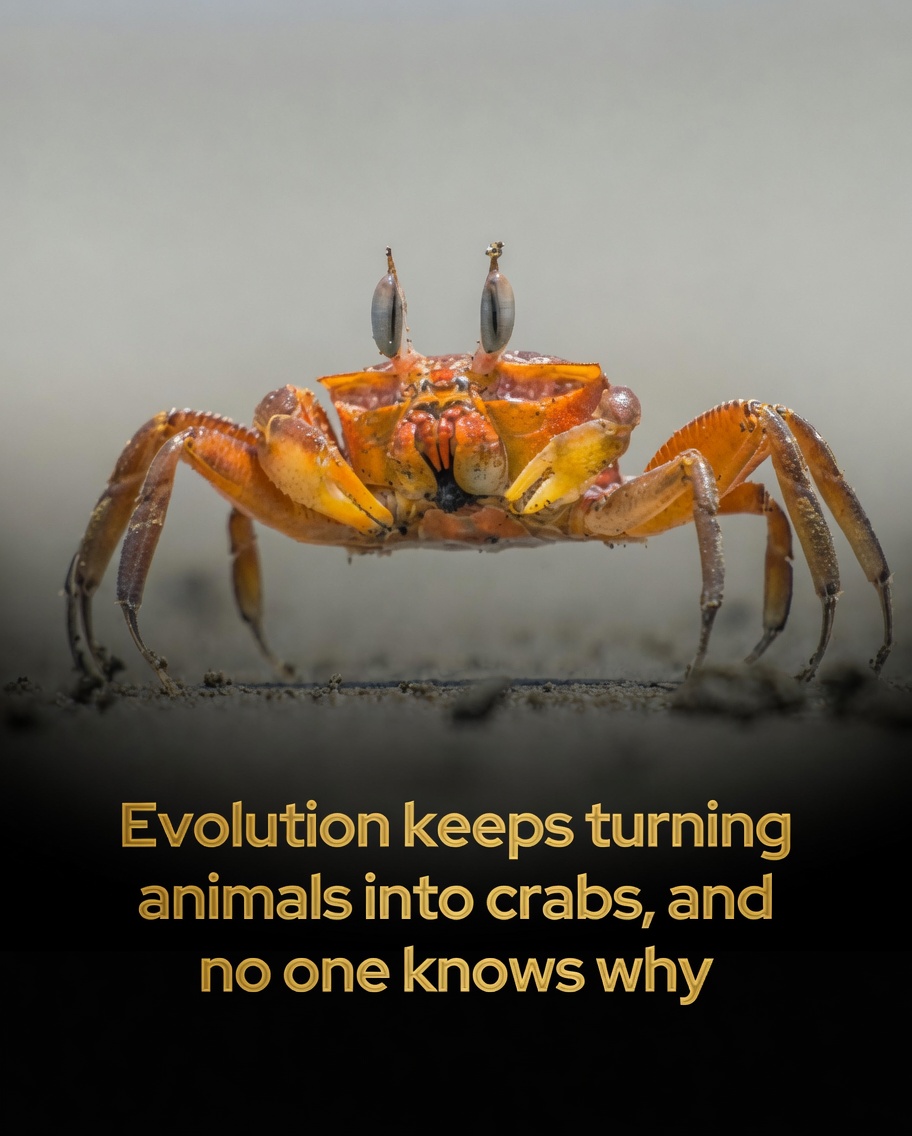
Over the last 250 million years, at least five completely unrelated lineages of crustaceans have independently evolved into crab-like forms, a phenomenon so common that biologists gave it its own name: carcinization.
And despite decades of study, scientists still don’t fully understand why it keeps happening.
Detailed evolutionary research shows that “crabbiness”, the distinctive wide, flattened body, tucked tail, and armored shell, has appeared, disappeared, and sometimes reappeared across different branches of the crustacean family tree. In one of the strangest cases, king crabs actually re-evolved crab-like traits after their ancestors had already lost them (a process called decarcinization).
This repeated convergence suggests the crab body plan offers powerful survival advantages. Crabs are incredibly successful and adaptable, thriving in virtually every marine and coastal environment on Earth — from coral reefs and rainforests to deep-sea vents and underground caves.
Their sideways scuttling allows quick directional changes while keeping an eye on predators, and their hard exoskeleton provides excellent protection. Yet the mystery remains: some crab-like species walk forward, others have ditched the shell entirely, and plenty of non-crab crustaceans do just fine without ever evolving into crabs.
The real fascination for biologists lies in what this tells us about evolution itself: under certain environmental pressures, nature seems to repeatedly converge on the same highly effective solutions — almost as if the crab shape is one of evolution’s favorite “optimal” designs.
[“One hundred years of carcinization – the evolution of the crab-like habitus in Anomura (Arthropoda: Crustacea).” Biological Journal of the Linnean Society]
someone recently asked what my interests are & i told them i have three macro categories & we can jump into each one in detail. but in essence, i am deeply interested in:
- relationships (every facet of connection)
- business (the nonobvious nuances of what makes a wonderful business that impacts society at scale)
- culture (the silent & invisible layer that drives everything)
you’ll notice most, if not all, of my thoughts on here fit in one of these categories.
Villa a Protiro (Villa with Prothyrum Entrance), Submerged Archaeological Park of Baiae, Bacoli (Naples), Italy. Date: c. 2nd century AD for the black‑and‑white floor mosaic. Medium: tessellated stone laid in situ at ~5 m depth. The complex takes its name from a small columned porch at the entrance. Photo Credit: Dreamstime / Stock Photo.
Baiae’s shoreline moves with the “breathing” of the earth. In the Phlegraean Fields the ground periodically rises and falls—a volcanic phenomenon called bradyseism—so the ancient waterfront subsided and whole quarters slipped below the waves. The underwater park preserves these drowned streets and houses. Baiae itself was the Mediterranean’s address for luxury from the late Republic through the Empire. Roman elites built extravagant seaside villas here; ancient writers and later tradition connect the town with rulers such as Julius Caesar and Nero, and imperial estates expanded under Augustus. The reputation was part spa, part social stage.