Michael Hamel

20 posts

Michael Hamel

Michael Hamel

@uti1ity27

Katılım Kasım 2024
7 Takip Edilen0 Takipçiler
Massimo
Massimo@Rainmaker1973·
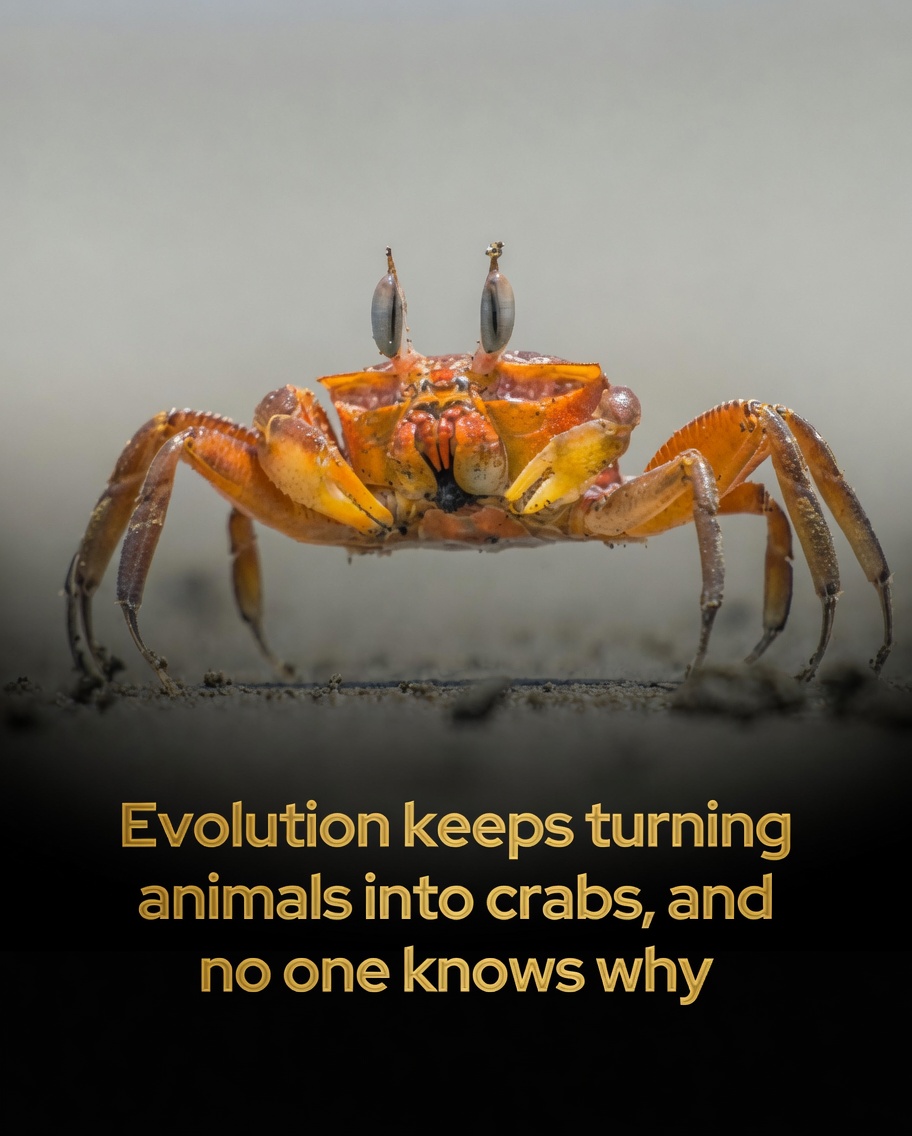
Over the last 250 million years, at least five completely unrelated lineages of crustaceans have independently evolved into crab-like forms, a phenomenon so common that biologists gave it its own name: carcinization. And despite decades of study, scientists still don’t fully understand why it keeps happening. Detailed evolutionary research shows that “crabbiness”, the distinctive wide, flattened body, tucked tail, and armored shell, has appeared, disappeared, and sometimes reappeared across different branches of the crustacean family tree. In one of the strangest cases, king crabs actually re-evolved crab-like traits after their ancestors had already lost them (a process called decarcinization). This repeated convergence suggests the crab body plan offers powerful survival advantages. Crabs are incredibly successful and adaptable, thriving in virtually every marine and coastal environment on Earth — from coral reefs and rainforests to deep-sea vents and underground caves. Their sideways scuttling allows quick directional changes while keeping an eye on predators, and their hard exoskeleton provides excellent protection. Yet the mystery remains: some crab-like species walk forward, others have ditched the shell entirely, and plenty of non-crab crustaceans do just fine without ever evolving into crabs. The real fascination for biologists lies in what this tells us about evolution itself: under certain environmental pressures, nature seems to repeatedly converge on the same highly effective solutions — almost as if the crab shape is one of evolution’s favorite “optimal” designs. [“One hundred years of carcinization – the evolution of the crab-like habitus in Anomura (Arthropoda: Crustacea).” Biological Journal of the Linnean Society]
Massimo tweet media
English
64
148
652
57.5K
Michael Hamel
Michael Hamel@uti1ity27·
I absolutely agree that one must start with assumptions. But to hold onto those assumptions in the face of clear refuting evidence is ridiculous. Given all of the scientific discoveries in the last 100 years, Darwin himself would have abandoned common descent long ago. The leaders in biological science have, and are looking for new theories, recognizing that neo-Darwinism has no information gaining mechanism to innovate.
English
0
0
0
40
men liker
men liker@yugoi_·
@uti1ity27 @Rainmaker1973 you sound incredibly stupid. you do get assumptions and questions have to be made so they can research to prove or disprove that notion right? go back to watching football.
English
1
0
1
151
JSP 🇨🇦
JSP 🇨🇦@Shuturfivehole·
@uti1ity27 @Rainmaker1973 Instead of shaking your head like moron, pick up a book and educate yourself. A lot better than looking like sister loving hillbilly who yells at the sun.
English
1
0
1
77
Michael Hamel
Michael Hamel@uti1ity27·
@Phalaenopsis93 @AMAZlNGNATURE I don't understand. How would this have evolved? What are the intermediate steps that would have benefitted this bird between a non-woodpecker and a woodpecker? How would this have developed naturally over time? This doesn't make sense.
English
0
0
0
21
Phalaenopsis
Phalaenopsis@Phalaenopsis93·
@AMAZlNGNATURE Such is the wonder of the natural world every animal evolves toward survival👍
English
1
0
0
151
Nature is Amazing ☘️
Nature is Amazing ☘️@AMAZlNGNATURE·
A Woodpecker’s tongue is so long that it wraps around its skull. When retracted, the tongue curves around the bird’s head and helps absorb force from constant pecking, while also allowing woodpeckers to reach deep inside trees for insects.
Nature is Amazing ☘️ tweet mediaNature is Amazing ☘️ tweet media
English
56
132
1.1K
103.8K
Michael Hamel
Michael Hamel@uti1ity27·
@sonofagor @AMAZlNGNATURE Wait, what? Why are you using the words engineering and evolution? Those don't go together. There is no mechanism in evolution for innovation.
English
0
0
0
14
SOLEX🐘
SOLEX🐘@sonofagor·
That's incredible! Woodpeckers' tongues aren't just long they coil around the skull like a built-in helmet, absorbing massive G-forces while pecking at 20 times per second. Nature's ultimate engineering: protection + precision foraging in one elegant adaptation. Evolution at its finest! #AmazingNature
English
1
0
0
149
Priya Saini
Priya Saini@PriyaSa98159995·
@AMAZlNGNATURE That’s insane 🔥 A tongue wrapping around the skull just to protect the brain AND hunt food… evolution is next level!
English
1
0
3
1.2K
Michael Hamel
Michael Hamel@uti1ity27·
Um . . . "Scientifically rigorous" and "evolution" do not go together. When you base your entire belief system on massive assumptions and then continue to hold on to it when all of the evidence points a different direction, that's not good science. There is no mechanism in the theory of evolution for the gaining of new information, only reduction (natural selection) and corruption (genetic mutation). Time isn't some magic hero. And even if you had a mechanism, mathematically, it doesn't work even if you had trillions of years. The fossil record also doesn't show the transitions that would be needed to slowly move from one creature to the next version with a new function. There should be thousands of times more fossils of creatures with transitional-but-not-yet-functional features than there are fully functional fossils. But in the millions of fossils we now have, there are only a handful of highly disputed examples brought forward. The data just isn't there to support the story of evolution, and it's been clear for quite a while now. It's past time to move on.
English
0
0
0
19
CommanderCorn
CommanderCorn@R3dBeerd·
@SempereCarlos @ShawnSaavedra @sciencegirl I'm pretty sure the most scientifically rigorous examples of evolution aren't compatible with a "few thousand years" I suppose extinction can happen suddenly and explain half of the equation, but time preference is at the fulcrum of both the virtues and problems with evolution
English
2
0
0
42
Science girl
Science girl@sciencegirl·
Honey locust trees are one of the most fascinating examples of what scientists call an “evolutionary anachronism”, a trait that seems designed for animals that no longer exist. Its dense clusters of enormous thorns, growing along the trunk and lower branches, are thought to have evolved during the Pleistocene epoch to protect the tree from bark damage caused by giant herbivores such as Mastodon and Giant ground sloth. While these prehistoric animals likely helped disperse the tree’s seeds by eating its sweet pods, they could also strip bark, break branches, and damage the tree as they fed. Though those Ice Age giants vanished thousands of years ago, the honey locust still carries its ancient armour today, a living reminder of a prehistoric world shaped by megafauna. 📸Greg Hume
Science girl tweet media
English
104
368
3.6K
198K
Michael Hamel
Michael Hamel@uti1ity27·
It's unreal that this is still a conversation we are having after modern discoveries (like DNA coding and the complexity of basic cells) have rendered neo-Darwinism clearly absurd. But that is how deep the religious belief in materialism has been entrenched. These people actually believe common-descent "has been proven", ignoring all of the scientific evidence that indicates the opposite. Even leading atheistic scientists are seeking to move on from Neo-Darwinism, recognizing that it doesn't have any creative mechanism to innovate. But people who have been lied to their whole lives are stuck in outdated thinking, as they have been given only the one option and have been convinced it has already been proven. SMH Scientifically, information only comes from a mind.
English
0
0
1
24
Shawn Saavedra
Shawn Saavedra@ShawnSaavedra·
@thecraftycreep1 @N7_Party @sciencegirl Countless irreducibly complex elements are now known to be in a single cell - things that without one single component have no evolutionary reason for preservation - no function, because they break completely.
English
2
0
1
29
Natalie Wolchover
Natalie Wolchover@nattyover·
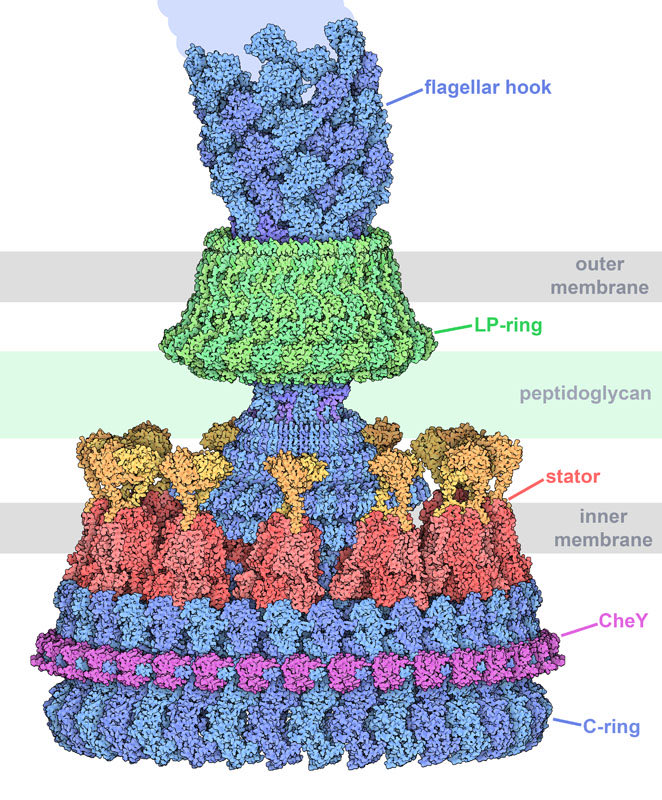
Bacteria move around using a molecular machine called the flagellar motor that rotates faster than the flywheel of a race car engine and switches directions in an instant. After 50 yrs, scientists have finally figured out how it works. “My lifelong quest is now fulfilled.” Link⤵️
English
530
4.4K
32.9K
6.1M
Michael Hamel
Michael Hamel@uti1ity27·
@QuantaMagazine Engineering and evolution don't go together. Do you even hear yourself anymore?
English
0
0
2
164
Quanta Magazine
Quanta Magazine@QuantaMagazine·
It’s hard to fathom the level of engineering that the bacterial flagellar motor has achieved in a billion years of evolution. Read the latest Qualia column from Natalie Wolchover: quantamagazine.org/what-physical-…
Quanta Magazine tweet media
English
8
32
265
15.5K
Dr Singularity
Dr Singularity@Dr_Singularity·
New Quanta article looks at one of the coolest tiny machines in biology - the bacterial flagellar motor. It’s basically a microscopic spinning engine that bacteria use to move. After decades of trying to fully understand it, scientists are finally figuring out how it actually works. The motor is powered by a flow of charged particles (kind of like a tiny battery), which creates force and makes it rotate. So what looks like something alive and mysterious is really just an incredibly advanced microscopic machine running on the same basic rules as everything else. More broadly, the article addresses the idea of a "life force." It argues that no special force is needed to explain life. Instead, biological activity arises from physical processes that operate far from equilibrium, where constant energy flow keeps the system active and organized. The flagellar motor shows that living systems can be understood as energy driven, self organizing systems. What appears to be uniquely "alive" can be explained by standard physical laws, such as thermodynamics and molecular interactions. Physics pushed to an extreme level of complexity.
Dr Singularity tweet media
Natalie Wolchover@nattyover

Bacteria move around using a molecular machine called the flagellar motor that rotates faster than the flywheel of a race car engine and switches directions in an instant. After 50 yrs, scientists have finally figured out how it works. “My lifelong quest is now fulfilled.” Link⤵️


English
63
585
3.4K
309.7K
Michael Hamel
Michael Hamel@uti1ity27·
I agree, science speaks for itself. Science has in no way shown that complex design can come from naturalist processes. Models built on massive and unrealistic assumptions are not evidence. Darwinism lacks a solid foundation, just assumptions built on assumptions, built on assumptions. The fossil record clearly shows the opposite of what you say, which is the complete lack of these millions of transitions that Darwinism predicts. What the fossil record does clearly demonstrate is sudden appearance and stasis. If you are really interested in science you should actually look into this stuff, rather than rely on assertions that have no basis in reality. How you are describing creationists (closed-minded, stuck in dogma, lacking in fundamental scientific understanding, etc.) is truly a description of yourself. It would be funny if it weren't so sad.
English
1
0
0
39
Jagan Mohan R., MD
Jagan Mohan R., MD@qctr·
@grok please respond to this wall of text. I am yet to get my morning coffee. Mr. Hamel, the good thing about science is that we don't have to convince creationists who will refuse every bit of evidence in favour of dogma. Science speaks for itself. I had presented an ironman version of behe's argument and how this tiny gap for asserting a creator - as small as a bacterial flagella has now been closed. Yet, predictably, your closed mind won't accept. On top, you seem to lack understanding of science at a fundamental level. So a closed mind plus ignorance, hallmark of creationist science, is yet again such an unassailable opponent. I understand creationists are grieving over the death of this last resort theory of irreducible complexity and are in the denial stage however, and they do have my sympathies. > The sharing of “common physio-chemical properties” is not a proof of shared ancestry, but rather an indication of the common design elements in a variety of contexts No dude, we can trace exactly how these properties evolved from the simplest forms to life to complex. And it is all in the fossil record. The sharing does indicate common origins. You can choose not to follow the evidence though. Being a creationist does mean denial of evidence. > You mention “God of the Gaps”, apparently as a label for those who lack understanding or sufficient evidence for their beliefs, and therefore must rely on some miracle to explain their position. That is not what 'god of gaps' means. > A true scientific approach leads us to observe that a Design always comes from a Designer and Information always comes from a Mind. Random chance and billions of years lead to nothing. This is not just a biological reality, but also one of chemistry, mathematics, logic, and reasoning. By dawg! No dude. Science has shown that complex designs can come from naturalist processes. One of the ways is evolution by natural selection. We can even model this on your smartphone. Try it. Ask your AI to create you a program to model how evolution works. As for your creator god, In the immortal words of Pierre-Simon "Blackhole" Laplace, "we have no need of that hypothesis"
English
2
0
0
44
Michael Hamel
Michael Hamel@uti1ity27·
Thanks for your thoughtful response. I read through the article you provided and I found no evidence showing “the flagellum could and did evolve gradually via known mechanisms”, much less “demolishing” the irreducible-complexity argument. What I did find were many examples where a cosmos which is supposed to be blind, indifferent, and purposeless acted as if it had a keen intention and careful planning to produce a level of complexity that makes our greatest engineers seem as simpletons by comparison. (cf. “the opportunism of evolutionary processes would mix and match proteins to produce new and novel functions.” This is a huge assumption. There is no evidence for this, and no mechanism for this to occur, regardless of the available time. Yet it is stated as if it were fact.) The sharing of “common physio-chemical properties” is not a proof of shared ancestry, but rather an indication of the common design elements in a variety of contexts, much like an automobile designer would implement similar mechanisms in various parts of a car. (The functioning hinges of the side door might be quite similar to the functioning hinges which open the trunk. The similarity doesn’t mean one evolved from the other.) As the author of the article recognizes, in order for the argument (that the TTSS is an example of a functioning precursor to the flagellum) to make any sense it would have to be shown that the flagellum evolved from the TTSS. As this has not been done, the irreducible complexity position has not collapsed, rather it has inadvertently been reinforced as the author has only provided another valid example of irreducible complexity, each which could not work in their own specific context, without all of their parts. (Stating that there is another version in a different context does not mean that you could substitute in the TTSS version of the machine into the flagellum and the flagellum would operate effectively.) Pulling back out of the weeds of author's assertions, ultimately, the arguments in these articles and in your post suffer from the same root problems. 1) Building on unsupported assumptions as if there were scientifically proven facts. 2) Belief in, if given enough time, amazing things will magically happen through random chance. 3) Ignoring all paths of evidence that go against a narrow naturalistic worldview. Putting aside for now the staggering mathematical and probability hurdles which would need to be overcome, all evolutionary-based studies in biology still have no reasonable mechanism which could lead to the billions of micro-functional improvements (even if given many billions of years) which would be required to explain how we arrived at the present. Natural Selection does not result in a gain of information, only a loss of information. This is why it includes the word “Selection”. It can only select from the information that is already available. A “naturally selected” creature would then retain less genetic information than the previous generation, as that information is now lost. Just basic genetics. Similarly, Genetic Mutation leads only to a reduction in genetic information as the information that has been corrupted no longer functions as it was designed. There is no gain of new function possible in either of these mechanisms. Though there are a few rare examples where a loss if information could actually increase survivability, given specific conditions, you still have a loss of information from the previous generation. You can’t build creatures who have ever increasing features and abilities through loss of information. But common decent requires all contemporary complex life to come from some starting simple life far in the past. But there is no mechanism to go from simple to complex, regardless of how much time you want to insert into our cosmic history. Time doesn’t do anything if the mechanisms are not there. Back in Darwin’s time, the understanding of what made up Life was very rudimentary, with the belief that life was just made up of something homogenous, akin to “goo”, which might be relatively simple to initiate and then to change or adjust over time. This simplistic view made the idea of billions of minor changes over billions of years seem somewhat plausible. But with the advances in science since that time, we have increasingly discovered how extraordinarily complex are even the most simple of creatures, all of the way down to the cellular level where we see complex systems which operate similarly to, and with greater efficiency than, human-designed mega-factories. Yet, most people continue to hold tightly to the outdated thinking and beliefs of Darwin’s time. The actual leaders in naturalistic science have abandoned evolution as a viable explanation and are trying to come up with alternative theories. But since there is no viable option to replace it (from a purely naturalistic worldview), the story of evolution continues as the dominant scientific belief even though it has been abandoned by its leaders. A true scientific approach to the data would not close the door to where the evidence leads just because it isn’t in a naturalistic direction. A true scientific approach leads us to observe that a Design always comes from a Designer and Information always comes from a Mind. Random chance and billions of years lead to nothing. This is not just a biological reality, but also one of chemistry, mathematics, logic, and reasoning. We haven’t even addressed the deeper topic of origins and how far away our scientific understanding is from working out how life could have begun in the first place. We are further away than we have ever been from figuring that out, because the more we inch forward in our understanding, so too grows the awareness of how truly difficult and expansive the problem really is. The goalposts keep moving further away from us at a rate which far exceeds our progress. Modern naturalistic science has locked itself in a self-made prison of thinking, unable to recognize what is clear from the evidence. You mention “God of the Gaps”, apparently as a label for those who lack understanding or sufficient evidence for their beliefs, and therefore must rely on some miracle to explain their position. But the story of evolution is fully built on an unsubstantiated belief, an “Evolution of the Gaps”, which relies on massive assumptions (e.g. given enough time something must have happened) and has no evidence to support its claims (no viable observations). Intelligent Design is not inserting “magic” to fill in gaps in understanding, rather it is a recognition through observation that there is a clear purposeful design in all aspects of the universe, and we explore in wonder the amazingly discoverable physics, chemistry, math, and logic that reveal to us how the great Designer carries out his spectacular, awe-inspiring, and beautiful creation. Please stop self-limiting your science by viewing everything from only a naturalistic worldview, which is insufficient to explain the fullness of our created universe and the human experience.
English
1
0
0
176
Jagan Mohan R., MD
Jagan Mohan R., MD@qctr·
Do care to expand please. I really don't understand much - and that pushes me to learn. But this much I know: My Iron man version of Behe's position (do correct me forcibly if I am wrong): Behe argued the motor requires roughly 30–40 specific proteins (including a rotor, stator, drive shaft, bushings, and propeller-like filament) assembled in precise order. Take away any one, and it stops working as a motor—no partial function for propulsion. He compared it to a mousetrap: all parts are essential, so it couldn’t arise through gradual Darwinian evolution (random mutation + natural selection), as non-functional intermediates would be useless and selected against. This was held up as an evidence for ID. Everybody jumped on it. The irreducible complexity motor featured prominently in the 2005 Kitzmiller v. Dover trial and ID literature as evidence that some biological systems require direct intervention rather than unguided evolution. I hope my ironman was fair enough, now to rebuttal, as much limited knowledge and understanding I possess: Much of the following is copied from many sources though: Mainstream evolutionary biology has demolished (spectacularly if I may say so) the irreducible-complexity argument through multiple and myriad lines of evidence showing the flagellum could and did evolve gradually via known mechanisms like gene duplication, co-option (repurposing existing parts like any good engineering teams), and stepwise addition of components. Core refutation here is: Homology to the Type III secretion system (TTSS) See: millerandlevine.com/km/evol/design… A simpler subset of the flagellar proteins forms the TTSS (or injectisome), a syringe-like apparatus many pathogenic bacteria use to inject toxins into host cells. The TTSS shares ~20–30 homologous proteins with the flagellar basal body (rotor, export apparatus, etc.) but performs a different function: protein export, not motility. This demonstrates that a functional “partial motor” exists in nature with utility, undermining the claim that removing parts leaves nothing useful. Evolutionary models propose the flagellum evolved from a primitive secretory system (or vice versa) by adding components like the filament and stator for propulsion. ID proponents (ironman version) counter that the flagellum came first or that the TTSS isn’t a true precursor, but phylogenetic, structural, and genomic data support shared ancestry and co-evolution from a common proton-powered ancestor. See: pubmed.ncbi.nlm.nih.gov/18753783/ The authors mocked ID in such an academic way: Bacterial flagella at first sight (note: this is the mockery - don't take anything at first sight - only ID/creationists do) appear uniquely sophisticated in structure, so much so that they have even been considered 'irreducibly complex' by the intelligent design movement. However, a more detailed analysis reveals that these remarkable pieces of molecular machinery are the product of processes that are fully compatible with Darwinian evolution. Additionally, consider the following: 1. The motor’s core is related to other rotary machines like ATP synthase, which also harnesses proton flow—showing modular reuse across biology. 2. Detailed genetic and assembly pathways (e.g., sequential protein export and self-assembly) have been mapped, with viable intermediates documented in lab and comparative studies. 3. Stepwise models (supported by bioinformatics and experiments) show how mutations could add parts incrementally without losing function at each stage. My own understanding was much helped by this reddit post: reddit.com/r/evolution/co… Coming to this article in the original post that references new discoveries highlighted in the Quanta Magazine article (April 20, 2026): explains how recent cryo-electron microscopy (cryo-EM) and functional experiments have revealed the motor’s atomic-level structure and physics in unprecedented detail, further showing it operates via straightforward, evolvable physical principles rather than mysterious design. Key findings (primarily 2020–2026): 1. Stator geometry and proton-driven mechanism: The stator complexes have a precise 5:2 protein arrangement (pentameric ring around two central proteins). Protons flow through these “turnstiles” down an electrochemical gradient (the proton motive force, or PMF—combining pH and voltage differences created by the cell’s electron transport chain). This flow generates torque, rotating the C-ring (34 proteins) and flagellum. In December 2025, experiments by Aravinthan Samuel’s team directly confirmed >2,000 protons pass per second per stator. A March 2026 follow-up showed the system’s extreme sensitivity (responsive to a single signaling molecule). 2. Direction switching: Phosphorylated CheY proteins bind the C-ring, causing a conformational change that reverses rotation—elegant but purely mechanical/chemical. 3. No “life force”, God of Gaps required: The motor converts entropic/electrochemical energy from PMF into kinetic rotation, exactly like ATP synthase. Starve the cell of PMF (e.g., by opening a proton channel), and it stops instantly. As researcher Mike Manson (who has studied it since the 1970s) noted, this fulfills a lifelong quest to understand the mechanism: it’s physics, not magic. In conclusion, the article explicitly addresses ID: The creationists cite irreducible complexity, “Yet it very much did [evolve].” These discoveries demystify the motor as an optimized product of evolution acting on physical laws - proton gradients are ancient and widespread, easily co-opted. No part requires foresight; each incremental improvement (better torque, switching, efficiency) confers survival advantages, as bacteria rapidly evolve flagellar variants
English
2
0
1
111
Michael Hamel
Michael Hamel@uti1ity27·
@qctr @nattyover You clearly don't understand the capabilities of evolution if you think that is how this came about.
English
1
0
0
47
Jagan Mohan R., MD
Jagan Mohan R., MD@qctr·
This impressive nanoscale motor, has long been a centerpiece of intelligent design (ID) and creationist arguments. And like every other Intelligent Design and Creationist arguments (God of Gaps actually), the flagellar motor went from ID’s “poster child” to a textbook case of evolutionary exaptation and biophysical optimization. Ongoing structural and evolutionary studies (including 2025 papers on torque adaptations) continue to close any remaining gaps, with no credible scientific support for irreducible complexity as a barrier to natural origins. The new discoveries, was the last nail in the coffin of the ID proponents, demystifying the motor as an optimized product of evolution acting on physical laws.. proton gradients are ancient and widespread, easily co-opted. No part requires foresight; each incremental improvement (better torque, switching, efficiency) confers survival advantages, as bacteria rapidly evolve flagellar variants. Background: In his 1996 book Darwin’s Black Box, biochemist Michael Behe (a key ID advocate) popularized the flagellar motor as the premier example of irreducible complexity. He defined this as “a single system composed of several well-matched, interacting parts that contribute to the basic function, wherein the removal of any one of the parts causes the system to effectively cease functioning.” See: biologos.org/articles/bacte…
English
2
0
3
185
Michael Hamel
Michael Hamel@uti1ity27·
@nattyover Great design! (maybe you should think about that more deeply)
English
0
0
0
129
Michael Hamel
Michael Hamel@uti1ity27·
@Galdrameistari @elonmusk None of the things you said are true. You have clearly not actually listened to anything Charlie Kirk actually said.
English
0
0
0
39
🇮🇸Jack H. Daniels🇸🇪🏍
Yes he was murdered but stop and look at what he stood for before you judge. Charlie had an ideology that was dominant in the 14th century but not in the 21st and it is sad to see and hear how many people are in favor of abolishing all the rights that women have fought for throughout the 20th century and oppressing the public into slavery to capitalism and imposing martial law to enforce it. Politicians who behave like this are (unfortunately) justified in the eyes of the public, ordinary people who just want to work in peace, spend time with their loved ones, have a family and live in peace but then individuals like this jerk, Donald Trump and Keir Starmer come along with their fourteenth century way of thinking and laws. Justified? No but they absolutely belong in institutions for brain-damaged individuals
English
1.9K
53
1.4K
482.3K