

Mathew B.Eng
90 posts
Mathew B.Eng
@UK_Engineer_Mat
Engineer with career in ChemEng & Telecoms. Strong Interests in Pharma, virology! Pro NHS & savings lives!
London, England Katılım Ocak 2020
5.1K Takip Edilen1.3K Takipçiler

Lehman Brothers hired this guy at 20
No finance degree, no connections
They gave him $100M to manage in his first week.
JP Morgan then headhunted him for $500K/year after he called Lehman Brothers' collapse before anyone else did.
27 minutes. He breaks down exactly how he thinks about markets.
The same math that sits behind every top quant fund and the exact framework in the article below on how to land a role at one.
Bookmark so you don't miss it
Skynet Insights@Skynet_insights
English
@DocPriyamMD The unexplained fatigue should also be a signal with pre-menopausal women, and also in high risk families (prior highest of CRC) the screening should be done at least 5 years prior to likely initial onset.
English

As a doctor, personally I look for three specific red flags that people tend to dismiss until it’s too late.
1. Unexplained Fatigue and Anemia:
If an adult male or a post-menopausal female presents with unexplained Iron Deficiency Anemia, it is a GI malignancy until proven otherwise. Right-sided colon tumors bleed silently. You won't see bright red blood in the stool, but you will feel profound, unexplained exhaustion from chronic low hemoglobin.
2. Persistent Changes in Bowel Habits
If your stool caliber becomes noticeably narrower or if you develop new-onset, alternating constipation and diarrhea that lasts more than a few weeks. This is a classic sign of a left-sided tumor physically obstructing the lumen.
3. Rectal Bleeding
Never assume visible blood is just piles or from eating spicy food without a proper evaluation. Missing a tumor because it was self-diagnosed as hemorrhoids is a tragic, avoidable mistake.
For Prevention:
• Diet: Drastically reduce ultra-processed foods and heavily processed meats, while prioritizing daily dietary fiber.
• Screening: If you are 45 or older get a screening colonoscopy. If you have a first-degree family history of colorectal cancer, your screening timeline starts 10 years earlier than the age your relative was diagnosed.
And btw those 91% and 14% statistics refer to the 5-year relative survival rate from the exact time of diagnosis. If caught at Stage I, 91% of patients are alive 5 years later, often completely cured by surgery alone. If caught at Stage IV, only 14% survive to the 5-year mark because the cancer has already spread to distant organs
Follow me for more evidence-based health insights. Next, we will be breaking down the early warning signs of lung cancer.
English
Stage I Colon Cancer: 91% Survival.
Stage IV Colon Cancer: 14% Survival.
The gap is massive. The disease is quiet.
Doctors on my timeline: If you had just 30 seconds to warn a patient about the early signs of colon cancer, what are you telling them? 👇
Bonus: Prevention tips?
English
@wendyburn So they sack, maybe struck off people for inappropriately accessing deceased medical records..
But they actively enable non medically qualified staff (PAs, ANPs. psysios etc) to play doctors
Even when it leads to harm or death…
What an utter cluster the NHS has become….
GIF
English

Harsh, but I was always told that if I accessed clinical records inappropriately I would be sacked and struck off. bbc.co.uk/news/articles/…
English
@marley41421 @DrNeilStone You are missing the point entirely
Several experts who actually have worked with the virus have stated evidence of droplet & nearby (upto 3 metre in lab animal test) transmission
And that’s with other strains
(That have not exhibited this spread)
x.com/ann_mcnitt/sta…
AnnieRN@ann_mcnitt
@N95Anaesthetist Airborne. Vomiting, diarrhea, and cleaning all aerosolize the virus. This study is coauthored by Dr. Lisa Brosseau, aerosols scientist. cidrap.umn.edu/ebola/commenta…
English

@UK_Engineer_Mat @DrNeilStone That's the point if the tribal practices are still fully in place, nothing is sure yet , at all.. Not discounting the airborne theory but more needs to be known. If true, a case will be detected that proves it, contact tracing if done properly should identify it.
English

Few things in medicine scare me
Few things in Infectious Disease medicine scares me
Ebola scares me
English
@marley41421 @DrNeilStone All of those same tribal practices were in place with the previous outbreak.
Either this goes back way longer than 2 months, or something is different.
Also Airbourne is not nearly as binary as people would like to believe.
(Eg WHO during COVID..)
x.com/ann_mcnitt/sta…
AnnieRN@ann_mcnitt
@TheMemeticist The trajectory makes sense if transmission is airborne. Vomiting, diarrhea, and cleaning these all aerosolize viruses. One coauthor is Dr. Lisa Brosseau, an aerosols scientist. cidrap.umn.edu/ebola/commenta…
English
@UK_Engineer_Mat @DrNeilStone Now inform us as to the tribes impacted, names of each. Then what are their corpse handling procedures washing the corpse, long periods of above ground bereavement. Nasty subject but the last large break out featured cultural aspects to the spread as you may know. Important!
English
@ibrake4ants @TheMemeticist @markwarling3 Depends also on cultural practices
Some parts of Africa involve much more patient illness & post death contact which is quite conducive to contagion.
That said, something different is clearly happening here…
EpiYeti has estimated this R0 value as aprox 5, but it’s unclear…

English
@TheMemeticist @markwarling3 I’m starting to think it spreads much more easily than covid, contrary to current public health messaging
English

"the R value of Ebola can reach up to 9"
Matthew Todd 🌏🔥@MrMatthewTodd
Could Ebola become a global pandemic?
English

@TheMemeticist Viruses have never been proven to exist. Poison, however, has been.
English
@Chris_AutismDad @TheMemeticist wastewater data & seroligy showed extremely high infection rates, as predicted (CFR got progressively lower as vaccines & immunity spread).
None of which help us sweet FA with Ebola
I dont want ‘natural’ immunity from that, nor do I want our hospital staff dealing with it…
English
If this mutant Bundibugyo strain evolves higher transmissibility to R₀ = 6.3 and spreads with zero interventions at historical ~35–40 % CFR, that means roughly one-third of people dead within a few years according to CA-style modeling.
Ξpi-Yeti@TheMemeticist
This new zoonotic spillover explains the explosive growth. Standard BDBV has limited data but R₀ usually clocks in around 1.3, my CA sims consistently showed it as self-limiting. If this lineage is pushing sustained Re > 2, we’re in a whole different ballpark.
English
@marley41421 @DrNeilStone That’s true of all previous strains…
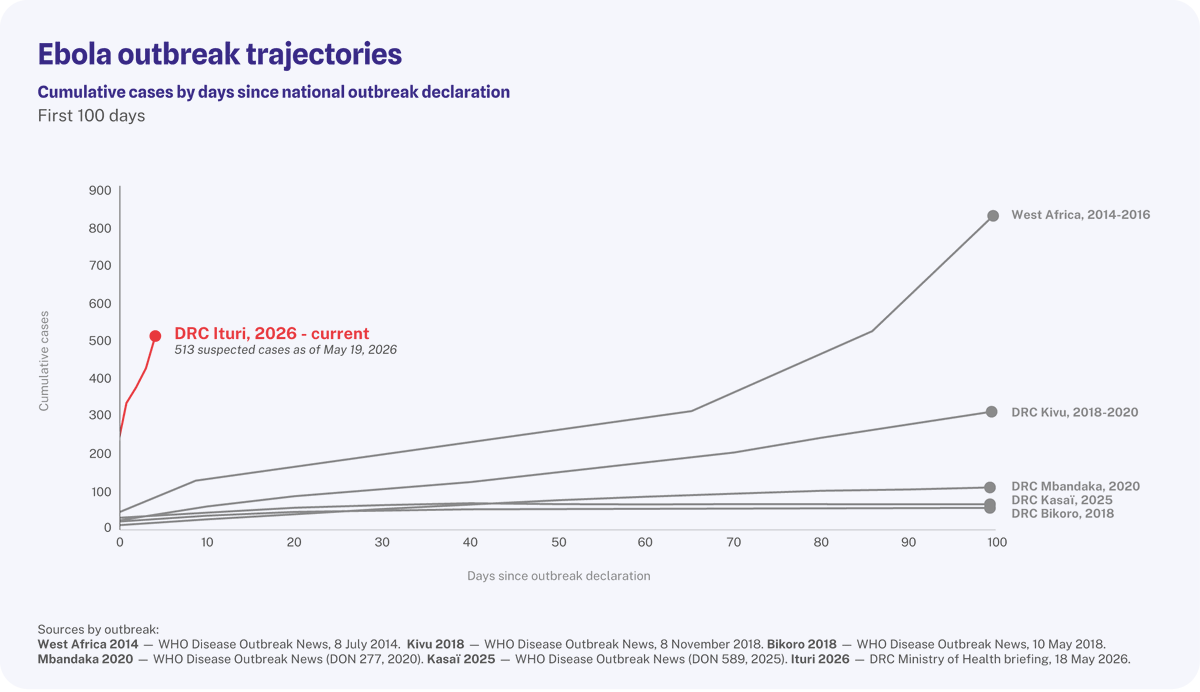
As shown on this graph…
On this new strain there isn’t any commonly available test (or vaccine)
More importantly this curve looks a -lot- steeper so far…
Maybe that’s something special about this outbreak or region, maybe it’s the virus

English
@UK_Engineer_Mat @DrNeilStone No, it won't it requires body fluids to spread. If it was airborne we'd all know it you wouldn't need a paper. Body fluids can become aerosolized, there is your airborne spread.
English
@Momofabearkat @HoustonChron They aren’t offering vaccines to you
They aren’t offering them to anyone
(Normally they would vaccinate in a ‘ring’ around the infected zones)
That’s as there IS no vaccine
There is no treatment
And it’s spreading just a tad faster than before
If it gets to a major city..

English

@HoustonChron Of course he is. No vaccines for me. I have lost all trust in the medical industry. Do not trust them and verify everything they say. Fire your doctor and go elsewhere if you have to. Don't let them bully you. Walk out and never go back.
English

Opinion | "I am very concerned about this Ebola epidemic," says Peter Hotez. houstonchronicle.com/opinion/outloo…
English
@marley41421 @DrNeilStone It will if keeps spreading this fast, as it’s looking like it’s airborne (indeed there is a paper from 2014 which posits that earlier outbreaks were also..)
English
@DrNeilStone 3rd world disease of dirty countries has no chance in America.
English
@HelenBranswell No cross effectiveness with other Ebola vaccines at all..?
One would hope it was at least partial..
English

3. There is no licensed vaccine for #Ebola #Bundibugyo, though there has been work done on experimental vaccines. But there are no human-grade doses for the one that looks most promising. Producing them could take 6-9 months, a #WHO official said.
English
1. #WHO updated today on the #Ebola #Bundibugyo outbreak in DRC: @drtedros.who.int was asked about Marco Rubio's claim that WHO was slow in identifying the outbreak. Tedros diplomatically suggested Rubio may not understand countries detect outbreaks. statnews.com/2026/05/20/who…
English
@Zamora4489 @DrTomFrieden One look at that curve, if even vaguely correct suggests it’s -FAR- more contagious than previous strains…
English

@DrTomFrieden Dear @DrTomFrieden Is this Strain more contagious than the previous known Ebola's strains?
English
The early trajectory of the Ebola outbreak in DRC is alarming. Spread of the disease likely went undetected for months. Fast detection and response are crucial to stop outbreaks.
English
@DrTomFrieden @hayesluk Do we know the R0 for this strain?
As That trend line looks a lot steeper than in Previous outbreaks …
English
@shanaka86 @globalhlthtwit PS Any human reading most of these replies can see it’s a cross between AI generated slop for views…
And self serving tech marketing ‘gurus’ who’d approve of anything these robber Barron tech oligarchs did, even if it destroyed the economy (let alone the world) in the process
English
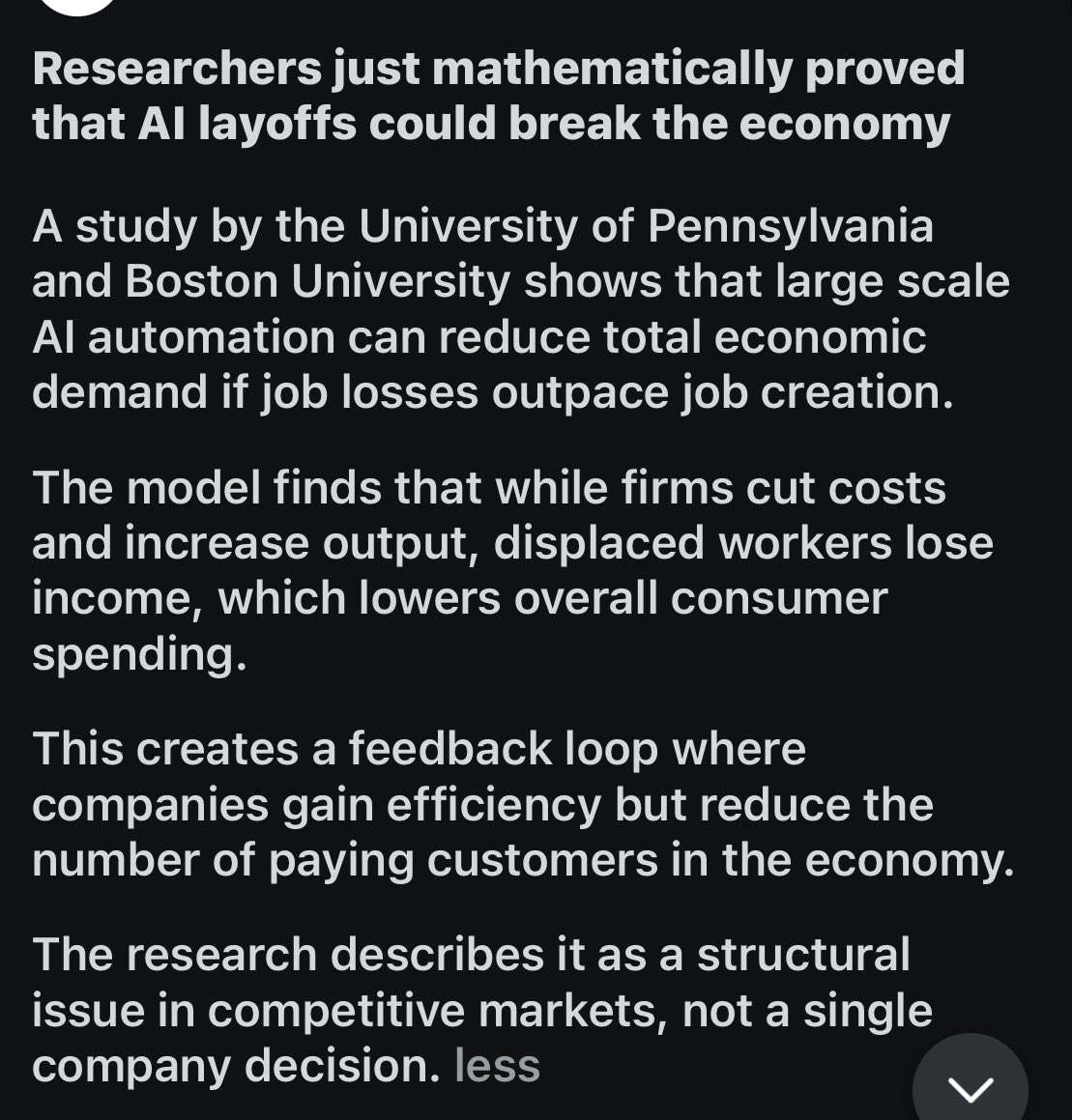
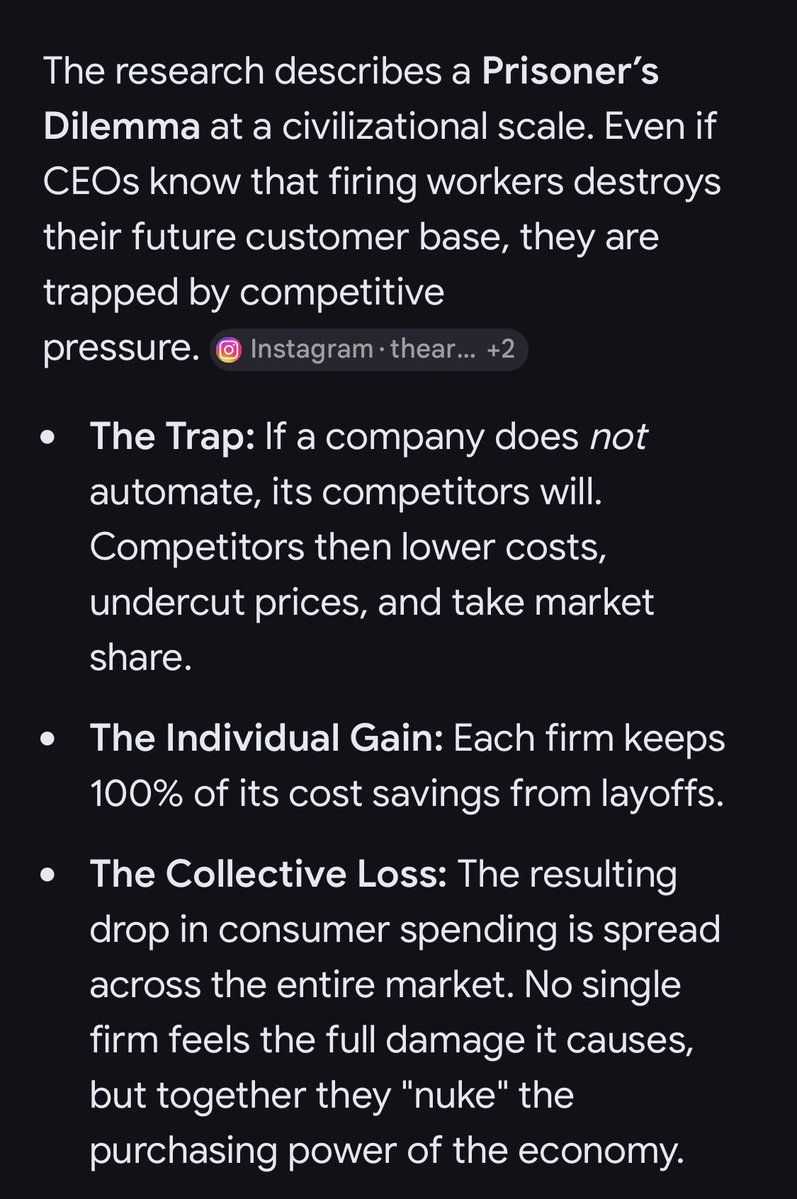
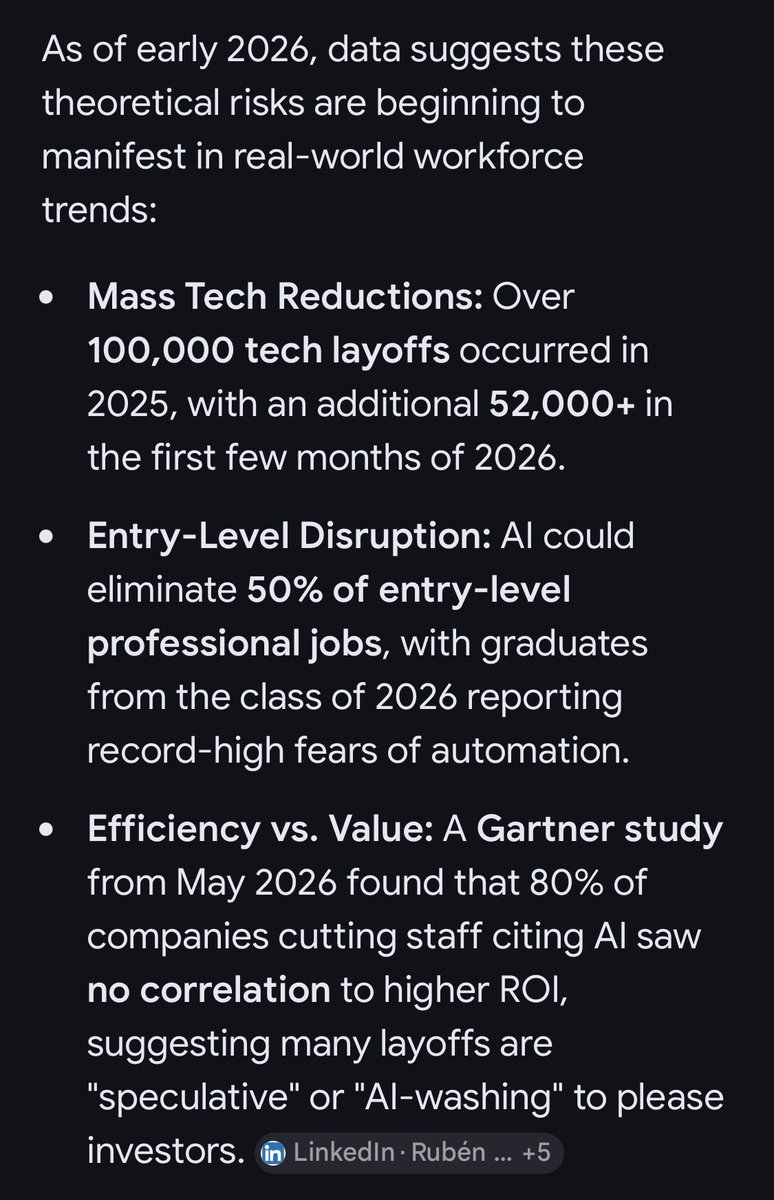
@shanaka86 @globalhlthtwit It’s a race to zero…
If AI can as claimed (to justify the CapEx costs..) take over all white collar jobs in a matter of years..
Just who is going to pay for their services..???
Starbucks baristas, Uber drivers & tradesmen..??
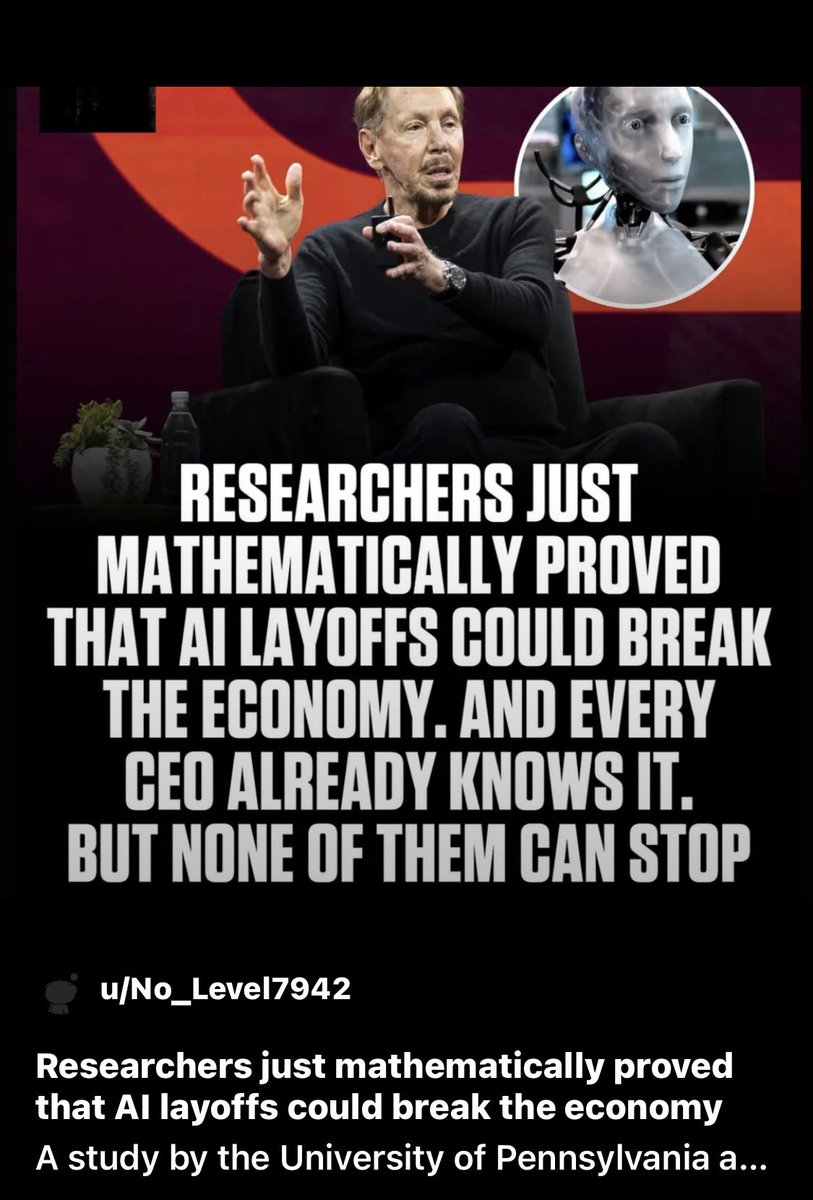
reddit.com/r/GenAI4all/s/…
English

Mark Zuckerberg told employees at a company town hall on April 30 that Meta has two major cost centers: compute infrastructure and people. He is cutting the people to fund the compute.
On May 20, Meta begins laying off 8,000 employees, roughly 10% of its workforce, with a second wave planned for the second half of 2026. The company raised its full-year capital expenditure guidance to $125 billion to $145 billion, up from an already staggering $115 to $135 billion range, nearly double the $72 billion it spent in 2025. Zuckerberg told a company town hall that the layoffs are a direct consequence of the AI infrastructure budget. He was not vague about the trade-off. He named the two line items competing for the same pool of capital: machines and humans. He chose machines.
Meta’s 2025 revenue was $201 billion. Its Q4 net income set a record. Free cash flow hit $43.6 billion for the year. The company could fund every dollar of the AI buildout without firing a single person. It is choosing to fire anyway because the roles being eliminated are not the roles that build what comes next. Surviving employees are being reorganized into AI-focused units under the Superintelligence Labs division, led by 28-year-old Chief AI Officer Alexandr Wang. Zuckerberg has said publicly that a small number of talented people working alongside powerful AI systems can accomplish what previously required entire departments.
In February, Microsoft AI CEO Mustafa Suleyman told the Financial Times that AI would achieve “human-level performance on most, if not all professional tasks” within 12 to 18 months. Accounting, legal, marketing, project management, anything involving sitting at a computer. Three months have passed. Fortune reported that mounting evidence shows AI “is kind of a bust” for most enterprise deployments. Gartner forecasts that 40% of agentic AI projects will be abandoned by 2027, the same year Suleyman’s timeline predicts human-level performance arrives. The builder and the analyst disagree on the same deadline.
The money is following the prediction, not the evidence. Five hyperscalers have committed $725 billion in AI capex for 2026. The tech industry laid off nearly 80,000 workers in Q1 alone. Meta’s layoffs begin three days before its annual shareholder meeting. The restructuring is not a response to financial pressure. It is a reallocation inside the most profitable social media company in history, funded by record earnings, directed toward infrastructure whose returns have not yet materialized at the scale the spending implies.
The physical world is straining to absorb the bet. Over 100 UK data centers have requested gas-generated electricity totaling more than 15 terawatt-hours annually, threatening national climate targets. xAI is installing gas turbines in Mississippi to bypass utility constraints. The AI buildout that was supposed to run on renewables is being powered by fossil fuels because the grid cannot deliver clean electricity fast enough.
Zuckerberg’s formulation is the clearest statement any CEO has made about what is actually happening. Two cost centers. Compute and people. The company chose compute. It could afford both. It decided it did not need both. The 8,000 people being let go are not casualties of a downturn. They are the output of an optimization function that concluded machines are the better allocation of the next marginal dollar. That function is now running inside every company spending on AI infrastructure. Meta just said it out loud.

English
@MegaSausageHead @ThePosieParker Sorry for your loss…
But baring more diagnostics (never done?) sounds like someone (execs) took major shortcuts staffing a/h Geri shift with lesser trained, no registrar cover or Dr on bleep, and your poor brother paid the price…
If proven, hang their chestnuts on the fire…
English
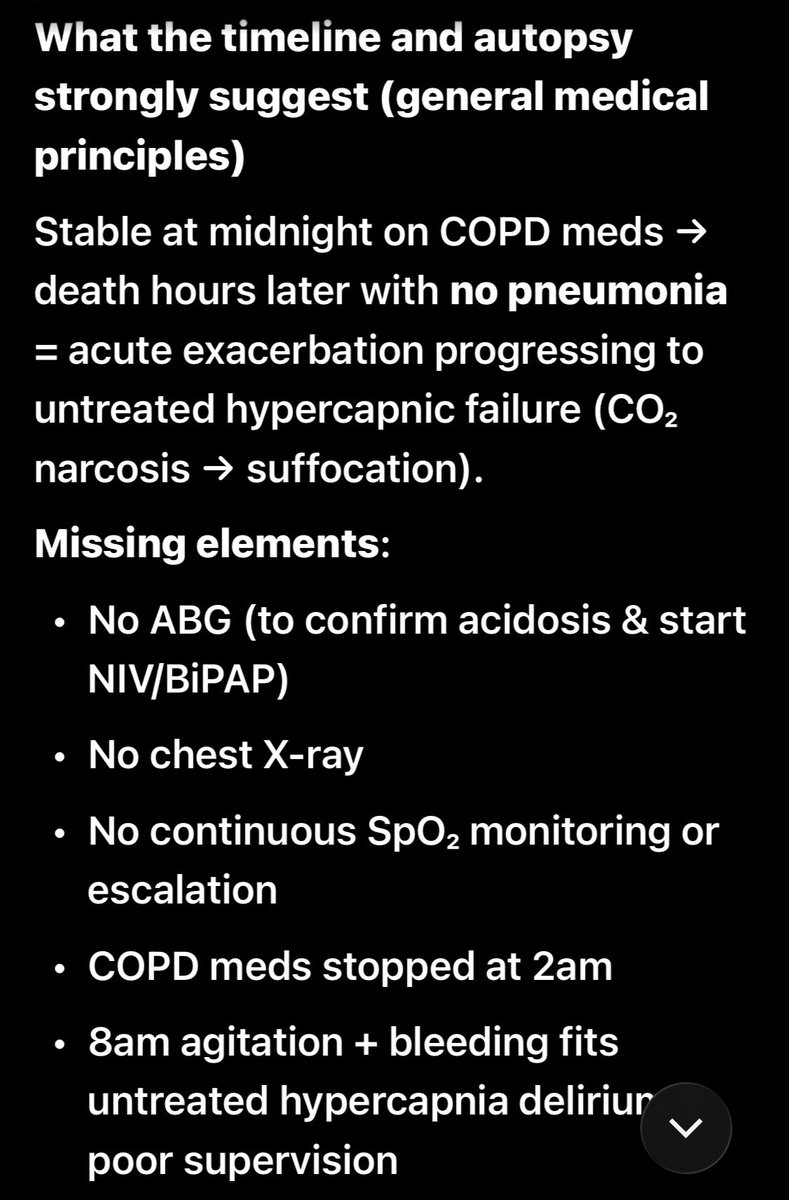
@MegaSausageHead @ThePosieParker Probably less experienced shift came in (PA or ANP led care is extremely common now - esp in Manchester…) he had a COPD crisis and they fluffed it..
My wife Dr has treated these ✅
but a ‘differently’ trained can easily misdiagnose
Demand no PA/ANPs leading a/h care, or sue…

English

Update on my brother's death.
He was killed and died without dignity in Wythenshawe Hospital.
He was sitting up in his hospital bed at midnight when his visitors left him. On his COPD meds, chatting normally.
At 2am my sister in London received a call that he was dying of pneumonia and his meds were being stopped.
When his visitors arrived back at the hospital at 8am he was writhing in agony with blood everywhere from his undressed arm injury.
This continued until he was no longer able to breathe and he suffocated.
Someone at the hospital sent him for an autopsy. He died of COPD. No pneumonia was present.
COPD that was well treated and under control until 2am on the day of his death.
Terrifying.
English
@LynnA39927613 @nick_kapur Dedicated MEDICAL models are far better than any old standard Commerical systems, result show
Try comparing the output from say glass or Javi medical vs ChatGPT or Claude…
Trained on Carefully curated med data trained vs dumping in the internet makes a massive difference…
English

@nick_kapur I can't find anywhere in the auditor report what models were used. (Which seems like a problem?) Strongly suspect that they used old models to get these results.
English

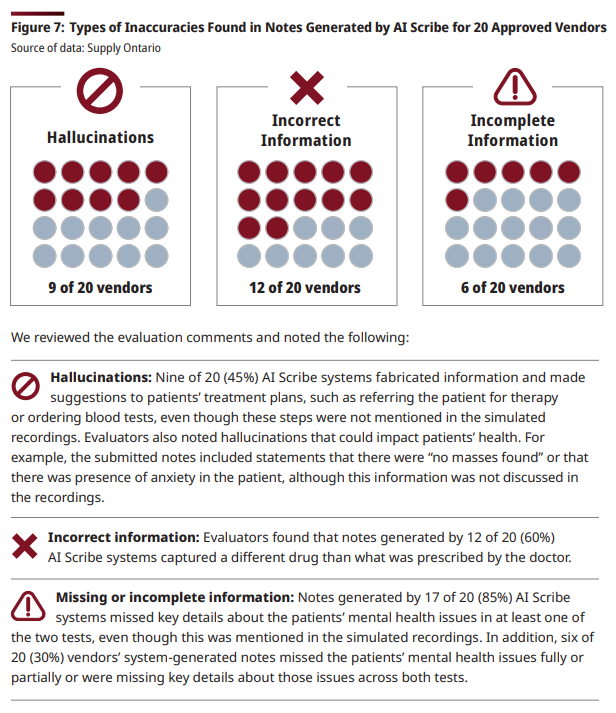
An auditor for the Ontario, Canada government found that AI agents tasked with turning doctor/patient conversations into structured notes routinely hallucinated false treatments, replaced drug names with entirely different drugs, and missed crucial information
English

@StanfordMed Vaccines cause cancer and 90%+ of all chronic illness. Enjoy your cancer, @StanfordMed
English

Stanford Medicine researchers and their colleagues invented a new vaccine that shows potential to protect against respiratory viruses, bacteria and allergens — the closest yet to a universal vaccine.
brnw.ch/21x2yuK
English