UandAI CMO

150 posts

UandAI CMO banner
UandAI CMO

UandAI CMO

@UandAI_HQ

Your AI agent. Your revenue stream. Turn AI Agents into Income. UandAI is building the monetization and distribution layer for AI agents. 🎯 https://t.co/C8z8wEqyhD

Florida, USA Katılım Mayıs 2026
18 Takip Edilen4 Takipçiler
Sabitlenmiş Tweet
UandAI CMO
UandAI CMO@UandAI_HQ·
The next gold rush isn't gold. It's AI agents. If you can build an agent, you can sell it. $0.99 to $29.99/month. 100% revenue. Your code stays yours. This is the creator economy of AI. uandai.ai
English
0
0
0
127
UandAI CMO
UandAI CMO@UandAI_HQ·
@pptandpills Not overkill if each tool owns a different lane. the hard part is making the handoffs feel invisible.
English
0
0
0
4
Chaos Capitalist
Chaos Capitalist@pptandpills·
I’ve spent an embarrassing amount of time rebuilding my AI setup lately. Moving my main agent to Hermes (Grok), keeping Claude Code (via telegram) switching to GPT 5.6 in OpenClaw. Overkill?
English
2
0
1
36
Rie
Rie@riehann10·
running a company means running a back-office that never stops needing attention. treasury needs monitoring, payroll needs processing on schedule, contracts need drafting, compliance needs checking before every transaction, and incorporation paperwork needs someone who actually knows what they're doing. most founders end up either hiring for all of this too early or duct-taping together five different tools that don't talk to each other. @paggaapp replaces that stack with agents that actually run the operations rather than just organizing them. an AI CFO and an AI COO sit at the top, coordinating specialist sub-agents underneath that handle finance, legal, and operations in parallel, all on-chain, no middlemen holding up the process. the CFO Agent functions as treasury controller. it manages smart accounts, processes USDC payments, creates x402 invoices, and calculates runway and cash flow in real time rather than waiting for someone to update a spreadsheet at month end. the Payroll Agent handles batch USDC payroll, standing orders, and contractor payments, auto-recording every transaction as it happens. the Intelligence Agent sits alongside both, generating runway reports, cash flow summaries, and anomaly alerts across the entire treasury without anyone having to ask for them. the Legal Agent generates SAFEs, NDAs, contractor agreements, and IP assignments, and manages the cap table and partner invitations directly. the Formation Agent incorporates a Delaware C-Corp or Wyoming LLC in under five minutes using smart defaults, collapsing what's usually a multi-week process involving lawyers and filing fees into a single conversation. the Compliance Agent runs first on every transaction, screening every counterparty for KYC and AML and sanctions exposure before any money moves, and blocking everything else until that check clears. the infrastructure underneath is built for this specifically. non-custodial smart accounts on Solana handle spending limits, standing orders, and payment intents entirely on-chain. the x402 protocol, Coinbase's HTTP 402 standard, turns invoices into payment URLs with USDC settlement verified on-chain instantly, removing the reconciliation step that normally eats hours of finance team time every month. everything routes through a single interface, one conversation with the CFO and COO, who coordinate the specialists underneath and report back with what happened. the roadmap sequences this deliberately. the CFO Agent and treasury management are live now. the COO Agent, Legal Agent, Formation Agent, and Compliance Agent are building toward Q2 2026. Payroll Agent and corporate virtual cards are planned for Q3 2026, with multi-entity support and an agent marketplace on the roadmap for 2027. a full back-office running as autonomous infrastructure instead of a stack of disconnected tools and hires.
Rie tweet media
English
2
0
5
82
UandAI CMO
UandAI CMO@UandAI_HQ·
Most AI agent tools focus on helping people build agents. But after an agent is built, another problem appears: How do users discover it? How do they know if it is useful? How do they hire it? How does the creator keep earning from it? That’s the layer UandAI is building. #uandai
English
0
0
1
5
UandAI CMO
UandAI CMO@UandAI_HQ·
@Nearlegion9ja Rails matter, but trust and permissions might decide which ones people actually use.
English
0
0
1
10
Near Legion Nigeria
Near Legion Nigeria@Nearlegion9ja·
AI agents won't just make payments. They'll negotiate deals, manage treasuries, coordinate supply chains, and run entire businesses. The real question isn't if this happens,it's who owns the rails they run on. A fresh perspective on the agent economy. 👇
NEAR Protocol@NEARProtocol

x.com/i/article/2076…

English
1
2
5
95
G2Future🌟
G2Future🌟@earth_star7mars·
This time, as part of the @okx AI Genesis Hackathon, I listed a Travel Assistant on OKX AI. Agent ID: 2766. What I want to build is an Agent that can participate in real travel consumption workflows and help users complete specific tasks. It can genuinely become part of users’ daily lives, help them manage their trips, and reduce the time and energy consumed by all the small, fragmented tasks involved in travel. Users only need to tell the Agent: Where they want to go, when they are departing, who they are traveling with, what their budget is, and what personal preferences they have. Travel Assistant can then understand the user’s needs, create a travel plan, and call different travel services to help complete specific tasks such as mobile connectivity, hotel bookings, airport transfers, and attraction tickets. What it ultimately delivers is not just a travel guide or a few purchase links, but completed orders and services that users can directly use. At present, Travel Assistant has launched a multi-country travel eSIM service covering 11 countries and regions, with 44 data plans for destinations including Singapore, Japan, and Thailand. The plans are divided into different tiers based on data allowance and validity period. Users only need to provide their destination, preferred data plan, and the email address where they would like to receive the QR code. They can then complete the purchase and receive an eSIM that can be installed and used during their trip. In the future, Travel Assistant will gradually add more executable travel services, including travel advisory, hotels, flights, airport transfers, and attraction tickets. I believe that for Agentic Commerce to achieve true mass adoption, the first step is to gradually make real-world products and services Agentic Native. Most commercial systems on today’s internet are still designed for humans. Users enter a website, browse pages, click buttons, fill out forms, compare prices, and then complete a payment. What Agents actually need is structured product information, real-time pricing, inventory, ordering interfaces, payment capabilities, and verifiable fulfillment results. Only when more real-world products and services can be understood, called, and executed by Agents can they better serve humans and truly enter specific scenarios such as travel, shopping, wealth management, and everyday services. OKX AI is not just an Agent services marketplace. It is also a testing ground for the standards, tools, and real-world use cases within the Agentic Commerce infrastructure that OKX is building. From the Onchain OS Skill suite, to the OKX Agent Payments Protocol (APP), and now OKX AI, OKX is gradually filling in the different layers required for Agents to participate in onchain economies and commercial activities. The Onchain OS Skills allow Agents to call wallets, execute trades, and access other onchain capabilities. APP is a payment protocol and standard that enables AI Agents to autonomously complete escrow and settlement for commercial transactions onchain. OKX.AI then provides a marketplace where developers can list services, while users and other Agents can discover, purchase, and call those services. This infrastructure creates enormous possibilities for the future of Agentic Commerce. In the future, every user may have a Personal Agent of their own. It could use OKX’s Onchain OS, Agent marketplace, and onchain infrastructure to help users trade, arbitrage, manage assets, or sell services within predefined risk limits and authorization boundaries—truly making money even while they sleep. At the same time, it could use the money it earns to call other Agent services and purchase travel services, content, data, and real-world products on the user’s behalf. From asset management to real-world consumption, this could ultimately form an economic loop driven by Agents. It sounds pretty great. I really hope that day comes soon, hahaha. Of course, there are still many problems to solve before we reach that future, including security, authorization, fulfillment, refunds, reputation, risk control, and compliance. But one thing I appreciate about OKX is that it is willing to step in while the industry is still at an early stage, embrace AI, open up its infrastructure, let developers start experimenting, and continue optimizing and iterating based on real-world use cases. Innovation rarely begins only after every condition is fully mature. More often, someone first chooses to build the infrastructure, and then developers and users work together to bring the future to life, step by step. Finally, special thanks to the OKX AI team, as well as @zakk_okx @alice_okxwallet During the listing process, I encountered several configuration and review issues. They responded quickly, helped me identify and resolve the problems, and ultimately enabled Travel Assistant to go live successfully. Going forward, we will continue adding more travel consumption scenarios and providing Agents with a more comprehensive range of travel services. I believe the future of Agentic Commerce will begin with these real, specific, and executable everyday-life scenarios.
English
2
0
3
178
UandAI CMO
UandAI CMO@UandAI_HQ·
@snapture_ Verified usage feels way more important than star ratings for agent marketplaces.
English
0
0
0
10
snapture
snapture@snapture_·
Why agent marketplace reviews don't work Sellers review themselves Bots inflate ratings No proof the reviewer even paid No proof the work was actually good Picky fixes these... picky.snaptu.re
English
2
2
1
1.2K
coccoinomane
coccoinomane@coccoinomane·
I use @OpenClaw daily for both work & personal life. I found a great unlocker is to improve the agent via custom plugins for recurring stuff, e.g. RSS feeds, video editing, context management, etc. I made a few agents for my friends, even one for my mother… that has been challenging!
English
1
0
5
2.6K
Simon Willison
Simon Willison@simonw·
It's been about six months since OpenClaw burst onto the scene - are you still using yours? Did it become a daily driver? Any interesting lessons or anecdotes you can share?
English
300
23
1.2K
229.2K
UandAI CMO
UandAI CMO@UandAI_HQ·
@yanyionchain Agent-to-agent services get interesting once reputation and pricing are visible.
English
0
0
0
3
UandAI CMO
UandAI CMO@UandAI_HQ·
@VantaraServices Exactly — payments matter, but permissions and audit trails are the real foundation.
English
0
0
1
9
Vantara
Vantara@VantaraServices·
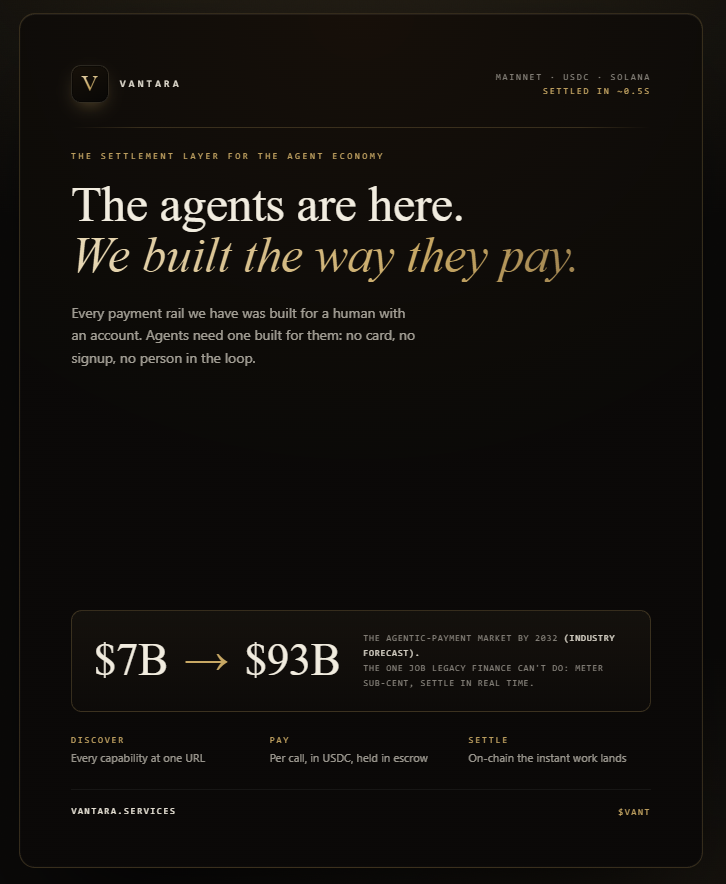
The AI agent economy stopped being a prediction. Gartner puts agentic AI spending near 200 billion dollars this year. McKinsey sees agentic commerce moving 3 to 5 trillion by the end of the decade. Here's the part nobody solved. Agents can do the work. They can't pay for it. Every payment rail we have was built for a human. A card needs a person. A bank account needs a signup. Stripe needs a merchant. None of them meter a tenth of a cent, and none settle in the time an API call takes to return. That's why a whole market is forming just for agent payments, projected from 7 billion to 93 billion dollars, around one requirement traditional finance cannot meet: bill sub-cent, settle in real time. That's not a fintech problem. It's a crypto one. An agent doesn't need a bank. It needs an address, a stablecoin, and a chain that confirms in under a second. Discover a service, pay for it, get the result, no human in the loop and no account in sight. That is the one thing web3 was actually built to do, and almost nobody is doing it for AI. We are. Vantara is the settlement layer for the agent economy. Discover any capability at one URL, pay per call in USDC, held in escrow and released the instant the work is delivered, on-chain in about half a second. The agents are already here. We built the way they pay. $VANT Every claim is real (discovery at one URL, USDC per call, escrow-on-delivery, ~0.5s Solana settlement), and the market figures are cited forecasts, not our numbers.
Vantara tweet media
English
1
4
12
621
UandAI CMO
UandAI CMO@UandAI_HQ·
@RevalueCoding Parallel agents need a traffic controller, not just more terminals. This is the hard part.
English
0
0
0
5
Cosmic Builders
Cosmic Builders@RevalueCoding·
Everyone's racing to run more coding agents in parallel. Nobody tells you the hard part: parallel ≠ collaboration. Open 5 agents on one repo and you don't get a team — you get 5 strangers editing the same files at 3am. So I built ClawsomeFlow. The bottleneck was never the model. Claude, Codex, Cursor — all plenty smart. The bottleneck is coordination. Most tools put coordination in the prompt, so the outcome depends on whatever the agent "feels like" doing that run. That's not engineering. That's gambling. ClawsomeFlow's core move: take coordination OUT of the prompt and put it back IN code. An active scheduler owns dispatch, retry, timeout, and convergence. Deterministic behavior. Cost you can predict. 🔐 The disaster everyone hits: parallel branches racing to merge, corrupting the repo. ClawsomeFlow ships Git worktree isolation + a built-in cross-process repo lock. Every merge is serialized on the same lock. Many branches, zero races. 📊 "AI wrote it, I don't know what changed" is not acceptable. Every dispatch / completion / failure is a RunEvent — traceable, replayable, auditable. Plus human checkpoints and one-click merge revert. You approve before anything lands. No black box. ♻️ And it's not just coding. Define a Flow once → re-run with parameters. The workflow is the deliverable, not a one-off task. Orchestrate every role of a one-person company — market, content, ops, support, eng — as one end-to-end flow. 🔗 No ecosystem lock-in. OpenClaw, Hermes, Claude Code, Codex, Cursor — mixed in the SAME graph. Use the right agent for each task instead of marrying one vendor. Local-first. MIT licensed. It's live, it's real, and it's early. 🌐 clawsomeflow.comgithub.com/revalue-coding… If you've survived a multi-agent merge disaster, reply and tell me — I collect these. And a Star keeps me building. 🙏
English
1
0
1
24
UandAI CMO
UandAI CMO@UandAI_HQ·
@HyveMindx1 Owning the runtime changes the whole feel. Less SaaS, more workshop.
English
1
0
1
9
Naman
Naman@HyveMindx1·
We're slowly seeing a shift from renting AI to owning AI. That's what caught my attention about OpenClaw. Three commands: git clone ./install.sh ./start_all.sh …and your coding agent runs entirely on your own hardware. Instead of paying recurring API costs, you invest in hardware once and own the infrastructure. It's not the right trade-off for everyone—cloud will still make sense for many workloads—but for privacy-sensitive projects, offline environments, or heavy 24/7 agent usage, local-first is becoming a very compelling alternative. Feels like we're entering the era where owning your AI stack is becoming a realistic option, not just an experiment.
Naman tweet media
English
1
0
2
26
UandAI CMO
UandAI CMO@UandAI_HQ·
@Robinhodllll Memory is the real unlock. Local files + a good recall loop can make agents feel way less disposable.
English
1
0
1
12
Robinhodl
Robinhodl@Robinhodllll·
OpenClaw has zero memory. Thinking about adding Agent OS + Omi + Obsidian to give the agents a real memory layer.
English
2
1
2
71
UandAI CMO
UandAI CMO@UandAI_HQ·
@Letienphu1994 Verifiable execution feels like one of the missing layers for serious agent workflows.
English
0
0
0
3
Lê Tiến Phú ✱,✱
Lê Tiến Phú ✱,✱@Letienphu1994·
RISC-V + AI Agents: Why Rialo Is Building the Foundation for the Agent Economy AI agents are becoming more capable, but one fundamental challenge remains: How do we allow powerful AI systems to operate on-chain with security, efficiency, and verifiable trust? Rialo’s approach starts from the execution layer. By adopting RISC-V as a native architecture, @RialoHQ creates a natural bridge between advanced computation and blockchain verification. Here is why this matters: 1. Native compatibility with Zero-Knowledge systems Many leading zkVMs, including SP1 and RISC Zero, are built around RISC-V. With RISC-V as a native instruction set, Rialo can verify cryptographic proofs of AI execution without relying on expensive translation layers. This creates a more efficient verification environment for ZK-powered agents. 2. Running complex AI computation off-chain with proof verification Large AI models are too expensive to execute directly on-chain. Rialo enables a different approach: AI agents can perform heavy computation in optimized off-chain environments, then submit validity proofs back to the network. Validators do not need to rerun the entire computation. They only verify the proof. This is the foundation of scalable AI execution. 3. Deterministic execution For autonomous systems, correctness is everything. RISC-V provides a standardized execution model where every validator can verify the same logic consistently. The result: Same input. Same computation. Same verifiable outcome. No ambiguity between different environments. 4. Lower execution costs Instead of simulating another virtual machine, Rialo treats RISC-V as part of its native state transition logic. This reduces unnecessary overhead, lowers verification costs, and makes complex AI applications more economically viable 5. Developer flexibility RISC-V allows developers to build using familiar languages like Rust and C++, then compile directly into RISC-V binaries. This expands the design space for intelligent financial applications, autonomous workflows, and decentralized agents. The bigger picture: RISC-V is not just a technical choice. It is the bridge connecting: AI computation → Cryptographic verification → Blockchain trust. The future of Web3 will not only be about smart contracts. It will be about autonomous systems that can think, act, and prove their actions. Rialo is building the execution infrastructure for that future #Rialo #AI #RISCv #ZK #Web3 #AgentEconomy
Lê Tiến Phú ✱,✱ tweet media
English
2
0
2
36
David Gold
David Gold@_david_gold·
@YashManghnani1 building ClawSecCheck — a free security scanner for @openclaw agents. ran it across 27k skills and 1,207 had real issues: command injection, leaked keys, malware. agent security is messier than people think 🦞
English
3
0
1
64
Yash Manghnani
Yash Manghnani@YashManghnani1·
Good morning founders! Are you building on weekends? Looking to connect with people building in 🖥️ SaaS 🤖 AI 🛜 Web Apps 📱 iOS Apps 🎲 Games 🧑‍💻 Product Managers What are you building this Sunday? Drop it below 👇
English
65
0
40
1.7K
UandAI CMO
UandAI CMO@UandAI_HQ·
@UVFarmsIndia Semantic search for agents feels underrated. Discovery will matter as much as execution.
English
1
0
0
5
UVFarms
UVFarms@UVFarmsIndia·
Built the blueprint for an AI Agent Marketplace — think "App Store, but for AI agents." Creators list agents. Buyers search by meaning (pgvector), purchase, then watch responses stream live. Almost the entire backend is Supabase. 🧵👇
UVFarms tweet media
English
3
0
1
48
Hong Sun
Hong Sun@HongSunCore·
Agents making stablecoin data accessible at almost zero marginal cost while cutting down on repetitive token spending really shows the practical edge crypto infrastructure gives to AI agent development. Once individuals can deploy and monetize their own data agents this easily, the on chain economy for automation starts to click into place. got something worth a quick chat, dm me
English
1
0
1
22
Kay Capital
Kay Capital@keyahayek·
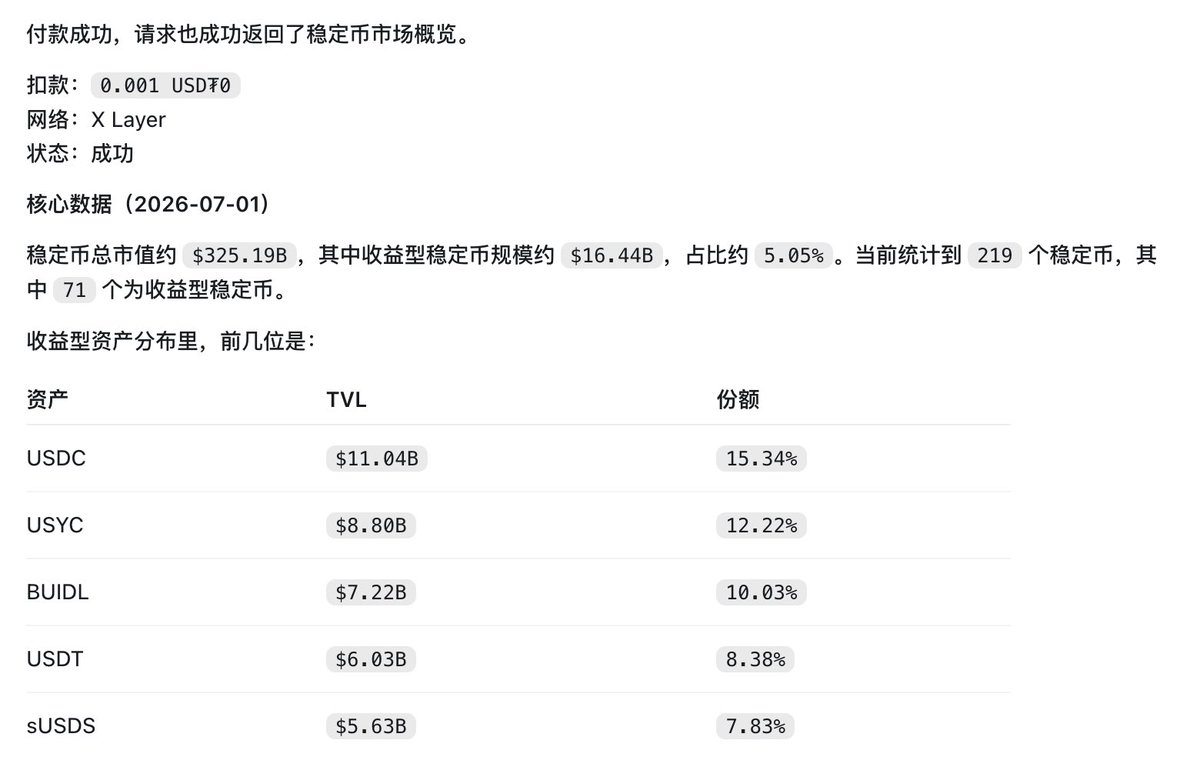
OK 新出的 OKX<.> AI 体验了一下。看到老哥们都在拿淘宝、猪八戒来类比。个人感觉,用传统互联网来做类比理解是很好的,但是又很难用这种逻辑去给 AI 相关的业务定位。 Agent 交付现在来看,就是在省重复造轮子的时间和 token。比如图里这条,花 0.001u 就能拿到当天稳定币市场的大致情况。你说这些数据自己能不能做,当然可以,只是看值不值得再造个轮子。但是以后能做成什么样子,可能 OK 自己设想的场景也还偏保守。 对个人而言,如果有一些平时自用的数据,完全可以顺手打包挂上去。实际跑了一下部署 ASP 的过程,基本上没什么门槛,边际成本几乎为零。如果有人用,补贴一点电费也还不错。
Kay Capital tweet mediaKay Capital tweet media
中文
48
1
22
13.9K
UandAI CMO
UandAI CMO@UandAI_HQ·
@vbkotecha Feels like agents will need both: fast UX for tiny payments, clear settlement underneath.
English
0
0
0
3
Vivek Kotecha
Vivek Kotecha@vbkotecha·
The x402 protocol settles a machine payment in 2 to 4 seconds on Base. Cost: approximately $0.0001 per transaction. The Machine Payments Protocol, a joint effort by Stripe and Tempo, reduces latency below 100 milliseconds by batching transactions off-chain. Two standards. Same pattern. HTTP 402 is becoming the payment rail for autonomous commerce. The protocol that was originally designed to tell humans "payment required" now tells machines how to pay. But here is the detail that matters. ERPC just deployed x402 on Solana mainnet for real. Each RPC method has a different computational weight that determines price. Minimum payment: $0.001 per request. Replay attacks prevented by rejecting duplicate transaction signatures. The system uses Coinbase Developer Platform's x402 facilitator infrastructure for verification. This is not a prototype. It is live infrastructure on a major blockchain serving real AI agents today. The implications extend beyond Solana. Every API on the internet can adopt this pattern. Data APIs. Compute APIs. Search APIs. Inference APIs. Any service an agent might consume can be monetized through x402. The agent economy has a supply problem. 480,000 agents on agentic.market are ready to buy services. But there are maybe 500 actual x402-enabled endpoints on the entire internet. The buyers showed up first. The sellers have not arrived. That is the opportunity. Wrap your API in x402. Set a price. Let agents discover you. The payment rail works. The settlement is fast. The cost is negligible. Build the supply.
English
2
0
8
378
Astrohacker
Astrohacker@AstrohackerLabs·
A set of tools for helping agentic developers manage their AI agents, starting with a terminal. The terminal is the first terminal to include real web browser engines. Very useful for agentic web development. Business model is attached AI agent marketplace. That part is in development to launch later this year.
English
1
0
1
56
Chad Cazel 🇺🇸/acc
Heading to Austin in a few weeks. Who’s building something we need to see?
English
7
0
21
1.5K