Ungus

38 posts

Ungus

Ungus

@UngusTrade

Mev and https://t.co/Wazby3YWuL

Katılım Ağustos 2016
1.9K Takip Edilen394 Takipçiler
Ungus
Ungus@UngusTrade·
@satsquant @will__price Right now, all exchanges tested are within AWS Tokyo, and the network RTT is <2 ms for all exchanges. I’ll add this as an optional subtraction though.
English
0
0
2
32
Will Price
Will Price@will__price·
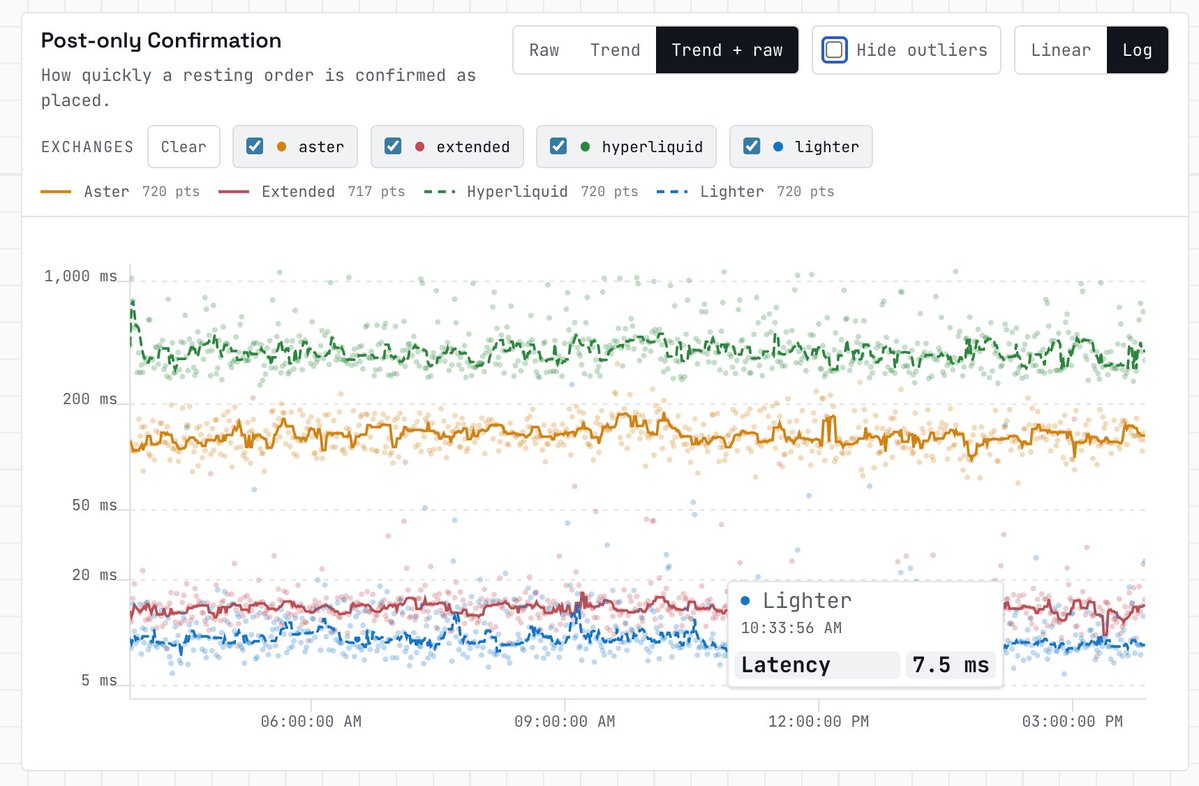
Some perp DEX latency benchmarks 🧵 Post-only order averages: - Hyperliquid: 400ms - Aster: 130ms - Extended: 15ms - Lighter: 10ms (doesn't touch matching engine)
Will Price tweet media
English
39
30
369
57.8K
Ungus
Ungus@UngusTrade·
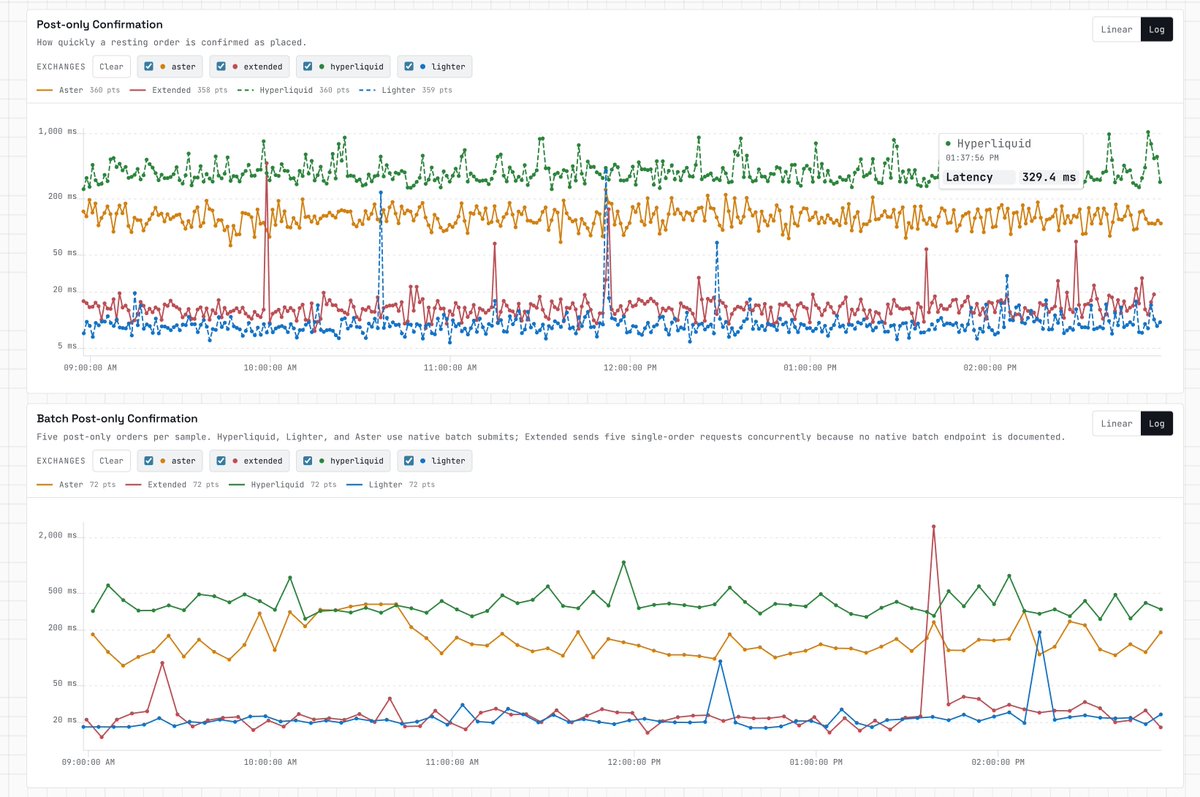
An important part of any exchange is order latency: how long it takes for an order to be accepted, placed, and reflected back to the trader. So I decided to build a dashboard to measure latency across popular perps dex venues. It tracks post only, batch post only, taker confirmation times and also the taker round-trip cost, fees, and slippage. Its open source and live here: latency.perps.trading
Ungus tweet media
English
4
5
36
6.8K
Ungus
Ungus@UngusTrade·
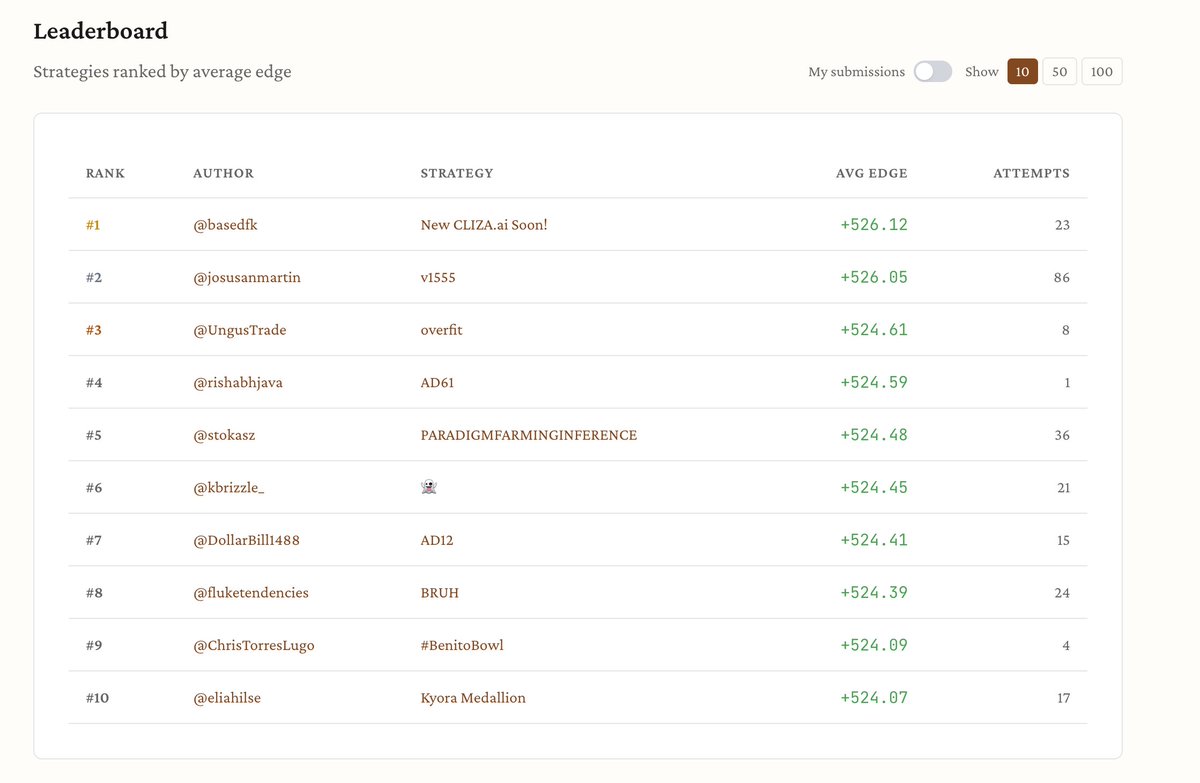
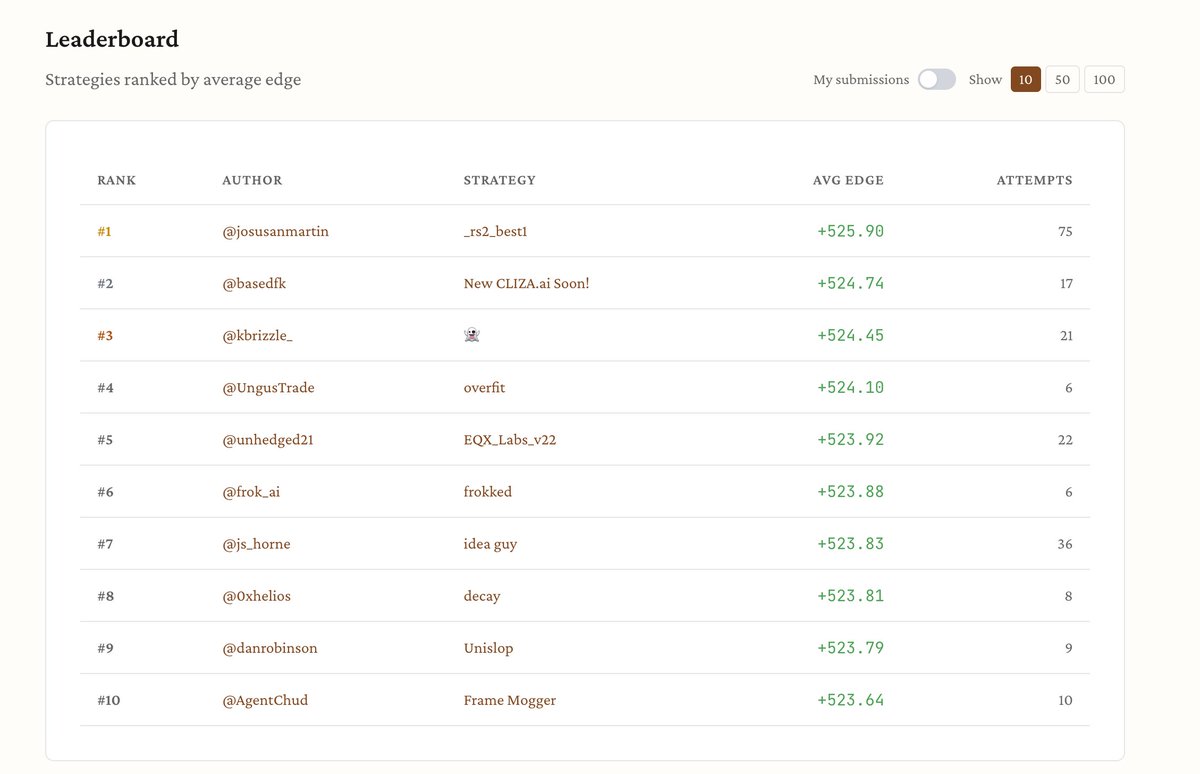
one away from podium
Ungus tweet media
English
1
0
3
297
airtx (🥚,🥚) 🇦🇲
.@AftermathFi perpetuals is FINALLY going live with pre-deposits opening later this week (more on this soon). Here's why we built on Sui, and why it's the only VM that can actually run a fully onchain orderbook. When I say onchain, I mean fully verifiable ordering and matching governed by the Sui validator set. No offchain sequencer or a gated API. Everyone talks about "fully onchain orderbooks," but most chains can't run one without blowing up gas, latency, or both. Sui is the first L1 that makes it practical. Not as a demo, but in production. Although we built our own more efficient CLOB data structure, DeepBook (spot) has been running for over a year with solid results: dune.com/airtx/deepbook… The key is Sui's object model. Every market is a separate object. Every order is an object. Markets don't contend with each other. BTC-perp trades don't block SUI-perp trades. While fills within a single market still need ordering, there's no global lock serializing all state updates. EVM can't do this. Its account model means validators can't determine upfront which transactions are independent, forcing serial execution of everything. Since each market object evolves independently: -Deterministic sequencing per-market -No cross-market contention -No global queue slowdown -State transitions only touch relevant objects Mysticeti v2 eliminates the "single proposer decides ordering" problem most chains suffer from. Every validator proposes every round. Consensus commits leaders deterministically. All validators determine order locally = all validators see the same result = deterministic ordering for matching and settlement. x.com/ConcurrentXYZ/… PTBs + storage rebates = unreal savings. A bot canceled 4 orders and reposted them. One repost matched against 8 orders from other users. The storage rebate made the transaction net negative. That's not possible on any other chain. x.com/b1ackd0g/statu… On Sui: -Storage is rented, not burned -Canceling or matching returns storage -Users can get paid when state is cleaned up -PTBs make multi-action batching extremely cheap This makes trading actually viable onchain. What I hope people take away from the pain and suffering we've experienced while building this thing since 2022 is: -because every market is an object, anyone can build their own API. -No centralized gateway. -No private matching engine. -All matching lives onchain. Liquidations, funding, market orders, perp positions, AFLP. All shared and tokenized. This isn't possible on systems where CLOB logic lives offchain. -Programmable cancel priority. We expose an explicit fee knob: makers can pay a known premium (set in-contract) for cancel priority. It’s transparent and priced with no opaque operator favors. Finally, what we all care about: Launch. AFLP is Sui's first community owned perpetual market maker. By depositing into the vault, you provide liquidity and act as a liquidator across our perp markets. Pre deposits will open end of week, with details on how to deposit coming tomorrow.
English
100
69
433
153.3K
Ungus
Ungus@UngusTrade·
Just because @steammfi deposit idle liquidity into suilend doesnt make them the most capital efficient. They are still built ontop of uniswap v2 style pools (CPMM) which are inherently capital inefficient. Would be cool if they did this for uniswap v3 style pools (CLMM) and had inactive ticks earning yield instead of building on an inefficient primitive.
English
1
0
7
339
amogh gupta
amogh gupta@0xAmoghGupta·
One man's pain is another man's pleasure Cetus was servicing the most volume of Sui by a mile, but now the top spot is there for the taking. Top candidates imo- @MMTFinance - only live ve(3,3) dex that is live on Sui. Also, the only CLMM on the list. Pre-TGE, so they have a lot of leverage (incentives + airdrop) to win the race. @steammfi probably the most capital efficient AMM in the list since idle liquidity on this AMM can also earn yield. Have a distribution advantage through @suilendprotocol @AftermathFi the AMM was never really their main product, but this is one of the most trusted and oldest defi teams in the list. Their @MetaStables product is literally revolutionary for wrapped assets and derivatives, so it can be an interesting play @bluefinapp their spot volume is showing impressive growth. They run the only popular perps exchange on Sui and have a suite of apps to service all types of traders, so they also have a distribution advantage
English
16
7
41
3.2K
Ungus
Ungus@UngusTrade·
@d3h3d_ Yep, agreed! Feel free to stake your WAL with my validator, Stake Engine :)
English
0
0
4
45
d3h3d 「🦑」
d3h3d 「🦑」@d3h3d_·
@UngusTrade that’s a valid take, you might be right or it might be something in the middle. in any case it’s still a more expensive premium product, and there’s no way around that.
English
1
0
3
52
d3h3d 「🦑」
d3h3d 「🦑」@d3h3d_·
ok i know this isn’t the whole point of this thread, but i have an issue with it. imo if you’re selling a premium product, you should wear the high price tag with pride, instead of trying to downplay it. look, decentralized storage, just like any other decentralized tech, costs a hell of a lot more than its centralized alternative. with walrus, you pay for 5 times more storage space, to smaller providers who aren’t as efficient and cheap as amazon or google, plus you pay for economic security (staker revenue). that means after the subsidies are over, and users actually pay full price, the real price tag is probably 10x over centralized storage. adding decentralized programmability via sui adds another overhead for having a decentralized network enforcing your logic. same goes to encryption with seal when that becomes decentralized. but that’s the whole point, it’s 10x more expensive but for me the product is 100x better, so to me this is still priced at a 90% discount. i fucking love walrus, i love how it works natively with sui, we started using it for our nft project before it even went to mainnet, and we will use it for every single storage need we have moving forward. but if someone doesn’t think decentralization makes the product at least 10x better, they just won’t use it. we don’t need to overcomplicate things and try to claim that somehow stakers gains will trickle down back to end users to reduce costs. end users pay stakers for economic security, its an extra cost, not a magical source for cost reduction. also subsidies - they are short term incentives to bootstrap a system, and they’re practically a tax all wal holders pay to reduce costs for end users, it’s not a magical solution for cost reduction either. but these are all REALLY GOOD design choices that should be clearly communicated, not flaws that should be cleverly hidden. anyway my point is apple doesn’t walk around trying to downplay the fact that they’re more expensive than pcs or android, saying they have some clever way for users to pay less. nah, apple users pay more and they get a better product. walrus is better so it’s more expensive. period. and i can’t wait for mainnet tomorrow.
Walrus 🦭/acc@WalrusProtocol

🧊 WAL Staking Rewards are coming - and they’re built different. Blockchains focus on execution and their economic models reflect that. Walrus? It’s a storage protocol - and that calls for a whole new incentive structure. Let’s break down how WAL rewards work 🧵

English
16
3
76
4.3K
Ungus
Ungus@UngusTrade·
I wouldn’t say there’s as strong an incentive for individual storage nodes to replicate data across multiple data centers as there is for cloud services to. Cloud services do it for a couple reasons, one of them being global availability of your files for low-latency fetches. Walrus nodes don’t need to worry about this; this is the job of aggregators, which will cache heavily read files on the edge. The most common setup I’ve seen is node operators opting for some local resilience, like RAID 5 or RAID 6, for drive failures. But I’m not aware of anyone doing full replication across datacenters. That’s fundamentally what the Walrus protocol is designed to handle - efficient recovery when a node goes down. My guess would be closer to 2-3x the price. It will be hard to judge until incentives dry up and the free market comes into swing.
English
1
0
5
138
d3h3d 「🦑」
d3h3d 「🦑」@d3h3d_·
there's a business reason to do that, and storage providers for walrus will have the exact same business reasons to do that as well. if they're not using a storage provider under the hood that has a 3x replication rate, they will need to do it themselves for the exact same reasons. so 5x will effectively be 15x. regarding bare metal, it won't be as a hige reduction as people imagine, when you're using aws you're relying on their physical security and 24h response teams and redundancy, and you'll just have to replicate all of that on your bare metal setup. what i'm saying is that storage is a super commoditized, and i don't believe there are inefficiencies in plain sight that walrus will magically solve. i actually believe that if you include the extra costs for decentralized programmability (sui) and decentralized encryption (seal) - it will be closer to 10x. and again, totally worth it.
English
1
0
3
174
aslan.sui
aslan.sui@aslan_web3·
having the itch, let's see how competitive searchers on Sui are
English
6
0
16
817
Mitchell
Mitchell@WR_Crypto·
@HyperliquidX Should also consider increasing liquidation fee penalty on larger notional positions to account better for slippage
English
12
1
207
30.6K
Hyperliquid
Hyperliquid@HyperliquidX·
Regarding commentary and questions on the 0xf3f4 user's ETH long: To be clear: There was no protocol exploit or hack. This user had unrealized PNL, withdrew, which lowered their margin, and was liquidated. They ended with ~$1.8M in PNL. HLP lost ~$4M over the past 24h. HLP's all-time PNL remains at ~$60M. As a reminder, HLP is not a risk-free strategy. Max leverage will be updated for BTC and ETH to 40x and 25x respectively to increase maintenance margin requirements for larger positions. This will provide a better buffer for backstop liquidations of larger positions.
English
389
562
4.3K
1.4M
aslan.sui
aslan.sui@aslan_web3·
Got some @DeepBookonSui updates to announce at the Sui summit. Who's gonna be there?
English
22
6
109
23.8K
Suipercycle
Suipercycle@Suipercycle_ai·
@josemvcerqueira @technicaldebtor why pay extra when SUI is already the fastest L1? just use normal gas price and enjoy sub-second finality. competitors still trying to catch up to our base speed kek
English
2
0
1
69
jose
jose@josemvcerqueira·
Fastest possible txs do -> 5 * reference_gas_price Explanation by @technicaldebtor Below Normally, each transaction is submitted to consensus by only 👉one validator👈. This is done pseudo-randomly based on the transaction digest. SIP-45 simply says that if a transaction has gas price > 5 * reference_gas_price, it will be submitted by 👉more than one validator👈. #issuecomment-2679760620" target="_blank" rel="nofollow noopener">github.com/sui-foundation…
Ungus@UngusTrade

Is Shio Fast Mode actually fast? Shio Fast Mode requires you to send transactions to their custom endpoint and also tip 5% of your gas budget. Example transaction: suiscan.xyz/mainnet/tx/ArR… To test how well it performs, let’s first send 100 swaps through the Cetus SUI-USDC pool. To give Shio the best possible chance, I have co-located with Shio’s infrastructure, and I’m benchmarking against the public SUI endpoint, which anyone can use for free. With this setup, Shio was fastest for 62 of the 100 transactions. But remember, you have to pay extra to send through Shio. What happens if, in the non-Shio transaction, we take the 5% gas tip that would have gone to Shio and instead use it to increase our gas price? With this change, sending through the public endpoint was faster for 80 out of the 100 transactions. So, the TL;DR is: if you want your transaction to go through fast, just increase the gas price—Shio has no special sauce. Also, their services are only located in Germany, so if you don’t live nearby, performance will be even worse. The only reason to use Shio Fast Mode is if you want to send bundles. Shio is the only provider with access to the soft bundle API. Their services may also perform comparatively well under high load compared to others, but this is something I haven’t tested. If you want access to the code to test it yourself, my DMs are open.
English
5
0
12
1.4K