Vibe Physics

11 posts

Vibe Physics banner
Vibe Physics

Vibe Physics

@VibePhysics

If I have seen further than others, it is only because of I prompted a sand god. Turning hallucination into inspiration since 2025. Send me your top slop.

Time-space Katılım Ağustos 2025
25 Takip Edilen5 Takipçiler
Vibe Physics retweetledi

steve hsu
steve hsu@hsu_steve·
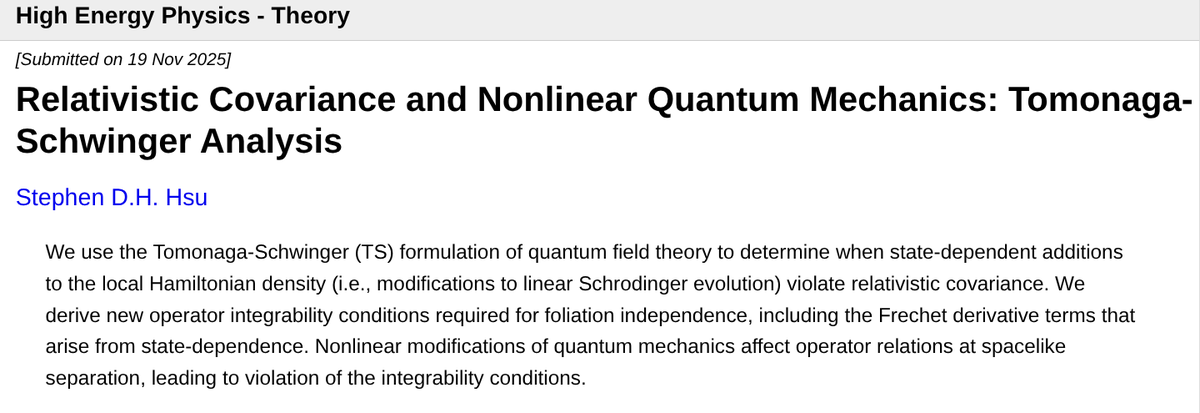
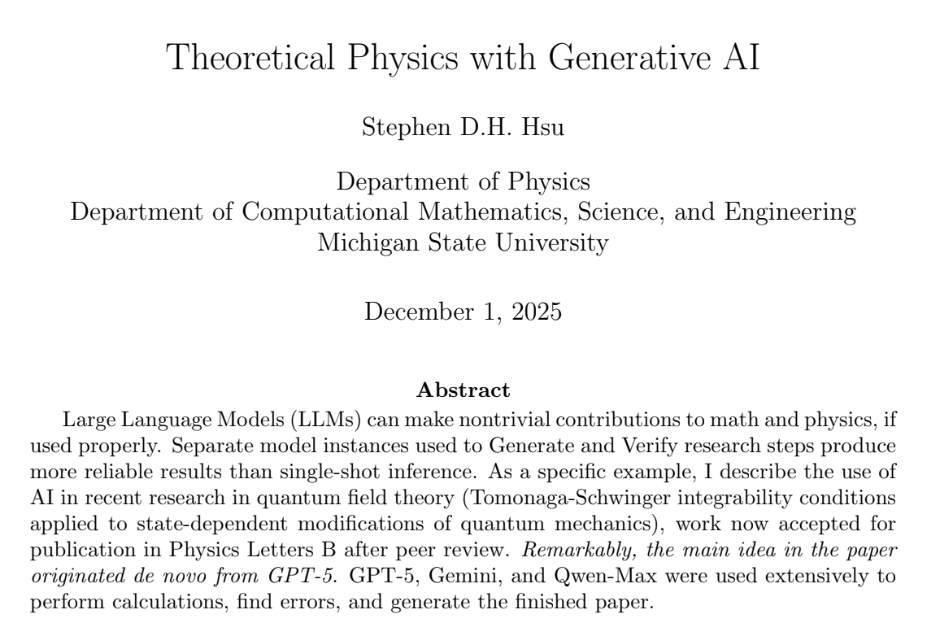
I think I’ve published the first research article in theoretical physics in which the main idea came from an AI - GPT5 in this case. The physics research paper itself (on QFT and state-dependent quantum mechanics) has been published in Physics Letters B. I've written an accompanying AI paper describing the Generator - Verifier method I used to obtain useful research results from frontier LLMs. It may be of interest to other physicists and to AI researchers. From the AI paper: ... models sometimes make very simple mistakes (e.g. in calculation) and also even make incorrect conceptual leaps that are superficially plausible. The second type of error can lead even expert researchers astray, consuming large amounts of effort to detect and correct. Research with an LLM might be compared to collaboration with a brilliant but unreliable human genius who is capable of deep insights but also of errors both simple and profound. Fortunately, both types of errors can be strongly suppressed by using structured orchestration of multiple model instances, greatly improving reliability. A Generate - Verify protocol, in which one model produces a step forward and another model instance independently checks it, reduces hallucination errors significantly compared to single-pass generation. ... The physics paper (abstract below) derives new operator integrability conditions required for foliation independence (necessary for integrability of quantum field theory; cf Tomonaga-Schwinger) that are very difficult to satisfy in any modifcation of quantum mechanics that is "state dependent" - i.e., deviates from linear Schrodinger evolution. Whether quantum evolution is EXACTLY linear is one of the most fundamental questions in all of science. It has implications for quantum computing and quantum foundations - i.e., whether we live in an Everettian multiverse!
steve hsu tweet media
English
52
125
896
470.5K
Vibe Physics retweetledi
Vlad Tenev
Vlad Tenev@vladtenev·
We are on the cusp of a profound change in the field of mathematics. Vibe proving is here. Aristotle from @HarmonicMath just proved Erdos Problem #124 in @leanprover, all by itself. This problem has been open for nearly 30 years since conjectured in the paper “Complete sequences of sets of integer powers” in the journal Acta Arithmetica. Boris Alexeev ran this problem using a beta version of Aristotle, recently updated to have stronger reasoning ability and a natural language interface. Mathematical superintelligence is getting closer by the minute, and I’m confident it will change and dramatically accelerate progress in mathematics and all dependent fields.
English
258
639
5K
1.6M
Vibe Physics retweetledi
Asher
Asher@asher5772·
if i had a nickel for every MIT professor who told me GPT5 made a novel research discovery in the past week, i'd have 2 nickels. which isn't a lot, but it's strange that it happened twice
English
81
86
2.8K
1M
Vibe Physics
Vibe Physics@VibePhysics·
@OseniloPhys Thanks for this! You mention that this model doesn't explain entanglement. Do you already have ideas for how to incorporate it?
English
1
0
0
25
Vibe Physics
Vibe Physics@VibePhysics·
@Patriot5715 @grok Can't be! The effect also occurs when there's no atmosphere. It also happens in zero gravity FWIW.
English
0
0
0
8
Patriot57
Patriot57@Patriot5715·
@VibePhysics @grok Its bouyancy. Acceleration decreases atmospheric pressure above the arms while centrifugal force pushes upward. Like a helicopter, you are generating lift by changing the external forces acting on the frame.
English
1
0
0
10
Vibe Physics
Vibe Physics@VibePhysics·
When you spin, your arms go up. Imagine instead that you stand still and the whole universe is spinning around you. Do your arms still go up? If all motion is relative, then the answer is “yes” because these are just two ways of describing the same thing! But why do your arms go up? The answer depends on which frame you take. If you're spinning, then your arms’ inertia pulls them outward more strongly than gravity pulls them down. But if you're not spinning, then your arms have no inertia! If the universe is spinning around you, then what pulls your arms up? Stop here and think! Answer in 🧵.
GIF
English
3
0
2
66
Vibe Physics
Vibe Physics@VibePhysics·
@grok What's your take on this? Is this tired or wired? Has the time come to give up on Mach's ideas, or should we double down on them? Is it really the stars pulling up our arms when we spin?
English
2
0
0
32
Vibe Physics
Vibe Physics@VibePhysics·
This beautiful idea is called Mach's Principle. It raises many questions, including: 1. Could this provide an explanation for inertia? Maybe the reason things resist changes to their motion is because of their relationships to the stars! 2. Why do you only feel the stars’ pull while spinning? 3. How can we validate this idea? Is it compatible with known physics and cosmological data? This is the beginning of a deep rabbit hole. Stay tuned 🙂 en.wikipedia.org/wiki/Mach%27s_…
English
2
0
1
44