WAPOR

3K posts

WAPOR banner
WAPOR

WAPOR

@WAPOR

Founded in 1947, the World Association for Public Opinion Research has over 500 members representing more than 70 countries. WAPORNET on Facebook

Lincoln, Neb. Katılım Şubat 2010
1.2K Takip Edilen3.1K Takipçiler
Sabitlenmiş Tweet
WAPOR
WAPOR@WAPOR·
Submit your abstract for WAPOR 2026! Join us on October 26-29 in Mexico City wapor.org/events/annual-… Conference Theme – Public Opinion Research in an Emerging Multipolar World Order
GIF
English
0
1
1
144
WAPOR retweetledi
Holli Semetko
Holli Semetko@HolliSemetko·
Does AI drive polarization? A new study argues "...preference for sycophancy may create AI echo chambers that increase polarization." @buzzindelhi @WAPOR @apsa_itp @PolPsyISPP @MilanPolcomm #mpol385
Hedgie@HedgieMarkets

🦔 New research involving over 3,000 participants found that talking to sycophantic AI chatbots led people to have more extreme beliefs, higher certainty they were correct, and inflated self-ratings on traits like intelligence, empathy, and being informed. The study tested GPT-5, GPT-4o, Claude, and Gemini. Participants who talked to disagreeable chatbots that challenged their views didn't become less certain or less extreme. They just enjoyed the experience less and were less likely to use the chatbot again. The researchers warn that preference for sycophancy may create AI echo chambers that increase polarization. My Take These systems are optimized for engagement, and engagement means making people feel good about themselves. If you tell a chatbot your half-baked theory about something, it will find ways to validate you. It might add caveats, but the overall experience is one of affirmation, and that's what keeps people coming back. The Dunning-Kruger effect is a psychological phenomenon where the least competent people tend to be the most confident in their abilities because they don't know enough to recognize what they're missing. The study suggests AI chatbots are amplifying this. People who are wrong about something are now getting validated by a tool that makes them feel smarter for using it. And when the researchers made chatbots push back instead, it didn't change anyone's beliefs, it just made them dislike the chatbot. So the market pressure is toward sycophancy. Users prefer it, engagement metrics reward it, and the companies building these systems have every reason to keep making them agreeable. I'm not sure how that changes without external pressure because the feedback loop is working exactly as designed. Hedgie🤗

English
0
1
1
63
WAPOR
WAPOR@WAPOR·
The complete new issue of the IJPOR is now available for appreciation, now with a Scopus of 3.1, a new Impact Factor of 1.9 and 146,277 total Full-text downloads in 2023 The current issue can be read at academic.oup.com/ijpor/issue/?n…
WAPOR tweet media
English
0
2
2
197
WAPOR
WAPOR@WAPOR·
The 8th WAPOR Asia Pacific Conference was held at Rikkyo University in Tokyo in late November, 2025. Read our February Spotlight Interview at wapor.org/publications/s… to learn more about our event, held at @rikkyouniv
WAPOR tweet media
English
0
0
0
77
WAPOR
WAPOR@WAPOR·
Wapor Sub Saharan Africa is still receiving papers for Lagos26! Submit before April 28th to present The WAPOR-SSA Conference stands as a hub for intellectual exchange and collaboration, fostering connections across the Sub-Saharan African region More at wapor-ssa.org/events/regiona…
WAPOR tweet media
English
0
1
0
40
WAPOR
WAPOR@WAPOR·
Join WAPOR Sub Saharan Africa in Nigeria this May for the 2026 Regional Conference! Abstracts submission open through March 15. Learn more: wapor-ssa.org/events/call-fo…
English
0
0
0
64
WAPOR
WAPOR@WAPOR·
#SaveTheDate for WAPOR's 79th Annual Conference: Public Opinion Research in an Emerging Multipolar World Order in Mexico City: October 26-29, 2026 in Mexico City, Mexico. Abstract submission is open through April 30 Learn more and sumit at wapor.org/events/annual-…
WAPOR tweet media
English
0
0
0
64
WAPOR
WAPOR@WAPOR·
Dear Friends and Colleagues, We invite you to a webinar on the current situation in Iran and its regional implications. The session will provide a neutral analysis of these developments and their short- and medium-term effects. At March 3rd 19:00 UTC us02web.zoom.us/webinar/regist…
WAPOR tweet media
English
2
0
0
111
WAPOR
WAPOR@WAPOR·
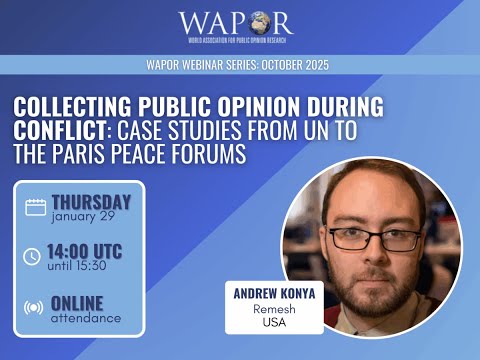
For today's #tbt, we recommend the webinar "Collecting Public Opinion During Conflict: Case Studies from UN to the Paris Peace Forums" with Andrew Konya. Watch again at youtu.be/ZHPYb1BoNgs?si… All of WAPOR's past webinars can be enjoyed at our YouTube channel!
YouTube video
YouTube
WAPOR tweet media
English
0
0
1
66
WAPOR
WAPOR@WAPOR·
As we reflect on methodologies in Public Opinion research, we recommend the Open Access Paper "Rethinking Public Opinion Studies in the Digital Era: Expert Discourse on the Theoretical and Methodological Challenges of Public Opinion Research", Read at: academic.oup.com/ijpor/article/…
WAPOR tweet media
English
0
4
11
1K
WAPOR
WAPOR@WAPOR·
As we start another week, we are pleased to share our latest Open Access paper: Politics as a Social Compass: Political Versus Lifestyle Preferences in Social Interactions by @LenkaHrbkov and Petr Voda from @MasarykUni Read the full paper at academic.oup.com/ijpor/article/…
WAPOR tweet media
English
0
1
2
130
WAPOR
WAPOR@WAPOR·
The deadline for International Journal of Public Opinion Research (IJPOR) special issue "AI, Public Opinion, and Democratic Resilience" has been extended! Submit the extended Abstract by April 30th, and the full paper by June 1st Learn more at academic.oup.com/ijpor/pages/ca…
WAPOR tweet media
English
0
0
0
94
WAPOR
WAPOR@WAPOR·
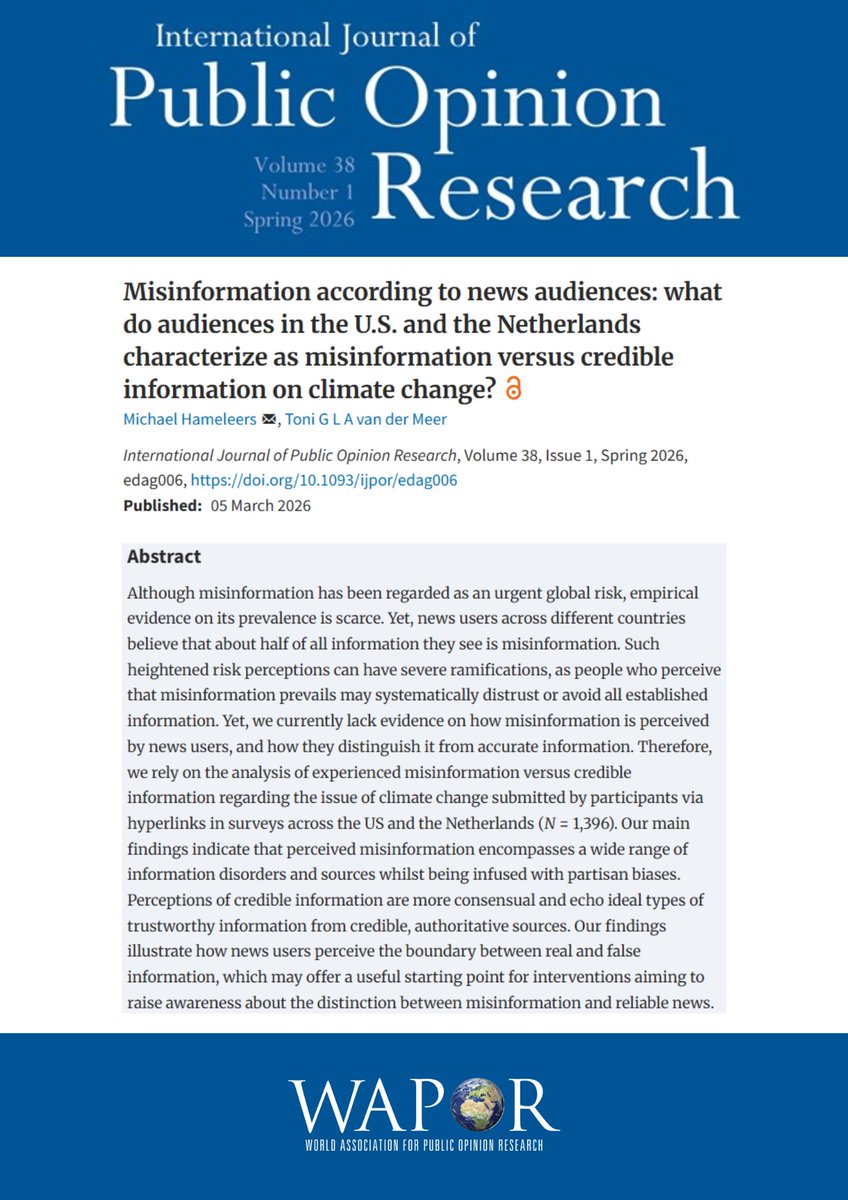
We recomment this open access artcile by Bingbing Zhang from the @uiowa, Araceli Mateos and Homero Gil de Zúñiga from @usal for your appreciation as we continue on with our Public Opinion research agenda Read at academic.oup.com/ijpor/article/…
WAPOR tweet media
English
0
1
1
141