
Sabitlenmiş Tweet
Ͼ¥βΞЯ~ШΛ⅃ΉΞ§
1.4K posts


Ͼ¥βΞЯ~ШΛ⅃ΉΞ§
@Walhes00
Cybersecurity 🛡️ • SOC • Blue Team
Earth Katılım Haziran 2022
656 Takip Edilen360 Takipçiler

Just wrapped up today’s class on Nmap and Network Security Basics and I must say it was a really good session.We went through practical Nmap scanning techniques from basic host discovery, port scanning, service version detection, to OS fingerprinting.
I also touched on how these skills connect to real network defense and why understanding your network footprint is the foundation of good security.
The students were active, asking sharp questions, and you could see the “aha” moments when they realized how much information a simple nmap command can reveal about a system.
Teaching this stuff never gets old. Seeing people move from zero knowledge to running their first meaningful scans feels fulfilling every single time.
Quick Tip from today’s class:
Always start with -sV -O for version detection and OS fingerprinting, but remember aggressive scanning without permission is illegal. Use it responsibly on networks you own or have explicit permission to test.
This was a fun time for me doing one of the things thats literally gives me joy and happiness :)



English
Ͼ¥βΞЯ~ШΛ⅃ΉΞ§ retweetledi

THE 2026 NETWORKING ROADMAP
If I were starting networking from zero today, this is the path I’d follow.
It’s a personal roadmap based on what’s working for me and what I plan to learn next. Adjust it to fit your goals.
{THREAD}
𝐇𝐚𝐦𝐳𝐚 | Network Engineer (Aspiring)@Hamzaonchain
Networking is the backbone of tech. Who wants a step-by-step guide to learn it in 2026?
English
Ͼ¥βΞЯ~ШΛ⅃ΉΞ§ retweetledi

If you're looking to specialize as a Blue Team SOC Analyst, here are some great resources to get started! Each of these platforms offers courses and labs to help you practice and develop your skills:
1. Security Blue Team - [Introduction to Threat Hunting](https://www•securityblue•team/courses/introduction-to-threat-hunting): Learn the essentials of threat hunting with practical labs.
2. Microsoft Certifications - [Security Operations Analyst Certification](https://learn•microsoft•com/en-us/credentials/certifications/security-operations-analyst/?practice-assessment-type=certification): Earn a certification that focuses on security operations, ideal for SOC roles.
3. Splunk - [Free Courses Overview](https://www•splunk•com/en_us/training/free-courses/overview.html): Splunk provides several free courses to help you build skills with this popular tool in threat detection and response.
4. Let's Defend - [Hands-on Training Platform](https://app•letsdefend•io/training): Practice with real-world labs that simulate SOC scenarios, helping you to build incident response and threat hunting skills.
5. Juniper Networks - [Juniper Open Learning](https://learningportal•juniper•net/juniper/user_activity_info.aspx?id=JUNIPER-OPEN-LEARNING&referral=sandraliu): Gain hands-on experience with Juniper's security solutions and network defense.
[copy and paste in browser replace “•” with “.”]
These resources cover the fundamentals and advanced skills needed to become proficient in a SOC analyst role. Dive in and take advantage of these labs to practice and grow your expertise.
English

A network technician can ping a server by its IP address but cannot connect using its hostname (e.g., myserver.local). Which service is most likely failing?
A) DHCP
B) ARP
C) DNS
D) NAT
English
Ͼ¥βΞЯ~ШΛ⅃ΉΞ§ retweetledi

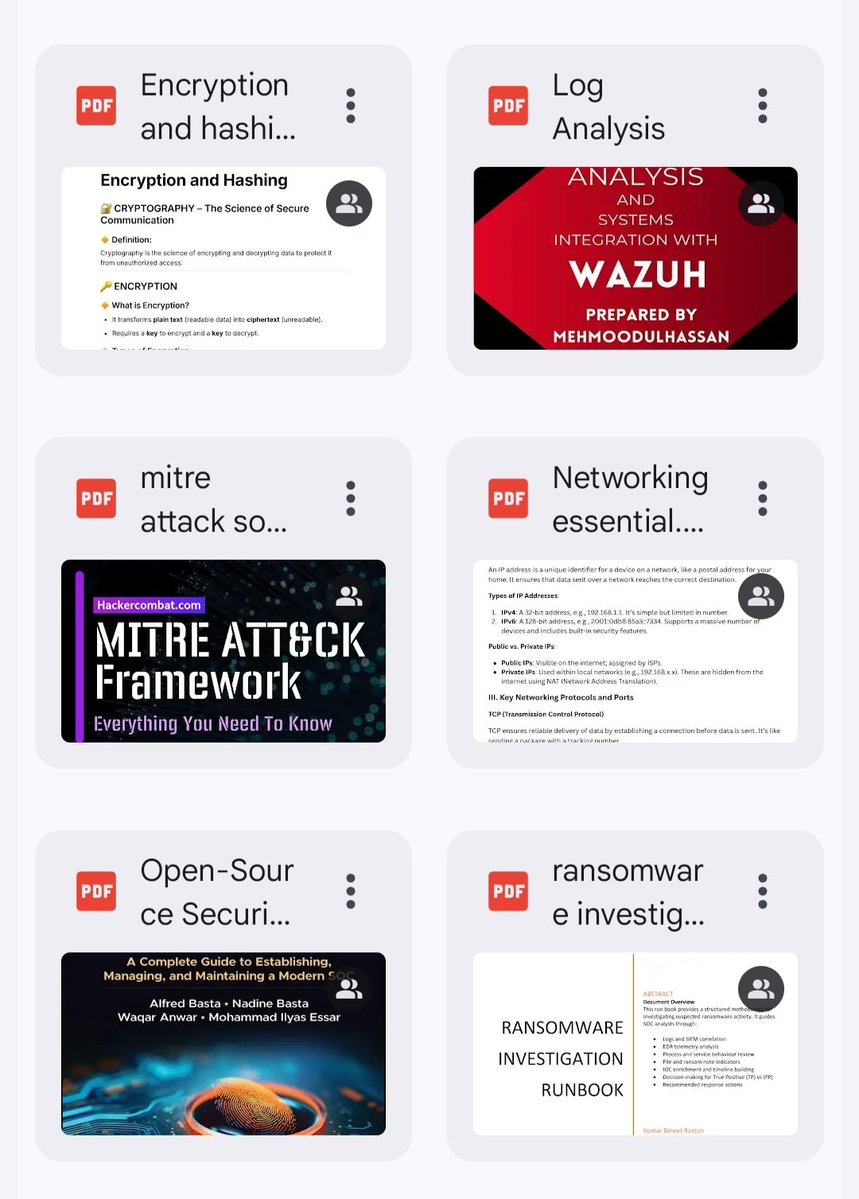
🔥 SOC Analyst & Blue Team PDF Collection — From Networking to Threat Detection
(Splunk • Wazuh • MITRE ATT&CK • SIEM • SOC Tools • CCNA • Threat Hunting • Incident Response)
This collection covers practical Blue Team and SOC fundamentals:
• Splunk Queries & Commands
• SOC Analyst Notes & Interview Q/A
• Wazuh Log Analysis
• MITRE ATT&CK Framework
• Threat Intelligence Basics
• SIEM & EDR Concepts
• Ransomware Investigation
• Encryption & Hashing
• Cisco SD-WAN & CCNA Notes
• Open-Source SOC Setup
• Networking Essentials
• Incident Detection & Log Analysis
⚠️ PDFs alone won’t get you a SOC job.
You still need: • Hands-on labs
• Log analysis practice
• Splunk/Wazuh setup
• Windows & Linux fundamentals
• Networking clarity
• Consistent alert investigation practice
📥 Free PDF Collection:
drive.google.com/drive/folders/…
#SOCAnalyst #BlueTeam #CyberSecurity #MITREATTACK #SIEM #CCNA #IncidentResponse #threatintel



English
ISC2 Bootcamp for Cybersecurity enthusiasts 👇👇
CyBlack@Cyblackorg
Are you passionate about cybersecurity but unsure where to begin? We’ve partnered with ISC2 to offer a structured cybersecurity bootcamp designed to help you start your journey & set you up for success. Register here to be shortlisted for the bootcamp:👇🏾 docs.google.com/forms/d/e/1FAI…
English
Ͼ¥βΞЯ~ШΛ⅃ΉΞ§ retweetledi

Everyone talks about becoming a SOC Analyst…
but very few people talk about the TOOLS that actually make a SOC work 👀
If you really want to break into Blue Teaming, learn these:
• Wazuh → beginner-friendly SIEM
• Splunk → enterprise favorite
• Elastic Security → powerful log analysis
• Security Onion → full SOC lab experience
• Wireshark → packet investigation
• VirusTotal → IOC/threat analysis
Security Onion is honestly one of the craziest free tools to learn with.
It’s basically a SOC-in-a-box:
✔️ SIEM
✔️ IDS/IPS
✔️ Threat Hunting
✔️ Packet Capture
✔️ Network Monitoring
Most beginners think cybersecurity is just hacking…
Meanwhile real SOC analysts spend hours:
investigating alerts
reading logs
tracing attacker activity
analyzing traffic
Learn the tools.
That’s where the real skill starts.
English
Ͼ¥βΞЯ~ШΛ⅃ΉΞ§ retweetledi
Thinking of starting cybersecurity but don’t know when to begin a virtual internship?
Start sooner than you feel ready.
Here’s the simple roadmap:
Step 1: Basics
Learn what cybersecurity is, basic networking, and how the internet actually works.
Step 2: One Core Skill
Pick ONE: • SOC / Blue Team (logs, alerts, SIEM)
• Networking basics
• Linux fundamentals
Don’t try to learn everything.
Step 3: Start a Virtual Internship (Immediately after basics)
Yes, this is where most beginners hesitate.
But virtual internships are for learning, not proving expertise.
You’ll learn faster inside than outside.
Step 4: Document everything
What you learned, what confused you, what you fixed.
That’s what builds your profile.
Truth is:
You don’t “qualify” for internships in cybersecurity.
You grow through them.
Start early. Adjust while learning. Stay consistent.

English

Excited to share that I’ve officially earned the CompTIA CySA+ certification! 🎉
This achievement represents months of learning, hands-on practice, and deeper growth in:
Threat detection & analysis
Security operations (SOC)
Incident response
Vulnerability management
Log analysis & threat hunting
Defensive cybersecurity strategies
Earning CySA+ has strengthened my ability to analyze and respond to real-world cyber threats while improving my understanding of modern security operations and risk mitigation.
Grateful for the continuous learning journey and excited for the opportunities ahead in cybersecurity, SOC analysis, and incident response.
View my verified achievement from @comptia. credly.com/badges/e13e56a… via @credly
#CyberSecurity #CompTIA #CySA #SOCAnalyst #ThreatHunting #IncidentResponse #BlueTeam #SecurityOperations #CyberDefense #InformationSecurity #Tech #Certification #ContinuousLearning
English
Ͼ¥βΞЯ~ШΛ⅃ΉΞ§ retweetledi

Dark Web 101 Simple Guide to Safe Access.
Step 1 Use VPN + Tor
VPN hides Tor usage from your ISP.
Tor hides the websites you visit.
Set Tor to Safest.
Step 2. Disable JavaScript to block tracking & malware scripts.
Step 3. Don’t maximize your window
Screen size can fingerprint your device.
Step 4. Use verified .onion links
You can’t guess dark web URLs.
Step 5. Practice strict OPSEC
No personal info. No downloads.
Anonymity online is only as strong as your smallest mistake.
English
The free @ISC2 Certified in Cybersecurity (CC) exam offer ends on May 20, 2026.
The exam normally costs $199, but you can still register & claim it for free before deadline.
A solid entry point for anyone looking to start a career in cybersecurity. 🔐
isc2.org/landing/1mcc

English
Calling all cybersecurity professionals: Analysts, Engineers, and Architects.
Join our community group by dropping a 🛡️ if interested!
English

If you are any of these:
Cybersecurity Engineers
Software Developers
Web Developers
Mobile App Developers
Data Scientists
Cloud Engineers
DevOps Engineers
IT Support Specialists
System Administrators
Project Managers (Tech)
UI/UX Designers
Product Designers
Digital Marketers
Say Hi and let's connect😊
English

Proud to have completed my Cyblack cybersecurity internship covering ethical hacking, cloud security, SOC operations, threat intelligence, and GRC.
Grateful for the hands-on learning experience and excited to keep building in cloud security.
@ireteeh @Cyblackorg @thariskyjohn

English
Looking to connect with:
cloud engineers,
SOC analysts,
cybersecurity students,
threat intelligence analysts,
and security architects.
English
SOC Analyst Roadmap 👇👇
Gabriel Odusanya • WoTxOSec@gabbytech01
🚨 Aspiring to break into cybersecurity on the defensive side? If you're a beginner looking to become a SOC Analyst, Security Analyst, or build Blue Team skills, this clear roadmap is exactly what you need. In the video, I cover: • What Blue Team cybersecurity really is • Starting with foundational concepts and TryHackMe labs • Key skills: log analysis, threat detection, incident response, and security monitoring • Practical resources to gain hands-on experience Defense is just as critical (and in high demand) as offense. Whether you're switching careers or just starting out, this guide will help you build a strong foundation. Watch the full video: youtu.be/TR6u0HCHzQc?si… What’s your biggest challenge getting into cybersec? Drop a comment below! 👇
English
Ͼ¥βΞЯ~ШΛ⅃ΉΞ§ retweetledi
SIEM dashboards look complicated until you stop trying to understand EVERYTHING at once.
Here’s the truth:
Most beginners open a SIEM and immediately get overwhelmed by:
• Thousands of logs
• Red alerts everywhere
• Weird IP addresses
• Endless tabs and graphs
But experienced analysts don’t read everything.
They follow patterns.
A simple way to navigate a SIEM faster:
1. Start with the alerts panel
Don’t jump into raw logs first. Focus on high-severity alerts and understand WHY they triggered.
2. Learn the “normal” behavior
You can’t spot suspicious activity if you don’t know what normal traffic looks like.
3. Focus on 4 things:
• Source IP
• Destination IP
• Username
• Timestamp
Those 4 details solve more investigations than people think.
4. Trace the timeline
Good analysts think like detectives:
“What happened before this alert?”
“What happened after?”
5. Don’t memorize every query
Understanding the logic matters more than memorizing SPL or KQL syntax.
6. Use dashboards for visibility, not panic
A dashboard is there to help you prioritize, not stress you out.
The fastest way to understand SIEM dashboards:
Use them daily.
At first it feels chaotic.
Then patterns start repeating.
Eventually, you’ll open a dashboard and instantly know where to look.
That’s when real analyst thinking begins.

English
Ͼ¥βΞЯ~ШΛ⅃ΉΞ§ retweetledi
One of the hardest parts of learning cybersecurity is feeling like you’re behind everyone else.
You scroll online and see people:
• Passing certifications
• Building home labs
• Getting internships
• Posting technical writeups
Meanwhile you’re still trying to fully understand networking.
But honestly?
Progress in cybersecurity is rarely loud in the beginning.
Most growth happens quietly:
• Watching tutorials at night
• Taking notes nobody sees
• Failing labs
• Retrying again
Don’t underestimate small progress.
It compounds.
English
Ͼ¥βΞЯ~ШΛ⅃ΉΞ§ retweetledi
Before you apply for SOC jobs, master these 3 skills first:
1. Log Analysis
If you can’t read logs, you can’t investigate attacks.
Learn how to spot:
Failed logins
Suspicious IPs
PowerShell abuse
Unusual authentication patterns
Endpoint activity
Logs tell the real story.
2.Networking Fundamentals
You don’t need CCNA-level mastery first, but you MUST understand:
IP addressing
Ports & protocols
DNS
TCP/UDP
HTTP/HTTPS
How traffic flows
Most cyber attacks move through networks.
3.Incident Investigation Mindset
SOC isn’t just “monitoring alerts.”
It’s:
Thinking critically
Connecting events together
Identifying what’s normal vs abnormal
Asking the right questions under pressure
Tools can be taught.
Analytical thinking is what separates good analysts from alert clickers.
Too many beginners focus only on certifications.
Real SOC teams want people who can investigate, communicate, and think.
Master these 3 first, and you’ll already be ahead of most applicants. 🔥
English