The real unlock here isn't the skills spec, it's that your notes become the agent's context window. We've been running something similar in production and the difference between an agent with access to your actual decision history vs. one starting cold is night and day. Curious how it handles vault-level permissions when multiple agents are writing concurrently.
THE CREATOR OF OBSIDIAN JUST TURNED YOUR NOTE VAULT INTO AN AI AGENT.
Not a plugin.
Not an integration.
A full agent skills system that teaches Claude Code, Codex, and OpenCode to READ, WRITE, and REASON inside your Obsidian vault like a power user.
27,000 GitHub stars in days.
Here is what shipped at launch:
obsidian-markdown — wikilinks, embeds, callouts, properties, the full Obsidian flavor Claude now understands natively.
obsidian-bases — Claude can create .base files with views, filters, formulas, and summaries.
json-canvas — Claude builds .canvas files with nodes, edges, groups, and connections.
obsidian-cli — Claude controls your vault, develops plugins and themes directly from the terminal.
defuddle — strips web pages into clean Markdown so you stop burning tokens on clutter.
Install the whole thing in one line:
npx skills add github.com/kepano/obsidia…
Then connect it to Claude Code, Codex, or OpenCode.
That is it.
Your second brain now has an agent inside it that understands how Obsidian actually works.
Not a generic AI that pastes text into files.
An agent that knows what a wikilink is. What a callout is. What a canvas is.
Built on the open Agent Skills spec. MIT license. Free forever.
The gap between people using Obsidian as a note app and people using it as an AI operating system just got wider.
Bookmark this before you open your vault today.
Follow @cyrilXBT for every build that changes how Obsidian and Claude work together.
@_MaxBlade I honestly just act like a middle man between my max plan opus 4.7 “tuned to act more like 4.6” inside a project and my Openclaw sonnet orchestrating codex for executing/ perplexity for research. Was hitting $5-$15 with opus in Openclaw now Pennie’s - $1.50 with sonnet.
Everyone says Hermes / Openclaw is unusable without Opus 4.7
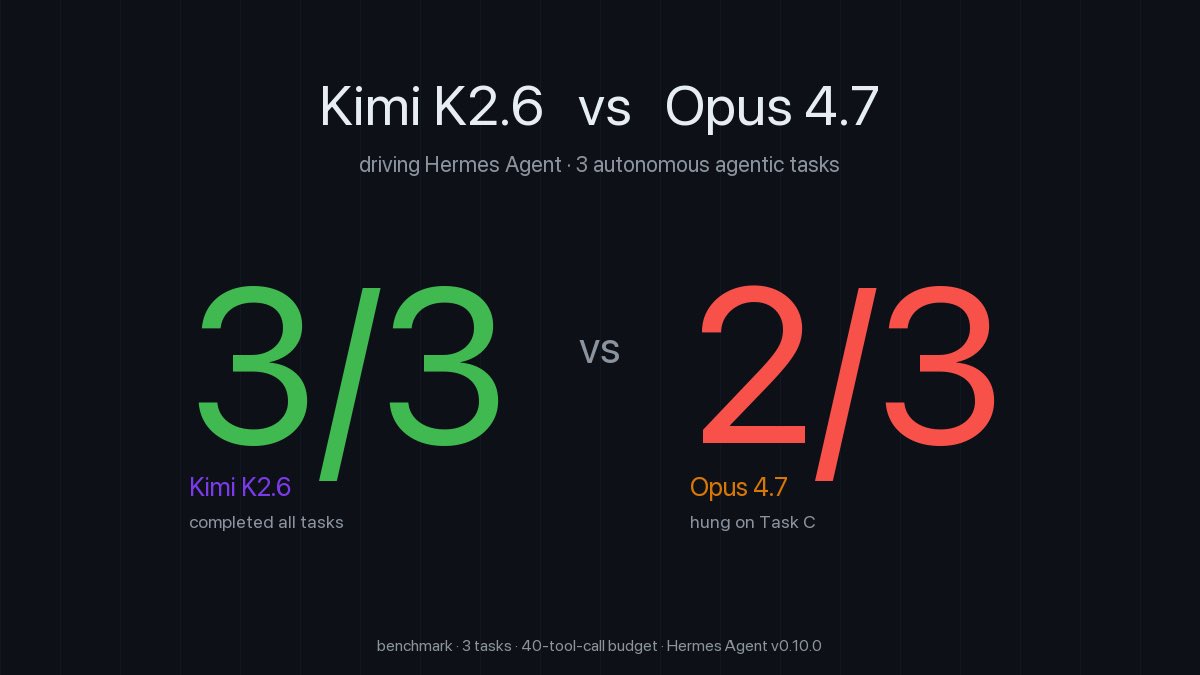
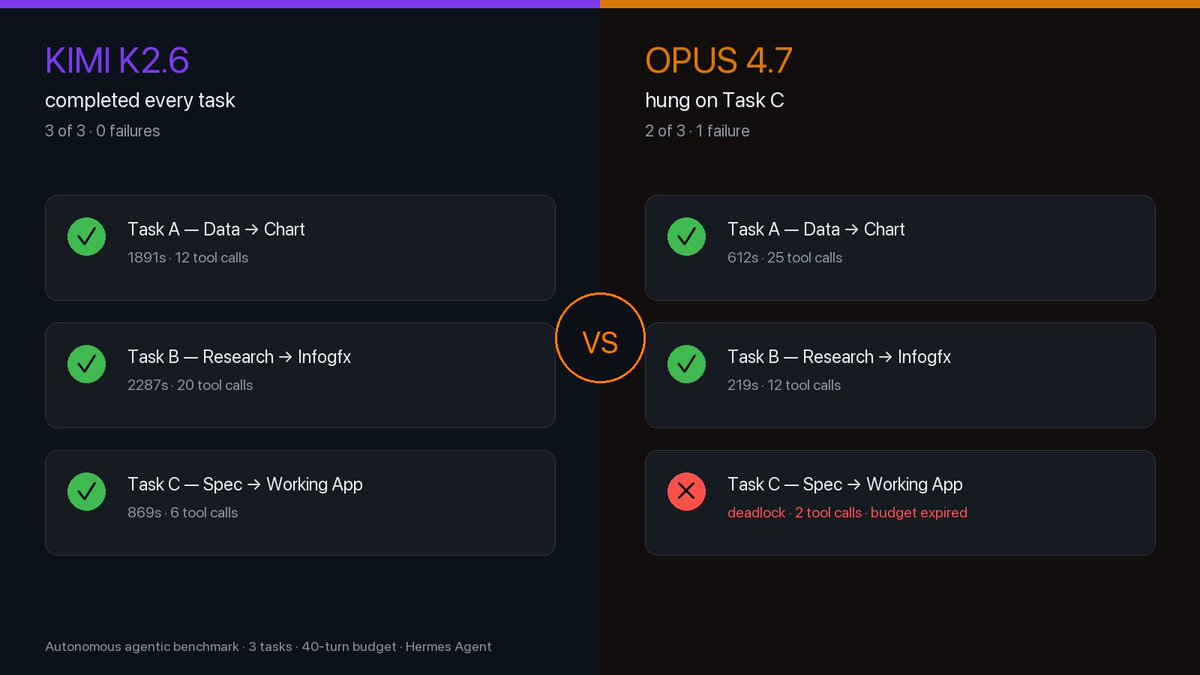
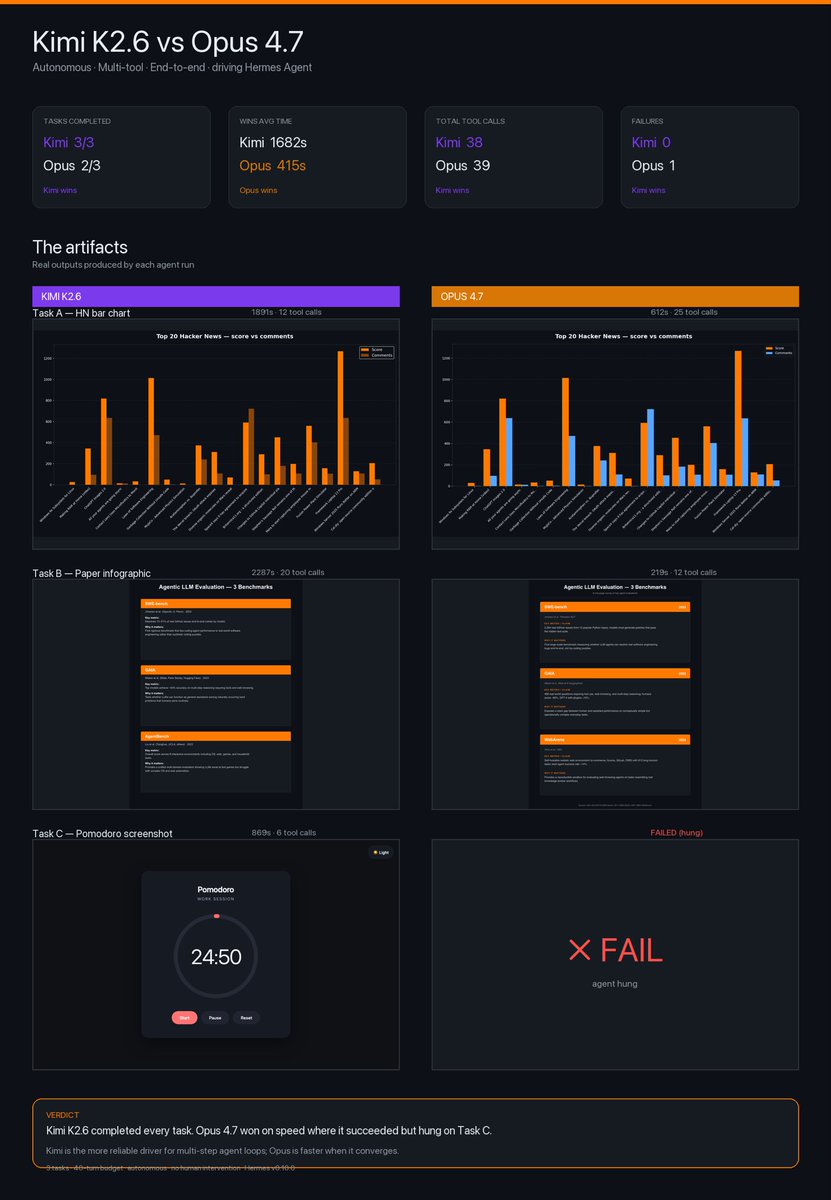
I just ran two Hermes agents head to head, one with k2.6 and one with opus 4.7, through three heavily agentic tasks with one prompt.
OPUS DID NOT COMPLETE 😳
Kimi completed all tasks.
It took 4x longer, but is 10x less expensive to run.
This is SHOCKING.
“Opus 4.7 you talk too much.”
I had to tell it “Commit fast, fix if wrong. Speed of decision + low reversal cost = momentum. Don't run like a careful engineering organization or you’ll miss the whole point”.
Hitting Claude session limits? You need token visibility.
So I built a free local dashboard that breaks down:
→ Input, output, cache reads, etc.
→ The prompts that ate the most
→ Usage per project, model, and tool
Give Claude Code the repo and it sets itself up.
I was paying $400/month for tools that Claude now does for free.
The moment I discovered MCP servers my entire stack changed.
15 servers. One AI. Zero subscriptions.
The solo builder era is just getting started.
I think I’ve found my Openclaw setup sweet spot.
Openclaw setup:
- Sonnet orchestrates, crons
- Codex codes
- Haiku heartbeats
Claude max x20
- Create like project
- project knowledge: update readme.md often daily/weekly
- opus 4.7 oath for prompting Openclaw
Tips:
1. Stay as the driver, sonnet executes, you decide.
2. Speed of decision + low reversal cost = momentum
3. Phase large builds, smaller scopes, verify between
4. Plain English beats eng. theater
5. Route prompts through opus via projects. Flat rate planning, mtrd execution
SpaceX now has over 10,000 Starlink satellites in orbit, which is honestly an absurd engineering achievement.
And no, they are not just up there freelancing and hoping for the best.
They stay separated because they are placed in organized orbital lanes, constantly tracked, and able to maneuver when needed. Starlink also uses automated collision-avoidance systems, which is how a constellation this large can operate without turning low Earth orbit into a scrapyard.
It’s already the closest thing in the world to a true work-anywhere network and they are just getting started.
FINALLY, a legit article that breaks this down in detail.
Obsidian + Claude Code = an AI that actually knows your work.
Not a generic chatbot. A real assistant with memory.
@cyrilXBT nailed it.
Most of the "agents keep breaking" problems come from one model trying to do everything with no guardrails. Separate the thinking from the coding from the research, give it persistent memory, and make it ask before it acts. Been running stable since.
- Phase gates. It builds in phases, stops at each checkpoint, and doesn't move forward without approval. No freestyling.
- A cron job runs a daily self-review at 3am. What it built, what broke, why. A second job at 3:30 checks if the first one ran. It learns from itself.