Leigh Woznick

9.1K posts

Leigh Woznick

Leigh Woznick

@Wozleigh

Middle school librarian. Amateur genealogist. YA lit freak, mystery lover, sometime writer. Tweets mine
Katılım Şubat 2013
3.5K Takip Edilen1.3K Takipçiler
Leigh Woznick
Leigh Woznick@Wozleigh·
@NealShusterman Your books ALWAYS give readers something to think about! That’s how I booktalk them😃
English
0
0
1
8
Leigh Woznick retweetledi
NealShusterman
NealShusterman@NealShusterman·
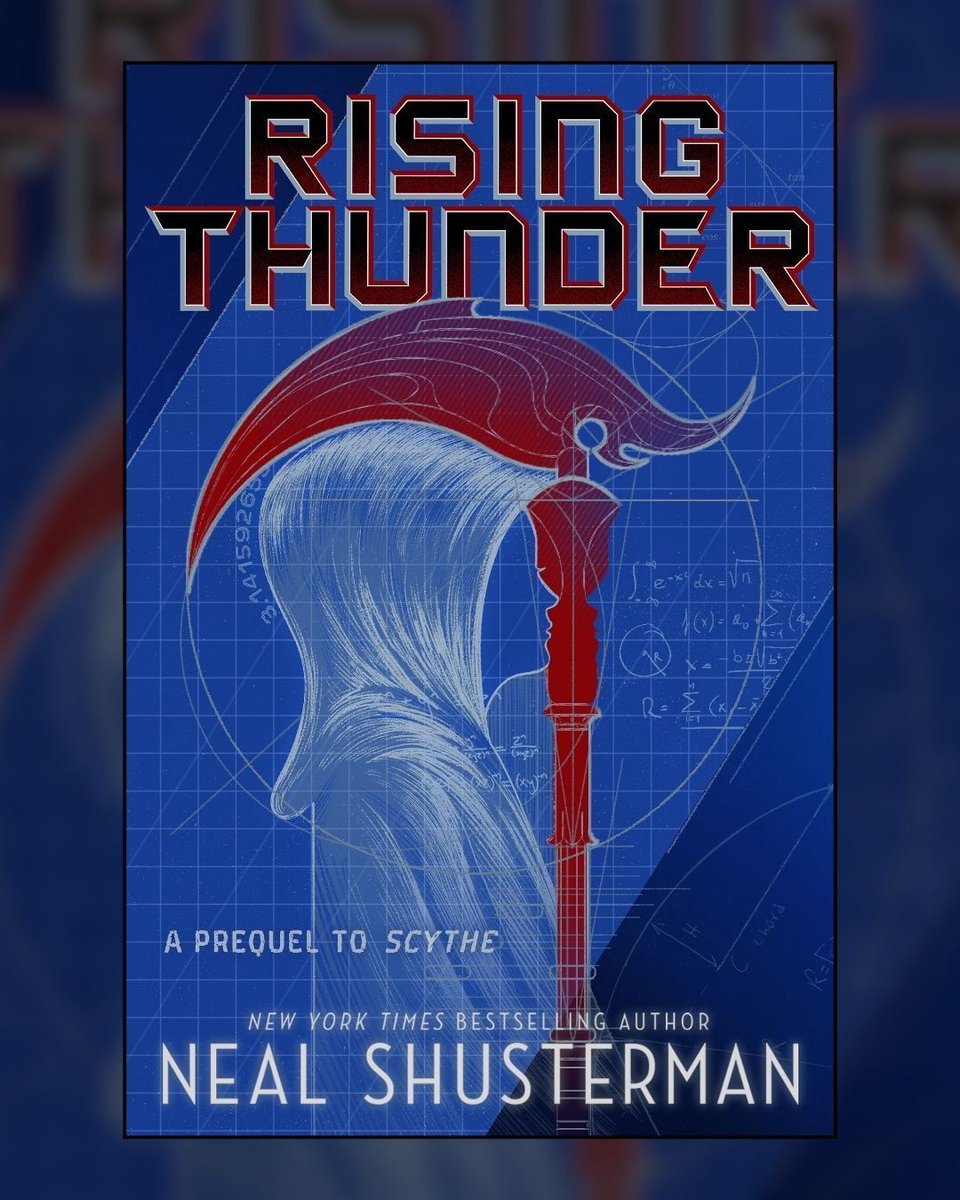
The RISING THUNDER cover reveal is here! Go check out Reactor Magazine's coverage of the premise and cover art of RISING THUNDER! Link in bio. Enjoy the sneak peek too!
NealShusterman tweet mediaNealShusterman tweet media
English
2
15
89
3.1K
Leigh Woznick retweetledi
Anish Moonka
Anish Moonka@anishmoonka·
The research behind this is wild. Your brain can’t flip from full alert to sleep like a light switch. It needs a runway. And reading builds it faster than almost anything else. A University of Sussex study found that just 6 minutes of reading cut stress by 68%, more than music (61%), tea (54%), walking (42%), or video games (21%). The effect is surprisingly physical. When you read, your nervous system shifts from fight-or-flight into rest-and-digest mode. Heart rate slows, breathing deepens, muscles release tension. The neuropsychologist who ran the study, Dr. David Lewis, described it as entering “an altered state of consciousness,” where focused imagination activates the part of your brain that tells your stress response to stand down. A 2021 randomized trial tested this directly. Researchers split nearly 1,000 people into two groups: read a book in bed for seven nights, or don’t. After one week, 42% of readers reported better sleep versus 28% of non-readers. Nothing else changed. Now compare that with what 86% of Americans actually do before bed: scroll their phones for an average of 38 minutes a night. A 2025 Norwegian study of 45,000 university students found that every additional hour of screen time in bed raised insomnia risk by 59% and cut sleep by 24 minutes. A separate American Cancer Society study of 122,000 adults found daily screen use before bed was tied to 50 fewer minutes of sleep per week. Screens hit you with two sleep-blockers at once. Blue light suppresses melatonin, the hormone that tells your body it’s time to sleep, by about 50% according to a Harvard study. But the bigger problem is the content itself. News, social media, work emails, all of it fires up your brain’s threat-detection mode and spikes your stress hormones right when they’re supposed to be at their lowest point of the day. A physical book sidesteps both problems entirely. The long game matters too. A Yale study tracked 3,635 adults over 12 years and found that people who read 3.5+ hours per week were 23% less likely to die during the study. That worked out to living roughly 2 years longer, regardless of gender, wealth, or education. Books beat newspapers and magazines. The researchers pointed to deep, sustained reading creating a kind of workout for the brain that protects it as it ages. So the 5-10 minutes he’s describing? The science says 6 minutes is the threshold where your body starts winding down. His brain is switching off its stress response and easing into a state where sleep becomes almost automatic.
Mayne@Tradermayne

Reading before bed has improved my sleep hygiene more than anything else. 5-10 mins of a book in bed and I’m out like a light no matter what I’ve done before.

English
48
835
6.5K
657.9K
Leigh Woznick retweetledi
Smithsonian Magazine
Smithsonian Magazine@SmithsonianMag·
Since the 1930s, mass-market paperbacks have been beloved for making reading accessible. bit.ly/4ksqpnY
English
3
33
44
2.1K
Leigh Woznick retweetledi
Anish Moonka
Anish Moonka@anishmoonka·
Went down the rabbit hole on this. Your brain treats a physical book like a landscape. It builds a spatial map of the text, the same way it maps trails, rooms, and city blocks. When you scroll on a phone, that map breaks apart. Seven large-scale research reviews and direct brain scans confirm what you already feel. A 2023 study in PLOS ONE attached brain-activity sensors to children’s heads while they read the same text on paper and on screen. Paper reading produced fast brain waves, the pattern linked to focused attention. Screen reading shifted the brain into slow waves, the pattern linked to mind wandering and daydreaming. Same kids. Same words. Measurably different brain states. A separate 2022 study from Showa University in Japan scanned the front of the brain, the area that manages focus and comprehension, during phone versus paper reading. Smartphones sent that region into overdrive, meaning the brain was straining just to keep up with basic processing. Paper reading produced a moderate load that triggered natural deep breathing, which helped regulate brain function and sustain focus. The phone suppressed that breathing pattern entirely. Since 2017, researchers have published seven major reviews combining hundreds of individual studies. Six of seven reached the same conclusion: people understand less on screens. A 2018 review of 54 studies and 170,000+ participants, literally titled “Don’t throw away your printed books,” found paper outperformed screens across the board for non-fiction. A 2024 follow-up with 49 more studies confirmed it. The gap has grown steadily every year since 2001. Being a “digital native” doesn’t help. The best explanation is how your brain tracks where you are. Your short-term memory can only juggle about 7 things at once. A physical book gives you constant location cues: the weight shifting from right hand to left, where a paragraph sits on the page, how thick the remaining pages feel. Your brain hands off the “where am I in this text?” job to those physical signals, leaving more room for actually understanding what you’re reading. On a phone, every screen looks identical. Your brain has to track position and process meaning at the same time, and something gives. A Norwegian eye-tracking study analyzing 25,000+ individual eye movements found screen readers processed text more shallowly. The students had no idea they were reading differently. In 2019, nearly 200 reading scientists from 30+ countries signed an open letter warning that screen reading was degrading deep comprehension. Since then, Scandinavian countries, among the most digitized school systems on Earth, have started putting physical books back in classrooms.
shree🪄@Goldensky0

reading books on a phone and reading paperback books are two different things
English
144
2.1K
9.5K
1.5M
Leigh Woznick retweetledi
Industrial Light & Magic
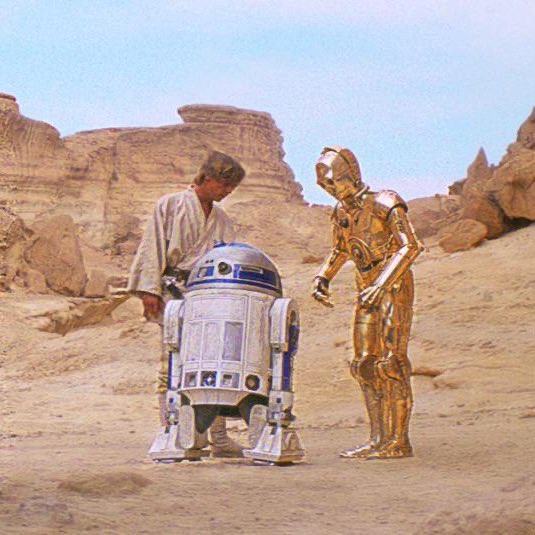
50 years ago on March 22, 1976, Star Wars began filming in Tunisia. Among the shots captured were the first attempts at Luke Skywalker's view of the iconic twin sunset. Although that first day's sunset shots were not ultimately used, they marked the first live action plate photography ever captured for Industrial Light & Magic, who would be tasked with adding the suns to the background. ILM was less than a year old that spring of '76, and were busily preparing their visual effects pipeline at their Van Nuys, California studio. Read more here: starwars.com/news/star-wars…
Industrial Light & Magic tweet mediaIndustrial Light & Magic tweet mediaIndustrial Light & Magic tweet media
English
15
644
2.5K
80.2K
Leigh Woznick retweetledi
DiscussingFilm
DiscussingFilm@DiscussingFilm·
50 years ago today, ‘STAR WARS’ began filming.
DiscussingFilm tweet mediaDiscussingFilm tweet media
English
405
9.7K
79K
4.4M
Leigh Woznick retweetledi
Anish Moonka
Anish Moonka@anishmoonka·
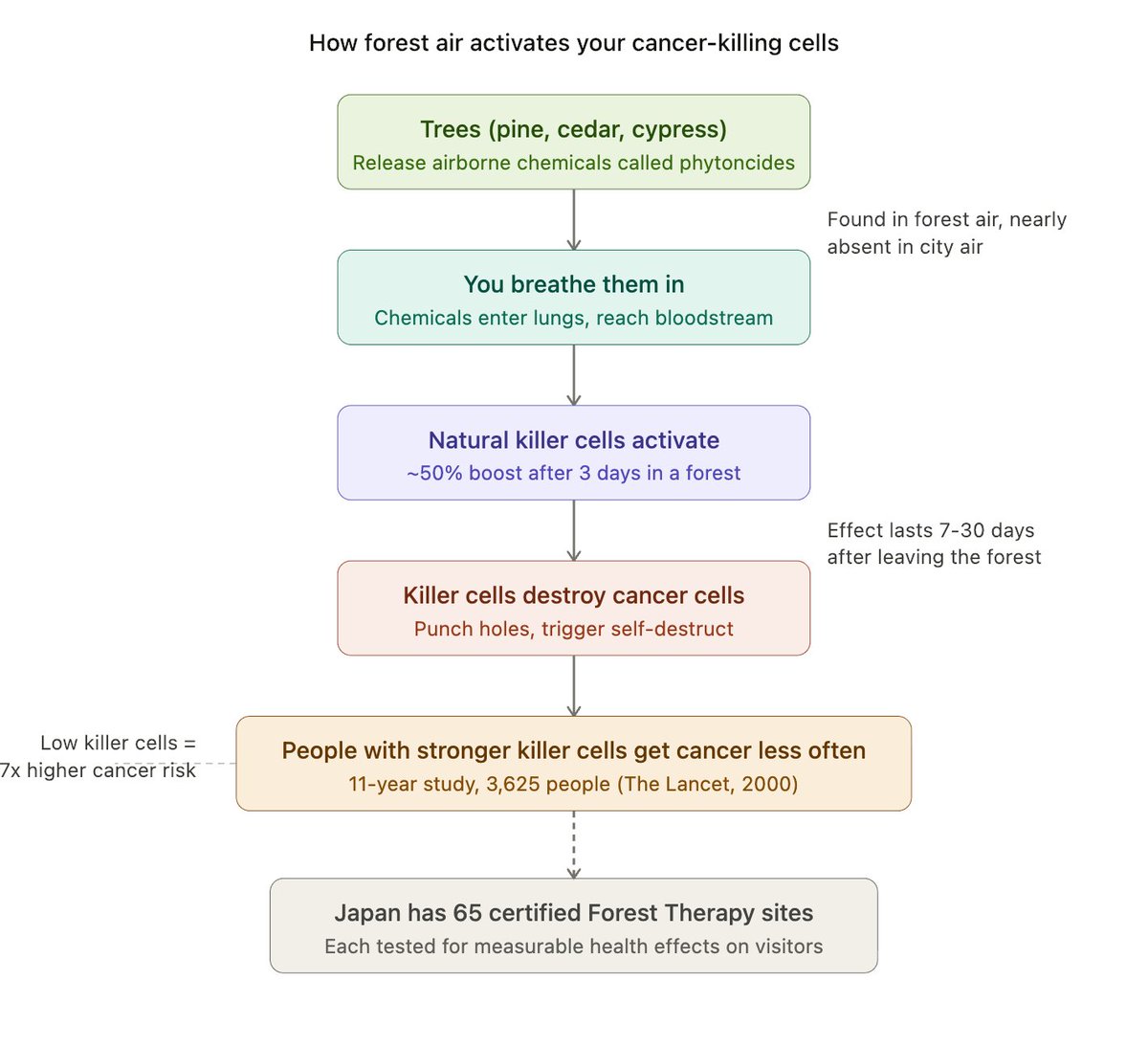
Trees release invisible chemicals into the air to protect themselves from bugs and disease. Turns out those same chemicals also switch on your body's cancer-fighting cells. They're called natural killer cells. They're a type of white blood cell that patrols your bloodstream looking for cancer cells and virus-infected cells. When they find one, they punch a hole through its outer wall and inject proteins that force the cell to self-destruct from the inside. You're born with them. Unlike most of your immune system, they don't need to be "trained" on a specific threat first. They just attack anything that looks wrong. The 50% number in this tweet comes from Dr. Qing Li at Nippon Medical School in Tokyo, who has been studying the effects of forests on the human body since 2004. His original 2007 study took 12 men on a 3-day, 2-night forest trip, walking two hours a day. Blood tests showed 11 of 12 had roughly 50% more cancer-killing cell activity afterward. A follow-up with 13 female nurses found the same thing. But the part the tweet leaves out: the boost didn't vanish when they went home. It lasted over 7 days in both groups, and in men, it was still detectable in blood work 30 days later. Li's conclusion is that one forest trip per month could keep these cells running at a higher level year-round. The obvious next question is whether it's the forest itself or just the vacation. Li tested this directly. A separate group took a city tourist trip with the same amount of walking. No boost to killer cells. No stress hormone drop. Zero effect. Then he ran an even more controlled test: 12 men stayed in a regular Tokyo hotel room for three nights while a humidifier pumped tree oil (from Japanese cypress) into the air overnight. Their killer cells still went up. Their stress hormones still dropped. That isolates the cause to those tree chemicals, called phytoncides. Pine, cedar, and cypress trees release the most. These chemicals were found in forest air but were nearly absent in city air. A 2021 lab study showed that one of these tree chemicals directly switches on killer cells and slows colon tumor growth in mice. The bigger picture connects these cells directly to cancer risk. An 11-year study published in The Lancet (one of the world's top medical journals) tracked 3,625 Japanese people and found that those with weaker natural killer cells developed cancer at significantly higher rates. A separate study screening for bowel cancer found that people with low killer cell levels were 7 times more likely to be diagnosed. Li's own research across all 47 regions of Japan showed that areas with less forest had higher cancer death rates for lung, breast, uterine, prostate, kidney, and colon cancers, even after accounting for differences in smoking rates and wealth. The caveats: Li's original studies used small groups (12 and 13 people), and the regional data show a pattern but don't directly prove that forests prevent cancer. No large-scale clinical trial has confirmed that yet. But the chain is consistent: trees release chemicals, those chemicals wake up the cells in your blood that kill cancer, the effect lasts weeks, not hours, and people with more active killer cells get cancer less often. Japan now has 65 government-certified Forest Therapy sites across the country, each tested and approved based on the physical effects they have on visitors.
Anish Moonka tweet media
All day Astronomy@forallcurious

🚨: Research suggest that just 3 days of camping in the forest can increase the production of cells that kill cancer by more than 50%.

English
37
957
3.8K
283.2K
Leigh Woznick retweetledi
Anish Moonka
Anish Moonka@anishmoonka·
Part 2. Yale tracked 3,635 people over the age of 50 for 12 years. People who read books for more than 3.5 hours a week lived 23 months longer than people who didn’t read at all. A 20% drop in mortality risk. From sitting on a couch with a book. They controlled for age, sex, race, education, wealth, health status, and depression. The gap held across every single one. It only worked for books, though. Newspapers and magazines barely moved the needle. The researchers traced it to something specific: books force your brain to hold characters, plotlines, and ideas in memory at the same time and connect them across hours or days. That kind of sustained mental effort builds cognitive reserves that magazines and news articles simply don’t demand. A University of Sussex study found that just 6 minutes of reading cut stress levels by 68%. That beat listening to music (61%), drinking tea (54%), and going for a walk (42%). The cognitive neuropsychologist who ran it, David Lewis, said it works because reading locks the mind onto a single narrative, which slows heart rate and eases muscle tension. Your brain can’t spiral about your inbox when it’s tracking a plot. A 2013 study published in Science tested whether reading literary fiction improves your ability to read other people’s emotions. Five experiments. All showed the same thing: people who read literary fiction scored higher on emotion-recognition tests than people who read nonfiction, genre fiction, or nothing at all. The theory is that literary fiction presents complex, unpredictable characters who train your brain to decode real human behavior. Fair caveat: later replication attempts got mixed results, so the single-session effect is still debated. But the broader correlation between fiction reading and social cognition has held up across multiple independent studies. Reading on physical paper may matter more than you’d expect, too. Six out of seven meta-analyses have found that people comprehend text better on paper than on screens. Researchers call it the “screen inferiority effect.” Scrolling fragments attention and strips away physical cues (page thickness, text position) your brain uses to build a mental map of the material. A Norwegian eye-tracking study caught something unsettling: students reading on screens processed text more shallowly than paper readers. They didn’t even realize they were doing it. Part 1 covered the brain rewiring. This is the rest of the picture. Books cut stress faster than a walk. They may add nearly two years to your life. They sharpen your ability to read the room. And paper beats screens in 6 out of 7 studies for actually understanding what you read. Six minutes a day is where it starts.
English
15
145
712
59.1K
Leigh Woznick retweetledi
Anish Moonka
Anish Moonka@anishmoonka·
Scientists put kids through 100 hours of reading, then scanned their brains. New wiring had physically grown inside the language regions. Communication between brain areas sped up by a factor of 10. Kids who didn't read showed zero change. That was a 2009 Carnegie Mellon study. It gets wilder. In 2013, Emory University scanned 19 students every morning for 19 straight days while they read one novel chapter each night. Mornings after reading, the brain areas responsible for understanding other people's emotions lit up with new connections. So did the region that processes physical sensation. Their brains were simulating what the characters felt, as if it were happening to them. Those changes stuck around for 5 days after they finished the book. Now flip to scrolling. A massive review published in Psychological Bulletin last September pulled together 71 studies covering 98,299 people. Heavy short-form video use (TikTok, Reels, Shorts) showed a clear pattern: worse attention, weaker self-control, and more anxiety. Consistent across teenagers and adults, across every platform tested. Oxford didn't name "brain rot" its 2024 Word of the Year for nothing. A 2024 brain wave study found that people hooked on short-form video had weaker activity in the front of the brain, the part that controls focus and impulse control. Separate brain scans showed the same thing: heavy scrollers had less activation in the exact regions that deep reading strengthens. UCLA neuroscientist Maryanne Wolf has been studying this for decades. Humans were never born to read. There's no gene for it. Reading is something we invented, and it hijacked neurons that were originally meant for recognizing faces. Over time, it built entirely new brain circuits connecting language, vision, and emotion. But those circuits only survive if you use them. Stop reading, and they fade. Wolf's conclusion is simple: screens built for speed produce a speed-wired brain. Books built for depth produce a depth-wired brain. One honest caveat: most of these studies are snapshots, not long-term tracking. People who already struggle to focus might just prefer short videos. But the same pattern showing up across nearly 100,000 people is hard to shrug off. The tweet repeats the line seven times. The research backs it up with brain scans, EEG data, and white-matter imaging across tens of thousands of people.
✒️@Literariium

The antidote for brain rot is books. The antidote for brain rot is books. The antidote for brain rot is books. The antidote for brain rot is books. The antidote for brain rot is books. The antidote for brain rot is books. The antidote for brain rot is books.

English
166
5.2K
25.3K
2M
Leigh Woznick retweetledi
Hedgie
Hedgie@HedgieMarkets·
🦔 Grammarly is pulling down its Expert Review feature after backlash from writers, journalists, and academics. The tool claimed to offer writing advice inspired by real experts, including people who never agreed to participate and at least one professor who died in January. Kara Swisher, whose name was used without permission, told the company to get ready for her to go full McConaughey on them. Grammarly's CEO says they're disabling the feature while they reimagine it to give experts real control over how they're represented. My Take They trained an AI on people's writing, slapped their names on it, and sold subscriptions based on the implication that you're getting advice from Stephen King or Kara Swisher. Then they buried a disclaimer in the documentation saying none of these people actually endorsed or affiliated with Grammarly. That's the whole business model. Use the reputation, deny the association, collect the $12 a month. The dead professor thing is what got everyone's attention but the living writers are just as mad. Casey Newton found an AI version of himself giving writing advice. Benjamin Dreyer pasted lorem ipsum and got tips from Stephen King. The feature didn't even work, it just pattern-matched famous names onto generic suggestions. Grammarly says they're reimagining the feature to give experts control, but the obvious version of that product is one where you ask people first. They didn't do that because most people would say no, and a feature nobody agreed to be in isn't much of a feature. The apology is about getting caught, not about the thing they did. Hedgie🤗
Hedgie tweet media
English
9
81
349
27.4K
Leigh Woznick retweetledi
Library of Congress
Library of Congress@librarycongress·
Once again, we have been so inspired by the amazing athletes at the #Olympics, we decided we needed to celebrate with Games of our own! 📚🥇🥈🥉🤓
English
4
17
88
5.6K
Leigh Woznick retweetledi
Boston Radio Watch®️
Boston Radio Watch®️@bostonradio·
“Miracle” opened at a theater near you 22 years ago today, February 6, 2004. Kurt Russell as the 1980 US men hockey team's head coach Herb Brooks in “This Is Your Time” scene.
English
68
362
3.2K
156.3K
Leigh Woznick retweetledi
NealShusterman
NealShusterman@NealShusterman·
Today is the day! Want a set? Head over to @JuniperBooks or the link in my bio!
NealShusterman tweet media
English
2
1
18
604
Leigh Woznick
Leigh Woznick@Wozleigh·
@BritBox_US I am so disappointed. gifted a year’s subscription to my retired mom for Christmas; she was thrilled! But it doesn’t work no matter what she does. Then to talk to a person she got scammed for $70??!! I paid $150 she should get help w/out paying xtra What a nightmare
English
4
0
1
66
Lori Tecler
Lori Tecler@LoriTecler·
Crochet club crew has been working hard to finish their cup cozies before winter break starts later this week. Here are a few ready to go. I gave them to go cups filled with a cocoa packet and a candy cane to make a sweet gift for them to give to someone special. #SchoolLibrary
Lori Tecler tweet media
English
5
0
14
368
Leigh Woznick retweetledi
Maria Shriver
Maria Shriver@mariashriver·
Adding your name to a memorial already named in honor of a great man doesn’t make you a great man. Quite the contrary. Putting your name on top of someone else’s doesn’t mean that people will speak of you in the same breath as the other man. Putting your name above another man’s name on his existing memorial… What is that about? Truly? What’s that about? Do you want people to speak the names as one? Dig down deep. What are you trying to say? I’m really interested. There is no other president who would do this. None. Zero. In fact, it’s not even legal. Congress named the performing arts center as a living memorial in 1964, and only congress can change that law. This will always be the John F. Kennedy Center for the Performing Art. A great man would have said to his hand picked board, “Thank you, but the building already has its name. Let it stand. Let it be. I don’t need that.” But then again…
Maria Shriver tweet media
English
5.4K
14.5K
63.3K
2M
Lori Tecler
Lori Tecler@LoriTecler·
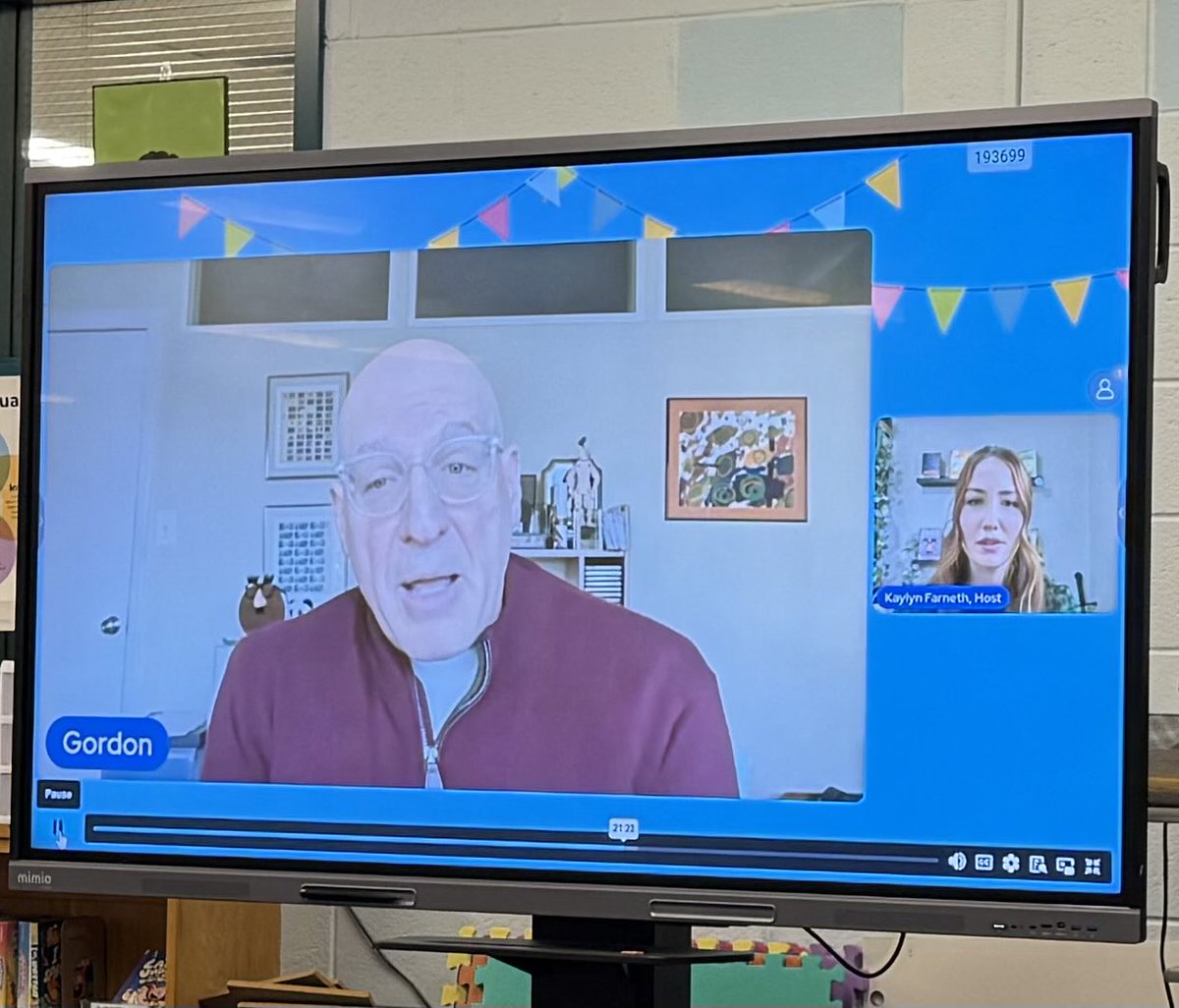
We have lots of Gordon Korman fans in 5th grade so they were excited to watch this week’s @BookBreak4Schls virtual visit to hear about RESTART & his career as an author. They gasped when they heard Ariana Grande was in the movie version of SWINDLE. #MGLit #SchoolLibrary
Lori Tecler tweet media
English
1
1
9
189
Megan Fritts
Megan Fritts@freganmitts·
One of my reading goals for 2026 is to read more plays, which historically I have not much enjoyed but I’m starting to get into now. Drop a favorite play in the comments and maybe it’ll make it into my queue!
English
556
92
2.2K
80.2K