

Maude Findlay
27.1K posts
Maude Findlay
@WriteOnMaude
health care worker, armchair social critic, compulsive retweeter. Opinions are mine.
Katılım Ekim 2012
2.8K Takip Edilen697 Takipçiler

BREAKING: Adam Hoffman has been released from jail for "good behavior."
Hoffman is the 49-year-old Waco, TX attorney who faced life without parole for repeatedly raping a young boy, until Texas AG Ken Paxton offered him 1 day in jail and no need to register as a sex offender. A judge increased his sentence to a whopping 60 days. He got out in 30 days.
This is MAGA's vision for the USA. Full story: letsaddresstexas.substack.com/p/ken-paxtons-…

English
@dabbs346 Wasn’t Susan Collins hanging out with Nazi militia members yesterday?
English

Susan Collins just disclosed taking $3,500 from this far-right New Yorker seeking to ban books in Maine
#mesen #mepolitics

Maine Public@MainePublic
The lead funder of the group sending text messages to Maine voters and claiming Democratic Gov. Janet Mills is putting controversial books in Maine schools is a GOP megadonor and head of a controversial right wing think tank: bit.ly/3DGFcrQ
English
@JakeAuch Why isn’t Collins support for mass murder disqualifying?
English

Susan Collins is a rubber stamp for the worst admin in history. Claims that I would endorse her, implicitly or otherwise, ignore my track record supporting Democrats to take back both chambers. As I said months ago, I find Platner's Nazi tattoo and his commentary about it personally disqualifying. If it were me I'd vote for someone else in the Maine Democratic primary.
Regardless of what happens in Maine, Democrats need to take back the Senate and I'll keep working hard to make it happen.
English
@SweetSavvySavio I hadn’t thought of that and I’m still reading through it but this document is definitely worthy of a study group. It does seem to favor some kind of Creative Commons licensing?
English

Did the Pope just say we need to get rid of IP?
Pope Leo XIV@Pontifex
Today, among the goods that are universally intended for everyone, we must also include new forms of property, such as patents, algorithms, digital platforms, technological infrastructure and data. In a context where the wealth of nations depends increasingly on knowledge and technology, when these goods remain concentrated in the hands of a few, without adequate forms of sharing and access, a new imbalance is created that contradicts the universal destination of goods. In turn, it widens the gap between the included and the excluded, between those who can participate in the digital revolution and those who remain on the margins. #MagnificaHumanitas
English
Maude Findlay retweetledi

Whereabouts of missing Rep. Tom Kean (R-N.J.) remain unknown, but he’s trading stocks again. From today’s @NOTUSreports newsletter:

English
Maude Findlay retweetledi
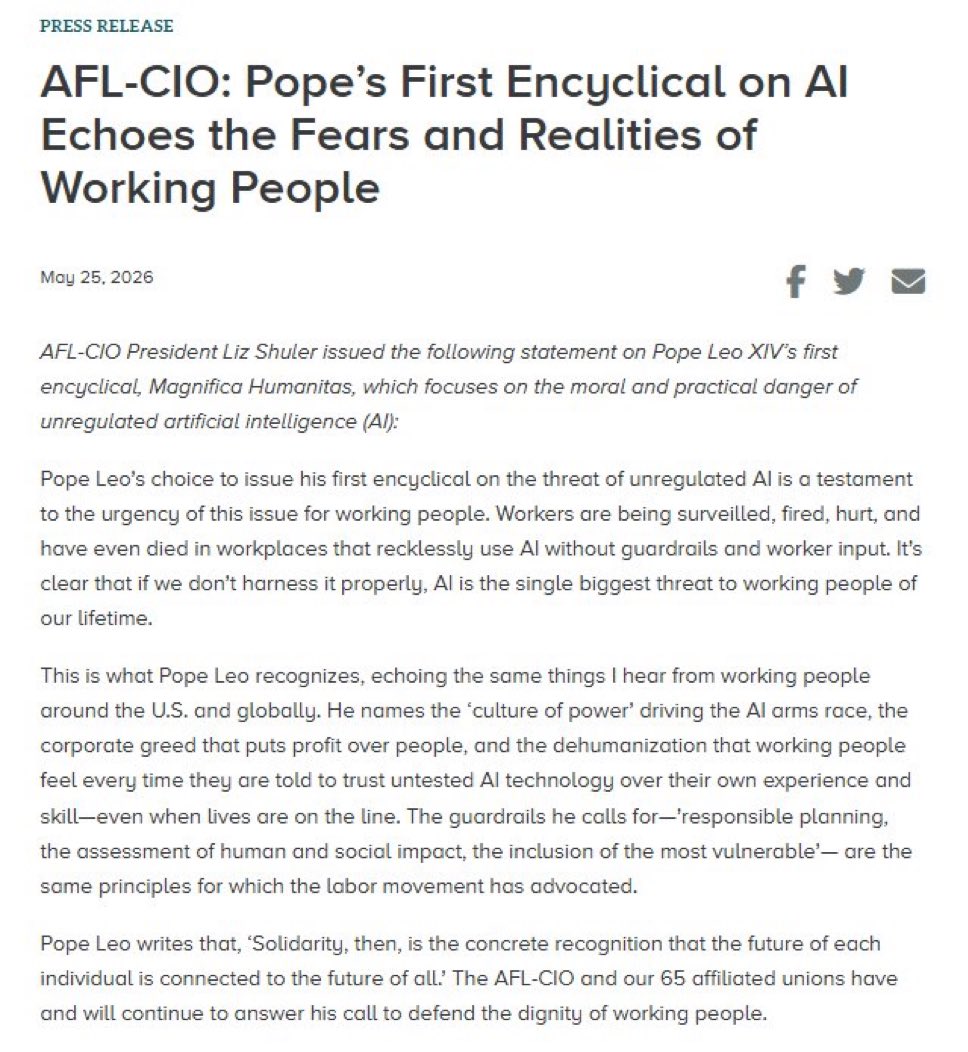
If we don’t harness it properly, AI is the single biggest threat to working people of our lifetime. Pope Leo XIV sees this, echoing the concerns I hear from working people around the U.S. and globally. He’s calling for solidarity, and unions will answer. aflcio.org/press/releases…
English
I feel it is important to address concerns regarding the recently released Encyclical Letter, “Magnifica Humanitas,” of the Holy Father Leo XIV. pillarsoffaith.net/a-catholic-dis…
English
@JLLiedl I see what you are saying. I’m just offering that Church acknowledgment of the inherent holiness in gay relationships would be an improvement.
English
@WriteOnMaude No, there is no "ameliorative" tendency re: prohibitions of same-sex relations in the Bible or patristic period. They are universally recognized as sinful.
English
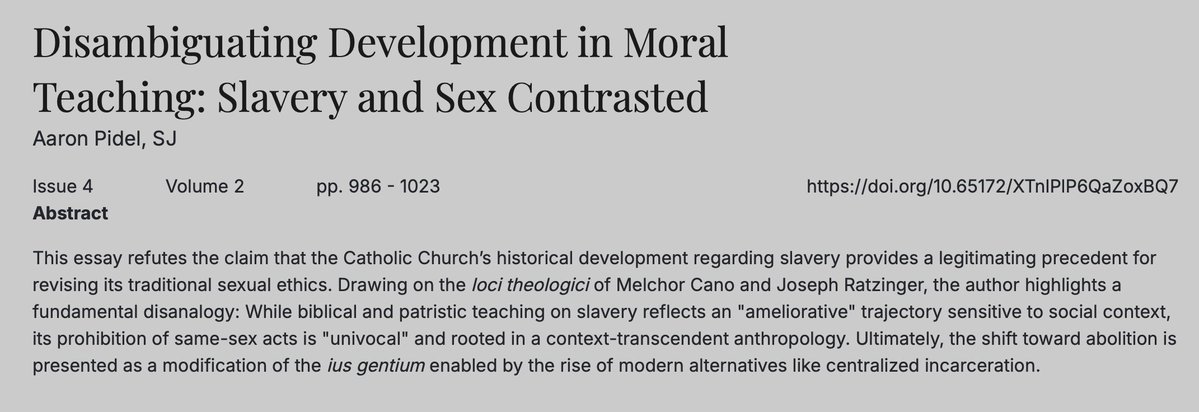
I'm gonna get ahead of some of the "if the Church changed its mind on slavery, it can change its mind on same-sex relations, too!" think pieces that are currently being typed up after today's encyclical by dropping this here:
newressourcement.wordonfire.org/article/104
English
Maude Findlay retweetledi

The Pope's humanist manifesto does something really interesting; not only does he call for new regulations and guardrails, but he also calls out what he describes as the "anti-human vision" pervasive in the tech world.
Human limitations, he argues, are not bugs in our code to be fixed or optimized. They're at the core of love, wonder, community, the shared vulnerability of being human.
charlottealter.substack.com/p/the-pope-is-…
English
Maude Findlay retweetledi

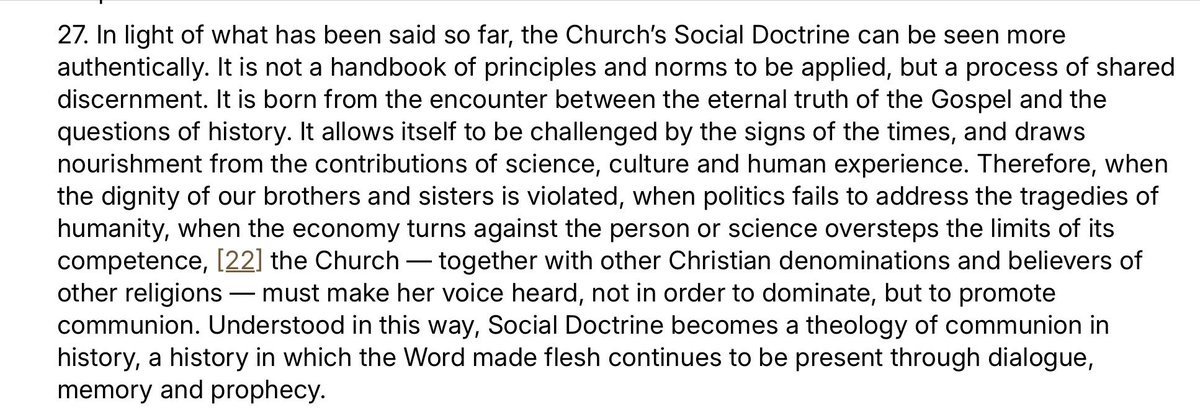
I am working my way through Magnifica Humanitas and can honestly say that the Holy Father may have permanently changed my understanding of the nature of Catholic social teaching. See, eg, paragraph 27. Though Pope Leo doesn’t cite him, this way of viewing Social Doctrine has obviously roots in Saint John Henry Newman’s (aka, Cardinal Newman) arguments on the development of doctrine. Without ever explicitly articulating it, I have always thought of Social Doctrine precisely as a set of “principles and norms to be applied.” But I now see that Leo (and Newman) offer a better way.
English
Maude Findlay retweetledi

This passage from Leo's Encyclical is perfect. Perfect.

English
Paragraph 61: “The common good is a ‘plus.’”
Joseph Nolla, SJ@josephnollasj
“Pope Leo was a math major? I wonder what his encyclicals will be like” Like this
English
Maude Findlay retweetledi
They haven’t used mercury in American vaccines for decades but the Trump administration is working to put more mercury into your water.


English
Maude Findlay retweetledi
Pope Leo called for disarming AI in his address after releasing his groundbreaking document "Magnifica Humanitas."
"Artificial intelligence needs to be disarmed," the pope said.
"The word is strong, I know, but deliberately chosen because this moment needs words capable of attracting attention, awakening consciences, and indicating paths forward for humanity. The church has long been working for nuclear disarmament, aware that every great technical power can affect people's lives and so must be accompanied by adequate moral discernment and public control."
"Nuclear disarmament remains a service to peace and the dignity of the human family. In a similar sense, artificial intelligence now demands to be disarmed, freed from logics that turn it into an instrument of domination, exclusion and death. Like nuclear energy, it must be at the service of all and of the common good. Decisions about technology must never be separated from conscience and responsibility. Let us not sleep as others do, admonished the apostle Paul. But let us keep awake. Such vigilance is necessary today. Peace, not merely the absence of war is justice at work, but when technology weakens our critical sense, peace itself is at risk," Pope Leo stressed.
"Disarming, however, is not enough. We must build," the pope stressed. "The word build reminds me of my years as a missionary in Peru. In 2017, torrential rains and floods struck the north of the country. Many families saw their homes swallowed by mud and many roads too. There, I learned that rebuilding does not mean simply replacing what has been destroyed. It means repairing bonds, restoring trust, and reawakening hope in the future."
Moreover, "no one rebuilds alone" in "Magnifica Humanitas," the pope said. "I recall the biblical prophet Nehemiah before the ruined walls of Jerusalem. He gathers discouraged people to bring about rebirth. The image of walls does not legitimize closures or divisions, but invites each and everyone to do their part. Brick by brick. A more just coexistence takes shape, capable of safeguarding the dignity of all."
The pope stressed that "Magnifica Humanitas was born from listening.
"I've listened to scientists and engineers who work with sincere enthusiasm and technologies capable of alleviating immense suffering; to political leaders and public officials who have perseveringly sought just rules; to parents and teachers who are deeply concerned for the future of younger generations."
"Other very troubling voices have also reached me about increasingly autonomous weapons systems, practically beyond any human reach to govern them effectively. I hear very troubling accounts of algorithms that can block access to health care, employment, and security on the basis of data tainted by prejudice and injustice. And I've heard the silence of those who have no voice."
"Artificial intelligence can be a construction site of history from within a horizon of communion, in which technical progress learns to serve human life," the pope said, stressing that "no one can be reduced to productivity, to cognitive performance, or to mere data."
"The person bears within him or herself a freedom, an interiority, and the vocation to love and worship that no machine can replace or block. Only with such an integral vision can artificial intelligence be directed toward the common good."
The Church, he said, "wishes with humility and frankness to be part of conversations on artificial intelligence. We do not possess the technical answers, nor do we seek to displace those with expertise. But we bring a wisdom concerning the human that our present time desperately needs."
"From this launch of Magnifica Humanitas, please take with you a commitment to stay awake and as artisans of hope, to keep on building the work site of our time."
Video: Vatican Media
English
Maude Findlay retweetledi
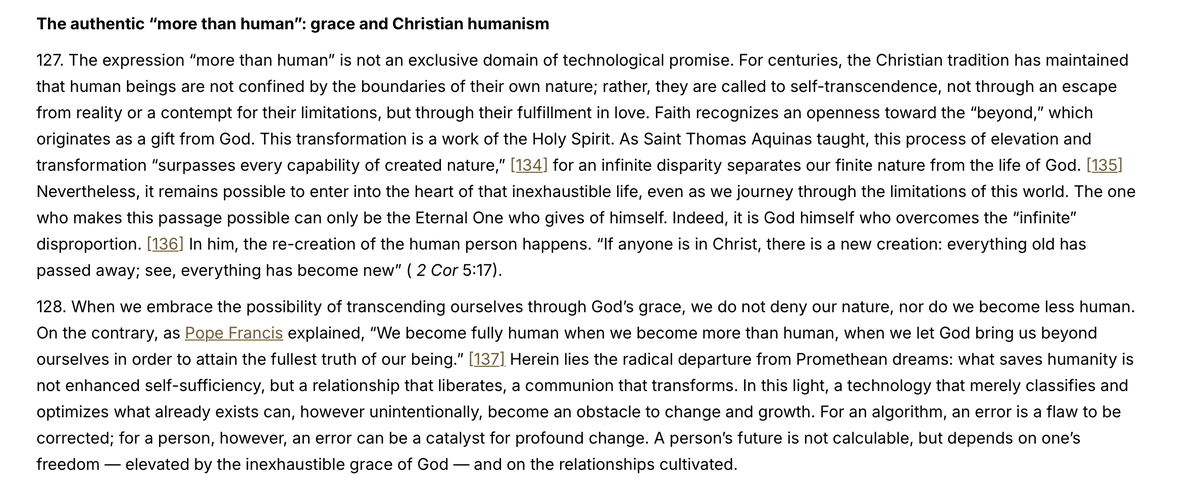
I don't know what the encyclical's impact will be on macro-level issues of AI, war, etc. But I do know persons who pick it up looking for answers to our current crises will discover an integral vision of reality (ie, below) that can transform their life if they're open to it.
English
Maude Findlay retweetledi

Pope Leo XIV called for robust regulation of artificial intelligence and for its developers to work for the common good rather than profit, issuing a sweeping manifesto on safeguarding humankind as the technology impacts everything from work to war. apnews.com/article/pope-a…
English
Maude Findlay retweetledi
"Magnifica Humanitas," Pope Leo's first encyclical on safeguarding a human person in the time of artificial intelligence is more than an encyclical on AI. It's a "chapeau bas" to humanity. A tribute to human intelligence, the way humans think and communicate, and a call to safeguard human decisions, conscience and emotions in the time when AI furiously invades all human spaces, from schools to warzones.
There is more in it than any Tweet is able to digest, but here are my takes - directly in Pope Leo's quotes I highlighted fervently reading through the document. The encyclical is a little over 42,000 words - here is a "3,000 words" take on - mostly "best quotes" of Leo. I think they're enough to encourage anyone to read that groundbreaking encyclical. It's only a social media post, and overview of what was said in the encyclical in a very subjective way of the the Catholic reader.
The encyclical brings to the world two contradictory biblical images, reflected in the opening sentence of the encyclical: "Humanity, created by God in all its grandeur, is today facing a pivotal choice: either to construct a new Tower of Babel or to build the city in which God and humanity dwell together."
The city that Pope Leo talks about here is Jerusalem rebuilt by Nehemiah -- in collaboration, communication and care of others, preceded by prayer, and with God's blessing. The Tower of Babel -- on the contrary, has been built "on pride" and the "claim to self-sufficiency." With such, "communication breaks down, languages are confused and people no longer understand each other. The result is not unity, but dispersion. Babel thus reveals the limits of any effort that, however grandiose, arises from self-affirmation, sacrifices human dignity for efficiency, and aspires to reach heaven without God’s blessing."
A different approach, Nehemiah's approach, is the way, Pope Leo says: "We wish to engage in dialogue with all men and women of our time, with whom we share in the events, questions and aspirations of humanity."
When undertaking a task, he encourages all of us to undertake it "with God at the center," as Nehemiah "rebuilds relationships before rebuilding with stones."
"The primary choice is not between a “yes” or “no” to technology, but rather between constructing Babel or rebuilding Jerusalem; between a power that claims to dominate the heavens and a people who work together in the presence of God to rebuild the walls of fraternal coexistence," Pope Leo writes.
"We must, then, avoid the “Babel syndrome,” namely the idolatry of profit that sacrifices the weak, a uniformity that neutralizes differences, and the pretense that a single language -- even a digital one -- can translate everything, including the mystery of the person, into data and performance."
"We must lovingly safeguard the grandeur of humanity bestowed upon us and revealed in its fullness in Christ, the splendor of which no machine can ever replace. True progress always stems from a heart open to others, an intelligence willing to listen and a will that seeks what unites rather than what separates."
And for those reading it and thinking -- why on earth the pope is telling humanity what to do regarding technological advancements, or why the Church doesn't simply "do God," Leo provides the answer referring to the man whose legacy he continues: "When some objected that the Church should not waste energy on worldly matters, but instead focus on communicating the message of eternal life, Leo XIII responded with realism and wisdom, saying that the proclamation of the Gospel cannot overlook the concrete lives of people."
Pope Leo XIV adds, however:
"While Leo XIII spoke in his time of “new things” (rerum novarum), today we cannot limit ourselves simply to repeating his insightful teachings. Instead, we must ask God for the wisdom to interpret the great trends of our time, particularly technological advances."
"It now falls to us to face the challenges of our time with clarity of thought and responsibility. It is necessary to establish adequate regulatory tools capable of upholding justice and curbing the distorting effects of technological power" -- Pope Leo XIV insists.
The Church "actively participates in the processes by which society grows and is organized, and she offers her own contribution to the creation of a more just and fraternal society".
"The Church’s Social Doctrine is not the result of a project devised at a desk, but rather the product of a patient process in which each pontiff ... made a unique contribution in light of the 'new things' of each particular era."
Coming back to the roots of the modern papal magisterium and teaching of Vatican II in the first part of the encyclical, Pope Leo affirms that everything he wrote and what Catholics and all people are asked to do has a fundamental goal: the common good.
"The Church reminds us, with a firm yet humble voice, that true fulfilment is not achieved by eliminating weakness but through harmonious growth," Pope Leo wrote in "Magnifica Humanitas."
Technology is assumed "The res novae of our time" in his encyclical.
"The power and prevalence of emerging technologies are interwoven into the fabric of daily life, shaping decision-making processes and deeply affecting the collective imagination," he said, asking all peoples of the digital age to remain human.
"In the era of artificial intelligence, when human dignity is threatened by new forms of dehumanization, ours is the pressing duty to remain profoundly human," Pope Leo called.
The Augustinian Pope -- citing saints, including St. Augustine, and his papal predecessors, most often Pope Francis and St. John Paul II, reminds, that "The wisdom of the word of God" can be "in dialogue with the human sciences."
"The word of God provides reliable standards for establishing paths of justice and opening ways of reconciliation and peace among peoples," he said.
"Understanding that the truth is a gift to be shared, not a possession to be monopolized, frees the Church from the temptation of seeking forms of presence based on power," Pope Leo wrote.
Technology, the pope wrote, steps right in the middle of the social doctrine of the Church and it's fundamental principles, such as the principle of the common good, solidarity and social justice while protecting human dignity "freedom against dependencies and commercialization" remains the challenge.
"Human dignity does not depend on a person’s abilities, wealth or position in life, nor on the right or wrong choices made; instead, it is a gift that precedes and transcends each person, endowed by God as an expression of his unfailing love," Pope Leo said, adding that "Today, among the goods that are universally intended for everyone, we must also include new forms of property, such as patents, algorithms, digital platforms, technological infrastructure and data."
"Solidarity demands that decisions regarding data, algorithms, platforms and artificial intelligence take into account not only the immediate benefit for a few, but also the impact on all peoples and on future generations," Pope Leo called, saying that "In the digital age, a just social order guarantees everyone equal access to opportunities, protects the youngest and weakest members of society, combats hate and misinformation and subjects the use of data and technology to public oversight."
Technological innovations, he said, including artificial intelligence, "are not neutral, for they can foster participation and justice, or they can exacerbate inequality, control and exclusion."
Artificial intelligence, the pope underlines, cannot be considered "intelligence" in the same sense as human intelligence.
"These systems merely imitate certain functions of human intelligence," the pope says, emphasizing that "They do not possess a body, do not feel joy or pain, do not mature through relationships and do not know from within what love, work, friendship or responsibility mean."
"We cannot consider AI to be morally neutral. In reality, every technical tool embodies choices and priorities through what it measures, ignores and optimizes, and how it classifies people and situations," Leo writes, proposing to "disarm" AI - a term he uses often in his calls for peace, including in the Jubilee Prayer for the year of St. Francis of Assisi.
"Disarming AI means freeing it from the mentality of 'armed' competition ... freeing technology from monopolistic control and opening it to discussion and debate, therefore making it human-friendly."
A striking subtitle in chapter three -- the one that talks about "technology and dominance" is "What must not be lost," in which Pope Leo says that "The quality of a civilization is measured not by the power of its means, but by the care it is able to offer, by its ability to recognize the other as a face not merely as a function."
"If the human being is treated as something to be perfected or surpassed," the pope stressed, "it becomes easier to accept that some lives are less useful, less desirable or less worthy."
"Humanity flourishes not despite limitations, but often through them," Pope Leo told the world.
Talking about the the authentic “more than human”: grace and Christian humanism, Pope Leo quotes Pope Francis, who wrote in Evangelii Gaudium: "We become fully human when we become more than human, when we let God bring us beyond ourselves in order to attain the fullest truth of our being."
Pope Leo emphasized the role of schools in safeguarding the future generations and urge to form "An educational alliance for the digital age."
"In an era when truth is often distorted in order to serve particular interests and communication strategies, the field of education assumes decisive importance," the pontiff wrote.
Confronted with a record speed of establishing AI technologies, "Education, by contrast, is a long journey requiring patience, and therefore needs time for development and for engagement with reality beyond appearances."
While he cautions the educational world was caught unprepared for the technological roller coaster of AI, the fact is that "The speed and ease with which answers or summaries can be obtained risk extinguishing the desire to ask questions."
Therefore, he says, "it is essential to form an alliance among policy-makers, educational institutions and families that is capable of concretely supporting adults in this task."
"Schools are not called to follow the pace of the digital world, but to offer that which the digital sphere by itself cannot provide, namely a shared time for learning and developing trustworthy relationships."
The dignity of work at a time of digital transition is also of fundamental concern in the age of AI, the pope said.
""The pursuit of greater profits cannot justify choices that systematically sacrifice jobs, because the human person is an end, not a means, and the economic order must remain subordinate to human dignity and the common good."
"For young people, job insecurity is particularly devastating ... When access to work is hindered... many young people find the path to their human and professional fulfillment blocked."
Protecting freedom of men against commercialization is an urgent task.
"When business models thrive on human weakness, the person is treated as a means rather than as an end," the pope said, stressing that "If technology becomes the ultimate criterion, the human person risks being reduced to data, a cog in a machine or a commodity."
"It is not enough for artificial intelligence to make us more efficient or connected; it must also serve to build a universal human family, with shared rights and duties," Pope Leo wrote.
Last but not least, Pope Leo gave a keynote on world politics, power, war and peace in his first encyclical, stressing that the Christian presence in the midst of it is not delusional and naive, but realistically needed.
"We are witnessing a real paradigm shift in public discourse and in decisions regarding rearmament, with a troubling revival of war as an instrument of international politics, while the very ethical principles that had previously limited its use are being eroded," Pope Leo wrote.
"The growing ease with which autonomous weapons systems can be deployed makes war more 'feasible' and less subject to human control."
With that, "It is not permissible to entrust lethal or otherwise irreversible decisions to artificial systems. No algorithm can make war morally acceptable."
The civilization of love in the midst of that, Pope Leo says, "will not arise from a single or spectacular gesture, but from the sum total of small and steadfast acts of fidelity that serve as a bulwark against dehumanization."
"Dialogue is an ordinary part of human life and does not only concern relations between States. It involves acquiring an attitude that seeks to forge bonds of fraternity," he wrote.
Catholics are called to be active participants in the coordinated effort to rebuild the walls of today's Jerusalem: "We are called to assume an active role, without taking refuge in spiritual sentimentality or retreating into our own little worlds. We must be faithful to the truth, invest in education, cultivate relationships, and love justice and peace."
Pope Leo makes a fervent appeal in his encyclical to respect and remember history and the tragedies of war.
But "a closer analysis of history confirms" also something else: that "Even in the darkest nights, the Lord raises up men and women who refuse to give up, who persevere in doing good, who protect the vulnerable and open pathways to reconciliation. The memory of the saints, righteous people and the oft-forgotten peacemakers, show us that grace does not magically eliminate conflict, but instead it inspires active resistance to evil and an astonishing creativity in doing good. Christians see the darkness and acknowledge it for what it is, yet they do not merely gaze upon it passively, for they know the light and understand that the darkness has not overcome it and cannot defeat it (cf. Jn 1:5)."
Pope Leo talks of "false realism," -- based "not only on the prevailing mentality of force, but on the cultural and anthropological belief that war is an inevitable part of human nature. It is said that things have always been this way, except for occasional pauses, and that it will always be so!"
As a result, Pope Leo says, "the concern is no longer the search for peace -- which has been lost as a point of reference on the international stage -- but rather how and when to take military action. This same argument maintains that it would be irresponsible not to prepare for conflict."
"I would argue, however, that what is truly irresponsible is Realpolitik, the form of political 'realism' that sows in consciences and in society an attitude of resignation to the inevitability of war, and dismisses peace and dialogue as utopian or irrational positions that ignore the risks at stake. In fact, peace is neither a naïve hope nor merely the absence of war; instead, it is always possible as the fruit of justice and charity," Pope Leo wrote in his encyclical.
Authentic realism, Pope Leo says, "does not give up on changing the world; indeed, it starts by clearly identifying interests, fears, constraints and power dynamics, precisely in order to determine what can be achieved, and the measures needed to achieve it."
"In order to build the civilization of love, we must engage in dialogue, for this is the primary means of coexistence between people and nations, and it is the alternative to open conflict. On the eve of the Second World War, Pius XII affirmed that nothing is lost with peace, whereas with war everything can be lost," the pope stressed.
He repeated his call to the people of power from the beginning of his pontificate:
“The peoples of our world desire peace, and to their leaders I appeal with all my heart: Let us meet, let us talk, let us negotiate! War is never inevitable. Weapons can and must be silenced, for they do not resolve problems but only increase them. Those who make history are the peacemakers, not those who sow seeds of suffering. Our neighbors are not first our enemies, but our fellow human beings; not criminals to be hated, but other men and women with whom we can speak. Let us reject the Manichean notions so typical of that mindset of violence that divides the world into those who are good and those who are evil."
Reminding the role of Holy See in conflict, Pope Leo wrote: "In the international context, the Holy See’s diplomacy adopts the Gospel’s principle of mercy as a concrete criterion for political action. This is one of the ways in which the Holy See places itself at the service of humanity, thereby appealing to consciences in the name of charity and truth, defending the dignity of every person, and speaking up on behalf of the poor, migrants and victims of war. In this way, Papal diplomacy expresses the catholicity of the Church and contributes to the building of a civilization of love, where even new technologies can be oriented toward the common good."
And finally, as victims of sexual abuse ask me whether anything was said on "their" topic in major papal documents -- this is what Pope Leo called for regarding transparency in his first encyclical:
"Christian communities, too, are called to commit themselves to transparency in communication and to the honest pursuit of facts. Sadly, this has not always been the case. We have witnessed with shame the emergence of painful truths concerning even members of the Church and ecclesial realities. In particular, some journalists, driven by a passion for truth, have played a crucial role in bringing injustices and abuses to light. To them, I wish to repeat the words that Pope Francis used in speaking to journalists: 'I also thank you for what you tell us about what goes wrong in the Church, for helping us not to sweep it under the carpet, and for the voice you have given to the victims of abuse.' Yet vigilance and transparency remain first and foremost a grave responsibility for the Church herself, and we must not wait for others to compel us to confront uncomfortable truths about ourselves."
This was said in the part of the encyclical where Pope Leo speaks about the "ecology of communication."
"Our first task is neither to demonize nor idolize technological tools, but to utilize them on the basis of a fundamental principle, namely that truth is a common good and not the property of those with power or influence," the pope said.
"We must therefore promote an ecology of communication. On the level of public policy, this entails establishing norms so that the decision-making behind content selection and its development becomes more transparent and protects personal data. Regarding social and cultural aspects, this requires a strengthening of intermediary organizations, serious journalism and forums for debate, where reasoned argumentation and verification carry greater weight than immediate reaction."
For families and schools, Pope Leo said, "there is a growing need for new educational awareness and for formation concerning the proper and critical use of digital tools, AI and online commercial and financial platforms. In universities, the principal challenge lies in the integration of knowledge, so as to cultivate the capacity to connect and synthesize knowledge in order to grasp complexity, while also forming the skills necessary for verifying facts."
A day after Pentecost, in his newly published encyclical, Pope Leo said:
"In the humble fidelity of daily life, even the era of AI can become a time in which the Holy Spirit brings about the civilization of love to fulfilment in our lives."
The incredible coverage of @OSVNews on the first papal encyclical is linked below!
English
Maude Findlay retweetledi

Pope Leo XIV called for robust regulation of artificial intelligence and for its developers to work for the common good rather than profit, issuing a sweeping manifesto on safeguarding humankind as the technology impacts everything from work to war. apnews.com/article/pope-a…
English

The work of Pope Benedict XVI is taking on new life through AI. The Benedict XVI Society has partnered with Perpetuals.com to develop an AI system trained on the writings of the late pope. Professor Patrick Gruhn, CEO of Perpetuals.com, discusses this project.
English