
Sabitlenmiş Tweet
Y Ron Li
2.3K posts


Y Ron Li
@YRonLi3
staff engineer @tesla_optimus
Sunnyvale, CA Katılım Mayıs 2016
477 Takip Edilen421 Takipçiler

Interesting. Shenzhen is special for hardware imo.
But of all tech hubs I think Beijing is most underrated. Just a stodgy capital to outsiders. But Haidian district alone (home of Tsinghua & Peking U) is one of the most innovative, talent-dense places in the whole world.
Rui Xu@xu545302
Here's a quick litmus test for separating tourist takes on Chinese manufacturing from writing by people who've actually worked in it: measure the Shenzhen-content. Shenzhen is one node in Chinese manufacturing. Not even the biggest one. Unitree, the robotics company everyone's watching, is in Hangzhou. Xiaomi — phones, EVs, appliances — is in Beijing. NIO is Shanghai/Hefei, Li Auto is Beijing, XPeng is Guangzhou. Huaqin, the ODM king that builds more phones than almost anyone on earth, is in Shanghai. CATL is in Ningde. BOE is in Beijing. SMIC is in Shanghai. Of that entire list, only BYD calls Shenzhen home. If your whole mental model of Chinese manufacturing is "Shenzhen = 48-hour injection molding," you're describing Huaqiangbei circa 2012, not the industrial system that actually exists today. As a Chinese blogger once put it: "Ah, Silicon Valley! Home of Microsoft and IBM!"
English
@WhileTravelling Not just questionable integrity, but poor judgement. No one wants to be on the same team with an engineer with poor judgement.
Y Ron Li@YRonLi3
Every hardware engineer at OpenAI is not only embarrassed by Tan and Liu, but concerned about future employers questioning their own integrity. There could be 2000 from Apple who interviewed; 800 got offers and only these 400 said “Yes” after the highly unusual interview.
English

Imagine you’re one of the 400 Apple employees. To impress your future employer, you’re allegedly expected to bring confidential blueprints, hardware, or internal knowledge from the company that still pays your salary. Why?
Because the reward is a 10× salary increase, lucrative stock options before an IPO, and a seat in what, if these allegations are true, looks like a pyramid built on disloyalty. Talent and intelligence don’t automatically come with integrity, do they?
Integrity is the very first thing I look for in a candidate or in anyone, for that matter. Skills can be taught. Experience can be gained. Integrity is way harder to build once it’s missing.
Apple, however, shouldn’t walk away thinking it’s just the victim. Someone allegedly found a way around the company’s offboarding and security procedures. Instead of reporting the vulnerability, they allegedly exploited it and others followed the same path. In one sense, Apple may have inadvertently filtered out hundreds of employees willing to compromise confidential information. More importantly, it received a brutally expensive lesson. Internal controls are only as strong as the people and processes enforcing them.
If these allegations are true, this case deserves to be taught in every Economics and Law classroom. Why?
From an economics perspective, OpenAI allegedly attempted to shortcut one of the most expensive investments any firm makes, research and development. That’s an attempt to appropriate another firm’s sunk investments, weakening the incentives that drive innovation across the entire economy.
From a legal perspective, intellectual property rights exist because markets fail when free-riding becomes cheaper than creating. But property rights are meaningless without robust governance. Trade secrets only remain trade secrets if you consistently treat them as such.
Polymarket@Polymarket
BREAKING: Apple reportedly sues OpenAI, alleging it unlawfully used confidential trade secrets.
English
理解。酱油是中国发明的,传到日本后,是荷兰人第一次把醤油的汉字日语发音(しょうゆ / shōyu),转成了Sojie,英语就是soy sauce,意思就是“醤油调料”。之后,酱油原料、原生于中国的大豆,在英文中,也因为酱油,而被称为soybean,“醤油豆”。
Ted@ted_huang
Of course the Chinese use soy sauce--they invented it But the term soy sauce did come from the Japanese word shōyu (醤油) via Dutch VOC traders who adapted it as Soije Moreover, the sauce was named in English first & the soybean got its name from the sauce!
日本語
@yunta_tsai Maybe they rely on AI instead of human recruiting sourcers.
Y Ron Li@YRonLi3
Every hardware engineer at OpenAI is not only embarrassed by Tan and Liu, but concerned about future employers questioning their own integrity. There could be 2000 from Apple who interviewed; 800 got offers and only these 400 said “Yes” after the highly unusual interview.
English

If you need to transplant the entire department to build hardware, maybe you don’t know how to build hardware at all?
English
Every hardware engineer at OpenAI is not only embarrassed by Tan and Liu, but concerned about future employers questioning their own integrity. There could be 2000 from Apple who interviewed; 800 got offers and only these 400 said “Yes” after the highly unusual interview.
Gerrit De Vynck 🦭@GerritD
The Apple lawsuit against OpenAI is the most aggressive and intense I've seen since Waymo/Uber. Apple is saying OpenAI has been trying to rip them off cold and the whole OAI hardware drive is built on Apple IP This is a way bigger deal to OpenAI than the Elon lawsuit was IMO
English

>be Chang Liu
>senior system electrical engineer at Apple
>8 years working on iphone
>january 2026: leave Apple to join OpenAI
>apple asks for laptop back
>ignore them
>lmao it’s my laptop now
>within HOURS of leaving
>message Yu-Ting “Alyssa” Peng, friend at Apple:
Liu: “I still have another computer”
>uses it to access Apple secret info
>within weeks, use HER Apple work laptop
>february 9: try Apple’s network storage
>cloud repo of confidential engineering files
>authentication bug. still works!
>message Peng: “LOL, I found out I can access the [network storage], so funny”
Peng: “I’m ready”
>while developing hardware for OpenAI
>download DOZENS of confidential files
>including a thousand-plus-page compilation of technical files
>including MLB (main logic board) manufacturing + testing presentations
>send Peng links to Apple’s proprietary folders
>point her to specific project data
>coach her how to copy files “to avoid trouble with the security team”
>tell her which confidential Apple materials to study before her OpenAI interview
>warn her another guy “fumbled” Tang Tan’s questions about a secret Apple project
>“download some info” for her to review
>tell her: switch to LINE Messenger so nobody sees this
>she gets the OpenAI offer, leaves Apple April 16
>meanwhile every message was left on APPLE-ISSUED WORK LAPTOPS
>july 10: Apple Inc. v. Chang Liu
>named first. before OpenAI. before Tang Tan
LOL
so funny


English
@ShuoYangAIR So cool! I want to walk it like walking a dog, so it becomes my buddy who explores the world with me, and sometimes even pulls me forward.
English

A year ago, when I left Tesla Optimus to co-found Mondo, I made a promise to my son: I would build him a little robot buddy — something like the robot friends from our bedtime stories, but real.
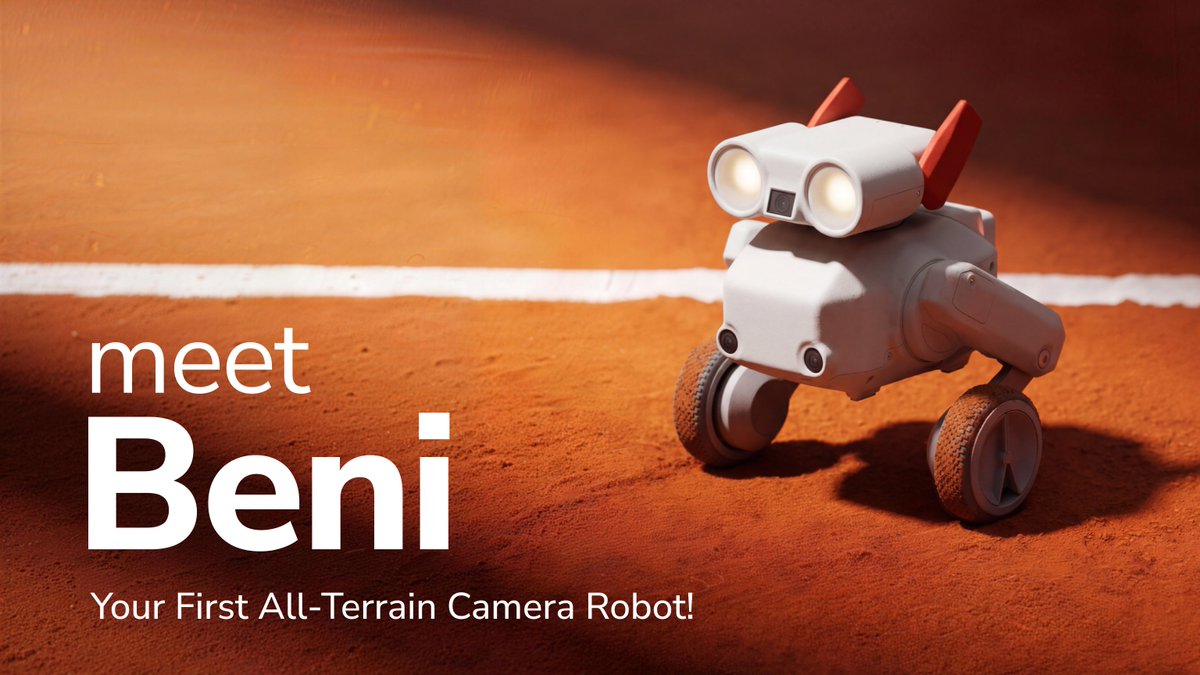
At the time, it was not really a product statement. It was a father’s promise to a little boy I love more than anything — a boy who loved stories about a child and his robot companion. Over the past year, that promise slowly became real — Beni the robot.
Beni follows you, films you in 4K, moves across different terrain, jumps over obstacles, captures moments from new angles, and helps turn your clips into highlights. We designed it for families, pets, creators, athletes, and anyone who wants a robot that feels less like a gadget and more like a little sidekick.
I’m deeply grateful to the Mondo team for turning countless prototypes, failures, late-night tests, and difficult tradeoffs into something people can finally meet. Although we have only just launched on Kickstarter, this world-class team is already deep in the “production hell”, and we expect to ship the product in the next few months.
I’m also especially thankful to my family. Building hardware takes time, patience, and sacrifice from the people closest to you. Beni would not exist without their love and support. My son often visits our office and plays with Beni. Watching them together has reminded me why I started this journey in the first place. I do not want him to grow up thinking of robots only as distant machines in labs, factories, or videos. I want him to grow up in a world where robots can feel close, friendly, safe, and present — something he can play with, trust, and remember as part of his childhood.
For the robotics community: Beni may look cute, but it is a serious robotics product. We used reinforcement learning to train Beni’s motion policies, with NVIDIA Isaac Lab and Google MuJoCo as part of our training and validation pipeline. Under the playful exterior are real robotics problems in locomotion, perception, control, and sim-to-real transfer. The lessons we are learning from Beni also directly inform our future humanoid product. Different form factor, same belief: advanced robotics should not feel distant or abstract. It should become close, present, and part of everyday life.
For my son, Beni began as a promise. For Mondo Robotics, it is just the first step.
Meet Beni: mondorobotics.com

Mondo Robotics@mondorobotics
Beni is live on Kickstarter. Your first camera robot that follows, jumps, flips, films, reacts, gets back up when he falls, and turns real moments into footage you can keep and share. Super Early bird from $549. Shipping starts in October tinyurl.com/mrx2mtfm Here's what Beni can do 🤖
English

New product line, not brand.
#XiaomiSkyNomad

Lei 𝕏ing邢磊@leixing77
There it is. Xiaomi's new brand for its first large EREV SUV codenamed Kunlun N3 set to debut later this year.
English
Y Ron Li retweetledi


Y Ron Li retweetledi

Europe is on the cusp of a boom as adoption of AC takes off. x.com/i/grok/share/3…
English
He has The Future in his hands.
Jeremy Judkins@jeremyjudkins_
I never expected sentry mode to record something like this. Such a cute moment. 🥹
English
Y Ron Li retweetledi


Y Ron Li retweetledi

Saw this Tesla Semi this morning.
I wonder if they know we do dumb shit like this whenever we see them? 🤣
English
Y Ron Li retweetledi

FSD is absolutely jaw-dropping.
You’ve never seen anything like this.
It reversed for a full 7 minutes… right on the edge of a cliff.
Credit: Douyin AE68 & 卢23
Source video: v.douyin.com/CJs8EKx9Lvk/
English

Japanese minister of defense pushes US for public and direct response, if tension arises, but strategic ambiguity is the US card and it definitely won't fall for it.
(Conversation in English.)
Chum(ちゃむ)🏝️🦈@ca970008f4
【アジア安全保障会議】 ヘグセス長官の演説後、異例の直接質問で言質を取りに行く漢小泉 小泉防衛大臣 「一部の国は米国のアジア関与を過小評価している」 「緊張が高まれば、我々の間に楔を打ち込もうとする者が現れる」 「私は米国の関与は揺るがないと感じているが、私の理解は正しいか」
English