9.7K posts

❥ banner
❥

@YUBEACH

Katılım Ekim 2011
104 Takip Edilen1.3K Takipçiler
❥
@YUBEACH·
@ThankYouYeezy Sorry i didn’t mean to troll I actually didn’t know dot passed RIP 🕊️
English
0
0
0
27
❥
@YUBEACH·
I beg your absolute pardon?!?
English
0
1
0
662
❥ retweetledi
Amerikanets 📉
Amerikanets 📉@ripplebrain·
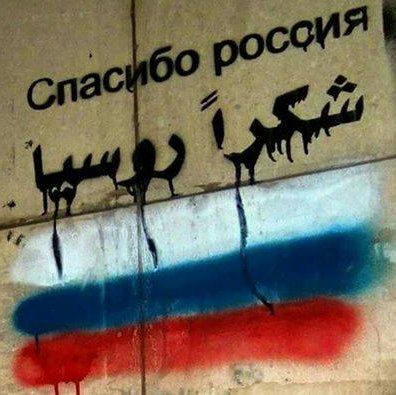
I'm going to explain this in detail for people aren't familiar with it. It's going to sound somewhat unbelievable because it's some of the most stone cold Sun Tsu Machiavelli shit of all time, but Sinwar openly described it in these terms. First, put yourself in his shoes. Gaza is an open air concentration camp, and there's no indication this will ever change. The Israelis are gobbling up increasing amounts of Palestine outside of Gaza. They're also normalizing relations with the Sunni Arab states to an unprecedented degree. The Abraham Accords were signed in 2020, and Israeli relations with the entire Sunni world are on an upward trajectory. The only faction within the region that could possibly come to your rescue is the Shia. The Iranians have huge military potential, but their strategy is to keep themselves at a distance while slowly attriting the Israeli axis with proxy forces, and this is having mixed results. The Iranians are under severe economic pressure and have no interest in a wider war. It looks unlikely that they'll be able to change the picture for the Palestinians if this continues. So what do you do? First, you need to understand the mindset of all the factions involved: Israel, the US, Hezbollah, Iran, the Gulf monarchies, Egypt, Ansar Allah, and so on. The Israelis are almost as dissatisfied with the present situation as you are. While they're achieving diplomatic success, their goal is to fully ethnically cleanse Gaza and the rest of Palestine, and start gobbling up territory in Lebanon and Syria to drive towards a future Greater Israel. Even if their position is gradually improving with the Sunni states, ultimately they're nowhere close to their long term goals, and have serious regional enemies in the form of Hezbollah and Iran. And they have the largest military in the world at their disposal if they need it. Sinwar's strategic decision was to force a "great battle," a "flood for Al-Aqsa." His calculus was that if Hamas initiated a massive, open attack on Israel, the Israelis would use it as a casus belli to implement their strategic goals with regard to Palestine. With relations still not fully normalized with the Arab states, this would heighten the contradictions within the Middle East and lead to a massive regional war. As the Israelis would be forced to go for broke, they'd attempt to also resolve their goals in Lebanon, which would of course suck in Hezbollah, and in turn suck in Iran. Perhaps the most crucial second-order effect without which this plan could have failed is the reaction of Ansar Allah. Their actions in the Red Sea and decision to regularly lob missiles and drones at Israeli territory kept the situation from cooling off. If they hadn't been willing to take on the US Navy solo, the plan might have failed. It's taken until this latest outbreak of hostilities between Israel and Iran to get the Iranians to fully break with their strategy of caution and de-escalation. Sinwar understood the US/Israeli relationship. The Israeli ability to wield the US military like a tool ensured that a direct American attack on Iran was inevitable, forcing the Iranians to adjust their posture. This plan required a willingness to make enormous sacrifices. Gaza has been destroyed, Hezbollah is severely degraded, and the Iranians are now under existential threat. But much of the public worldwide is rapidly coming to grips with the true nature of the US/Israeli relationship. Support for Israel around the world is at a 70 year low. Tel Aviv has been hammered with hundreds of ballistic missiles in four separate True Promise operations, and there are active blockades in both the Red Sea and Persian Gulf. The US has openly abandoned its Gulf allies, paving the way for a total collapse of the geopolitical picture as it stood in October of 2023. The Israeli position is more tenuous than it's been in decades. The most mind boggling thing is that Sinwar set all of this in motion and then took up a rifle and went out to meet the IDF head on. Once Al-Aqsa flood began, the situation, which would pull in dozens of countries, was beyond his control.
Amerikanets 📉 tweet media
Amerikanets 📉@ripplebrain

Total Sinwarification. We're all just pawns in the game of a man who died in battle more than a year ago.

English
392
4K
23.4K
2.8M
❥ retweetledi
Assal Rad
Assal Rad@AssalRad·
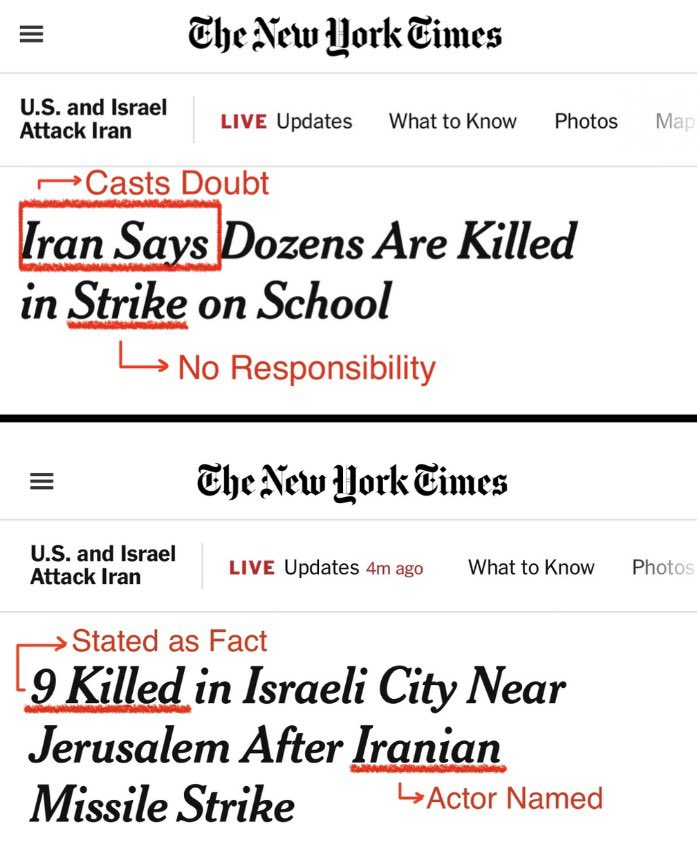
The difference is by design.
Assal Rad tweet media
English
2.4K
107.7K
574.5K
10.2M
❥ retweetledi
Hihi Gadid • 🇵🇸
Hihi Gadid • 🇵🇸@bigbrownenergy·
i won’t lie, this would pump me up so much
English
366
4K
25.3K
2.3M
Evan
Evan@EvanWritesOnX·
This is a war that was agreed upon to avoid a REAL war. Start thinking for yourselves. Just two days ago, Oman's Foreign Minister stood in front of cameras in Washington and said peace was "within reach." Iran had agreed; for the first time, to zero stockpiling of enriched uranium. Technical talks were scheduled for Vienna next week. The Omani FM was giving a thumbs-up in Geneva on Wednesday. By Saturday morning, Tehran was on fire. If you're watching this unfold and thinking the diplomacy failed, you're reading the surface. The diplomacy succeeded. What you're watching now is the invoice. On February 26, Iran and the US concluded their most substantive indirect talks to date. Iran offered to suspend enrichment, dilute its stockpile under IAEA supervision, and join an Arab-Iranian nuclear consortium. Oman's FM described the breakthrough as unprecedented. Ali Shamkhani; senior adviser to Khamenei himself, wrote publicly that an "immediate agreement is within reach" and that Araghchi had "sufficient support and authority for this deal." Forty-eight hours later, the US and Israel launched Operation Shield of Judah. The conventional read is that Trump lost patience, that diplomacy collapsed, that hawks won. That read is wrong. It misses the structural reality; the strikes are the diplomacy. They are the enforcement mechanism for a deal whose terms were already being set in Geneva. Ask yourself a simple question. Why would the US and Israel attack at the exact moment Iran was offering its largest concessions in forty-seven years? Because those concessions need cover. Iran's leadership cannot walk into a deal that dismantles its nuclear leverage, rolls back its missile program, and concedes on regional proxies while looking like it surrendered to American pressure. Khamenei cannot sell capitulation to the IRGC hardliners, the Basij networks, and the ideological apparatus that has sustained the Islamic Republic for nearly five decades. The regime needs an attack to justify the concession. It needs to be able to say: we were struck, we struck back, and then we chose peace from a position of defiance; not weakness. This is not speculation. Look at the Iranian response. Tehran fired missiles at US bases across the Gulf; Bahrain, Qatar, Kuwait, UAE, Jordan. The IRGC issued maximalist statements about "crushing responses" and "relentless operations." The rhetoric is wall-to-wall defiance. But look at what was actually hit. Qatar's defense ministry confirmed all missiles were intercepted. Kuwait intercepted everything at Ali al-Salem. The UAE reported one casualty in Abu Dhabi from debris. Saudi Arabia; notably was not targeted by Iran at all, despite Riyadh being the most significant US partner in the region. Iran struck at every country hosting US assets. It struck at none of the assets that would trigger an uncontrollable escalation. It avoided Saudi oil infrastructure entirely; the one target that would have genuinely destabilized global markets and forced a total war posture from Washington. The Strait of Hormuz remains open. Oil closed Friday at $72.87, barely a 3% move on a day the world was told war had begun. Compare this to what a real Iranian war posture looks like. Iran has the capability to do far worse. It chose not to. What you're seeing is not Iran's war capacity. It's Iran's negotiating choreography. Here's what should tell you everything: the Gulf states denied the US use of their airspace for the strikes on Iran. Saudi Arabia, UAE, Qatar, Kuwait; they all publicly refused. They lobbied Washington for weeks not to attack. MBS personally ruled it out. And then the strikes happened anyway. And then Iran hit their territories. If the Gulf states were genuinely blindsided, you'd expect emergency summits, defensive mobilizations, and a fracture in the US-GCC relationship. Instead, you got carefully worded condemnations, calls for dialogue, and crucially, Saudi Arabia immediately offering to "place all its capabilities at the disposal" of affected states. Riyadh condemned Iran's strikes while simultaneously urging Washington "not to get sucked in further." That is not the language of a shocked ally. That is the language of a state managing a transition it was briefed on. The GCC's posture throughout this crisis has been singular: prevent real war while allowing the theatre to run its course. They denied airspace to signal to Iran that they were not participants in the aggression. They absorbed Iran's retaliatory strikes to give Tehran its face-saving moment. And they immediately pivoted to de-escalation language because the next phase, the deal phase, requires them as brokers, not combatants. Oman was spared entirely. The mediator was left untouched. That is not an accident of targeting. That is a signal that the diplomatic channel remains open. By design. Iran is in the final stages of a structural pivot that has been underway since Qassem Soleimani's assassination in 2020. The proxy architecture; Hezbollah, Hamas, the Houthis, Iraqi PMF, has been systematically degraded. Not by accident, and not purely by external force. The degradation has been permitted. Hezbollah was functionally decapitated in 2024. Hamas's leadership was eliminated. The Houthi file has been separated. Iraqi militias are being absorbed into state structures or sidelined. The "Axis of Resistance" is not collapsing; it is being retired. Pezeshkian's presidency is not a coincidence. He represents the force within the Iranian system that emerged from the recognition that BRICS membership, GCC normalization, and economic survival require shedding the proxy portfolio. Iran's entry into BRICS, the Chinese-brokered Saudi-Iran rapprochement of 2023, and the Omani-mediated nuclear track are all components of the same trajectory: Iran exchanging regional militancy for economic integration. Khamenei approved this trajectory. Shamkhani's public statement; that Araghchi has "sufficient support and authority", is the clearest signal possible that the Supreme Leader has sanctioned the pivot. The hardliner establishment is being managed, not consulted. The IRGC's maximalist rhetoric today is the sound of an institution being given its last public performance before the script changes. The strikes allow this transition to happen without internal collapse. Iran can now frame any deal as a response to aggression rather than a capitulation to pressure. The regime survives. The proxies fade. The nuclear file closes. And Iran enters the regional economic order as a participant rather than a pariah. Netanyahu called the strikes an effort to remove an "existential threat" and projected that the joint operation would "create the conditions for the brave Iranian people to take their fate into their own hands." That is not a military objective. That is a political narrative. Israel's coalition has been on life support for months. The domestic political landscape is fractured. Netanyahu needs a "victory", not a military one, but a narrative one. Strikes on Iran give him the ability to claim he neutralized the nuclear threat, defended the homeland, and stood shoulder-to-shoulder with the US in a historic operation. The actual military impact is secondary. Iran's nuclear program was already "degraded" by the June 2025 12 day war strikes. The sites at Natanz, Fordow, and Isfahan were hit then. Then the media came out saying their nuclear facilities are intact. Today's strikes are a second pass on targets that were already compromised. The marginal military gain is modest. The political gain is enormous. Netanyahu gets his exit narrative. Whether he survives politically or not, he will leave claiming he "saved Israel from Iran's nukes." The real outcome, Israel's gradual integration into a GCC-brokered regional architecture where its freedom of unilateral action is constrained, will be managed by his successors. Both regimes, the Islamic Republic and the current Israeli government, are heading toward structural transitions. The strikes provide both with the domestic cover to make those transitions without admitting what they actually are: concessions. The June 2025 war lasted twelve days. This round will likely be shorter. The military objectives are limited, and the political objectives are already being achieved. A return to negotiations. The Vienna technical talks were scheduled for next week before the strikes. They will resume, possibly in a different format, once the shooting stops. The framework that was being discussed in Geneva does not disappear because missiles were fired. The missiles are part of the framework. GCC-mediated de-escalation. Saudi Arabia and Oman will emerge as the primary diplomatic brokers. Riyadh's immediate offer to support affected states while urging restraint positions it as the indispensable mediator. This is by design. OPEC+ production adjustments. The March 1 OPEC+ meeting was already scheduled to discuss increased output. Gulf producers have been pre-positioning supply to cover any disruption. Saudi Arabia and UAE were already boosting production. The oil market has been prepared for this. The entire point of this exercise, from Iran's perspective, is sanctions relief and economic integration. Once the dust settles and the ceasefire holds, expect a deal framework that includes phased sanctions relief in exchange for permanent nuclear constraints, missile programme limitations, and formalized proxy rollback. Despite Trump's rhetoric about "eliminating threats from the Iranian regime," the actual US posture does not support regime change. There are no ground forces. There is no occupation plan. The force structure is air and sea, designed for strikes, not governance. The objective is behavioral change and a deal, not the collapse of the Islamic Republic. What you're witnessing is not the failure of diplomacy. It's the most resource-efficient way to achieve what diplomacy alone cannot: a simultaneous restructuring of both the Iranian and Israeli strategic postures, managed under the umbrella of a US-GCC brokered regional order. The nuclear standoff that has defined the Middle East for thirty years is being resolved, not through a clean handshake at a summit, but through the controlled application of force that gives every actor the domestic cover they need to make concessions they've already agreed to in principle. Iran gets to shed its proxy liabilities and nuclear isolation under the banner of defiance. Israel gets to claim a historic security victory as its political system resets. The GCC gets the stable, de-militarized, de-nuclearized neighborhood is needs for Vision 2030 and beyond. The US gets a deal it can sell as strength. And the populations of every country involved get the one thing that was never going to be delivered by ideology or militancy: a path to normalization and economic integration. This is a war designed to prevent a real war. It is loud, dramatic, and terrifying on television. It is also bounded, choreographed, structurally purposeful with pre-agreed collateral. The theatre ends when the deal is signed. And the deal was already being written in Geneva.
English
209
273
1.3K
414.1K
❥
@YUBEACH·
Erm so what we all doing here with our stocks and shares today?
English
1
0
0
496
❥
@YUBEACH·
@TRAHOMCAMPAIGN Hello, Any more 8 month or less than one year old?
English
0
0
0
62
تراحم
تراحم@TrahomGaza·
طفلة يتيمة الابوين من ايتام الحرب على غزة بحاجة لكفالة مباشرة عبر تراحم. An orphan who lost her parents during the war in Gaza need a direct sponsership through TRAHOM. التواصل عبر تلغرام @trahomgaza
تراحم tweet media
2
24
29
2.3K
❥ retweetledi
Geo_monitor
Geo_monitor@colonelhomsi·
“The turn will come to each of you, they will come for you. What happened to Saddam awaits you too.” After that, a friendly laugh followed. Then, television cameras captured the laughter of Mubarak, and then Assad.
English
39
1.6K
16.2K
1.4M
❥
@YUBEACH·
@whtimes Do you know if the woman and baby are ok? Asking as it’s my car the woman crashed into and I’m hoping they’re both well
English
0
0
0
63
❥
@YUBEACH·
@JournoDanM hi Dan, noticed you wrote this article about a serious collision in Welwyn whtimes.co.uk/news/24662064.… my car was the one the woman crashed into, and I was wondering if the baby and the woman are ok?
English
0
0
0
65
❥
@YUBEACH·
Do people even tweet anymore
English
2
0
5
1.2K
❥
@YUBEACH·
@MCMLXXXVII_SA I get an influx of followers every time this resurfaces and I’m just tryna live life guys xoxo
English
0
0
4
538
❥
@YUBEACH·
The run Don is wavy had is like no other you had to be there
English
0
5
9
2.1K
❥
@YUBEACH·
and whoever made that fake video suck your mum
English
0
0
2
940
❥
@YUBEACH·
Need to get something off my chest and it’s that wild wild thoughts jinn video lives astonishingly rent free in my head so much so that I can never ever listen to that song
English
0
0
1
823