James Theuer retweetledi
James Theuer
17.1K posts


@TheOrthoEnsign @SanctusIustitia @EasternMilk St. Kant of Königsberg type of theology
(Ostpreußen ist Deutsch)
Deutsch

@SanctusIustitia @EasternMilk Not to mention that when the article DOES go off the rails, it starts talking about some "Reality Itself" (capitalized) that received Christ's sacrifice rather than God! Absolute idolatrous, pantheistic nonsense.
English
James Theuer retweetledi

@SanctusIustitia @EasternMilk Yeah definitely I mean hundreds of OCA websites say Christ's death was a fulfillment of divine truth's condemnation of sin

English

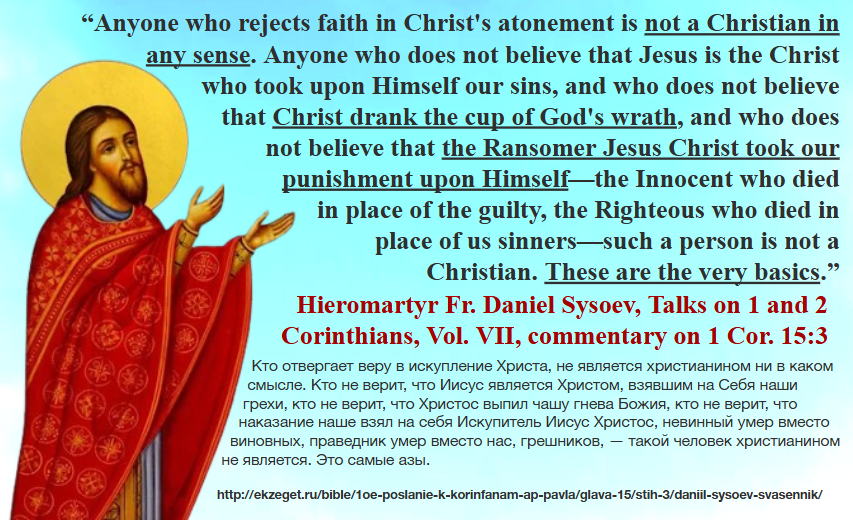
The main premises of PSA is that
1. Christ bore our sin guilt
2. God the Father must punish sin
3. Christ then bore the wrath of the Father upon himself
4. Christ's death appeased the wrath of God.
5. Through that appeasement God the Father no longer has wrath for those who beleive in Christ, thus redeeming humanity.
Now, Holy Orthodoxy fully beleives Christ bore our sin, meaning he suffered and died as the curse of sin had imputed. His sacrifice was not that of appeasing the wrath of a God that must have legal justice, but to willingly offer himself as a spotless lamb, enter into death, and rescue all those in hades. A sacrifice is never of wrath or punishment but always for reconciliation with food. God also does not need to hurt or kill anything for legal justice, he can forgive sin whenever he wishes, and does so many times without requiring pain or death. The ransom was not paid to God the Father but to Satan and death who bore the chains of sin and death in the world.
English
James Theuer retweetledi

‘“And forgive us our debts, as we also forgive our debtors.” Since we sin even after Baptism, we beseech Him to forgive us our debts, provided that we ourselves do not harbour resentment; for God takes me as His example, and what I do to another, He does to me.’
–St. Germanus of Constantinople, Commentary on the Divine Liturgy, On the Lord’s Prayer

English
James Theuer retweetledi

On the 26th July 1983: Victoria Gillick (a Roman Catholic mother of 10) lost her High Court challenge seeking to stop doctors prescribing or advising on contraception for under-16s without parental consent.
Victoria Gillick (then 36, née Gudgeon, born 1946) of Wisbech, Cambridgeshire, appeared before Mr Justice Woolf. She sought declarations that none of her five daughters under 16 (aged 1–13 at the time: Beatrice, Hannah, Jessie, Sarah and Clementine) could receive contraceptive advice or treatment until age 16 without her knowledge and consent, and that a Department of Health and Social Security (DHSS) circular advising doctors they could do so (in certain cases, as a matter of clinical judgment and confidentiality) was unlawful.
She argued it came close to aiding/abetting unlawful sexual intercourse with a minor and interfered with parental rights/duties.
Woolf J ruled against her on both points. He held that parents’ interests were better described as responsibilities or duties rather than absolute rights, that a doctor acting in good faith to protect a girl from the harmful consequences of intercourse would not be committing a criminal offence, and that the prescribed pill was more a “palliative against the consequences of the crime” than an instrument of it. He therefore declined to restrain the health authority or the circular.
Contemporary reporting records that Gillick reacted with strong emotion, bursting into tears, collapsing into the arms of her husband Gordon, and saying “God Almighty, that’s ridiculous” and that the judge did not realise “there are a large number of doctors happily encouraging children to be promiscuous.”
The case had already cost more than £7,600 (much of it legal aid); the couple said they would continue the fight and, if necessary, remortgage their 13-bedroom Georgian home. She had been in dispute with the West Norfolk and Wisbech Area Health Authority for several years after the 1980 DHSS guidance and had received significant public support (including from the National Housewives Association).
The Family Planning Association welcomed the ruling.
Gillick appealed successfully to the Court of Appeal (December 1984), which overturned Woolf J and held the guidance unlawful.
The DHSS appealed to the House of Lords, which in October 1985 (by a 3–2 majority) restored the lawfulness of the guidance in exceptional cases and established the principle now known as “Gillick competence”: a minor under 16 can consent to medical treatment (including contraception) if they have sufficient understanding and intelligence to understand fully what is proposed; parental rights/duties yield accordingly.
Gillick began with contraception/advice under the DHSS guidance but applies more broadly to medical decisions. It is assessed case-by-case by clinicians (not a fixed age threshold below 16).
At 16–17 there is a statutory presumption of capacity for most medical treatment under the Family Law Reform Act 1969.
Gillick competence has been central to debates over puberty blockers (GnRH analogues) and related interventions for gender dysphoria/incongruence in minors.
In Bell v Tavistock (2020 High Court), the court held it was “highly unlikely” that a child of 13 or under could be Gillick-competent for puberty blockers, and “very doubtful” for those aged 14–15. Reasons included the experimental nature of the treatment for this indication, the high likelihood of progression to cross-sex hormones, lifelong consequences (impacts on fertility, sexual function, bone density, cognitive/psychosexual development), and the weak evidence base.
The court noted that Tavistock/GIDS practice appeared to treat virtually all referred children as competent.
The Court of Appeal overturned key parts of that guidance in 2021. It ruled that assessing Gillick competence is primarily for clinicians (not courts setting general age-based improbability rules), and that puberty blockers did not create a special legal category distinct from other medical treatments.
Court authorisation was not routinely required.
The Cass Review (final report 2024) found the evidence for puberty blockers and hormones in this context to be of remarkably weak quality, with unclear benefits for gender dysphoria or mental health and unknowns around harms (including cognitive and developmental effects). This led to the NHS stopping routine prescribing of puberty blockers for gender dysphoria outside research, followed by legislative restrictions/bans on NHS and private prescriptions for under-18s (with review mechanisms and limited trial pathways).
Recent clarifications (e.g., 2025 Court of Appeal) emphasise that Gillick is limited to medical treatment consent and is not a general test of adolescent autonomy for all decisions.
In short: the legal doctrine comes from the contraception case. Its use in the puberty-blockers context has been highly contested, with courts, clinicians, and the Cass Review highlighting difficulties in applying “full understanding” to experimental interventions with lifelong stakes. Current UK policy has shifted toward much greater restriction based primarily on the evidence base rather than abolishing Gillick competence itself. The debate continues internationally, with varying approaches.
The test, originally about contraception, later applied to far more complex and contested treatments such as puberty blockers, has meant that courts, doctors, and reviews have since argued about whether (and how carefully) the test was being used in that context, especially given the weak evidence and lifelong consequences....

English
James Theuer retweetledi


@cum_granosalis @Jeff_Palouse Yeah I don't think he understands what spiteful wrecking the elite will do before ever letting rightists take over
English

@cum_granosalis @Jeff_Palouse He cites historical commentary on the Tractarians/Oxford Movement in the CoE & the Decadents, like Oscar Wilde, becoming RCC. The more Reformed, low church faction in the CoE was more masculine.
Might explain why ECUSA (high church here) succeeds with that demographic
English

@cum_granosalis @Jeff_Palouse en.wikipedia.org/wiki/Epworth_U…
Her father's roofing company did the terra cotta tiles; it had the largest pipe organ in the South when installed. Very sad.
Leon Podles, in his two books, cites past commentary about gays being attracted to high church settings
English

@cum_granosalis @Jeff_Palouse Oldest building in town is St. Paul's Episcopal Church; this page confers some idea of this phenomenon
stpaulsnorfolk.org/about-us/histo…
English

@cum_granosalis @Jeff_Palouse It was the state religion of the Virginia Colony from the beginning
English

@cum_granosalis @Jeff_Palouse Perhaps generally, but not in Norfolk, VA for whatever reason.
English

@Jeff_Palouse @Yakov_Toyer And of course i understand what James is referring to with ref to Ep., the same is true of ELCA, PCUSA, United Methodists, so on and so forth. Highly afield away from my OP.
English

@cum_granosalis I directly answered the questions & dumped what I know. A bunch of the converts at an Ortho parish I attended had been it. They viewed it as a sort of "milk" before high church "meat."
English

@Yakov_Toyer Not who I had in mind; thus ACNA (Anglican) , not Episcopalian. Your point.
English

@cum_granosalis Yes, one of many schismatic Episcopalian groups. Left over Gene Robinson. Lower Church than the others. Tiny & poor compared to ECUSA. Recent moral scandal. Notorious halfway house for RW exvangelicals on the way to EO
English