

Yanger Longkumer
42.1K posts

Yanger Longkumer
@YangerINC
Rave & Rant
Dimapur, Nagaland, India. Katılım Mart 2019
8.9K Takip Edilen15.9K Takipçiler
The days of the Epstein class market manipulation has ended.
The race for the convergence of the paper & physical delivery price of crude is accelerating at full knots, and Washington appears to have lost the wheel.
Spencer Hakimian@SpencerHakimian
🚨BREAKING: OIL HITS $130 AS TRUMP LOSES CONTROL
English
Yanger Longkumer retweetledi

I travelled through Great Nicobar today.
These are the most extraordinary forests I have ever seen in my life. Trees older than memory. Forests that took generations to grow.
The people on this island are equally beautiful - both the adivasi communities and the settlers - but they are being robbed of what is rightfully theirs.
The government calls what it is doing here a “Project.” What I have seen is not a project. It is millions of trees marked for the axe. It is 160 square kilometres of rainforest condemned to die. It is communities that have been ignored while their homes have been snatched away.
This is not development. This is destruction dressed in development’s language.
So I will say it plainly, and I will keep saying it: what is being done in Great Nicobar is one of the biggest scams and gravest crimes against this country’s natural and tribal heritage in our lifetime.
It must be stopped. And it can be stopped - if Indians choose to see what I have seen.
English
Yanger Longkumer retweetledi
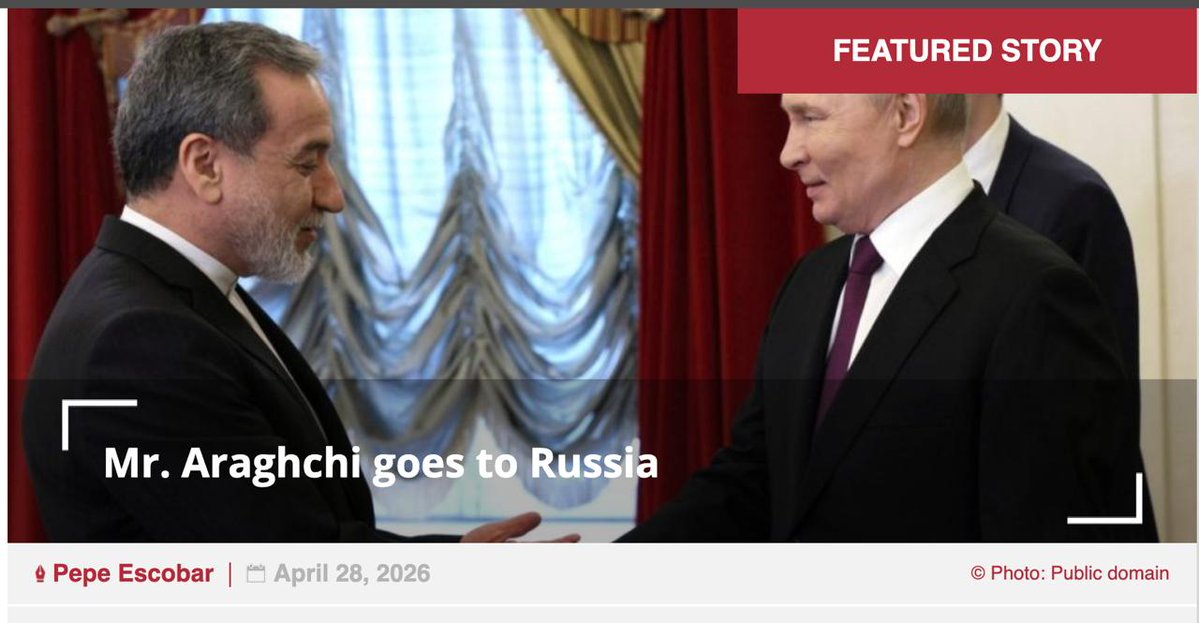
Took a while, but here it is, finally: written right after the meeting in St. Pete.
Bombshell. Russia is now all in.
sovereignista.com/2026/04/28/pep…
English
More crude means more fuel for domestic consumption.
Even a worst case scenario of zero crude export for months, will result in irreversible damage equivalent to just a fraction of production capacity.
What do you think the damage to your allies would be in the meantime?
Treasury Secretary Scott Bessent@SecScottBessent
While the surviving IRGC Leaders are trapped like drowning rats in a sewage pipe, Iran’s creaking oil industry is starting to shut in production thanks to the U.S. BLOCKADE. Pumping will soon collapse. GASOLINE SHORTAGES IN IRAN NEXT!
English
Every hospital should have separate trauma centres for handling trolling related burns 😂🤣
Piyush Rai@Benarasiyaa
Samajwadi Party chief Akhilesh Yadav met BJP leader Anupama Jaiswal, currently admitted in Medanta hospital, who had sustained facial burns while burning effigy of Akhilesh Yadav and Rahul Gandhi.
English
Quite a revealing glimpse into the new order of business in the Persian Gulf.
When it comes to the state of maritime commerce & logistics, follow the insurance money.
Middle East Observer@ME_Observer_
⚡️ Iran Now | Marine Affairs Director at Marsh Insurance, UK-based: - Shipping insurance companies have added a clause obliging ship owners to coordinate with Iranian authorities to ensure safe passage through the Strait of Hormuz
English
Yanger Longkumer retweetledi
Australian surgeon returns to Rafah’s field hospital for the 4th time: leaving my Palestinian colleagues was humanly unacceptable, he says

English
No nation in the world, not even Israel itself, would be depraved enough to try diluting the criticism of Israel's bombardment of Gaza.
But here we are.
Siddharth@svaradarajan
Once again, the Modi government covers itself in infamy East Jerusalem as the capital of Palestine is not just the correct position in international law but has been India's stand from the start. But Modi is afraid to upset his brother Netanyahu and uncle Trump. thewire.in/diplomacy/bric…
English
You capitulate to Trump once, he won't stop till he strips you bare.
All we can do now is to light candles & sing bhajans about strategic autonomy.
Suhasini Haidar@suhasinih
US sanctions waiver on Chabahar port ends today, could signal end of 23-year-old connectivity project, tests strategic autonomy. Govt considers options including transfer of ownership stakes in Chabahar if waiver not renewed. Reporting @the_hindu thehindu.com/news/national/…
English
Yeah, that's the top takeaway from the incident.
Acyn@Acyn
President Trump says tonight’s shooting at the WHCD is a clear example of why we need a need a new ballroom for The White House
English
It's a demand-supply issue.
An overwhelming majority of Israelites and its Zionists supporters across the globe demanded, Netanyahu supplied.
Glenn Greenwald@ggreenwald
The bullshit tactic of Israel supporters is to pretend the bad parts of Israel are due to Netanyahu, so that once he's gone, everyone can and should go back to loving Israel. Netanyahu is fully representative of Israel. That's why he's been in power 19 years. What comes after him will be more sociopathic. Netanyahu is the by-product of the evils of that country, not the cause.
English
Solidarity ✊ with @Pawankhera ji
Satyameva Jayate!
Congress@INCIndia
Assam CM is weaponising the state machinery to target AICC Media Department Chairman Pawan Khera ji, but he hasn’t answered the questions that have been posed: ❓ Does Himanta Biswa Sarma’s wife hold multiple passports? ❓Why were two Dubai properties not disclosed in his affidavit? Will the Election Commission act? ❓What is the link between CM’s wife and Bhuyan Properties Ltd in the UK? ❓ What is the source of funds for entities registered in Wyoming? ❓Clarify the entities RINIKIBHUYANSARMA Asset Collective LLC and HrinikiNandi LLC, both registered in Wyoming? ❓ Were fake KYC documents used to create shell companies and acquire properties? Asking questions and holding those in power accountable is the role of opposition in a democracy. Instead of intimidation and diversion, the Assam Chief Minister must answer the questions.
हिन्दी
This too shall pass ✊
Jairam Ramesh@Jairam_Ramesh
The entire Indian National Congress stands solidly in solidarity with @Pawankhera, the Chairman of its Media and Publicity Department. The verdict of the Guwahati High Court is in the process of being challenged in the Supreme Court. We are confident that justice will prevail over the politics of threat, intimidation, and harrassment.
English
Why just Israel?
When America, Germany & UK has a stronger claim to the title.
American Communist Party@ACPMain
It is time to designate Israel as a terrorist state.
English
This would be the standard procedure, in Utopia.
In the real world, the speaker/chair of the house is the law.
Either the turncoats will split the party through some state sponsored ninja play or the legal process will drag on beyond their tenures.
Arvind Gunasekar@arvindgunasekar
Constitutional bench judgment in Maharashtra case has stated clearly that the original political party has to merge with another party, not just the Parliamentary party of the party.
English