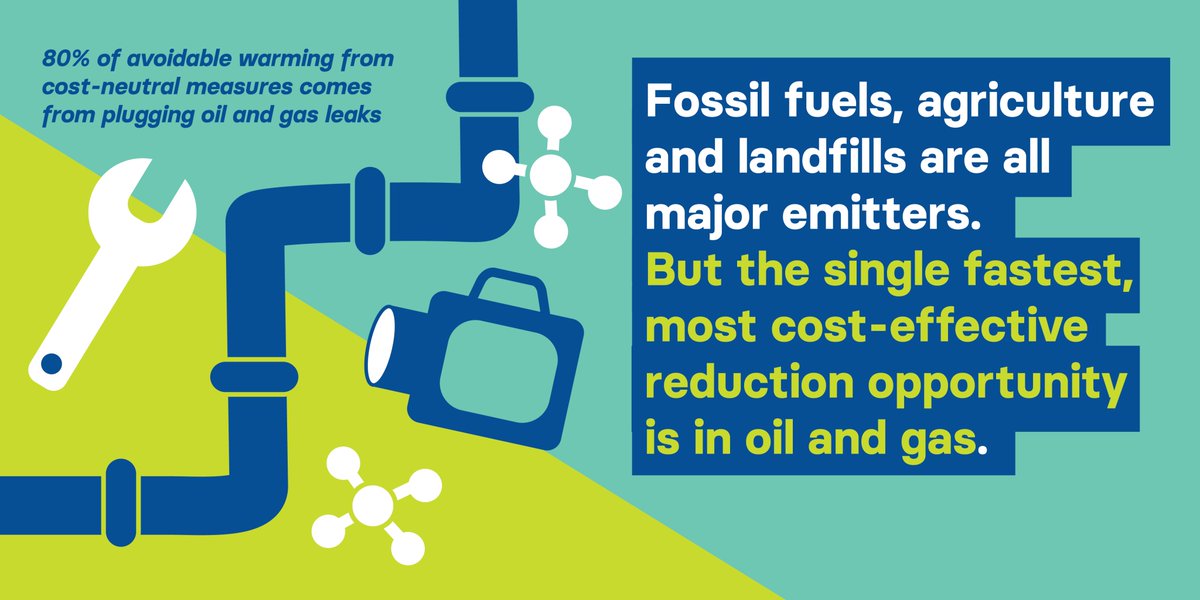
New study: Quick action to #CutMethane emissions can slow climate warming rate by 30%.
Fastest, cheapest emissions cuts are in oil & gas. Study underscores that reducing oil & gas methane *now* matters irrespective of if gas stays in the system longer. edf.org/ZXgL
Air quality in China is improving faster than we thought and this may cause a problem for the newest climate models to simulate climate since 2000s and project its change in the next 3 decades. @YangyangTAMU#npjclimatscigo.nature.com/3c7sSD7
Climate engineering to mitigate the projected 21st-century terrestrial drying of the Americas: a direct comparison of carbon capture and sulfur injection esd.copernicus.org/articles/11/67…
I tell you, nothing feels quite as good as having spent ~2mos on a proposal you thought turned out really well and you were actually excited to do the science, and then (6mo later) it's rejected due to "its overall quality and relevance in relation to other proposals received."
Prof John Schellnhuber Founding Director of the @PIK_Climate Postdam Institute for Climate Impact Research: "The question is not if we will miss the 1.5 C , we will, the question is by what margin? If we want to save millions of lives we must think in non-linearities" #COP24
@ed_hawkins@VariabilityBlog Yes that is from spm sr15, all numbers have uncertainty including ours. Let me send you the raw figures this evening .thanks
@YangyangTAMU@VariabilityBlog OK - so that whole sentence which uses Smith et al as a citation at the end has nothing to do with the results of Smith et al? And the 'IPCC projection' of 0.2C/decade in your figure is the 'current' rate stated in the SR1.5 report, without the uncertainties?
@YangyangTAMU In your recent Nature comment, your statement about 0.25–0.32 °C/decade cites Smith et al. (2018, GRL), and I'm curious where in the paper those numbers are derived from? Thanks. (cc. @VariabilityBlog)
@ed_hawkins@VariabilityBlog Sorry I meant multimodal mean in my figure. Did not use anything quantitative from smith, but I agree careful decadal prediction is needed
@YangyangTAMU@VariabilityBlog Your text says 'the next 25 years are poised to warm at a rate of 0.25–0.32 °C per decade' but Smith et al only shows data up to 2027 in Figure 2, i.e. the next 10 years. Please can you be more precise about where these numbers come from? Not at AGU to discuss unfortunately.
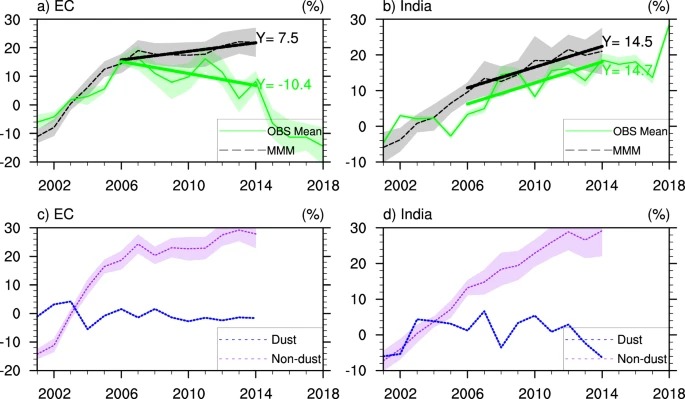
Changes in Extreme Rainfall Over India and China Attributed to Regional Aerosol‐Cloud Interaction During the Late 20th Century Rapid Industrialization - Lin - - Geophysical Research Letters agupubs.onlinelibrary.wiley.com/doi/10.1029/20…
Have you been saying to yourself, "I'd really like to live in College Station." If so, you're in luck! We are hiring! We have two open-rank tenure-track positions in Atmospheric Sciences. I'm the chair of the search committee, so DM if you have Qs. wit.twc.state.tx.us/WORKINTEXAS/wt…
Isolating the Meteorological Impact of 21st Century GHG Warming on the Removal and Atmospheric Loading of Anthropogenic Fine Particulate Matter Pollution at Global Scale - Particulate matter with the diameter smaller than 2.5 μm (PM2.5) poses health t... ow.ly/M5Qo50gNrp9