Dimitri Zabelin

7.6K posts

Dimitri Zabelin banner
Dimitri Zabelin

Dimitri Zabelin

@ZabelinDimitri

Geopolitical Strategist and founder of Pantheon Insights | Sr. Investment Research Analyst, AI @pitchbook | Seen on BBC News, Reuters, Forbes

San Francisco, CA Katılım Temmuz 2018
1.1K Takip Edilen7.5K Takipçiler
Sabitlenmiş Tweet
Dimitri Zabelin
Dimitri Zabelin@ZabelinDimitri·
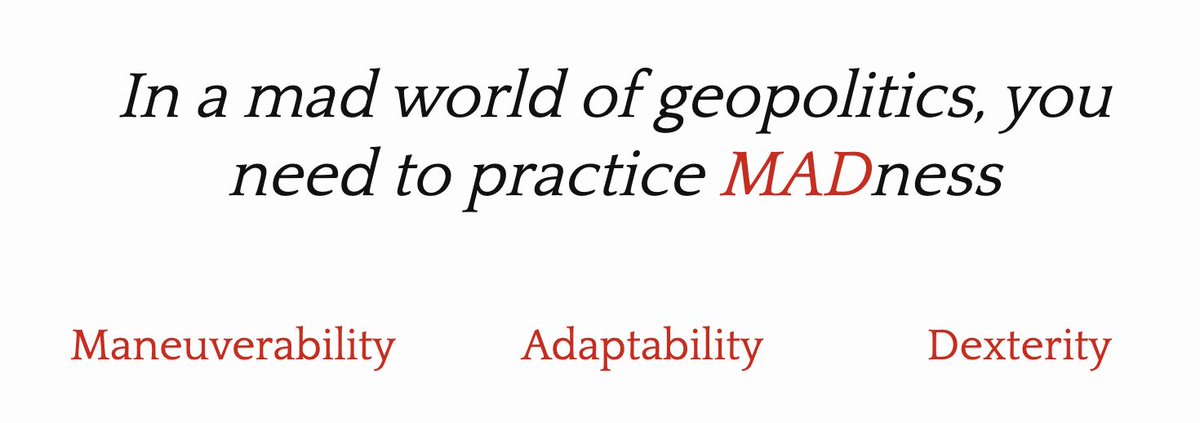
In a world of geopolitical volatility, where uncertainty shapes every decision, strategy is the foundation of resilience. The updated Pantheon Insights site reflects a philosophy of precision and clarity, designed to meet the demands of modern geopolitics. At the heart of this approach is a simple yet powerful idea: In a mad world of geopolitics, you need to practice a little MADness: Maneuverability | Adaptability | Dexterity Global volatility demands more than reaction—it requires deliberate, informed action, and strategic clarity transforms uncertainty into a competitive advantage. Understand how maneuverability, adaptability, and dexterity create sharper strategies for your businesses objectives. Link in bio.
Dimitri Zabelin tweet media
English
1
1
10
5.3K
Dimitri Zabelin
Dimitri Zabelin@ZabelinDimitri·
@KobeissiLetter I wrote an data-heavy report on agentic AI you’d find interesting in the context of this company. For example, in my report I wrote that “VC-backed agentic AI companies raised $24.2 billion across 1,311 deals in 2025 alone. That's nearly 73% of the total cumulative deal value the category saw in the entire prior decade”. Not surprisingly, cyber and IT had the great agentic uptake. Report is here: pitchbook.com/news/reports/q…
English
0
0
0
160
The Kobeissi Letter
The Kobeissi Letter@KobeissiLetter·
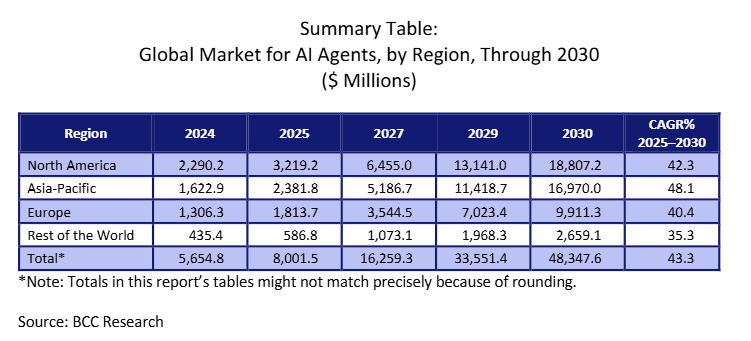
AI agents are exploding in popularity. As the AI Revolution advances, we are seeing massive growth in Agentic AI. Between 2025 and 2030, revenue in this market is set to grow at a CAGR of 43.3%, rising to ~$48.3 billion per year. As a result, Nvidia's CEO Jensen Huang has described current market conditions as the "inflation point" in AI. Today, HockeyStack has announced a $50M capital raise for AI Agents that effectively run businesses as investor capital increasingly rotates into the space. Autonomy is the future of AI.
The Kobeissi Letter tweet media
Emir Atli@emiratli_

We raised $50M to build the First AI Revenue Agent. It runs New Business, Expansion, and Prospecting to close you more business while you sleep.

English
72
67
489
152K
Dimitri Zabelin
Dimitri Zabelin@ZabelinDimitri·
Very true. A company’s moat is a combination of their proprietary data and how they integrate into their platform. AI at its best should turbocharge that architecture
sourcery@sourceryy

.@mlevchin says the companies that are most vulnerable to losing their business to AI are the ones without any proprietary data or value: "Companies that have built software orally and just sell that software are very vulnerable." "The bar for quality of software is going up rapidly." "DoorDash is not important by way of having a great app. It's important because it integrates with all your favorite restaurants." "Until OpenClaw can also do things like call every restaurant, negotiate with the owner, and install the right tablet and software and extract the menus and all the things that DoorDash does—I think DoorDash is actually quite safe in their business."

English
0
0
0
224
Dimitri Zabelin
Dimitri Zabelin@ZabelinDimitri·
Anthropic has reportedly had multiple offers from VCs valuing the company at as much as $800 billion. For perspective, OpenAI’s mega funding round of $120 billion put it at a similar valuation. I still think Anthropic will be the ultimate winner.
English
0
0
1
167
Dimitri Zabelin
Dimitri Zabelin@ZabelinDimitri·
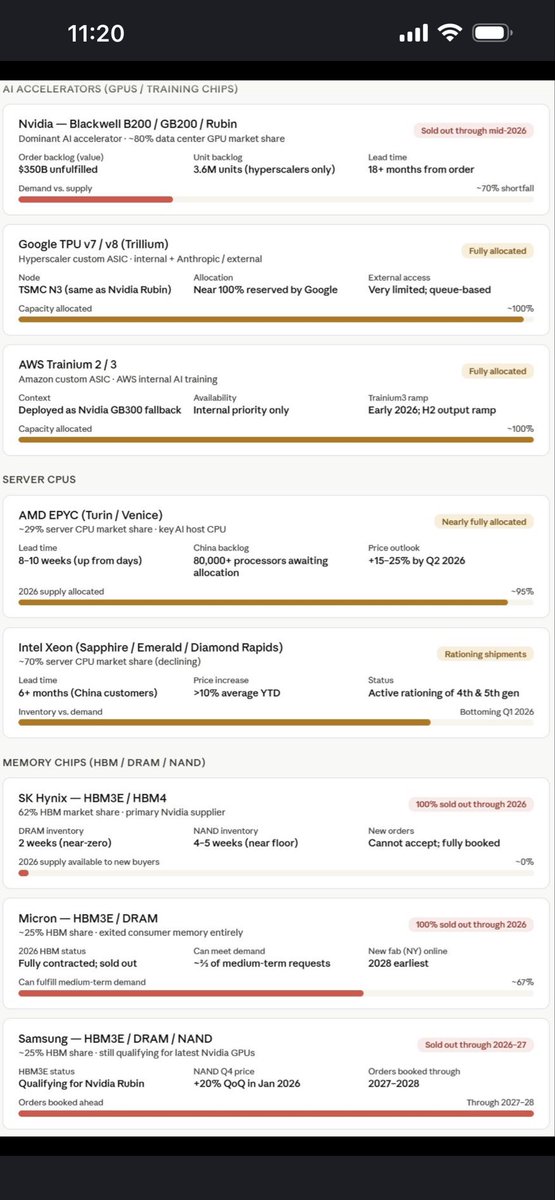
There's been a viral stat going around about half of all datacenter buildouts for 2026 are being stalled, delayed, or cancelled. That's great for chipmakers. In addition to the domestic buildout in the US, the technological hegemon in software, hardware, and ecosystem building, global demand is surging. Sovereigns are rushing in to secure investments for their AI buildout, and this is just for training. We haven't even started to do major buildout for running inference. That will come as agentic AI deployment accelerates. I have a report on both agentic and sovereign AI that I will link at the bottom of this post. The quarterly reports I've authored on AI has consistently shown that chipmakers - unsurprisingly - have proven to be the most resilient. They are an infrastructure bet, and the data is showing we are short on chips. That means two things. 1) Existing public and private incumbents will get more entrenched as scaled companies are more capable of delivering on structural demand. 2) Private companies innovating in the chip space will likely see better funding and exit prospects. As I and many others have stated before, we are in the very early stages of the AI buildout. I don't see demand slowing down in the near-term, and for chipmakers, this is great news. PitchBook Analyst Note: Agentic AI: The Evolution to Autonomous Systems: Part I PitchBook Analyst Note: Sovereign AI: The Trillion-Dollar Frontier: PitchBook Analyst Note: Sovereign AI: The Trillion-Dollar Frontier
Dimitri Zabelin tweet media
English
2
0
1
194
Dimitri Zabelin
Dimitri Zabelin@ZabelinDimitri·
🔥HOT OF THE PRESS🔥Part I of my paper "Agentic AI: The Evolution to Autonomous Systems" is officially out ⬇️ VC-backed companies in agentic AI raised $24.2 billion across more than 1,300 deals, equivalent to 73% of all dollars in the space from 2015 through 2024. The rapid rise means we’ve turned the corner from experimentation to deployment. Investment activity is concentrated in IT, where the cybersecurity, developer tooling, and productivity verticals are the most promising due to their faster deployment and measurable ROI. Part I does a macro assessment of deal flow activity of agentic AI companies by vertical and region. Biggest takeaways: 🔸 North America overwhelmingly leads with Europe trailing at a far second 🔹 IT has seen explosive growth in agentic uptake 🔸 Disparity in exits boils down to platforms vs application plug-ins 🔹 Cybersecurity funding and exit prospects are a bright spot Part II is coming out on April 20 and will have unique, on-the-ground insights from 13 different startup founders and Chief AI officers working in agentic AI space. Main takeaways and link to follow in 11 days! pitchbook.com/news/reports/q…
English
0
0
0
99
Dimitri Zabelin
Dimitri Zabelin@ZabelinDimitri·
Anthropic just looks unstoppable. The number of product rollouts over a short period of time and the uptake is incredible
English
0
0
0
78
Dimitri Zabelin
Dimitri Zabelin@ZabelinDimitri·
The war in Iran has people understandably guessing that come November, there will be a blue tsunami and the Dems will sweep Republicans. While I get the logic, I think people are overestimating. You will very likely see a blue uptick, but not at the magnitude people are expecting. It was like a few years ago when everyone was expecting a red wave and it was more of a wavelet. The cultural zeitgeist is still shifting to the right, and even if red voters don’t like how Trump handled the Epstein files and the Iran war, they are still strongly opposed to what democrats have to offer. The Republicans’ “cultural moat” is their biggest defense at the moment against Dems trying to capitalize on Trump’s policy shortcomings. I don’t put too much stock in polls. Also to be clear, I’m not endorsing one side or the other but looking at it from a macro view. What do you guys think?
English
0
0
1
94
BeSomebodyFX
BeSomebodyFX@BeSomebodyFX·
@ZabelinDimitri From ChatGPT to Claude or Claude to ChatGPT? Little confusing there 😉
English
1
0
1
148
Dimitri Zabelin
Dimitri Zabelin@ZabelinDimitri·
Switched to ChatGPT to Claude. Never going back. Unbelievable performance differential in output quality.
English
1
0
2
411
Dimitri Zabelin
Dimitri Zabelin@ZabelinDimitri·
Capital distribution is a good proxy for conviction, and sovereigns are putting their (taxpayer-funded) dollars where their priorities are: AI. Back in Q4 2025, I wrote the first-of-its-kind report connecting geopolitical trends to capital formation in private markets. In my view, there are three primary regions (North America, Europe, and Asia) that are executing their AI roadmaps with policy frameworks that mimic the political economy of their zones. For example: 🌎 North America - industrial policy 🌍 Europe - legislation 🌏 Asia (East + Southeast Asia + Middle East) - bureaucratic allocation and sovereign wealth funds, respectively There are, of course, some exceptions and overlap between these systems, but broadly, this framework captures the essence of capital levers being used by each region. Not surprisingly, the US is the technological juggernaut, leading in both the software and hardware layers; not to mention the unmatched VC ecosystem. Not surprisingly, capital allocation reflects that. For investors, this is important to watch because sovereign investment is often - and understandably - interpreted as a magnetizing force. If a government or sovereign wealth fund invests in a startup, it is the state telegraphing to the world "we believe this is a good use of tax payer's money". That is an immensely powerful message to other investors. For frontier models that are the literal foundation of the new digital economy, investing in them is essentially in infrastructure play; and infrastructure is not cyclical but structural. We are at the very beginning of the AI super cycle, where the spear of innovation is just barely piercing the future. Geopolitical competition will sharpen this thematic halberd as states race each other to achieve technological parity at least, and supremacy at best. See the full report here: pitchbook.com/news/reports/q…
English
0
0
0
90