Rob Murdock

4.9K posts

Rob Murdock banner
Rob Murdock

Rob Murdock

@ZeGreatRoB

The doom of man: great and terrible. Software dev, nerd-culture enthusiast, cat owner, home owner, gamer, occasional writer, podcaster, and ridiculous creature.


Ann Arbor, MI Katılım Haziran 2009
491 Takip Edilen172 Takipçiler
Sabitlenmiş Tweet
Rob Murdock
Rob Murdock@ZeGreatRoB·
arcane anti-legibility is a lifelong hobby
English
0
0
3
243
Rob Murdock retweetledi
Mike Binder
Mike Binder@MikeBinderjokes·
1/ It's 1985. I just did stand-up on David Letterman the night before. Five minutes. I'm 27 years old and I think I've made it. My agent calls me the next day and fires me.
English
108
229
2.9K
549.8K
Rob Murdock retweetledi
Loquitur Ponte Sublicio
Loquitur Ponte Sublicio@loquitur_ponte·
Here's the correct answer on the Star Wars prequels. They're not good movies. They're not super enjoyable to watch. They have some quite bad elements. But they exist in a very good universe that feels full of stories and potential. They're good world building. The original movies takes place on the fringe, you never really see the galaxy they're fighting over. The prequel galaxy is dense, alive, populated. You can imagine being a jedi in it, a sith, a merchant, a simple man. And everything good after, clone wars, andor, rogue one, feels like its in that rich full universe the prequels made and set the tone of. The prequels weren't good movies but they were good for *star wars*. They made more stories possible and appealing to tell than before. The sequels were also bad movies but they were also bad for star wars. They fled the rich galaxy back to the fringes, killed off characters and whole political systems in bulk, ensured no post empire pre sequel politics could be interesting because we know it utterly fails immediately, ensured no new jedi order story would be interesting because it utterly fails immediately, and then left a bunch of new threads no one cares to follow. The movies arent that much less enjoyable than the pretty bad prequels. But their impact on the range and attractiveness of potential stories was the opposite, shrinking the pool not widening it.
English
72
69
994
52.2K
Rob Murdock retweetledi
roon
roon@tszzl·
on the granta story. it’s clearly written by gpt. you can see all the motifs it loves and overuses like rain, weather, teeth, spine, memory. extreme overuse of figurative language and contrastive negation. it has the level of over-baking of probably GPT-5-thinking or 5.2-thinking the story is … something ? I don’t think it has no value. the model develops an indo-Caribbean world register, man tries to murder his wife and chickens out. there’s some reasonable religious imagery where he combining three mythologies there with the names and whatnot all of that is obviously overshadowed by the GPT prose style, and it’s hard for your eyes to not glaze over. there are various metaphors in there that boggle the mind. stuff like “the girl smiled like sunrise over a sink”. what’s interesting is I went through the story and asked Claude Opus - a different model than the author model - and it seemed to find each and every one of the metaphors I hated brilliant. it finds a just so explanation for each of them when you press it which makes you think, do these models have a shared internal vocabulary or compress various ideas in ways we don’t? the failures are quite interesting in that they reveal some different, and maybe bad, understanding of the human sensorium than a human has. why is pretraining knowledge compressed this way across all models? idk
English
105
45
975
104.7K
Rob Murdock retweetledi
owen cyclops
owen cyclops@owenbroadcast·
two principles about anger someone explained to me are: if your family smokes, and you stop smoking, they’ll get mad at you. and: if you tell someone else they have agency when they have a problem, they’ll get mad at you. this completely reframed my conception of what anger is.
English
63
309
5.8K
249.7K
Rob Murdock retweetledi
Bridget Phetasy
Bridget Phetasy@BridgetPhetasy·
People don’t hate data centers. They hate tech bros.
English
362
84
1.1K
676.9K
Rob Murdock retweetledi
alex peysakhovich
alex peysakhovich@alex_peys·
writer: ok im writing a sequel to the bible, ai comes and that’s the end of days. im naming the two battling ceos “alt man” and “amo dei” editor: isn’t that a little on the nose? writer: and then the pope will cameo like halfway through editor: get out
English
6
43
368
22.8K
Rob Murdock retweetledi
Daniel
Daniel@growing_daniel·
Today claude code is idiot and codex is genius. Every day is different. Tomorrow, who knows?
English
42
9
464
22K
Billy Binion
Billy Binion@billybinion·
This is slopulist nonsense that plays well on social media, but would make things worse. Institutional investors own a tiny share of housing stock. And rents often *increase* when you force them out of the market. How is it "America First" to make housing more expensive?
Donald Trump Jr.@DonaldJTrumpJr

Banning institutional investors from buying single-family homes is a commonsense policy to drive down home prices. Every single Republican in Congress should be supporting it. We can't allow RINOs and Dems in the Swamp to block my fathers America First agenda on housing!!!!

English
9
27
251
20.5K
Rob Murdock
Rob Murdock@ZeGreatRoB·
Jump-to-conclusions-mat-as-a-service
English
0
0
1
10
Rob Murdock retweetledi
Ross Douthat
Ross Douthat@DouthatNYT·
Btw another way to look at the second chart is that the Baby Boom was even more unexpected than generally understood and also if any major population repeated that kind of unexpectedness now they would dominate the human future. x.com/DouthatNYT/sta…
Ross Douthat@DouthatNYT

On the latest round of fertility discourse, friends don't let friends share chart 1 without the important context of chart 2, which is @lymanstoneky's child-survival adjustment:

English
17
26
451
568.9K
Rob Murdock
Rob Murdock@ZeGreatRoB·
LLM sycophancy may results in further increasing the value of us curmudgeons.
English
0
0
0
10
Rob Murdock retweetledi
Megan McArdle
Megan McArdle@asymmetricinfo·
In a democracy, if public enterprises do not benefit the public, then eventually, they will cease to provide jobs for public employees. There may be a lag, but eventually voters will sour on government and there will be a tax revolt.
Chris Freiman@cafreiman

There’s a tension between two views that are often held together: that public enterprises should benefit the public and that public enterprises are jobs programs for public employees.

English
29
12
199
33.3K
Rob Murdock retweetledi
Oliver Traldi
Oliver Traldi@olivertraldi·
To settle a troublesome discourse, I have provided here the most faithful and poetic possible translation of the beginning of the Odyssey. We male sex. We complex. We fake horse. We off course. We sail long. We hear song. We pig crew. We home soon.
English
145
1.8K
19.1K
473.8K
Rob Murdock retweetledi
Luca Dellanna
Luca Dellanna@DellAnnaLuca·
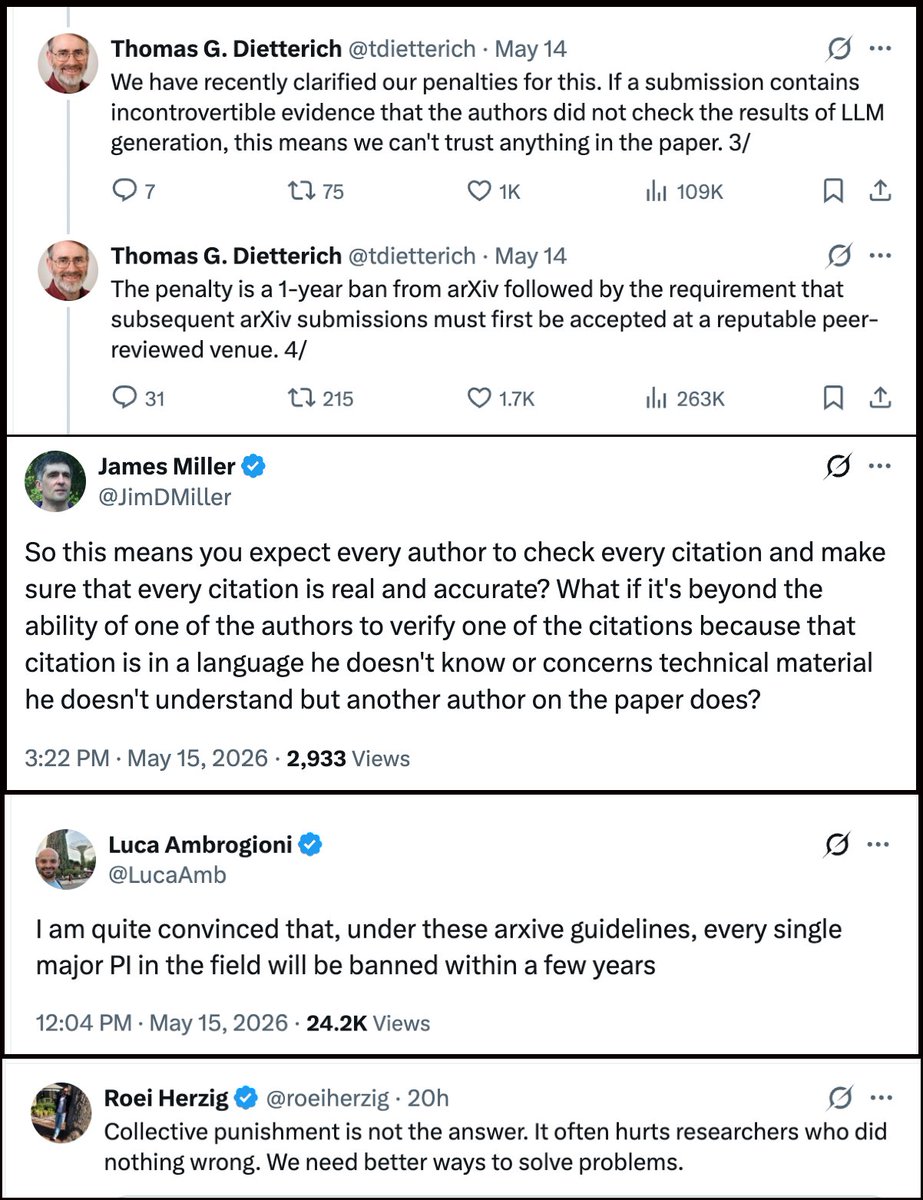
The reactions of many researchers on finally being held responsible for having read the very paper they submitted are... something.
Luca Dellanna tweet media
English
355
1.2K
12K
594.9K
Rob Murdock
Rob Murdock@ZeGreatRoB·
Important concern. I expect to see extreme action and extreme reaction and the whiplash will do a lot of damage.
Mitchell Hashimoto@mitchellh

I strongly believe there are entire companies right now under heavy AI psychosis and its impossible to have rational conversations about it with them. I can't name any specific people because they include personal friends I deeply respect, but I worry about how this plays out. I lived through the great MTBF vs MTTR (mean-time-between-failure vs. mean-time-to-recovery) reckoning of infrastructure during the transition to cloud and cloud automation. All those arguments are rearing their ugly heads again but now its... the whole software development industry (maybe the whole world, really). It's frightening, because the psychosis folks operate under an almost absolute "MTTR is all you need" mentality: "its fine to ship bugs because the agents will fix them so quickly and at a scale humans can't do!" We learned in infrastructure that MTTR is great but you can't yeet resilient systems entirely. The main issue is I don't even know how to bring this up to people I know personally, because bringing this topic up leads to immediately dismissals like "no no, it has full test coverage" or "bug reports are going down" or something, which just don't paint the whole picture. We already learned this lesson once in infrastructure: you can automate yourself into a very resilient catastrophe machine. Systems can appear healthy by local metrics while globally becoming incomprehensible. Bug reports can go down while latent risk explodes. Test coverage can rise while semantic understanding falls. Changes happens so fast that nobody notices the underlying architecture decaying. I worry.

English
0
0
0
22
Rob Murdock retweetledi
Mitchell Hashimoto
Mitchell Hashimoto@mitchellh·
I strongly believe there are entire companies right now under heavy AI psychosis and its impossible to have rational conversations about it with them. I can't name any specific people because they include personal friends I deeply respect, but I worry about how this plays out. I lived through the great MTBF vs MTTR (mean-time-between-failure vs. mean-time-to-recovery) reckoning of infrastructure during the transition to cloud and cloud automation. All those arguments are rearing their ugly heads again but now its... the whole software development industry (maybe the whole world, really). It's frightening, because the psychosis folks operate under an almost absolute "MTTR is all you need" mentality: "its fine to ship bugs because the agents will fix them so quickly and at a scale humans can't do!" We learned in infrastructure that MTTR is great but you can't yeet resilient systems entirely. The main issue is I don't even know how to bring this up to people I know personally, because bringing this topic up leads to immediately dismissals like "no no, it has full test coverage" or "bug reports are going down" or something, which just don't paint the whole picture. We already learned this lesson once in infrastructure: you can automate yourself into a very resilient catastrophe machine. Systems can appear healthy by local metrics while globally becoming incomprehensible. Bug reports can go down while latent risk explodes. Test coverage can rise while semantic understanding falls. Changes happens so fast that nobody notices the underlying architecture decaying. I worry.
English
513
1.9K
15.2K
1.5M