Antonella Zarra

2.3K posts

Antonella Zarra banner
Antonella Zarra

Antonella Zarra

@_AZarra

AI risk & transparency #DSA team @EU_Commission 🇪🇺 PhD Candidate Law & Econ @unihh @erasmusuni @unibo Ex @AIatMeta @OpenLoopProgram

Katılım Mayıs 2009
844 Takip Edilen808 Takipçiler
Antonella Zarra retweetledi
European Commission
European Commission@EU_Commission·
Today, we fined X for non-compliance with transparency obligations under the DSA. We're holding X accountable for: 🔹Deceptive design of its ‘blue checkmark’ 🔹Lack of transparency of its advertising repository 🔹Failure to provide access to public data for researchers ↓
English

19.2K
2.8K
13.6K
15.7M
Antonella Zarra retweetledi
More Perfect Union
More Perfect Union@MorePerfectUS·
NEW: People are developing antisocial and obsessive behavior after using AI — some have even taken their own lives. One journalist started getting emails from people in mental health crisis after using AI. She dug in, and found companies putting profits over users' lives.
English
16
264
684
151.1K
Antonella Zarra retweetledi
Henna Virkkunen
Henna Virkkunen@HennaVirkkunen·
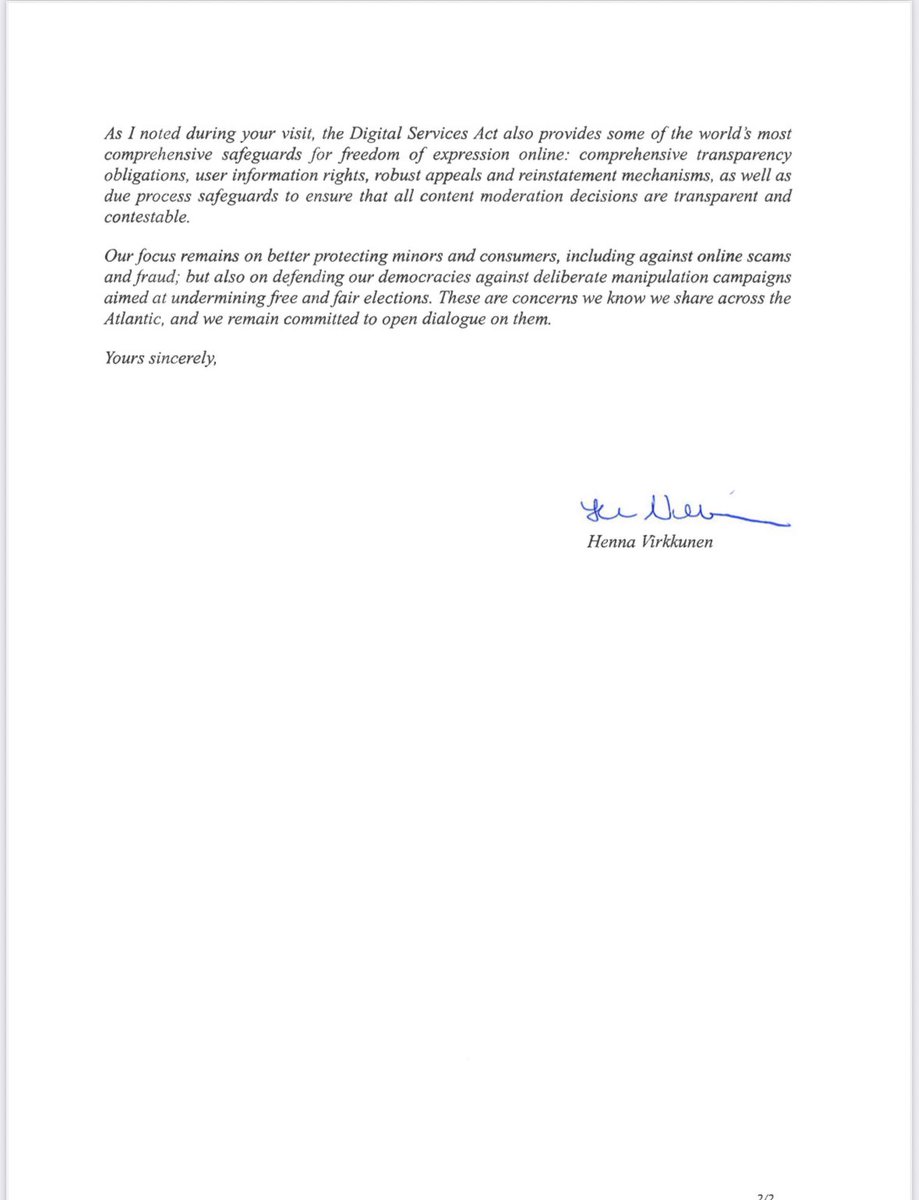
The DSA and DMA are our sovereign legislations - Non-discriminatory, applying to all online platforms in the EU. Fully protecting our fundamental rights, including freedom of expression. I will keep enforcing them, for our kids, citizens and businesses.
Henna Virkkunen tweet mediaHenna Virkkunen tweet media
English
36
70
211
28.5K
Antonella Zarra retweetledi
Digital EU 🇪🇺
Digital EU 🇪🇺@DigitalEU·
Have your say on the protection of minors online! This public consultation under the Digital Services Act (DSA) aims to create a safer online environment for children by ensuring a high level of: 🚸privacy 🚸safety 🚸and security Contributions are welcome until 10 June 2025 ↓
English
5
22
37
9.3K
Antonella Zarra retweetledi
Filomena Chirico
Filomena Chirico@FiloBXL·
No one is above the law. Next step, compliance by design #dma 🇪🇺
Digital EU 🇪🇺@DigitalEU

Today, the @EU_Commission concluded that Apple & Meta breached the DMA as: 🔸Apple restricts app developers’ ability to promote offers outside the App Store 🔸Meta’s ‘Consent or Pay’ model does not give users access to an equivalent service that uses fewer personal data for ads

English
1
9
11
1.4K
Antonella Zarra retweetledi
European Commission
European Commission@EU_Commission·
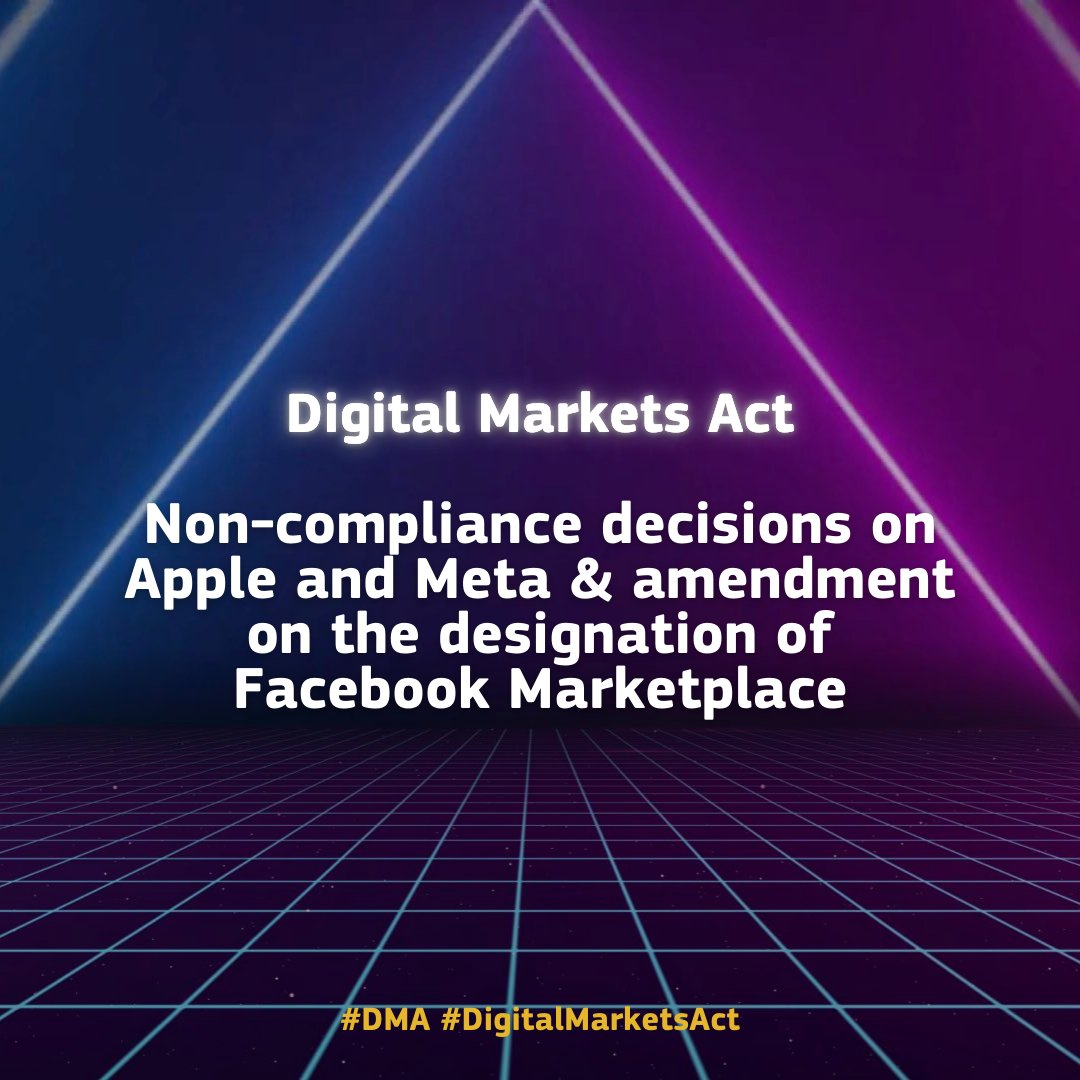
Today, we've fined Apple and Meta for breaching the #DMA. Apple restricts developers from informing customers about offers outside the App Store, while Meta doesn’t give consumers the choice of a service that uses less of their personal data. More info: europa.eu/!9RDQmk
European Commission tweet media
English
189
277
1.4K
94.7K
Antonella Zarra retweetledi
Digital EU 🇪🇺
Digital EU 🇪🇺@DigitalEU·
Today, the @EU_Commission concluded that Apple & Meta breached the DMA as: 🔸Apple restricts app developers’ ability to promote offers outside the App Store 🔸Meta’s ‘Consent or Pay’ model does not give users access to an equivalent service that uses fewer personal data for ads
Digital EU 🇪🇺 tweet media
English
16
33
64
17.2K
Antonella Zarra retweetledi
Forum INCYBER - EUROPE (FIC)
Forum INCYBER - EUROPE (FIC)@INCYBER_Europe·
Le Trust & Safety Forum est ouvert !  RDV en salle 3.7 pour la conférence : "Les #données derrière les plateformes : quelle est la prochaine étape pour les rapports de transparence ?" En intervenants : Louis-victor DE FRANSSU (@tremautech ), @_AZarra (@EU_Commission), Nayane TIRABOSCHI (@Concentrix), et @ComblezSamuel (@eenfance). Pour plus d'infos sur le programme du Trust & Safety Forum 👇 europe.forum-incyber.com/trust-safety-f… #FORUMINCYBER2025 #TrustandSafetyForum #confiancenumérique
Forum INCYBER - EUROPE (FIC) tweet media
Français
0
2
0
334
Antonella Zarra retweetledi
Ursula von der Leyen
Ursula von der Leyen@vonderleyen·
Your dignity honors the bravery of the Ukrainian people. Be strong, be brave, be fearless. You are never alone, dear President @ZelenskyyUa. We will continue working with you for a just and lasting peace.
English
16.9K
26.2K
189.5K
5.8M
Antonella Zarra retweetledi
Donald Tusk
Donald Tusk@donaldtusk·
Dear @ZelenskyyUa, dear Ukrainian friends, you are not alone.
English
15.7K
39.2K
317.3K
36.9M
Antonella Zarra retweetledi
Volodymyr Zelenskyy / Володимир Зеленський
Ukrainians know the true happiness of being at home and safe. I'm glad that @ceciliasala has been released from an Iranian prison, that she is well, and has already returned to her journalistic work. Her first interview after being released was done in Ukraine. Thank you for our meeting, for your continued interest in Ukraine, in our fight for independence, and a safe home for all Ukrainian families. Thank you, Italy, for all your support. Watch the full interview on Monday, January 27.
Volodymyr Zelenskyy / Володимир Зеленський tweet media
English
638
2.7K
19.5K
514.2K
Antonella Zarra retweetledi
DG MEME 🇪🇺
DG MEME 🇪🇺@meme_ec·
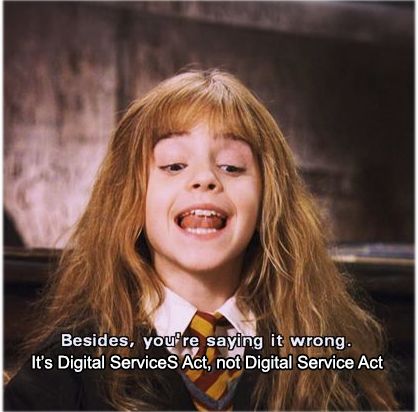
My favorite since Bolkestein Vs. Bolkenstein
DG MEME 🇪🇺 tweet media
Deutsch
1
11
178
8.6K
Antonella Zarra retweetledi
Cecilia Sala
Cecilia Sala@ceciliasala·
Ho la fotografia più bella della mia vita, il cuore pieno di gratitudine, in testa quelli che alzando lo sguardo non possono ancora vedere il cielo. Non ho mai pensato, in questi 21 giorni, che sarei stata a casa oggi. Grazie
Cecilia Sala tweet media
Italiano
2K
3.1K
36.2K
1M
Antonella Zarra retweetledi
Il Post
Il Post@ilpost·
Abbiamo due notizie: riguardano @lucasofri e @francescocosta. Insomma, al Post cambieranno un po' di cose. Le raccontano qui i diretti interessati (anzi, ora possiamo dire: i direttori interessati) ilpost.link/5RFJCbzP8s
Italiano
49
55
705
149K
Antonella Zarra retweetledi
Ultimora.net - POLITICS
Ultimora.net - POLITICS@ultimora_pol·
🔴 La giornalista Cecilia #Sala, arrestata circa tre settimane fa in Iran, è stata liberata e si trova in questo momento su un volo per l’Italia. Lo ha confermato poco fa il governo italiano. (ilPost) @ultimora_pol
Ultimora.net - POLITICS tweet media
Italiano
13
82
1.1K
83.8K
Antonella Zarra retweetledi
Daron Acemoglu
Daron Acemoglu@DAcemogluMIT·
This is a thread about remaking the tech sector. Silicon Valley still claims the mantle of “disruption”, as if it is made up of competitive small companies rushing to innovate in order to edge into established industries. The truth is that Silicon Valley is now home to the largest corporations humanity has ever seen. At the beginning of the 20thcentury, when US society and lawmakers were alarmed about the growing power of “trusts” (large corporations), the two leading companies, Standard Oil and US Steel, had market capitalizations of around $1 billion, which in today’s currency would be worth about $32 billion. In comparison, Alphabet/Google’s and Amazon’s market valuations are hovering around $2.3 trillion, Apple’s is above $3.6 trillion, and Microsoft’s is close to $3 trillion. Today’s tech giants also have revenues that are more than 100 times those of early 20th century trusts, including Standard Oil and US Steel. Tech boosters might argue that this is because of the innovativeness of these companies or an inevitable consequence of network economies, generating winner-take-all dynamics for companies that acquire the biggest clientele or the largest amount of data about users. The truth is more nuanced. Tech companies have been innovative. Nevertheless, there is recent evidence suggesting that they have done so by employing a large fraction of the supply of innovators and scientists, and once an innovator starts working for these large corporations, they are less innovative than they used to be in smaller companies: ufukakcigit.com/s/Akcigit_Gold… Worse, tech giants have also grown their size partly by aggressively acquiring rivals: ftc.gov/system/files/d… Numerous acquisitions, like Facebook’s purchase of Instagram, did not just help tech giants grow rapidly. They may have also extinguished competition: (see sciencedirect.com/science/articl… or insights.som.yale.edu/insights/wave-… also papers.ssrn.com/sol3/papers.cf… for the contrary view). My overall assessment from this evidence is that these companies have grown so much at least partly because of a failure of antitrust in the United States and Europe. A tradition dating back to US Supreme Court Justice Louis Brandeis recognizes that a failure of antitrust will not just mean higher prices for consumers and bigger distortions. It would also pose a challenge to democracy, as these companies wield oversized political and social power. This is what we have to come to accept as normal today, with the tech sector becoming the second-largest vendor on lobbying in the United States (after pharma) and the values and viewpoints of Silicon Valley dominating every part of our social lives, including unfortunately journalism. (The data on lobbying expenditures come from Open Secrets, opensecrets.org/federal-lobbyi…). Two key antitrust cases against Google’s monopoly in advertising on the two sides of the Atlantic could reshape the web and in the process kickstart a turnaround in antitrust philosophy and practice. (See npr.org/2024/10/09/nx-… ec.europa.eu/commission/pre…). It is about time. The background to the story is very well known. Digital ads dominate the web, and Google/Alphabet dominates digital ads (with Meta/Facebook being a distant second). The question is whether this state of affairs reflects Google’s amazing innovativeness in AdTech (the marketplace for digital advertising) or whether it also reflects the company’s monopolistic abuses. Lawmakers on both sides of the Atlantic are converging to the latter interpretation and are accusing Google of abusing its market power to generate monopoly profits and harming consumers, publishers and competition as a result. US judge Amit P. Mehta ruledin August that Google had illegally monopolized the search engine market, among other things, by paying billions to be the default search engine on various platforms. After years of tech giants consolidating their hold over key markets, this could be a first step towards limiting this growth or even a prelude to a series of breakups. True, the incoming Trump administration has promised to be much more friendly to various parts of the tech eco-system, and especially to artificial intelligence (AI) and crypto currency. Nevertheless, there is no love lost for Big Tech among some Trumpers. VP-in-waiting JD Vance, for example, recently praisedthe current head of the FTC, Lina Kahn, who is partly responsible for reenergizing anti-trust in the United States: fortune.com/2024/08/11/jd-… Next will be Europe’s turn. EU moved early against Big Tech, fining them for competition breaches and passing the Digital Markets Act and Digital Services Act. Yet the tech sector is as consolidated as ever and European consumers are still dependent on these mega platforms. EU could take a more decisive step towards ending the dominance of these tech companies with the Google AdTech case. The root problem is Google’s overwhelming dominance of the entire AdTech ecosystem, which enables the company to act simultaneously as buyer, seller, and market-maker in an industry worth over $800 billion today and projected to grow to $2.5 trillion in the next several years: fortunebusinessinsights.com/adtech-market-… Google’s control over the entire market leaves advertisers and publishers with little choice but to accept its terms. This dynamic has been ruinous for many industries, including journalism. Independent publishers are a cornerstone of any democratic marketplace but can no longer survive squeezed by Google. In 2023, Google accrued 237 billion dollars from its AdTech monopoly, while the revenues of independent publishers and newspapers have declined. As a result, we have a new phenomenon: news deserts, which are areas where communities lack access to credible local news sources, once again damaging democracy and civic citizenship: cmpf.eui.eu/news-deserts-o… Big Tech defenders have historically claimed that breaking up these companies will harm consumers, slow innovation, and lead to economic stagnation. But monopolies are typically bad for innovation. If the AT&T monopoly wasn’t broken up in 1982, the digital and then the subsequent Internet revolutions may not have taken place. Why should the dominance of today’s Big Tech be any different? Breaking up tech giants wouldn’t by itself be sufficient for a competitive marketplace in new technologies. In the US, bipartisan draft legislation proposes structural firewalls to prevent companies from operating on both sides of the AdTech market. Portions of the Digital Markets Act mandates ad transparency. If adopted on both sides of the Atlantic, these measures could help but are not sufficient. I have argued repeatedly that the key challenge for today is to innovate in new technologies that provide better information and services to consumers and create new tasks and productivity-enhancing for workers: amazon.com/Power-Progress… Yet, such technologies are unlikely to be forthcoming rapidly when digital ads are the only game in town and most of the revenues online are from digital advertisements. This isn’t just because of the social negatives of massive data collection and the attention economy undergirding huge digital ad revenues, which are now well understood. It is also because the current structure is anti-competitive. New companies experimenting with new technologies and business models are at a disadvantage relative to big platforms when they can only raise revenues by monetizing data via digital ads, because they have less data than established incumbents. Worse, as unknown quantities, they cannot develop new business models based on subscription fees or sales of new services when leading platforms are making money using digital ads. One way of breaking this cycle is to impose a sizable digital ad tax in order to increase competition in the online economy, as Simon Johnson and I have argued. We proposed a tax of 50% for all ad revenues above $500 million a year, which EU can unilaterally impose, changing the whole digital game at one fell swoop: shapingwork.mit.edu/research/the-u… Other reforms are also necessary. The future of the Internet and AI is entangled with creating a fair data economy, as a new report under the auspices of the Project Liberty Institute argues (to which I also contributed): projectliberty.io/news/project-l… To make such an aspiration a reality, we need new laws that simultaneously protect the privacy of individuals and lay the foundations for more inclusive markets, in which individuals and data collectives (or data unions) can control data, so that large platforms and AI companies cannot expropriate people’s information and the fruits of their labor. I believe that this shouldn’t be bad for tech companies. The right architecture of data markets would ultimately help the tech sector by encouraging people to invest in and produce higher-quality data, which are a key input for more useful AI tools and more valuable online services. But there would be a lot of opposition from many tech companies today against any attempt to protect people’s data and introduce property rights over data. Here, too, Europe can play the leading role, not only disrupting the current oligopoly in the tech sector but also taking steps towards a new, more productive, more competitive and fairer data economy.
English
33
302
1K
190.1K
Antonella Zarra retweetledi
Il Foglio
Il Foglio@ilfoglio_it·
Journalism is not a crime. Bring Cecilia Sala home. The journalist was arrested in Iran on December 19th and is now detained in Evin Prison. Tehran has chosen to challenge everything the West universally holds sacred: our freedom ilfoglio.it/esteri/2024/12…
English
115
535
2.3K
119.2K
Antonella Zarra retweetledi
Henna Virkkunen
Henna Virkkunen@HennaVirkkunen·
Commission has opened formal proceedings against TikTok for a suspected breach of the DSA in relation to TikTok’s obligation to properly assess and mitigate systemic risks linked to election integrity, notably in the context of the Romanian presidential elections
English
42
51
190
17.3K