Adrian Morris

29.5K posts

Adrian Morris banner
Adrian Morris

Adrian Morris

@_Adrian

Nerd/Techie Fighting A.I & $BTC FUD | $BTC ≠ Crypto | A.I. Super-User | Founding Member: @TNorth | Contributor: @BitcoinForCorps | Speak It Into Existence

Katılım Aralık 2009
500 Takip Edilen31.6K Takipçiler
DuBiBo
DuBiBo@Du_Bi_Bo·
You can weave thousands of words, but the fact is: bitcoin had a simple pragmatic setup and new factors were introduced without negative feedbacks to keep it working. BIP110 is just a negative feedback. We take a year to see how it works out. Probably needs extra controls, but lets see first.
English
1
0
3
43
Adrian Morris
Adrian Morris@_Adrian·
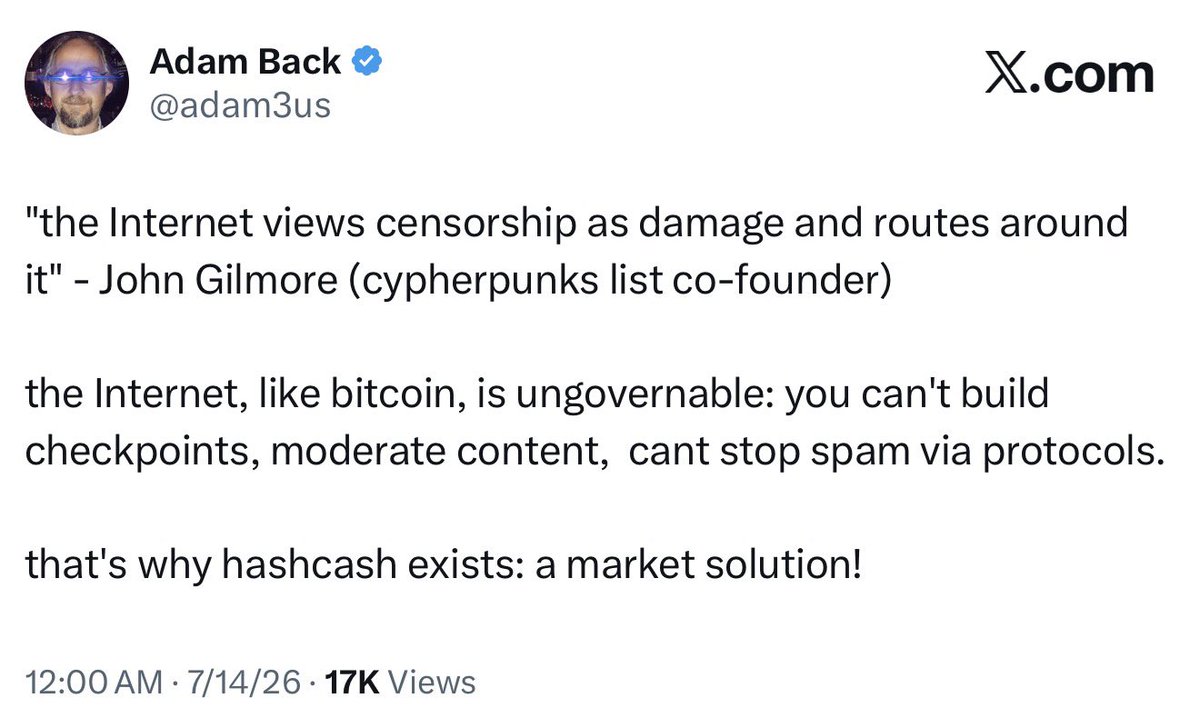
One of the ways I think of Bitcoin | BIP-110 boils down to this: We get spam in our email inboxes every day. I think most would like to avoid it. But we make the decision on how to mark | filter that spam into trash. This isn't done by a unilateral rule change that decides what to filter, without our input. One path represents individual choice; the other represents implementing censorship via code. As @adam3us noted, the Internet (and Bitcoin) are supposed to be ungovernable systems. We can’t (effectively) stop spam via intrusive protocol changes, but that’s why mechanisms like fees exist.
Adrian Morris tweet media
English
35
7
107
13.3K
Yope
Yope@soloyopee·
@_Adrian @1914ad @adam3us @saylor Merits are hard to find on some core decisions. But you are talking just one of many compounding omissions. The datacarriersize bypass bug that was "fixed" by changing the documentation is where things started to go wrong. Read hodlonaut's article series.
English
2
0
1
23
Adrian Morris
Adrian Morris@_Adrian·
No not if BIP-110 is implemented. Again: BIP-110 changes the consensus rules that define what counts as valid. Once activated, nodes that continue to accept the newly restricted data will reject blocks the rest of the network considers valid. That’s no longer just running your node “as you like”, it means operating on a different chain.
English
1
0
4
147
Adrian Morris
Adrian Morris@_Adrian·
Not exactly. The blockchain doesn’t store images or jpegs, it stores raw bytes. So any data whether its text, code, or formats that external software later interprets as an image is just bytes on the chain. This has been the reality since the genesis block and node operators who are genuinely concerned about how certain bytes might be interpreted can already apply stricter voluntary relay policies and filters on their own nodes. People tend to forget (or maybe dont know) BIP-110 doesn’t prevent people from embedding problematic data; it simply moves size and structure restrictions from local policy into consensus rules that every node must enforce. That’s a fundamentally different approach that carries its own long term risks for how rules can be changed in the future.
English
1
0
0
86
Michael Saxon
Michael Saxon@Michael_Saxon·
Node operators risk severe penalties from inadvertently storing CSAM on the immutable ledger as data capacity grows. Worse, widespread CSAM on Bitcoin invites regulatory crackdowns: ISP blocks, node operator liability, forced KYC, or protocol mandates that kill decentralization. BIP-110’s consensus limits better protect the network from this attack vector than voluntary filters alone.
English
1
0
2
55
Adrian Morris
Adrian Morris@_Adrian·
Yea this kind of framing doesn't go far with me. BTC is a technology, not an ideology and this strikes me as an ideological, rather than technical stance. We cant keep shifting the convo from whether using consensus rules to limit data is a bad anti-BTC idea, to “Core is the bad guy who started it". Core v30 (whether I agree with it or not) changed default policy, not consensus rules, and it did so through the normal development process with configurability preserved. Labeling it “unilateral” is a narrative serving move IMO. Something should be implemented on its merits. Period.
English
3
0
3
162
Justin Bechler #BIP-110
@_Adrian @adam3us @saylor Adrian, you’re making a very fundamental mistake in your perspective. BIP-110 is a response to unilateral change. You just understand this! BIP-110 restores what once was before the change.
English
1
0
16
200
Adrian Morris
Adrian Morris@_Adrian·
OK I was prepared to let this go, but since you are one of (if not the) loudest proponents of BIP-110 I will give this reply some more time and restate the issues with your claims. You claim that BIP-110 is “how Bitcoin has always worked” and that “Whether it’s implemented in policy or consensus is immaterial”. What's so odd about this is that you don't refute anything I say, and you are trying a heavy handed collapse of architectural distinctions in $BTC design to reframe the convo. in a way that suits your narrative. $BTC has always maintained a clear separation between consensus rules and relay | mempool policy because they are two layers that serve fundamentally different functions. Consensus rules define what a " valid " $BTC transaction is; a transaction or block that violates them is rejected by nodes as invalid. So when “disagreement” on how to define these rules is sufficiently widespread a chain split might result. Therefore, any change to consensus rules, by definition, changes $BTC itself. The point I have been hammering and will continue to hammer is that node relay and mempool policies are local and voluntary. I as a node operator, independently decide what to accept into my own mempool and what to relay. Different implementations (Core vs. Knots) maintain different policies but these choices do not affect chain validity. A miner could still include any transaction that satisfies consensus rules, even if it runs contrary to my node policy. Conflating the two layers is not a minor semantic matter, it is not “immaterial”; the distinction between them is what preserves node sovereignty and permits genuine peer-determined diversity in the network. One model maintains $BTC decentralization while the other brings us closer to group-enforced uniformity. Again: BIP-110 is not a continuation of pre-existing consensus limits because it introduces new validity rules at the consensus layer. Historical practice addressed data considerations primarily through relay policy defaults and economic incentives, not through this class of consensus enforced constraints on scripts and Taproot features. Treating the policy vs. consensus distinction as "immaterial" places us on a slippery slope that will inevitably lead to future consensus changes that could further restrict use cases. If implemented, we are effectively warping $BTC from a system in which rules remain minimal and consensus is secured, toward one in which groups can push preferred outcomes that can be imposed at the protocol level and redefine them as a longstanding practice to less informed users. Simply put: you do not get to unilaterally redefine what $BTC is for the rest of us. The network will decide and it has no obligation to accept your redefinition.
English
3
0
6
206
Luke Dashjr
Luke Dashjr@LukeDashjr·
@_Adrian @adam3us @saylor Yes, they ARE how Bitcoin has always worked. Whether it's implemented in policy or consensus is immaterial.
English
4
2
26
420
Adrian Morris
Adrian Morris@_Adrian·
@nithusezni @adam3us @saylor OK but how you understand them is how you understand them. Not how the rest of us should understand them. That's the point. Run your node as you see fit, no one should define that for the rest of us.
English
2
0
4
226
Nithu Sezni
Nithu Sezni@nithusezni·
Bitcoin is immutable so there is no way to mark spam for trash on a full node. I agree with this, though, "One path represents individual choice; the other represents implementing censorship via code." Except I understand them in reverse. One path represents individual choice (right of exclusion to use of personal property); the other represents implementing censorship of node sovereignty via code."
English
2
0
2
421
Adrian Morris
Adrian Morris@_Adrian·
This is what is so frustrating about the entire BIP-110 conversation, we can't retroactively change what $BTC is or its history. Along those lines, your comment here is both factually and historically inaccurate because you are attempting to lump mempool/node relay policies in with consensus rule changes. BIP-110 is proposing new consensus rules that limits new transaction outputs to 34 bytes (except OP_RETURN at 83 bytes),  caps data pushes and adds various restrictions on valid Taproot structures/scripts. These are new restrictions being added to the consensus layer, and they are not how $BTC has "always worked". Historically, $BTC has handled unwanted or arbitrary  data through node relay policies (which are voluntary and local), fee driven economic incentives and POW. At no time has $BTC used or been made to use consensus level data size restrictions like BIP-110 is proposing. In fact, as I pointed out in my article and in other posts, Satoshi supported the idea of limited arbitrary data transactions. Just because $BTC has always had some mechanisms to deal with spam does not mean BIP-110 is exactly how $BTC has always worked. This isn't the same thing.
English
5
0
15
8.1K
Adrian Morris
Adrian Morris@_Adrian·
@HermesLux I agree with the if it aint broke mindset. Also? If there is a fix? Dont propose a "fix" that boils down to ideology driven censorship and change the consensus threshold for making the fix go wide. Just my two sats.
English
1
0
5
475
Hermes Lux
Hermes Lux@HermesLux·
Ref: BIP 110, I'm not sure why there's such strong passion for changing the protocol here. I generally lean toward 'if it ain't broke, don't fix it.' The road to more problems is often paved by well-meaning people with good intentions.
Adrian Morris@_Adrian

One of the ways I think of Bitcoin | BIP-110 boils down to this: We get spam in our email inboxes every day. I think most would like to avoid it. But we make the decision on how to mark | filter that spam into trash. This isn't done by a unilateral rule change that decides what to filter, without our input. One path represents individual choice; the other represents implementing censorship via code. As @adam3us noted, the Internet (and Bitcoin) are supposed to be ungovernable systems. We can’t (effectively) stop spam via intrusive protocol changes, but that’s why mechanisms like fees exist.

English
4
0
20
2.1K
JustFreshKicks
JustFreshKicks@JustFreshKicks·
Nike KD 19 "Candy Apple" 🍎 🗓️ July 15th 💰 $155
JustFreshKicks tweet mediaJustFreshKicks tweet media
English
1.2K
471
10.5K
6.5M
Adrian Morris
Adrian Morris@_Adrian·
I’m not arguing for removing all relay policies which I why I emphasize that node runners can already set their own filters locally; which is voluntary. BIP-110 is different because it tries to turn restrictions into consensus rules, which force them on the entire network. Its local policy vs changing what counts as valid for everyone.
English
1
0
1
51
Timón , the hypocrite
@_Adrian @adam3us @saylor with "don't worry about spam in the blockchain, remove all relay policies" then we will be forced to have a "node provider" instead of running our own node. just like most people don't run their own email servers. Sure, both ends, centralized or not, would be voluntary, so?
English
1
0
0
19
Adrian Morris
Adrian Morris@_Adrian·
@hir00717 @adam3us @saylor I didnt confuse anything. The X character limit & 21M cap are pre-existing rules everyone has always operated under. BIP-110 is attempting to change current consensus rules to make valid transactions invalid. That’s the distinction on the limits.
English
1
0
0
54
Adrian Morris
Adrian Morris@_Adrian·
The key difference though is how that centralization happens. With email, people **voluntarily** choose the providers. With BIP-110, the proposal is to force restrictions at the consensus level so every node has to follow the same rules. I’d rather accept whatever "organic" outcomes come from individual choice than have preferences imposed through protocol changes.
English
1
0
0
52
Timón , the hypocrite
@_Adrian @adam3us @saylor yeah, sorry for the strawman, I was trying to be funny. My point is, if the follow the email analogy, will we end up in the same place as with emails (ie a quite centralized world)?
English
1
0
0
19
Adrian Morris
Adrian Morris@_Adrian·
This is a bit of a strawman, I never aid or imied that I want a centralized authority to solve spam? My point is the exact opposite. I used the email | spam example to show individual choice and local control where we decide how to filter spam in our own inbox. I want users | node runners choosing to handle it themselves through voluntary tools (Knots, setting their own filters, etc), rather than having rules imposed on them or their nodes.
English
1
0
0
141
Timón , the hypocrite
@_Adrian @adam3us @saylor so we should just wait for "gmail for blockchain" ? we need a huge centralized company to "solve spam", like we did with emails? Is that you're reasoning? I guess that's a good argument in favor of ip110, if anything.
English
1
0
0
117
Adrian Morris
Adrian Morris@_Adrian·
The difference is that the X character limit and the 21M cap are pre-existing rules that have always been in place. We have operated within those boundaries from the start. BIP-110 is different since it’s proposing to change the current consensus rules to make transactions that are valid today become invalid. That’s quite different from enforcing original limits.
English
1
1
1
176
Adrian Morris
Adrian Morris@_Adrian·
I actually a informed that's why these "it's Core's fault" arguments (deflections) carry no water with me. Also you didn't really address anything I said. Core made the change, so what? That doesn't address whether changing consensus rules to invalidate currently valid transactions is the right response. (It's not) "Core" didn't remove people’s ability to set their own filters because users can still change datacarriersize in their own bitcoin.conf. v30 only changed the default settings which is materially different from a consensus rule change. Also, SegWit? That went through years of discussion, multiple BIPs, had broad developer consensus, and a fairly high activation threshold. BIP-110 lowers the threshold to 55% and has mandatory signaling. This is a very different scenario. Take care.
English
1
0
3
225
The Digital Sovereign
The Digital Sovereign@TheDigitalSov·
The system was designed with limits for arbitrary data. A unilateral body, core decided to expand the limits to accomodate a single corporations use case. That same body, core, removed individuals ability to control their own filter settings. You don’t have a informed take. Was segwit or any other prior upgrades done without governance? You don’t make sense
English
1
0
5
179