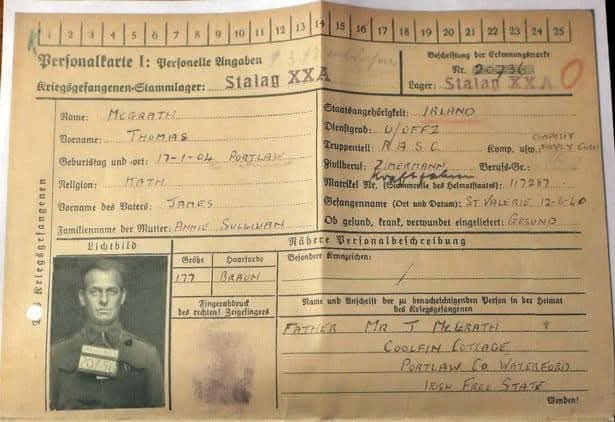
Today in 1942, an Irishman quietly walked out of a German prisoner-of-war camp in occupied Poland. Tom McGrath was a corporal in the British Army and a native of Portlaw, County Waterford. Like many Irishmen of his generation he had gone to Britain for work before the Second World War, only to find himself drawn into a conflict that would scatter him across a continent.
By 1940 he was serving with the 51st Highland Division when fate intervened at the disastrous surrender of Saint-Valery-en-Caux during the collapse of France. Ten thousand Allied troops were taken prisoner. McGrath was among them.
The prisoners were marched for weeks through northern France and the Low Countries before being shipped east. Eventually McGrath arrived at Stalag XXA, a vast prisoner-of-war camp near Thorn, in German-occupied Poland. At its height the camp held around 40,000 captives from across Europe. Among them were perhaps two or three dozen Irishmen.
Life in these camps was unsurprisingly brutal and humiliating and the lure of escape was always in the air. The Geneva Convention technically allowed prisoners to attempt it, and many felt it their duty to try.
McGrath secretly acquired civilian clothing piece by piece, a suit obtained through a sympathetic Polish contact, shirts and undergarments sent in parcels, and a pair of ordinary shoes traded inside the camp. He raised money by raffling a silver cigarette case among fellow prisoners. By the time the moment came he had assembled the essentials of a fugitive’s kit including 200 Reichsmarks, a bar of soap, and some chocolate.
Then, on the afternoon of 9 March 1942, he saw his chance. Some accounts say he slipped away from a work party outside the wire. Others say he simply found a gap in the fence and walked out. Either way the moment must have been surreal. One step he was a prisoner, the next he was a fugitive alone in Nazi-occupied Europe. But with chocolate.
For the first nights he hid in the woods near the camp. An elderly Polish man sheltered him in an attic for several days. Them Poles, great bunch of lads. From there the escape became a life or death game of pass the parcel with ordinary civilians bravely risking execution to move a stranger from one safe house to another.
Eventually he was smuggled by train to Berlin, a journey that must have felt like travelling through the lion’s den. Using forged identity papers he passed as a French labourer and continued westward. Must've been some accent! By August, five months after leaving Stalag XXA, he reached occupied Paris.
There he lay low for months while arrangements were made for the final and most dangerous stage of the journey. The path to safety lay south, over the Pyrenees, along the same clandestine escape lines used by downed Allied airmen and resistance couriers.
In the winter of 1942 he set out again. A Basque guide (another great bunch of lads) led him along a smuggler’s trail over the mountains toward the Spanish frontier. The trek was dangerous, but Spain lay just beyond the ridgeline. McGrath crossed the frontier near the pass of Ibardin and descended to the town of Bera.
Freedom, however, came with a twist. Spanish authorities promptly arrested him and placed him in an internment camp. Only months later, in April 1943, was he finally released and transported through Gibraltar back to Britain, more than a year after he had first stepped through the wire in Poland.
For his escape he was awarded three medals, including the Military Medal for bravery, announced in the London Gazette in June 1943. Yet like many Irish veterans of the British forces during the war, McGrath rarely spoke about his service.
He returned to Portlaw and worked as a mechanic and later opened the Lido Café with his wife Elizabeth. Tom McGrath died in 1968 and half a century later the story resurfaced when his son began researching the family history and wrote the biography "Unspoken: A Father's Wartime Escape.
@andyjearley Not too much these days since having a baby recently but can’t wait to get back on the horse. I’m living in Oz but moving back later this year and will no doubt see you soon. Are you still playing much?