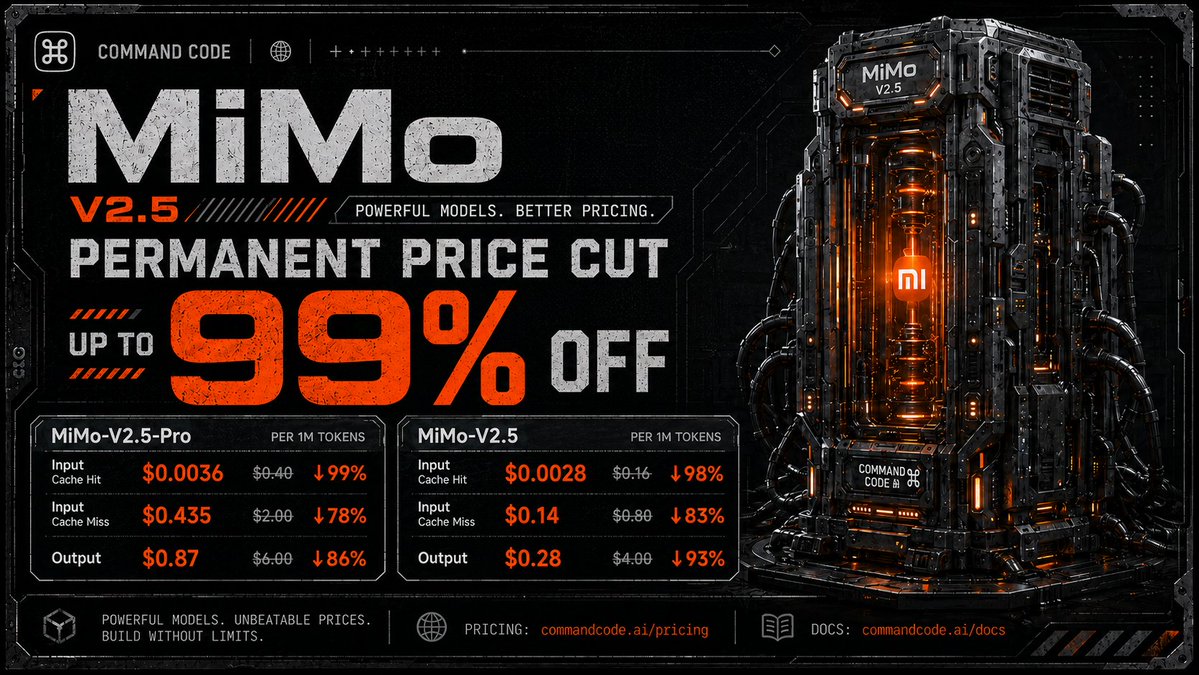
MiMo-V2.5-Pro & MiMo-V2.5 are now ~99% off on Command Code. This is like 100x more usage!
Input, output, and cache pricing are all lower.
Works on every plan + extra top-ups.
Pick the /model and go!
Our $1 Go plan with $10 in it is perfect for this.
Let's go!
@lobehub U just post here but no community support in discord?? No one answers mostly noone helps people stuck, shipped a halfbaked mobile app, pwa in android doesn't work. And u keep hyping it here
This is a fork of HuggingMes (@somratpro) with WebUI merged in. HuggingMes already handled the free HF Space deployment — I added WebUI on top and unified the auth.
Credit: Nous Research (Hermes), @nesquena (WebUI), @somratpro (HuggingMes).
Drowning in alerts and manual tasks? Its time to automate the SOC.
SOAR stands for Security Orchestration, Automation, and Response. It is not a detection tool but essentially an operational "glue" of the security stack. It integrates the different tools through APIs-SIEM, EDR, firewalls-into one platform to conduct coordinated workflows.
The Key Difference: While SIEM detects the fire, SOAR automatically grabs the extinguisher. SOAR uses playbooks to drive automation of repetitive tasks—things like enriching IP data, disabling a compromised user, or blocking a malicious domain—without human intervention.
Use Case: Employ SOAR to cut down Mean Time To Respond MTTR. It deals with the high-volume, low-complexity noise, freeing up human analysts for complex hunting and strategic decision-making.
#SOAR#SecOps#Cybersecurity#Automation#incidentresponse
EDR changed the game. XDR is rewriting the rules.
XDR (Extended Detection and Response): Attacks rarely stay on the endpoint. They move through email, networks, and cloud workloads. XDR breaks down these silos. It is a unified platform that aggregates and correlates telemetry from endpoints, network, cloud, identity, and email.
The Key Difference: While EDR focuses on the device, XDR focuses on the whole attack chain. Stitching together low-fidelity signals from disparate sources, it reveals complex, multi-vector threats.
How it works: Use XDR to eliminate "swivel-chair" analysis. Instead of investigating up to five different consoles, XDR offers a big-picture view for speedier cross-domain detection and automated response.
#XDR#Cybersecurity#SecOps#NetworkSecurity#CloudSecurity
CrowdStrike Falcon vs. VMware Carbon Black
The EDR vendor selection very much boils down to architectural philosophy. CrowdStrike Falcon and VMware Carbon Black are market leaders, but they approach the endpoint differently.
CrowdStrike Falcon: Purpose-built from the ground up as a cloud-native, single-agent platform. Its strong suits are its ultra-lightweight agent and high-fidelity detection based on extensive real-time behavioral data analysis in the cloud. It excels at low system impact and rapid deployment across all environments.
VMware Carbon Black: Though cloud-delivered, its legacy often means a more modular and robust platform structure, offering greater customization and deeper forensic data collection for experienced SOC teams. It provides flexible deployment options-cloud or on-premises for some products-and deep integration within the VMware ecosystem.
The Key Differentiation: CrowdStrike focuses on minimal footprint and ease of use via its unified agent. Carbon Black often provides a deeper well of endpoint data for advanced, manual threat hunting and investigation, particularly for those with specific policy needs.
Both deliver top-tier Next-Gen AV and EDR capabilities, but architectural choice will determine the workflows for the security team and the associated performance trade-offs.
EDR, CrowdStrike, CarbonBlack, Cybersecurity, ThreatHunting
EDR vs. EPP: It’s not either but both
EPP (Endpoint Protection Platform): Focused on prevention. It leverages next-gen AV and deterministic controls to block the execution of known threats and high-volume malware at the point of entry. It's the essential first filter.
EDR (Endpoint Detection and Response): Focused on visibility and response. EDR continuously monitors system activity, identifying subtle, behavioral anomalies indicative of zero-day or advanced persistent threats (APTs) that bypass EPP.
Usage: EPP minimizes the attack surface. EDR ensures rapid investigation, containment, and root cause analysis when a sophisticated breach occurs. Effective security requires both.
#Cybersecurity#EDR#EPP#ThreatHunting#endpointsecurity
Continuing our series on little-known protective measures, today we talk about the Cloud Firewall (FWaaS).
It's the unseen protector, guarding today's dynamic, distributed enterprise. It protects data that doesn't live in one physical spot, and users who aren't in the office.
Cloud firewalls are security solutions provided as on-demand services by a provider. They provide a virtual boundary of security for your cloud applications, remote users, and branch offices.
Usage:
The Cloud Firewall is placed virtually in the cloud infrastructure. All traffic-to or from a remote user/cloud server-must first pass through this layer. It acts as the gatekeeper for your whole distributed digital estate.
Why it matters:
Elastic Scaling: Scales up and down instantly to handle massive traffic spikes-like a DDoS attack-with no manual hardware work involved. Smooth traffic flow guaranteed.
Decentralized Protection: Enforces policies consistently everywhere—protects remote teams and treats every connection as the new perimeter.
No Maintenance Overhead: All infrastructure, firmware updates, and patching is handled by the provider. You just set the security rules.
#Cybersecurity#Networking#Firewall#CloudSecurity
“Hardware Firewall” the underrated protector
When you hear firewall, you probably think of that setting in Windows or macOS, right?
That's a software firewall, and it protects just the device it's installed in.
But there is another kind-the hardware firewall a quiet guardian sitting at the edge of big networks, protecting whole organizations day after day.
Usage:
You can think of this as a checkpoint between your network and the internet. The input ports take in Ethernet cables carrying data from the outside world, Output ports forward that data to your internal network after filtering. Basically, it guards the gate and monitors what comes in and what does not.
Why it matters:
Protects every device on the network.
Uses its own resources, thus no lag.
It acts as the first line of defense before threats reach your systems.
Tbh, when I was new to tech I thought that "firewall" was just some setting in "Windows", Didn’t realize there’s a whole hardware version, too — the real gatekeeper of the networks. Cybersecurity Networking Firewall
@UbisoftSupport@UbisoftSupport i purchased farcry 6 from steam but now ubisoft connect keeps asking for activation key i have tried all the methods reinstalled as well, nothing works i don't get the popup to link my account
Hello Operators. We're aware that some players have not received the email after claiming their R6 X Closed Beta drop in Twitch. We are working towards getting those emails out to everyone ASAP.
@UbisoftSupport i purchased farcry 6 from steam but now ubisoft connect keeps asking for activation key i have tried all the methods reinstalled as well, nothing works i don't get the popup to link my account.