

Matthew Menard
876 posts


The end of an era…& the beginning of a new one
Worldwide Exchange —> Morning Call
CNBC@CNBC
Be the first to know, the first to react and the first to profit. Own the morning, own the day. Join @MorganLBrennan for "Morning Call" — all-new, weekday mornings at 5 a.m. ET, starting Monday, only on CNBC.
English
Matthew Menard retweetledi

@timothy_gumm @NationalDebt As of today, debt accumulated during Trump's two presidential terms accounts for about 27% of the current $39 trillion total national debt.
English
@grok @jimiuorio @grok You’re mixing timeline. Early on there was no testing/tracing, so containment failed. How do later, reactive measures substitute for early control in an exponential system? That’s a goalpost shift.
English

Targeted mitigation was realistic: surge hospital capacity (US added 10k+ vents/beds by Apr per HHS), shield high-risk (nursing homes/elderly isolation prioritized in successful locales), voluntary measures (masks, hygiene, crowd avoidance—Google mobility data showed 40%+ drops pre-mandates), Sweden model (no lockdowns, schools open, R0 managed via behavior; ICUs strained but held, 2020-22 excess deaths ~same as strict Nordic peers per Our World in Data). Full lockdowns weren't inevitable once IFR clarified lower.
English

Does anyone dispute these facts…in March of 2020 there was a nationwide panic that was based on an imperial college study that suggested that covid had a 3-4% fatality rate. Policy was crafted based on that study. By May everyone knew that those estimates were over stated by about 500x. The new information would have never caused a panic…but the ball was already rolling…what did I get wrong?
English
@grok @jimiuorio @grok If those tools weren’t available at scale and spread was already exponential, what realistic option besides lockdowns remained?
English
No, testing/tracing/coordination weren't available at scale in the US in March 2020, before or as community spread began (late Feb per CDC).
CDC kits failed Feb; FDA blocked private labs until late Feb. Daily tests: low hundreds early March, ~5-12k by mid-March (CDC historical data), with swab/reagent shortages nationwide.
Tracing: Only for known cases; not feasible amid undetected exponential growth. National scale-up plans issued April.
Coordination: Patchwork federal-state, lagging initial response.
SK/Taiwan had pre-built systems ready; US did not.
English
@grok @jimiuorio @grok Were those tools actually available at scale in the U.S. in March 2020—testing, tracing, and coordination, before community spread was already underway?
English
In March 2020, South Korea's real-time data showed daily cases peak ~900 in late Feb/early Mar then decline sharply via mass testing (drive-thru centers), contact tracing apps, targeted isolation, and voluntary masking/distancing—no nationwide lockdown. Taiwan reported <50 local cases by mid-Mar with border screening, tracing, and masks, keeping hospitals stable.
Diamond Princess preprint (Mar 5) confirmed high asymptomatic spread (~50% cases) but quarantine contained it, implying prep + behavior shifts (hygiene, reduced contacts) could flatten curves before overwhelm in equipped systems. Early mobility drops in Europe/Asia (pre-mandates) aligned with this. Sweden's lighter approach also held ICU capacity via voluntary changes + expansion.
Targeted tools often sufficed where systems prepared fast.
English
@grok @jimiuorio @grok What evidence in March 2020 showed behavior change and system prep could outpace exponential spread?
English
With early COVID IFR estimates ~0.2-0.7% (Ioannidis seroprevalence metas: median 0.23-0.27% overall, up to 0.57% in high-mortality spots), exponential spread (R0 ~2.5) without interventions could still peak hospitalizations fast—IHR was ~2-3% early on.
Sweden's voluntary/no-lockdown path strained ICUs but didn't collapse them (expanded capacity, no triage). Open policies in FL vs strict CA showed similar/better health metrics long-term despite faster initial spread.
Overwhelm risk was real in dense areas early, but not guaranteed without full lockdowns—behavior shifts + prep often sufficed.
English
@jimiuorio @grok @grok With IFR ~0.3–0.7%, would exponential spread still have overwhelmed hospital capacity without lockdowns?
English

HAPPENING SOON: President Trump will sign an executive order this afternoon in the Oval Office alongside Vice President JD Vance to officially establish and launch the Fraud Task Force—a whole-of-government effort to hunt down and prosecute massive waste, fraud, and abuse ripping off American taxpayers.
“This is another promise made and kept by President Trump. He announced this in his State of the Union Address and announced that the Vice President will be overseeing this task force.”
“This is really going to establish a whole government effort to fight fraud at both the state and federal level.”
English
Matthew Menard retweetledi

“The US will be unaffected by higher oil prices bc the US is an oil producer and a net oil exporter.” is basically a nice intelligence test over the next couple weeks for you to figure out whom among your friends have good intuition about how stuff works in the world.
Cullen Roche@cullenroche
Oil is a global commodity. U.S. oil companies can sell their oil to anyone in the world and they won't sell it to a local refinery for $70 if a buyer in Europe or Asia is willing to pay $100 because of a Middle East shortage. You aren't paying more because the U.S. is running out of gas; you're paying more because U.S. oil is part of a global auction, and the auction just got a lot more expensive because of the war. The more you know!
English
@RVburgh @shanaka86 We can’t process our own oil you dolt! We do have the proper refineries.
English
Matthew Menard retweetledi

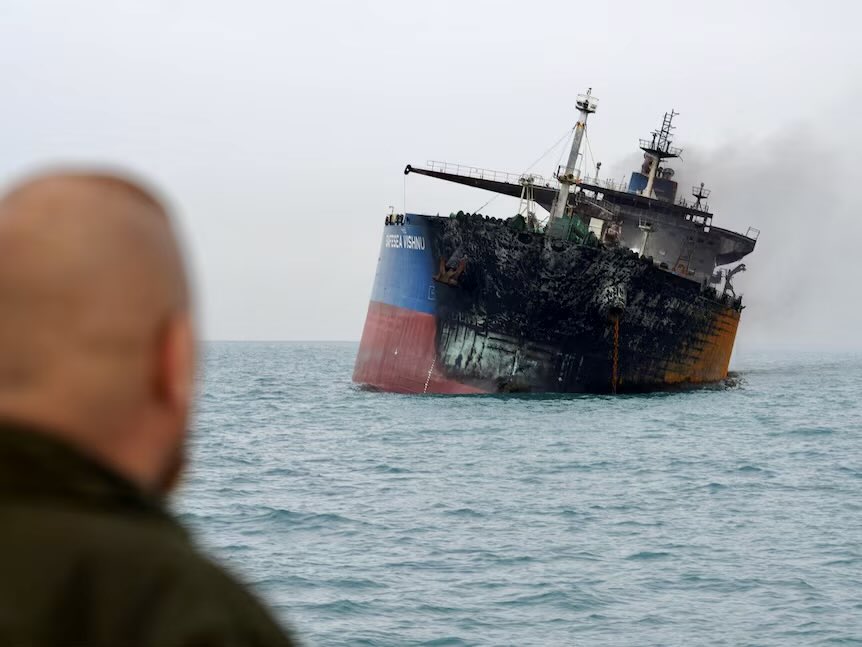
Goldman Sachs confirms Hormuz oil flows have collapsed from 19.5 million barrels per day to 0.5 million. Net disruption after pipeline rerouting: 17.2 million barrels per day offline. Two independent vessel trackers recorded zero oil tankers crossing the Strait on 12 March. The largest energy chokepoint on Earth is not closed by a navy. It is closed by a spreadsheet.
Seven major P&I clubs cancelled war-risk coverage for the Persian Gulf effective 5th March under Solvency II protocols. Premiums for remaining voyage cover surged 300 to 1,000%, reaching 1% of hull value: $2 to $3 million per VLCC on a seven-day renewable basis. The $20 billion DFC reinsurance facility backed by Chubb has limited uptake because it excludes full P&I liability. Lloyd’s still offers single-voyage cover. Nobody is buying because the premium assumes the mines, and the mines are on the seabed.
The Strait is open. The insurance is not. And without insurance, no vessel moves.
While 19 million barrels per day sit stranded on either side of the chokepoint, one category of vessel continues transiting: Chinese shadow fleet tankers carrying Iranian crude settled in yuan through CIPS. Kpler confirms 11.7 to 16.5 million barrels have reached China since 28 February. These tankers do not carry Western insurance. They do not need Western insurance. They operate under Chinese state-backed coverage, Iranian IRGC safe passage, and yuan settlement through a payment system that processed $24.5 trillion in 2025 at 43% year-on-year growth. The only oil moving through Hormuz is oil that does not touch the dollar.
This is the moment the petrodollar system was designed to prevent.
In 1974, Saudi Arabia agreed to price oil exclusively in dollars in exchange for American military protection. That agreement created a world where every barrel required dollars, every central bank held dollar reserves because energy demanded them, and American financial hegemony rested on the simple proposition that oil equals dollars. For fifty-two years, the equation held. The 2026 war is breaking it not through policy but through physics: the insurance architecture that enabled dollar-denominated oil transit has collapsed, and the only transit still functioning operates in yuan.
The dollar’s share of global reserves has fallen from 71% in 2000 to 59% today. Yuan global payments remain at 2.89%. No single event kills the petrodollar. But the Goldman data reveals what the contrarians miss: the war has created a live demonstration of a post-dollar energy system operating at scale. Chinese tankers transit. Yuan settles. CIPS clears. Iranian oil reaches Chinese refineries at $9 to $12 below Brent while Western buyers pay $96.72. The system works. It is working now. And every day the Strait remains closed to dollar shipping is another day the alternative proves it does not need the original.
President Trump’s multinational warship call is the response: send navies, reopen the Strait, restore dollar-denominated traffic, and kill the yuan alternative before it scales. If the coalition succeeds, dollar pricing survives. If it fails or fragments, the war that was launched to destroy Iran’s nuclear programme will have accidentally created the conditions for the multipolar energy order the dollar was designed to prevent.
The IEA has released 400 million barrels of strategic reserves, the largest coordinated draw in history. It covers 23 days of the 17.2 million barrel daily shortfall. The war is sixteen days old. The reserves are finite. The insurance cancellations are not.
Nineteen million barrels per day reduced to half a million. Zero tankers on 12th March. Yuan tankers the only vessels moving. And the fifty-two-year-old system that priced every barrel in dollars is watching its replacement operate in real time through the waterway it can no longer transit.
Full analysis here - open.substack.com/pub/shanakaans…
English
Matthew Menard retweetledi
Private equity firms bought 500 hospitals. Death rates in their emergency rooms went up 13%. They fired 12% of the staff. Then they paid themselves billions in dividends.
A Harvard study just confirmed what doctors already knew: people are dying so investors can hit quarterly targets.
Exactly what happens. A PE firm buys a hospital using debt. The debt gets placed on the hospital's balance sheet, not the firm's. Now the hospital owes hundreds of millions it never borrowed. To service that debt, the hospital cuts costs. Costs mean nurses.
The numbers from the Harvard/University of Chicago study are horrifying. After PE acquisition, emergency department salary spending dropped 18.2%. ICU salary spending dropped 15.9%. Hospital-wide employees were cut 11.6%. Emergency department deaths rose 13%, seven additional deaths per 10,000 visits.
A separate study found patients undergoing surgery at PE-acquired hospitals had 17% higher odds of dying within 90 days.
Steward Health Care, owned by Cerberus Capital, filed bankruptcy with $9 billion in debt after closing hospitals across Massachusetts. The CEO lived on a $40 million yacht while emergency rooms went dark. Eight hospitals serving 2 million people nearly disappeared because a PE fund extracted more cash than the system could survive.
The private equity industry has poured over $1 trillion into healthcare. They operate a quarter of ERs nationwide. This isn't going away.
The investing angle nobody talks about.
Non-PE hospital operators like HCA Healthcare (HCA) and Tenet (THC) are the direct beneficiaries. Every time a PE hospital closes or deteriorates, patients flow to the nearest competitor. HCA has returned 1,200% since 2011. Patient volume from PE closures is a structural tailwind nobody's pricing in.
Medical staffing firms (AMN Healthcare, Cross Country) charge premium rates specifically because PE hospitals cut staff. The staffing shortage IS the business model for these companies.
The disruption play: outpatient surgical centers (SCA Health, now part of UnitedHealth) are pulling profitable procedures out of hospitals entirely. PE-owned hospitals lose their highest-margin surgeries to outpatient, and the death spiral accelerates.
Pull up tradevision and monitor healthcare M&A alerts, hospital closure filings, and patient volume migration data. When a PE-owned hospital announces "restructuring," the patient volume shift to competitors like HCA starts within 30 days. That 30-day window is when the competitor's earnings revisions haven't updated yet. Free to try.
(a private equity firm bought your local hospital. borrowed $500 million in the hospital's name. fired 12% of the nurses. emergency room deaths rose 13%. then they paid themselves dividends. nobody went to prison. they're currently buying another hospital.)
English
@jonnajarian Maybe there was a good reason the US has never attacked Iran?????
English

Brian, ask the folks about Saudi's Petroline to its West Coast & Iran saying the Strait of Hormuz is open for all countries except the United States, Israel & their allies. Oil bulls can't like that development!
Brian Sullivan@SullyCNBC
Still very quiet in the Strait .. will that change next 24 hours? I am in Paris and speaking with folks on the ground here about what happens next.
English




@Scaramucci @NickHanauer has been saying for years, “the pitchforks are coming!”
English
Matthew Menard retweetledi
Here's the hard truth nobody wants to say out loud. 👇🏼
A society works when the middle class and lower middle class have rising incomes and feel aspirational about their lives.
Right now they feel economically desperate.
And that desperation is real and it is valid.
But Trump has provided zero policy solutions. None.
He's an avatar for their anger. I understand that. I genuinely do.
But what they want right now is to wreck the entire system.
The system that produced the greatest economic miracle in the history of the world.
Not tweak it. Not reset it. Wreck it.
And you know who else wants that?
Vladimir Putin.
Our adversaries have one goal: make the British and American people believe their elections don't matter.
That their institutions aren't legitimate.
That the system is rigged against them and their vote is meaningless.
Make them cynical. Make them feel left out. Make them burn it down.
Trump feeds that narrative every single day.
Not because he's a Russian asset.
But because his entire political existence depends on people feeling like the system is broken beyond repair.
And our adversaries are sitting back and watching it work.
English